



并查集的概念
在计算机科学中,并查集(英文:Disjoint-set data structure,直译为不交集数据结构)是一种数据结构,用于处理一些不交集(Disjoint sets,一系列没有重复元素的集合)的合并及查询问题。并查集支持如下操作:
- 查询:查询某个元素属于哪个集合,通常是返回集合内的一个“代表元素”。这个操作是为了判断两个元素是否在同一个集合之中。
- 合并:将两个集合合并为一个。
- 添加:添加一个新集合,其中有一个新元素。添加操作不如查询和合并操作重要,常常被忽略。
理解下面三句话,并查集就学会了:
“并”的意思是把两个处在同一个连通分量的结点给并到一起.
“查”的意思是查找一个结点的根节点.
“并”的时候需要用到“查”
不过这样还是比较晦涩。下面我们用图片的方式来讲讲。
图解并查集
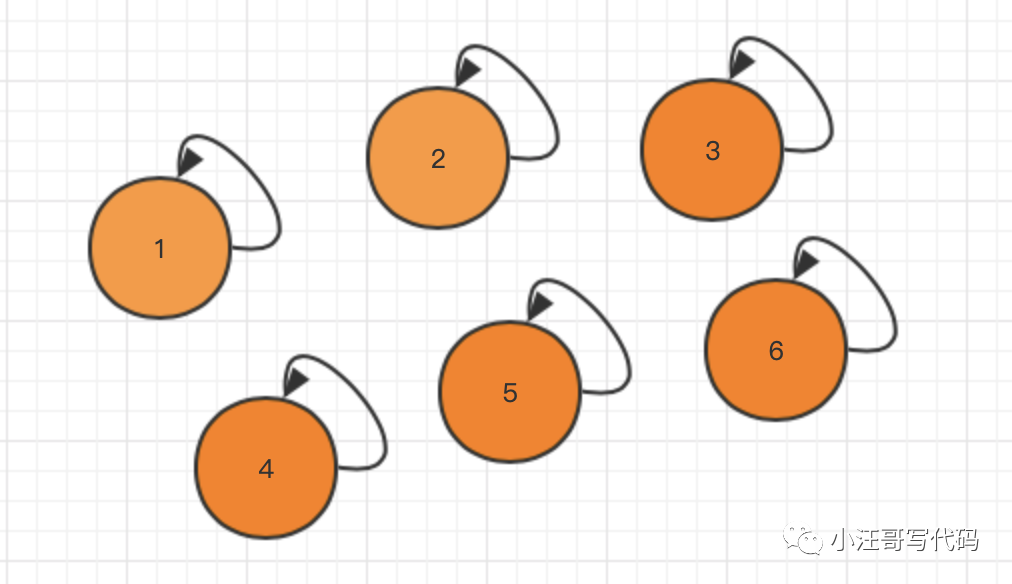
并查集的重要思想在于,用集合中的一个元素代表集合。
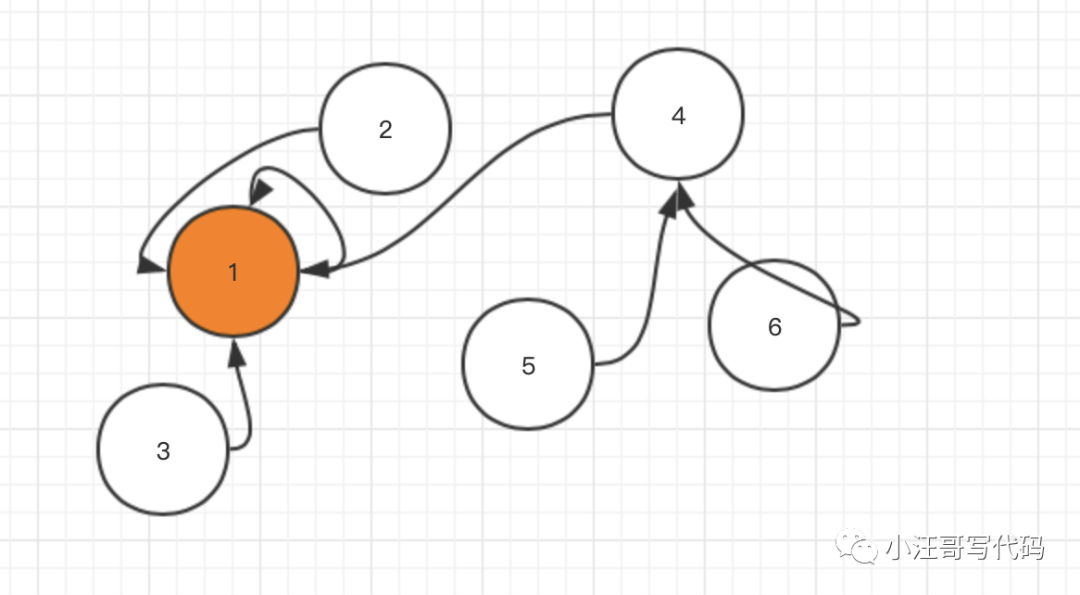
刚开始好比诸侯国,各自为政。
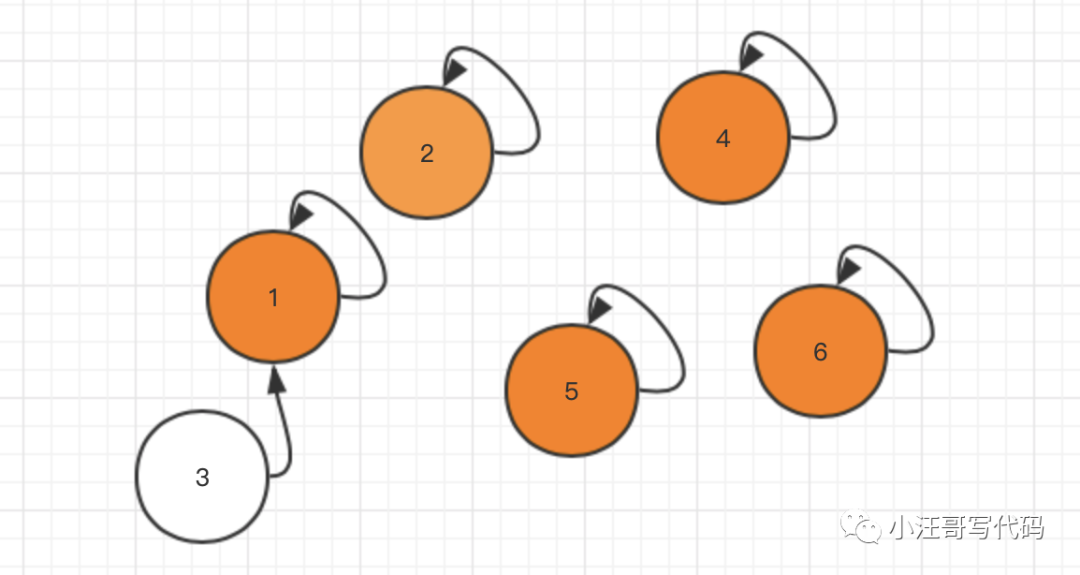
后来3号被1号吞并了,定都1号城池。
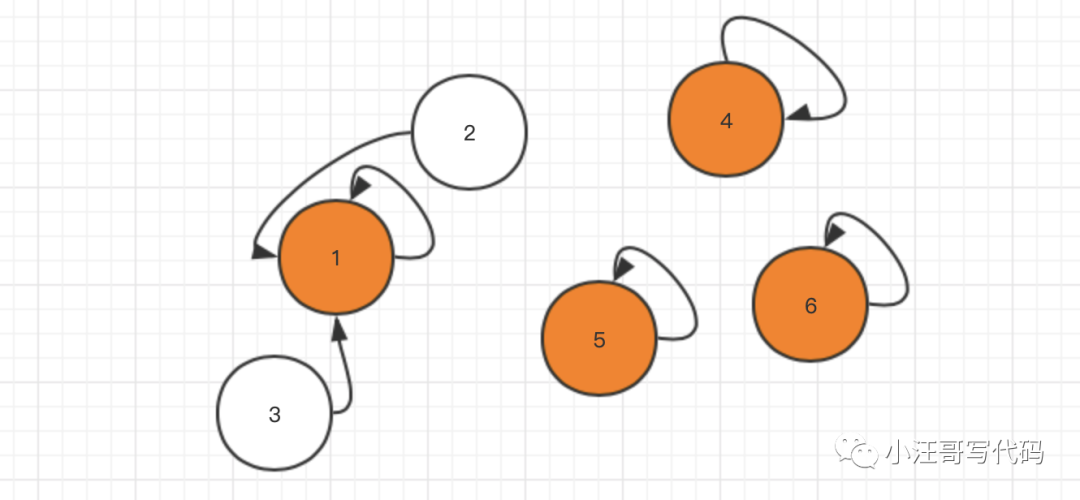
同时2号也被1号吞并了,定都1号城池。
神州大地上 4,5,6也发生着相同的事情,5,6也背4号诸侯吞并了,定都4号城池。
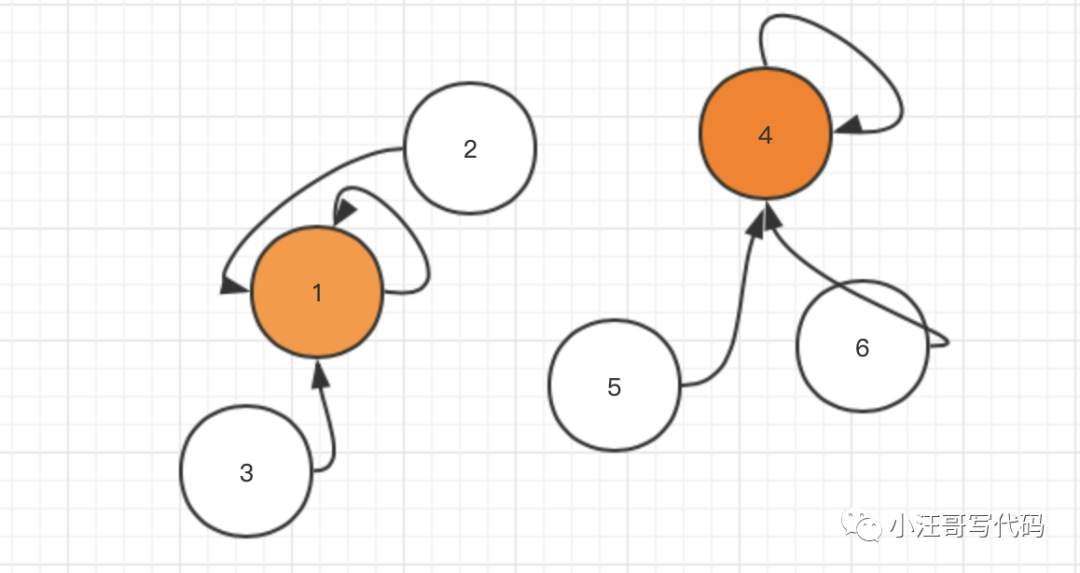
后来1号把4号给吞并了,5,6也连带成了1号的领土。定都1号城池。
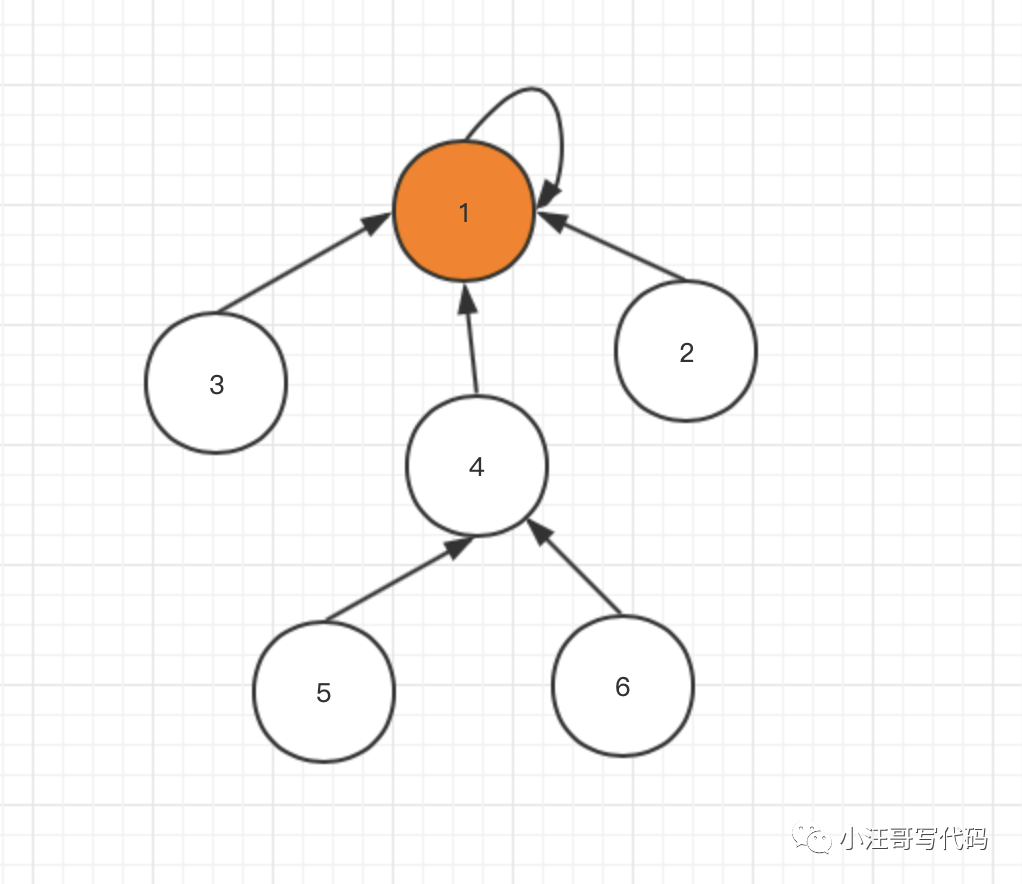
学习过前面的二叉树,其实我们可以把并查集想象成一个数的结构。
要寻找集合的代表元素(都城),只需要一层一层往上访问父节点(图中箭头所指的圆),直达树的根节点(图中橙色的圆)即可。
并查集实现代码
public static class Node<V> {V value;public Node(V v) {value = v;}}public static class UnionFind<V> {public HashMap<V, Node<V>> nodes;//所有的节点public HashMap<Node<V>, Node<V>> parents;// 每个节点的父几点public HashMap<Node<V>, Integer> sizeMap;// 每个父节点有多少个孩子public UnionFind(List<V> values) {nodes = new HashMap<>();parents = new HashMap<>();sizeMap = new HashMap<>();for (V cur : values) {Node<V> node = new Node<>(cur);nodes.put(cur, node);parents.put(node, node);sizeMap.put(node, 1);}}// 给你一个节点,请你往上到不能再往上,把代表返回public Node<V> findFather(Node<V> cur) {Stack<Node<V>> path = new Stack<>();while (cur != parents.get(cur)) {path.push(cur);cur = parents.get(cur);}while (!path.isEmpty()) {//优化parents.put(path.pop(), cur);}return cur;}//两个节点是不是在同一集合里public boolean isSameSet(V a, V b) {return findFather(nodes.get(a)) == findFather(nodes.get(b));}//合并两个节点public void union(V a, V b) {Node<V> aHead = findFather(nodes.get(a));Node<V> bHead = findFather(nodes.get(b));if (aHead != bHead) {int aSetSize = sizeMap.get(aHead);int bSetSize = sizeMap.get(bHead);Node<V> big = aSetSize >= bSetSize ? aHead : bHead;Node<V> small = big == aHead ? bHead : aHead;//把数量少的节点挂在数据多的节点下面,可以避免路径过长parents.put(small, big);sizeMap.put(big, aSetSize + bSetSize);sizeMap.remove(small);}}public int sets() {return sizeMap.size();}}
应用场景
leetcode朋友圈问题
https://leetcode.com/problems/friend-circles/
上面的并查集是HashMap用实现,常数时间比较长。下面我们用数组实现。数组直接寻址,速度比较快。
public static int findCircleNum(int[][] M) {int N = M.length;// {0} {1} {2} {N-1}UnionFind unionFind = new UnionFind(N);for (int i = 0; i < N; i++) {for (int j = i + 1; j < N; j++) {if (M[i][j] == 1) { // i和j互相认识unionFind.union(i, j);}}}return unionFind.sets();}public static class UnionFind {// parent[i] = k :i的父亲是kprivate int[] parent;// size[i] = k :如果i是代表节点,size[i]才有意义,否则无意义// i所在的集合大小是多少private int[] size;// 辅助结构private int[] help;// 一共有多少个集合private int sets;public UnionFind(int N) {parent = new int[N];size = new int[N];help = new int[N];sets = N;for (int i = 0; i < N; i++) {parent[i] = i;size[i] = 1;}}// 从i开始一直往上,往上到不能再往上,代表节点,返回// 这个过程要做路径压缩private int find(int i) {int hi = 0;while (i != parent[i]) {help[hi++] = i;i = parent[i];}for (hi--; hi >= 0; hi--) {parent[help[hi]] = i;}return i;}public void union(int i, int j) {int f1 = find(i);int f2 = find(j);if (f1 != f2) {if (size[f1] >= size[f2]) {size[f1] += size[f2];parent[f2] = f1;} else {size[f2] += size[f1];parent[f1] = f2;}sets--;}}public int sets() {return sets;}}
leetcode岛屿问题
https://leetcode.com/problems/number-of-islands/
1.感染法
public static int numIslands(char[][] board) {int islands = 0;for (int i = 0; i < board.length; i++) {for (int j = 0; j < board[0].length; j++) {if (board[i][j] == '1') {islands++;infect(board, i, j);}}}return islands;}// 从(i,j)这个位置出发,把所有练成一片的'1'字符,变成0public static void infect(char[][] board, int i, int j) {if (i < 0 || i == board.length || j < 0 || j == board[0].length || board[i][j] != '1') {return;}board[i][j] = 0;infect(board, i - 1, j);infect(board, i + 1, j);infect(board, i, j - 1);infect(board, i, j + 1);}
2.并查集-hashmap
public static int numIslands1(char[][] board) {int row = board.length;int col = board[0].length;Dot[][] dots = new Dot[row][col];List<Dot> dotList = new ArrayList<>();for (int i = 0; i < row; i++) {for (int j = 0; j < col; j++) {if (board[i][j] == '1') {dots[i][j] = new Dot();dotList.add(dots[i][j]);}}}UnionFind1<Dot> uf = new UnionFind1<>(dotList);for (int j = 1; j < col; j++) {// (0,j) (0,0)跳过了 (0,1) (0,2) (0,3)if (board[0][j - 1] == '1' && board[0][j] == '1') {uf.union(dots[0][j - 1], dots[0][j]);}}for (int i = 1; i < row; i++) {if (board[i - 1][0] == '1' && board[i][0] == '1') {uf.union(dots[i - 1][0], dots[i][0]);}}for (int i = 1; i < row; i++) {for (int j = 1; j < col; j++) {if (board[i][j] == '1') {if (board[i][j - 1] == '1') {uf.union(dots[i][j - 1], dots[i][j]);}if (board[i - 1][j] == '1') {uf.union(dots[i - 1][j], dots[i][j]);}}}}return uf.sets();}public static class Dot {//这里只是用了dot的内存地址}public static class Node<V> {V value;public Node(V v) {value = v;}}public static class UnionFind1<V> {public HashMap<V, Node<V>> nodes;public HashMap<Node<V>, Node<V>> parents;public HashMap<Node<V>, Integer> sizeMap;public UnionFind1(List<V> values) {nodes = new HashMap<>();parents = new HashMap<>();sizeMap = new HashMap<>();for (V cur : values) {Node<V> node = new Node<>(cur);nodes.put(cur, node);parents.put(node, node);sizeMap.put(node, 1);}}public Node<V> findFather(Node<V> cur) {Stack<Node<V>> path = new Stack<>();while (cur != parents.get(cur)) {path.push(cur);cur = parents.get(cur);}while (!path.isEmpty()) {parents.put(path.pop(), cur);}return cur;}public void union(V a, V b) {Node<V> aHead = findFather(nodes.get(a));Node<V> bHead = findFather(nodes.get(b));if (aHead != bHead) {int aSetSize = sizeMap.get(aHead);int bSetSize = sizeMap.get(bHead);Node<V> big = aSetSize >= bSetSize ? aHead : bHead;Node<V> small = big == aHead ? bHead : aHead;parents.put(small, big);sizeMap.put(big, aSetSize + bSetSize);sizeMap.remove(small);}}public int sets() {return sizeMap.size();}}
3.并查集-数组
public static int numIslands2(char[][] board) {int row = board.length;int col = board[0].length;UnionFind2 uf = new UnionFind2(board);for (int j = 1; j < col; j++) {if (board[0][j - 1] == '1' && board[0][j] == '1') {uf.union(0, j - 1, 0, j);}}for (int i = 1; i < row; i++) {if (board[i - 1][0] == '1' && board[i][0] == '1') {uf.union(i - 1, 0, i, 0);}}for (int i = 1; i < row; i++) {for (int j = 1; j < col; j++) {if (board[i][j] == '1') {if (board[i][j - 1] == '1') {uf.union(i, j - 1, i, j);}if (board[i - 1][j] == '1') {uf.union(i - 1, j, i, j);}}}}return uf.sets();}public static class UnionFind2 {private int[] parent;private int[] size;private int[] help;private int col;private int sets;public UnionFind2(char[][] board) {col = board[0].length;sets = 0;int row = board.length;int len = row * col;parent = new int[len];size = new int[len];help = new int[len];for (int r = 0; r < row; r++) {for (int c = 0; c < col; c++) {if (board[r][c] == '1') {int i = index(r, c);parent[i] = i;size[i] = 1;sets++;}}}}// (r,c) -> iprivate int index(int r, int c) {return r * col + c;}// 原始位置 -> 下标private int find(int i) {int hi = 0;while (i != parent[i]) {help[hi++] = i;i = parent[i];}for (hi--; hi >= 0; hi--) {parent[help[hi]] = i;}return i;}public void union(int r1, int c1, int r2, int c2) {int i1 = index(r1, c1);int i2 = index(r2, c2);int f1 = find(i1);int f2 = find(i2);if (f1 != f2) {if (size[f1] >= size[f2]) {size[f1] += size[f2];parent[f2] = f1;} else {size[f2] += size[f1];parent[f1] = f2;}sets--;}}public int sets() {return sets;}}
leetcode岛屿问题二
https://leetcode.com/problems/number-of-islands-ii/
public static List<Integer> numIslands(int m, int n, int[][] positions) {UnionFind1 uf = new UnionFind1(m, n);List<Integer> ans = new ArrayList<>();for (int[] position : positions) {ans.add(uf.connect(position[0], position[1]));}return ans;}public static class UnionFind1 {private int[] parent;private int[] size;private int[] help;private final int row;private final int col;private int sets;public UnionFind1(int m, int n) {row = m;col = n;sets = 0;int len = row * col;parent = new int[len];size = new int[len];help = new int[len];}private int index(int r, int c) {return r * col + c;}private int find(int i) {int hi = 0;while (i != parent[i]) {help[hi++] = i;i = parent[i];}for (hi--; hi >= 0; hi--) {parent[help[hi]] = i;}return i;}private void union(int r1, int c1, int r2, int c2) {if (r1 < 0 || r1 == row || r2 < 0 || r2 == row || c1 < 0 || c1 == col || c2 < 0 || c2 == col) {return;}int i1 = index(r1, c1);int i2 = index(r2, c2);if (size[i1] == 0 || size[i2] == 0) {return;}int f1 = find(i1);int f2 = find(i2);if (f1 != f2) {if (size[f1] >= size[f2]) {size[f1] += size[f2];parent[f2] = f1;} else {size[f2] += size[f1];parent[f1] = f2;}sets--;}}public int connect(int r, int c) {int index = index(r, c);if (size[index] == 0) {parent[index] = index;size[index] = 1;sets++;union(r - 1, c, r, c);union(r + 1, c, r, c);union(r, c - 1, r, c);union(r, c + 1, r, c);}return sets;}}
