



流程图
源码
入口
// 调用SparkContext,之前初始化时创建的dagScheduler的runJob()方法
    dagScheduler.runJob(rdd, cleanedFunc, partitions, callSite, allowLocal,
      resultHandler, localProperties.get)
看看runJob方法
def runJob[T, U: ClassTag](
      rdd: RDD[T],
      func: (TaskContext, Iterator[T]) => U,
      partitions: Seq[Int],
      callSite: CallSite,
      allowLocal: Boolean,
      resultHandler: (Int, U) => Unit,
      properties: Properties = null)
  {
    val start = System.nanoTime
    val waiter = submitJob(rdd, func, partitions, callSite, allowLocal, resultHandler, properties)
    waiter.awaitResult() match {
      case JobSucceeded => {
        logInfo("Job %d finished: %s, took %f s".format
          (waiter.jobId, callSite.shortForm, (System.nanoTime - start) / 1e9))
      }
      case JobFailed(exception: Exception) =>
        logInfo("Job %d failed: %s, took %f s".format
          (waiter.jobId, callSite.shortForm, (System.nanoTime - start) / 1e9))
        throw exception
    }
  }
看看submitJob()方法
  def submitJob[T, U](
      rdd: RDD[T],
      func: (TaskContext, Iterator[T]) => U,
      partitions: Seq[Int],
      callSite: CallSite,
      allowLocal: Boolean,
      resultHandler: (Int, U) => Unit,
      properties: Properties = null): JobWaiter[U] =
  {
    // Check to make sure we are not launching a task on a partition that does not exist.
    val maxPartitions = rdd.partitions.length
    partitions.find(p => p >= maxPartitions || p < 0).foreach { p =>
      throw new IllegalArgumentException(
        "Attempting to access a non-existent partition: " + p + ". " +
          "Total number of partitions: " + maxPartitions)
    }

    val jobId = nextJobId.getAndIncrement()
    if (partitions.size == 0) {
      return new JobWaiter[U](this, jobId, 0, resultHandler)
    }

    assert(partitions.size > 0)
    val func2 = func.asInstanceOf[(TaskContext, Iterator[_]) => _]
    val waiter = new JobWaiter(this, jobId, partitions.size, resultHandler)
    eventProcessLoop.post(JobSubmitted(
      jobId, rdd, func2, partitions.toArray, allowLocal, callSite, waiter, properties))
    waiter
  }
看看DAGSchedulerEventProcessLoop(eventProcessLoop)的JobSubmitted
private[scheduler] class DAGSchedulerEventProcessLoop(dagScheduler: DAGScheduler)
  extends EventLoop[DAGSchedulerEvent]("dag-scheduler-event-loop") with Logging {

  /**
   * The main event loop of the DAG scheduler.
   */
  override def onReceive(event: DAGSchedulerEvent): Unit = event match {
    case JobSubmitted(jobId, rdd, func, partitions, allowLocal, callSite, listener, properties) =>
      dagScheduler.handleJobSubmitted(jobId, rdd, func, partitions, allowLocal, callSite,
        listener, properties)
看看dagScheduler.handleJobSubmitted()方法
  /**
    * DAGScheduler的job调度的核心入口
    */
  private[scheduler] def handleJobSubmitted(jobId: Int,
      finalRDD: RDD[_],
      func: (TaskContext, Iterator[_]) => _,
      partitions: Array[Int],
      allowLocal: Boolean,
      callSite: CallSite,
      listener: JobListener,
      properties: Properties = null)
  {
    // 第一步,使用触发job的最后一个RDD,创建finalStage
    var finalStage: Stage = null
    try {
      // New stage creation may throw an exception if, for example, jobs are run on a
      // HadoopRDD whose underlying HDFS files have been deleted.
      // 创建一个stage对象,并且将stage加入DAGScheduler内部缓存中
      finalStage = newStage(finalRDD, partitions.size, None, jobId, callSite)
    } catch {
      case e: Exception =>
        logWarning("Creating new stage failed due to exception - job: " + jobId, e)
        listener.jobFailed(e)
        return
    }
    if (finalStage != null) {
      // 第二步,用finalStage创建一个job,这个job的最后一个stage,就是finalStage
      val job = new ActiveJob(jobId, finalStage, func, partitions, callSite, listener, properties)
      clearCacheLocs()
      logInfo("Got job %s (%s) with %d output partitions (allowLocal=%s)".format(
        job.jobId, callSite.shortForm, partitions.length, allowLocal))
      logInfo("Final stage: " + finalStage + "(" + finalStage.name + ")")
      logInfo("Parents of final stage: " + finalStage.parents)
      logInfo("Missing parents: " + getMissingParentStages(finalStage))
      val shouldRunLocally =
        localExecutionEnabled && allowLocal && finalStage.parents.isEmpty && partitions.length == 1
      val jobSubmissionTime = clock.getTimeMillis()
      if (shouldRunLocally) {
        // Compute very short actions like first() or take() with no parent stages locally.
        listenerBus.post(
          SparkListenerJobStart(job.jobId, jobSubmissionTime, Seq.empty, properties))
        runLocally(job)
      } else {
        // 第三步,将job加入内存缓存中
        jobIdToActiveJob(jobId) = job
        activeJobs += job
        finalStage.resultOfJob = Some(job)
        val stageIds = jobIdToStageIds(jobId).toArray
        val stageInfos = stageIds.flatMap(id => stageIdToStage.get(id).map(_.latestInfo))
        listenerBus.post(
          SparkListenerJobStart(job.jobId, jobSubmissionTime, stageInfos, properties))
        // 第四步,使用submitStage()方法提交finalStage
        // 这个方法的调用,其实会导致第一个stage提交,并且导致其他所有的stage,都给放入waitingStages队列里了
        submitStage(finalStage)
        // stage划分算法,实在太重要了,必须对stage划分算法很清晰,知道自己编写的spark application被划分了几个job,每个job被划分成了几个stage
        // 每个stage,包括了你的那些代码,只有知道了那个stage包括了哪些自己的代码之后,在线上,如果发现某个stage执行特别慢
        // 或者某个stage一直报错,才能针对那个stage对应的代码,去排查问题,或者是性能调优

        // stage划分算法总结
        // 1. 从finalStage倒推
        // 2. 通过宽依赖,来进行新的stage划分
        // 3. 使用递归,优先提交父stage
      }
    }
    // 提交等待的stage
    submitWaitingStages()
  }
看看submitStage()方法
 // 提交stage的方法
  // 这其实就是stage划分算法的入口,但是,stage划分算法,其实是由submitStage()和getMissingParentStages()方法共同组成的
  private def submitStage(stage: Stage) {
    val jobId = activeJobForStage(stage)
    if (jobId.isDefined) {
      logDebug("submitStage(" + stage + ")")
      if (!waitingStages(stage) && !runningStages(stage) && !failedStages(stage)) {
        // 调用getMissingParentStages()去获取当前这个stage的父stage
        val missing = getMissingParentStages(stage).sortBy(_.id)
        logDebug("missing: " + missing)
        // 这里其实会反复递归调用,直到最初的stage,它没有父stage了,那么,此时,就会首先提交这个第一个stage,stage0
        // 其余的stage,此时,全部都在waitingStages里面
        if (missing == Nil) {
          logInfo("Submitting " + stage + " (" + stage.rdd + "), which has no missing parents")
          submitMissingTasks(stage, jobId.get)
        } else {
          // 递归调用submitStage()方法,去提交父stage
          // 这里的递归,就是stage划分算法的推动者和精髓
          for (parent <- missing) {
            submitStage(parent)
          }
          // 并且将当前stage放入waitingStages等待执行的stage队列中
          waitingStages += stage
        }
      }
    } else {
      abortStage(stage, "No active job for stage " + stage.id)
    }
  }
看看getMissingParentStages()
// 获取某个stage的父stage
  // 这个方法的意思,就是说,对于一个stage,如果它的最后一个rdd的所有依赖,都是窄依赖,那么就不会创建任何新的stage
  // 但是,只要发现这个stage的rdd宽依赖了某个rdd,那么就用宽依赖的那个rdd,创建一个新的stage,然后立即将新的stage返回
  private def getMissingParentStages(stage: Stage): List[Stage] = {
    val missing = new HashSet[Stage]
    val visited = new HashSet[RDD[_]]
    // We are manually maintaining a stack here to prevent StackOverflowError
    // caused by recursively visiting
    val waitingForVisit = new Stack[RDD[_]]
    def visit(rdd: RDD[_]) {
      if (!visited(rdd)) {
        visited += rdd
        if (getCacheLocs(rdd).contains(Nil)) {
          // 遍历rdd的依赖
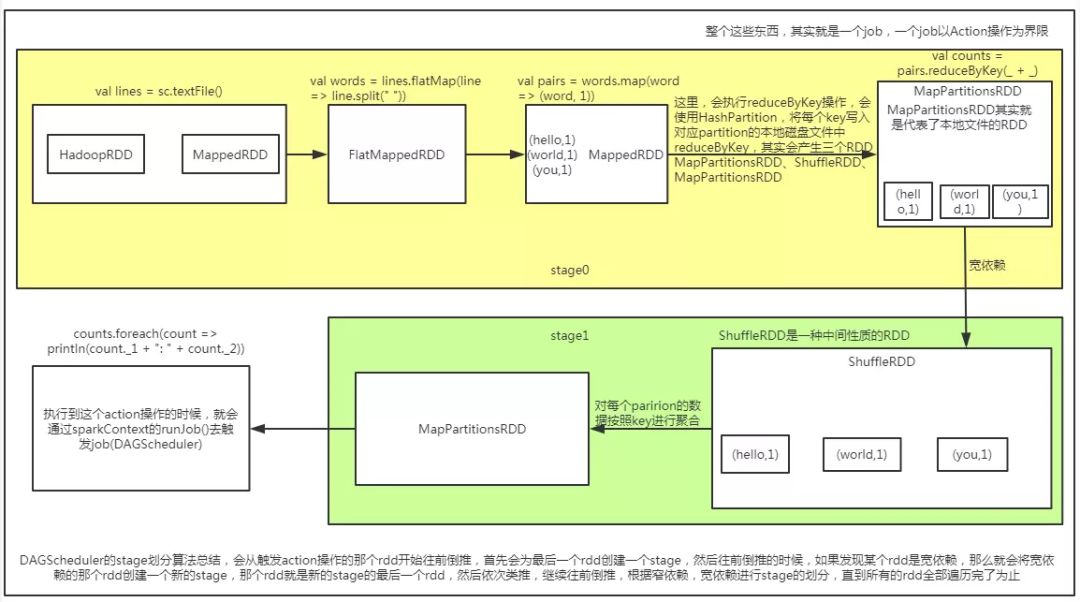
          // 所以说,针对之前那个流程图,其实对于每一种有shuffle的操作,比如groupByKey、reduceByKey、countByKey
          // 等操作,底层对应了三个RDD,MapPartitionsRDD、ShuffleRDD、MapPartitionsRDD,会划分为两个stage
          for (dep <- rdd.dependencies) {
            dep match {
              // 如果是宽依赖
              case shufDep: ShuffleDependency[_, _, _] =>
                // 那么使用宽依赖的那个rdd,创建一个stage,并且会将isShuffleMap设置为true
                // 默认最后一个stage,不是shuffleMap stage,但是finalStage之前所有的stage,都是shuffleMap stage
                val mapStage = getShuffleMapStage(shufDep, stage.jobId)
                if (!mapStage.isAvailable) {
                  missing += mapStage
                }
              // 如果是窄依赖,那么将依赖的rdd放入栈中
              case narrowDep: NarrowDependency[_] =>
                waitingForVisit.push(narrowDep.rdd)
            }
          }
        }
      }
    }
    // 首先往栈中,推入了stage的最后一个rdd
    waitingForVisit.push(stage.rdd)
    // 进行while循环
    while (!waitingForVisit.isEmpty) {
      // 对stage的最后一个rdd,调用自己内部定义的visit()方法
      visit(waitingForVisit.pop())
    }
    missing.toList
  }
看看submitMissingTasks()
// 提交stage,为stage创建一批task,task数量与partition数量相同
  private def submitMissingTasks(stage: Stage, jobId: Int) {
    logDebug("submitMissingTasks(" + stage + ")")
    // Get our pending tasks and remember them in our pendingTasks entry
    stage.pendingTasks.clear()

    // First figure out the indexes of partition ids to compute.
    // 获取你要创建的task的数量
    val partitionsToCompute: Seq[Int] = {
      if (stage.isShuffleMap) {
        (0 until stage.numPartitions).filter(id => stage.outputLocs(id) == Nil)
      } else {
        val job = stage.resultOfJob.get
        (0 until job.numPartitions).filter(id => !job.finished(id))
      }
    }

    val properties = if (jobIdToActiveJob.contains(jobId)) {
      jobIdToActiveJob(stage.jobId).properties
    } else {
      // this stage will be assigned to "default" pool
      null
    }

    // 将stage加入runningStages队列
    runningStages += stage
    // SparkListenerStageSubmitted should be posted before testing whether tasks are
    // serializable. If tasks are not serializable, a SparkListenerStageCompleted event
    // will be posted, which should always come after a corresponding SparkListenerStageSubmitted
    // event.
    stage.latestInfo = StageInfo.fromStage(stage, Some(partitionsToCompute.size))
    outputCommitCoordinator.stageStart(stage.id)
    listenerBus.post(SparkListenerStageSubmitted(stage.latestInfo, properties))

    // TODO: Maybe we can keep the taskBinary in Stage to avoid serializing it multiple times.
    // Broadcasted binary for the task, used to dispatch tasks to executors. Note that we broadcast
    // the serialized copy of the RDD and for each task we will deserialize it, which means each
    // task gets a different copy of the RDD. This provides stronger isolation between tasks that
    // might modify state of objects referenced in their closures. This is necessary in Hadoop
    // where the JobConf/Configuration object is not thread-safe.
    var taskBinary: Broadcast[Array[Byte]] = null
    try {
      // For ShuffleMapTask, serialize and broadcast (rdd, shuffleDep).
      // For ResultTask, serialize and broadcast (rdd, func).
      val taskBinaryBytes: Array[Byte] =
        if (stage.isShuffleMap) {
          closureSerializer.serialize((stage.rdd, stage.shuffleDep.get) : AnyRef).array()
        } else {
          closureSerializer.serialize((stage.rdd, stage.resultOfJob.get.func) : AnyRef).array()
        }
      taskBinary = sc.broadcast(taskBinaryBytes)
    } catch {
      // In the case of a failure during serialization, abort the stage.
      case e: NotSerializableException =>
        abortStage(stage, "Task not serializable: " + e.toString)
        runningStages -= stage
        return
      case NonFatal(e) =>
        abortStage(stage, s"Task serialization failed: $e\n${e.getStackTraceString}")
        runningStages -= stage
        return
    }

    // 为stage创建指定数量的task
    // 这里很关键的一点是,task的最佳位置计算算法
    val tasks: Seq[Task[_]] = if (stage.isShuffleMap) {
      partitionsToCompute.map { id =>
        // 给每一个partition创建一个task,给每个task计算最佳位置
        val locs = getPreferredLocs(stage.rdd, id)
        val part = stage.rdd.partitions(id)
        // 对于finalStage之外的stage,它的isShuffleMap都是true,所以会创建ShuffleMapTask
        new ShuffleMapTask(stage.id, taskBinary, part, locs)
      }
    } else {
      // 如果不是shuffleMap,那么就是finalStage,finalStage是创建ResultTask
      val job = stage.resultOfJob.get
      partitionsToCompute.map { id =>
        val p: Int = job.partitions(id)
        val part = stage.rdd.partitions(p)
        val locs = getPreferredLocs(stage.rdd, p)
        new ResultTask(stage.id, taskBinary, part, locs, id)
      }
    }

    if (tasks.size > 0) {
      logInfo("Submitting " + tasks.size + " missing tasks from " + stage + " (" + stage.rdd + ")")
      stage.pendingTasks ++= tasks
      logDebug("New pending tasks: " + stage.pendingTasks)
      // 最后,针对stage的task,创建TaskSet对象,调用taskScheduler的submitTasks()方法,提交taskSet
      taskScheduler.submitTasks(
        new TaskSet(tasks.toArray, stage.id, stage.newAttemptId(), stage.jobId, properties))
      stage.latestInfo.submissionTime = Some(clock.getTimeMillis())
    } else {
      // Because we posted SparkListenerStageSubmitted earlier, we should post
      // SparkListenerStageCompleted here in case there are no tasks to run.
      outputCommitCoordinator.stageEnd(stage.id)
      listenerBus.post(SparkListenerStageCompleted(stage.latestInfo))
      logDebug("Stage " + stage + " is actually done; %b %d %d".format(
        stage.isAvailable, stage.numAvailableOutputs, stage.numPartitions))
      runningStages -= stage
    }
  }
看看getPreferredLocs()方法
  private[spark]
  def getPreferredLocs(rdd: RDD[_], partition: Int): Seq[TaskLocation] = {
    getPreferredLocsInternal(rdd, partition, new HashSet)
  }
继续看getPreferredLocsInternal()方法
/**
    * 计算每个task对应的partition的最佳位置,说白了,就是从stage的最后一个rdd开始,去找哪个rdd的partition,是被cache了,或者checkpoint了
    * 那么,task的最佳位置,就是缓存的/checkpoint的partition的位置
    * 因为这样的话,task就在哪个节点上执行,不需要计算之前的rdd了
    */
  private def getPreferredLocsInternal(
      rdd: RDD[_],
      partition: Int,
      visited: HashSet[(RDD[_],Int)])
    : Seq[TaskLocation] =
  {
    // If the partition has already been visited, no need to re-visit.
    // This avoids exponential path exploration.  SPARK-695
    if (!visited.add((rdd,partition))) {
      // Nil has already been returned for previously visited partitions.
      return Nil
    }
    // If the partition is cached, return the cache locations
    // 寻找当前pdd的partiton是否缓存了
    val cached = getCacheLocs(rdd)(partition)
    if (!cached.isEmpty) {
      return cached
    }
    // If the RDD has some placement preferences (as is the case for input RDDs), get those
    // 寻找当前rdd的partition是否checkpoint了
    val rddPrefs = rdd.preferredLocations(rdd.partitions(partition)).toList
    if (!rddPrefs.isEmpty) {
      return rddPrefs.map(TaskLocation(_))
    }
    // If the RDD has narrow dependencies, pick the first partition of the first narrow dep
    // that has any placement preferences. Ideally we would choose based on transfer sizes,
    // but this will do for now.
    // 最后,递归调用自己,去寻找rdd的父rdd,看看对应的partition是否缓存或者checkpoint了
    rdd.dependencies.foreach {
      case n: NarrowDependency[_] =>
        for (inPart <- n.getParents(partition)) {
          val locs = getPreferredLocsInternal(n.rdd, inPart, visited)
          if (locs != Nil) {
            return locs
          }
        }
      case _ =>
    }
    // 如果这个stage,从最后一个rdd,到最开始的rdd,partition都没有被缓存或者checkpoint,那么task的最佳位置(PreferredLocs),就是Nil

    Nil
  }
