源码分析系列文章汇总在github,开源电子书地址如下:
github:
https://github.com/farmer-hutao/k8s-source-code-analysisgitbook:
https://farmer-hutao.github.io/k8s-source-code-analysis
IPtables-Mode Proxier
概述
Proxier 数据结构与类定义
Proxier对象生成与运行
Proxier 服务与端点更新 Tracker
syncProxyRule 同步配置与规则
UpdateServiceMap() SVC 服务的更新实现
UpdateEndpointsMap() 端点更新的实现
更新 service 和 endpoints ;返回更新结果
创建与联接 kube 链
创建 Iptables 基础数据
为每个 service 创建 rules
配置收尾规则数据
汇集与加载 iptables 配置规则数据
IPtables 底层的 runner 实现
iptables 执行器
iptables 执行器方法
1. 概述
kube-Proxy提供三种模式(userspace/iptables/ipvs)的proxier实现,userspace是早期的proxy模式,ipvs模式处于实验性阶段proxy模式,本文先从默认的内核级iptables proxier代码实现与逻辑分析开始,其它模式将用专文解析源码。
Iptables-mode Proxier的service配置和代码内都包含一些基础概念如clusterIP、nodeport、loadbalancer、Ingress、ClusterCIDR、onlyLocal、ExternalIP等,请在了解源码之前先熟悉其概念用途场景与类型区别,再看源码将对你理解proxy事半功倍。当然也需要对netfilter、iptables、connTrack等proxy基础依赖的工具熟悉。基础概念部分在本文将不深入介绍,有需求可自行查阅相关资料。
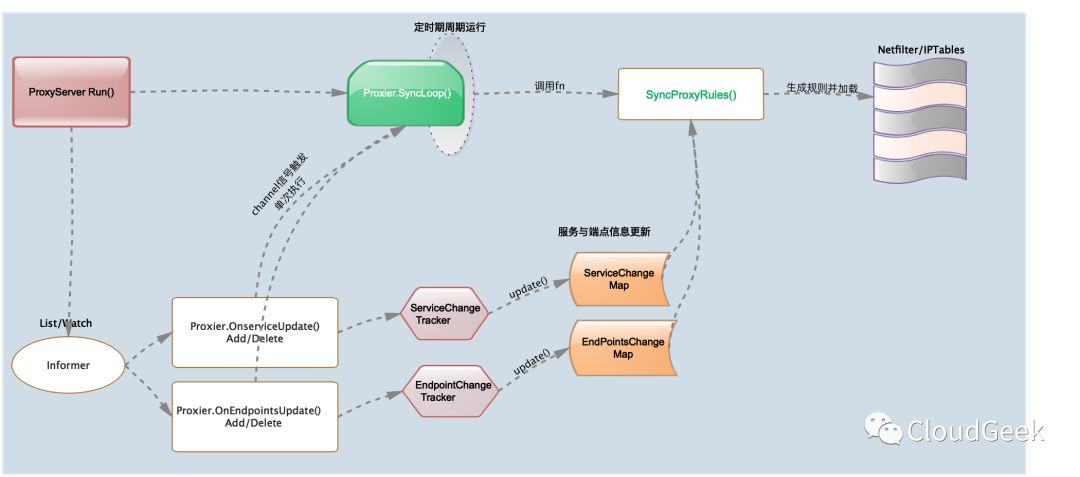
从kube-proxy组件整体框架层的代码来看,在ProxyServer.Run()最后走到了s.Proxier.SyncLoop()执行空间一直无限loop下去。而默认的ProxyServer配置的Proxier对象就是Iptables(if proxyMode == proxyModeIPTables),将调用iptabls-mode的Proxier.SyncLoop(),SyncLoop()时间定时循环执行syncProxyRules()完成services、endpoints与iptables规则的同步操作。
Iptables-mode proxier的负载均衡机制是通过底层netfliter/iptables规则来实现的,通过Informer机制watch服务与端点信息的变更事件触发对iptables的规则的同步更新,如下代码逻辑示意图:
下面proxier源码分析,我们先从proxier的接口、实现类、实现类方法列表一窥究竟,从结构上看整体Proxier的框架。然后我们再详细分析proxier对象的产生时所定义的属性值、值类型和用途。有了前面的两项的了解后我们再来分析proxier类方法的实现,也就是proxier代理逻辑部分(关键逻辑部分在syncProxyRules()方法分析部分)。最后我们分析proxier底层内核iptables的runner实现,也就是proxy上层逻辑层最终会调用iptables命令去执行规则的操作部分。
2. Proxier 数据结构与类定义
ProxyProvider 代理提供者接口定义,需要实现两个proxy的关键方法Sync()和SyncLoop()
pkg/proxy/types.go:27
type ProxyProvider interface {
  // Sync 即时同步Proxy提供者的当前状态至proxy规则
    Sync()
    // SyncLoop 周期性运行
  // 作为一个线程或应用主loop运行,无返回.
    SyncLoop()
}

Copy
Iptables-mode Proxier 为 ProxyProvider 接口实现类,proxier 类属性项比较多,我们先看一下注释用途与结构定义,在实例化proxier对象时我们再详看。
pkg/proxy/iptables/proxier.go:205
type Proxier struct {
    endpointsChanges *proxy.EndpointChangeTracker // 端点更新信息跟踪器
    serviceChanges   *proxy.ServiceChangeTracker  // 服务更新信息跟踪器

    mu           sync.Mutex                       // 保护同步锁
    serviceMap   proxy.ServiceMap                 // 存放服务列表信息                ①
    endpointsMap proxy.EndpointsMap               // 存放端点列表信息                ②
    portsMap     map[utilproxy.LocalPort]utilproxy.Closeable //端口关闭接口map

    endpointsSynced bool                          // ep同步状态
    servicesSynced  bool                          // svc同步状态
    initialized     int32                         // 初始化状态
    syncRunner      *async.BoundedFrequencyRunner // 指定频率运行器,此处用于管理对
                                                // syncProxyRules的调用

    iptables       utiliptables.Interface         // iptables命令执行接口
    masqueradeAll  bool
    masqueradeMark string                         // SNAT地址伪装Mark
    exec           utilexec.Interface             // exec命令执行工具接口
    clusterCIDR    string                         // 集群CIDR
    hostname       string                         // 主机名
    nodeIP         net.IP                         // 节点IP地址
    portMapper     utilproxy.PortOpener           // TCP/UTP端口打开与监听
    recorder       record.EventRecorder           // 事件记录器
    healthChecker  healthcheck.Server             // healthcheck服务器对象
    healthzServer  healthcheck.HealthzUpdater     // Healthz更新器

    precomputedProbabilities []string             //预计算可能性

  //iptables规则与链数据(Filter/NAT)
    iptablesData             *bytes.Buffer
    existingFilterChainsData *bytes.Buffer
    filterChains             *bytes.Buffer
    filterRules              *bytes.Buffer
    natChains                *bytes.Buffer
    natRules                 *bytes.Buffer

    endpointChainsNumber int

    // Node节点IP与端口信息
    nodePortAddresses []string

    networkInterfacer utilproxy.NetworkInterfacer  //网络接口
}

Copy
① ServiceMap和ServicePort定义
pkg/proxy/service.go:229
type ServiceMap map[ServicePortName]ServicePort

//String() =>  "NS/SvcName:PortName"
ServicePortName{NamespacedName: svcName, Port: servicePort.Name}

Copy
ServiceSpec service.spec定义,在用户前端可定义service的spec配置项。
vendor/k8s.io/api/core/v1/types.go:3606
type ServiceSpec struct {
    Ports []ServicePort                   //服务端口列表
    Selector map[string]string            //选择器
    ClusterIP string                      //VIP 、 portal
    Type ServiceType                      //服务类型
    ExternalIPs []string                  //外部IP列表,如外部负载均衡
    SessionAffinity ServiceAffinity       //会话保持
    LoadBalancerIP string                 //service类型为"LoadBalancer"时配置LB ip
    LoadBalancerSourceRanges []string     //cloud-provider的限制client ip区间
    ExternalName string
    ExternalTrafficPolicy ServiceExternalTrafficPolicyType
    HealthCheckNodePort int32
    PublishNotReadyAddresses bool
    SessionAffinityConfig *SessionAffinityConfig  //会话保持配置信息
}

Copy
ServicePort类定义和ServicePort接口
vendor/k8s.io/api/core/v1/types.go:3563
type ServicePort struct {
    Name string
    Protocol Protocol
    Port int32
    TargetPort intstr.IntOrString
    NodePort int32
}

//ServicePort接口
type ServicePort interface {
    // 返回服务字串,格式如: `IP:Port/Protocol`.
    String() string
    // 返回集群IP字串
    ClusterIPString() string
    // 返回协议
    GetProtocol() v1.Protocol
    // 返回健康检测端口
    GetHealthCheckNodePort() int
}

Copy
② EndpointsMap定义与Endpoint接口
pkg/proxy/endpoints.go:181
type EndpointsMap map[ServicePortName][]Endpoint

type Endpoint interface {
    // 返回endpoint字串,格式 `IP:Port`.
    String() string
  // 是否本地
    GetIsLocal() bool
    // 返回IP
    IP() string
    // 返回端口
    Port() (int, error)
    // 检测两上endpoint是否相等
    Equal(Endpoint) bool
}

Copy
Endpoints结构与相关定义
vendor/k8s.io/api/core/v1/types.go:3710
type Endpoints struct {
    metav1.TypeMeta
    metav1.ObjectMeta
    Subsets []EndpointSubset
}

type EndpointSubset struct {
    Addresses []EndpointAddress            // EndpointAddress地址列表
    NotReadyAddresses []EndpointAddress
    Ports []EndpointPort                   // EndpointPort端口列表
}

type EndpointAddress struct {
    IP string
    Hostname string
    NodeName *string
    TargetRef *ObjectReference
}

type EndpointPort struct {
    Name string
    Port int32
    Protocol Protocol
}

Copy
Iptables-mode Proxier提供的方法列表,先大概从名称上来了解一下方法用途,后面我在逻辑部分对主要使用的方法再深入分析。
func (proxier *Proxier) precomputeProbabilities(numberOfPrecomputed int) {/*...*/}
func (proxier *Proxier) probability(n int) string{/*...*/}
func (proxier *Proxier) Sync(){/*...*/}
func (proxier *Proxier) SyncLoop(){/*...*/}
func (proxier *Proxier) setInitialized(value bool){/*...*/}
func (proxier *Proxier) isInitialized() bool{/*...*/}
func (proxier *Proxier) OnServiceAdd(service *v1.Service){/*...*/}
func (proxier *Proxier) OnServiceUpdate(oldService, service *v1.Service){/*...*/}
func (proxier *Proxier) OnServiceDelete(service *v1.Service){/*...*/}
func (proxier *Proxier) OnServiceSynced(){/*...*/}
func (proxier *Proxier) OnEndpointsAdd(endpoints *v1.Endpoints){/*...*/}
func (proxier *Proxier) OnEndpointsUpdate(oldEndpoints, endpoints *v1.Endpoints){/*...*/}
func (proxier *Proxier) OnEndpointsDelete(endpoints *v1.Endpoints) {/*...*/}
func (proxier *Proxier) OnEndpointsSynced() {/*...*/}
func (proxier *Proxier) deleteEndpointConnections(connectionMap []proxy.ServiceEndpoint){/*...*/}
func (proxier *Proxier) appendServiceCommentLocked(args []string, svcName string){/*...*/}
func (proxier *Proxier) syncProxyRules(){/*...*/}

Copy
3. Proxier对象生成与运行
篇幅限制,本节参考 github
4. Proxier 服务与端点更新 Tracker
篇幅限制,本节参考 github
5. syncProxyRule 同步配置与规则
篇幅限制,本节参考 github
5.1. 更新 service 和 endpoints ;返回更新结果
pkg/proxy/iptables/proxier.go:652
    //更新SVC/EP
  serviceUpdateResult := proxy.UpdateServiceMap(proxier.serviceMap, proxier.serviceChanges)
    endpointUpdateResult := proxy.UpdateEndpointsMap(proxier.endpointsMap, proxier.endpointsChanges)

    staleServices := serviceUpdateResult.UDPStaleClusterIP
  // 从EndpointsMap更新结果返回中合并UDP协议废弃服务信息
    for _, svcPortName := range endpointUpdateResult.StaleServiceNames {
        if svcInfo, ok := proxier.serviceMap[svcPortName]; ok && svcInfo != nil && svcInfo.GetProtocol() == v1.ProtocolUDP {
            klog.V(2).Infof("Stale udp service %v -> %s", svcPortName, svcInfo.ClusterIPString())
            staleServices.Insert(svcInfo.ClusterIPString())
        }
    }

Copy
5.1.1. UpdateServiceMap() SVC 服务的更新实现
篇幅限制,本节参考 github
5.1.2. UpdateEndpointsMap() 端点更新的实现
篇幅限制,本节参考 github
5.2. 创建与联接 kube 链
篇幅限制,本节参考 github
5.3. 创建 Iptables 基础数据
获取现存在的Filter/Nat表链数据
创建iptables-save/restore格式数据(表头、链)
创建SNAT地址伪装规则
pkg/proxy/iptables/proxier.go:688
    //现存在的filter表链获取
    existingFilterChains := make(map[utiliptables.Chain][]byte)
    proxier.existingFilterChainsData.Reset()
    err := proxier.iptables.SaveInto(utiliptables.TableFilter, proxier.existingFilterChainsData)  //通过iptables-save方式来获取
    if err != nil {
        klog.Errorf("Failed to execute iptables-save, syncing all rules: %v", err)
    } else {
        existingFilterChains = utiliptables.GetChainLines(utiliptables.TableFilter, proxier.existingFilterChainsData.Bytes()) //输出结果
    }

    //同上,现存在的nat表链获取
    existingNATChains := make(map[utiliptables.Chain][]byte)
    proxier.iptablesData.Reset()
    err = proxier.iptables.SaveInto(utiliptables.TableNAT, proxier.iptablesData)
    if err != nil {
        klog.Errorf("Failed to execute iptables-save, syncing all rules: %v", err)
    } else {
        existingNATChains = utiliptables.GetChainLines(utiliptables.TableNAT, proxier.iptablesData.Bytes())
    }

    // Reset all buffers used later.
    // This is to avoid memory reallocations and thus improve performance.
    proxier.filterChains.Reset()
    proxier.filterRules.Reset()
    proxier.natChains.Reset()
    proxier.natRules.Reset()

    // 写表头
    writeLine(proxier.filterChains, "*filter")
    writeLine(proxier.natChains, "*nat")

Copy
写链数据
fileter: "KUBE-SERVICES" "KUBE-EXTERNAL-SERVICES"/ "KUBE-FORWARD"nat: "KUBE-SERVICES" "KUBE-NODEPORTS" "KUBE-POSTROUTING" "KUBE-MARK-MASQ"
pkg/proxy/iptables/proxier.go:720
    // 写chain链数据,将filter和Nat相关链格式化存放buffer
    for _, chainName := range []utiliptables.Chain{kubeServicesChain, kubeExternalServicesChain, kubeForwardChain} {
        if chain, ok := existingFilterChains[chainName]; ok {
            writeBytesLine(proxier.filterChains, chain)
        } else {
      // iptables-save/restore格式的链行":$chainName - [0:0]"
            writeLine(proxier.filterChains, utiliptables.MakeChainLine(chainName))
        }
    }
    for _, chainName := range []utiliptables.Chain{kubeServicesChain, kubeNodePortsChain, kubePostroutingChain, KubeMarkMasqChain} {
        if chain, ok := existingNATChains[chainName]; ok {
            writeBytesLine(proxier.natChains, chain)
        } else {
            writeLine(proxier.natChains, utiliptables.MakeChainLine(chainName))
        }
    }

Copy
写地址伪装规则,在POSTROUTING阶段对地址进行MASQUERADE(基于接口动态IP的SNAT)处理,原始请求源IP将被丢失,被请求POD的应用看到为NodeIP或CNI设备IP(bridge/vxlan设备)
pkg/proxy/iptables/proxier.go:738
  // 写kubernets特有的SNAT地址伪装规则
  // -A KUBE-POSTROUTING -m comment --comment "kubernetes service traffic requiring SNAT" -m mark --mark 0x4000/0x4000 -j MASQUERADE
    writeLine(proxier.natRules, []string{
        "-A", string(kubePostroutingChain),
        "-m", "comment", "--comment", `"kubernetes service traffic requiring SNAT"`,
        "-m", "mark", "--mark", proxier.masqueradeMark,
        "-j", "MASQUERADE",
    }...)

  //-A KUBE-MARK-MASQ -j MARK --set-xmark 0x4000/0x4000
    writeLine(proxier.natRules, []string{
        "-A", string(KubeMarkMasqChain),
        "-j", "MARK", "--set-xmark", proxier.masqueradeMark,
    }...)

Copy
5.4. 为每个 service 创建 rules
先了解serviceInfo的完整定义说明
pkg/proxy/iptables/proxier.go:141
type serviceInfo struct {
    *proxy.BaseServiceInfo
    // The following fields are computed and stored for performance reasons.
    serviceNameString        string
  servicePortChainName     utiliptables.Chain  // KUBE-SVC-XXXX16BitXXXX  服务链
    serviceFirewallChainName utiliptables.Chain  // KUBE-FW-XXXX16BitXXXX   Firewall链
    serviceLBChainName       utiliptables.Chain  // KUBE-XLB-XXXX16BitXXXX  SLB链
}

type BaseServiceInfo struct {
  ClusterIP                net.IP                   //PortalIP(VIP)
    Port                     int                      //portal端口
    Protocol                 v1.Protocol              //协议
    NodePort                 int                      //node节点端口
    LoadBalancerStatus       v1.LoadBalancerStatus    //LB Ingress
    SessionAffinityType      v1.ServiceAffinity       //会话保持
    StickyMaxAgeSeconds      int                      //保持最大时长
    ExternalIPs              []string                 //ExternalIPs(指定的node上监听端口)
    LoadBalancerSourceRanges []string                 //过滤源地址流量
    HealthCheckNodePort      int                      //HealthCheck检测端口
    OnlyNodeLocalEndpoints   bool
}

Copy
为每个服务创建服务"KUBE-SVC-XXX…"和外部负载均衡"KUBE-XLB-XXX…"链
pkg/proxy/iptables/proxier.go:791
        svcChain := svcInfo.servicePortChainName  //"KUBE-SVC-XXX..."
        if hasEndpoints {
            // Create the per-service chain, retaining counters if possible.
            if chain, ok := existingNATChains[svcChain]; ok {
                writeBytesLine(proxier.natChains, chain)
            } else {
                writeLine(proxier.natChains, utiliptables.MakeChainLine(svcChain))
            }
            activeNATChains[svcChain] = true
        }

        svcXlbChain := svcInfo.serviceLBChainName  // "KUBE-XLB-XXX…"
        if svcInfo.OnlyNodeLocalEndpoints {
            // Only for services request OnlyLocal traffic
            // create the per-service LB chain, retaining counters if possible.
            if lbChain, ok := existingNATChains[svcXlbChain]; ok {
                writeBytesLine(proxier.natChains, lbChain)
            } else {
                writeLine(proxier.natChains, utiliptables.MakeChainLine(svcXlbChain))
            }
            activeNATChains[svcXlbChain] = true
        }

Copy
clusterIP流量的匹配,clusterIP为默认方式,仅资源集群内可访问。
pkg/proxy/iptables/proxier.go:815
    //存在端点,写规则
        if hasEndpoints {
            args = append(args[:0],
                "-A", string(kubeServicesChain),
                "-m", "comment", "--comment", fmt.Sprintf(`"%s cluster IP"`, svcNameString),
                "-m", protocol, "-p", protocol,
                "-d", utilproxy.ToCIDR(svcInfo.ClusterIP),
                "--dport", strconv.Itoa(svcInfo.Port),
            )
     // proxier配置masqueradeAll
     //  -A KUBE-SERVICES -m comment --comment "..." -m $prot -p $prot -d $clusterIP \
     //     --dport $port -j KUBE-MARK-MASQ
            if proxier.masqueradeAll {
                writeLine(proxier.natRules, append(args, "-j", string(KubeMarkMasqChain))...)
            } else if len(proxier.clusterCIDR) > 0 {
       // proxier配置clusterCIDR情况:
       // -A KUBE-SERVICES ! -s $clusterCIDR -m comment --comment "..." -m $prot \
       //    -p $prot -d $clusterIP --dport $port -j  KUBE-MARK-MASQ
                writeLine(proxier.natRules, append(args, "! -s", proxier.clusterCIDR, "-j", string(KubeMarkMasqChain))...)
            }
      //  -A KUBE-SERVICES -m comment --comment "..." -m $prot -p $prot -d $clusterIP \
      //     --dport $port -j KUBE-SVC-XXXX16bitXXXX
            writeLine(proxier.natRules, append(args, "-j", string(svcChain))...)
        } else {
      // 无Endpoints的情况,则创建REJECT规则
      // -A KUBE-SERVICES -m comment --comment $svcName -m $prot -p $prot -d $clusterIP \
      // --dport $port -j REJECT
            writeLine(proxier.filterRules,
                "-A", string(kubeServicesChain),
                "-m", "comment", "--comment", fmt.Sprintf(`"%s has no endpoints"`, svcNameString),
                "-m", protocol, "-p", protocol,
                "-d", utilproxy.ToCIDR(svcInfo.ClusterIP),
                "--dport", strconv.Itoa(svcInfo.Port),
                "-j", "REJECT",
            )
        }

Copy
服务是否启用ExternalIPs(指定的node上开启监听端口)
pkg/proxy/iptables/proxier.go:846
    for _, externalIP := range svcInfo.ExternalIPs {
      // 判断externalIP是否为本node的IP以及协议为SCTP,且端口是否已开启
      // 如果未开启则在本地打开监听端口
            if local, err := utilproxy.IsLocalIP(externalIP); err != nil {
                klog.Errorf("can't determine if IP is local, assuming not: %v", err)
            } else if local && (svcInfo.GetProtocol() != v1.ProtocolSCTP) {
                lp := utilproxy.LocalPort{
                    Description: "externalIP for " + svcNameString,
                    IP:          externalIP,
                    Port:        svcInfo.Port,
                    Protocol:    protocol,
                }
                if proxier.portsMap[lp] != nil {
                    klog.V(4).Infof("Port %s was open before and is still needed", lp.String())
                    replacementPortsMap[lp] = proxier.portsMap[lp]
                } else {
          //打开与监听本地端口
                    socket, err := proxier.portMapper.OpenLocalPort(&lp)
                    if err != nil {
                        msg := fmt.Sprintf("can't open %s, skipping this externalIP: %v", lp.String(), err)

                        proxier.recorder.Eventf(
                            &v1.ObjectReference{
                                Kind:      "Node",
                                Name:      proxier.hostname,
                                UID:       types.UID(proxier.hostname),
                                Namespace: "",
                            }, v1.EventTypeWarning, err.Error(), msg)
                        klog.Error(msg)
                        continue
                    }
                    replacementPortsMap[lp] = socket
                }
            }

      //存在端点,写规则
            if hasEndpoints {
                args = append(args[:0],
                    "-A", string(kubeServicesChain),
                    "-m", "comment", "--comment", fmt.Sprintf(`"%s external IP"`, svcNameString),
                    "-m", protocol, "-p", protocol,
                    "-d", utilproxy.ToCIDR(net.ParseIP(externalIP)),
                    "--dport", strconv.Itoa(svcInfo.Port),
                )

         // -A KUBE-EXTERNAL-SERVICES -m comment --comment "..." -m $prot -p $prot -d \
        //    $externalIP --dport $port -j KUBE-MARK-MASQ
                writeLine(proxier.natRules, append(args, "-j", string(KubeMarkMasqChain))...)

        //  -A KUBE-EXTERNAL-SERVICES -m comment --comment "..." -m $prot -p $prot -d \
        //     $externalIP --dport $port -m physdev ! --physdev-is-in \
        //     -m addrtype ! --src-type Local -j KUBE-SVC-XXXX16bitXXXXX
                externalTrafficOnlyArgs := append(args,
                    "-m", "physdev", "!", "--physdev-is-in",
                    "-m", "addrtype", "!", "--src-type", "LOCAL")
                writeLine(proxier.natRules, append(externalTrafficOnlyArgs, "-j", string(svcChain))...)
                dstLocalOnlyArgs := append(args, "-m", "addrtype", "--dst-type", "LOCAL")

        //  -A KUBE-EXTERNAL-SERVICES -m comment --comment "..." -m $prot -p $prot -d \
        //     $externalIP --dport $port -m addrtype --dst-type Local
        //     -j KUBE-SVC-XXXX16bitXXXXX
                writeLine(proxier.natRules, append(dstLocalOnlyArgs, "-j", string(svcChain))...)
            } else {
        // 不存在端点信息则reject
        // -A KUBE-EXTERNAL-SERVICES -m comment --comment "..." -m $prot -p $prot -d \
        //    $externalIP --dport $port -j REJECT
                writeLine(proxier.filterRules,
                    "-A", string(kubeExternalServicesChain),
                    "-m", "comment", "--comment", fmt.Sprintf(`"%s has no endpoints"`, svcNameString),
                    "-m", protocol, "-p", protocol,
                    "-d", utilproxy.ToCIDR(net.ParseIP(externalIP)),
                    "--dport", strconv.Itoa(svcInfo.Port),
                    "-j", "REJECT",
                )
            }
        }

Copy
服务是否启用了外部负载均衡服务load-balancer ingress
pkg/proxy/iptables/proxier.go:917
    //存在端点,写规则
        if hasEndpoints {
            fwChain := svcInfo.serviceFirewallChainName     //"KUBE-FW-XXXX16bitXXXXX"
            for _, ingress := range svcInfo.LoadBalancerStatus.Ingress {
                if ingress.IP != "" {
                    // 创建服务KUBE-FW-X链
                    if chain, ok := existingNATChains[fwChain]; ok {
                        writeBytesLine(proxier.natChains, chain)
                    } else {  //原来不存在则新建
                        writeLine(proxier.natChains, utiliptables.MakeChainLine(fwChain))
                    }
                    activeNATChains[fwChain] = true
                    // The service firewall rules are created based on ServiceSpec.loadBalancerSourceRanges field.
                    // This currently works for loadbalancers that preserves source ips.
                    // For loadbalancers which direct traffic to service NodePort, the firewall rules will not apply.

                    args = append(args[:0],
                        "-A", string(kubeServicesChain),
                        "-m", "comment", "--comment", fmt.Sprintf(`"%s loadbalancer IP"`, svcNameString),
                        "-m", protocol, "-p", protocol,
                        "-d", utilproxy.ToCIDR(net.ParseIP(ingress.IP)),
                        "--dport", strconv.Itoa(svcInfo.Port),
                    )
          // -A KUBE-SERVICES -m comment --comment "..." -m $prot -p $prot -d \
          //    $ingresIP --dport $port -j KUBE-FW-XXXX16bitXXXXX
                    writeLine(proxier.natRules, append(args, "-j", string(fwChain))...)

                    args = append(args[:0],
                        "-A", string(fwChain),
                        "-m", "comment", "--comment", fmt.Sprintf(`"%s loadbalancer IP"`, svcNameString),
                    )

           // 在KUBE-FW链,每个源匹配规则可能跳转至一个SVC或XLB链
                    chosenChain := svcXlbChain
                    // If we are proxying globally, we need to masquerade in case we cross nodes.
                    // If we are proxying only locally, we can retain the source IP.
                    if !svcInfo.OnlyNodeLocalEndpoints {
            // -j "KUBE-MARK-MASQ" 地址伪装实现跨主机访问
                        writeLine(proxier.natRules, append(args, "-j", string(KubeMarkMasqChain))...)
                        chosenChain = svcChain   // 选择为SVC链
                    }

                    if len(svcInfo.LoadBalancerSourceRanges) == 0 {
            // 允许所有源,直接跳转
                        writeLine(proxier.natRules, append(args, "-j", string(chosenChain))...)
                    } else {
                        // 基于source range配置过滤 "-s $srcRanges"
            allowFromNode := false
                        for _, src := range svcInfo.LoadBalancerSourceRanges {
                            writeLine(proxier.natRules, append(args, "-s", src, "-j", string(chosenChain))...)
                            _, cidr, _ := net.ParseCIDR(src)
                            if cidr.Contains(proxier.nodeIP) {
                                allowFromNode = true    //配置CIDR包含节点IP,则允许来自节点请求
                            }
                        }

            // 添加 "-s $ingresIP" 来允许LB后端主机请求
                        if allowFromNode {
                            writeLine(proxier.natRules, append(args, "-s", utilproxy.ToCIDR(net.ParseIP(ingress.IP)), "-j", string(chosenChain))...)
                        }
                    }

          // 条件ingress.IP为空"-j KUBE-MARK-DROP"
                    writeLine(proxier.natRules, append(args, "-j", string(KubeMarkDropChain))...)
                }
            }
        }

Copy
服务是否启用了nodeport(在每个节点上都将开启一个nodeport端口)
pkg/proxy/iptables/proxier.go:989
        if svcInfo.NodePort != 0 {
      // 获取node addresses
            addresses, err := utilproxy.GetNodeAddresses(proxier.nodePortAddresses, proxier.networkInterfacer)
            if err != nil {
                klog.Errorf("Failed to get node ip address matching nodeport cidr: %v", err)
                continue
            }

            lps := make([]utilproxy.LocalPort, 0)
            for address := range addresses {
                lp := utilproxy.LocalPort{
                    Description: "nodePort for " + svcNameString,
                    IP:          address,
                    Port:        svcInfo.NodePort,
                    Protocol:    protocol,
                }
                if utilproxy.IsZeroCIDR(address) {
                    // Empty IP address means all
                    lp.IP = ""
                    lps = append(lps, lp)
                    // If we encounter a zero CIDR, then there is no point in processing the rest of the addresses.
                    break
                }
                lps = append(lps, lp)     //IP列表
            }

      // 为node节点的ips打开端口并保存持有socket句柄
            for _, lp := range lps {
                if proxier.portsMap[lp] != nil {
                    klog.V(4).Infof("Port %s was open before and is still needed", lp.String())
                    replacementPortsMap[lp] = proxier.portsMap[lp]
                } else if svcInfo.GetProtocol() != v1.ProtocolSCTP {
          // 打开和监听端口
                    socket, err := proxier.portMapper.OpenLocalPort(&lp)
                    if err != nil {
                        klog.Errorf("can't open %s, skipping this nodePort: %v", lp.String(), err)
                        continue
                    }
                    if lp.Protocol == "udp" {
                //清理udp conntrack记录
                        err := conntrack.ClearEntriesForPort(proxier.exec, lp.Port, isIPv6, v1.ProtocolUDP)
                        if err != nil {
                            klog.Errorf("Failed to clear udp conntrack for port %d, error: %v", lp.Port, err)
                        }
                    }
                    replacementPortsMap[lp] = socket //socket保存
                }
            }

      //存在端点,写规则
            if hasEndpoints {
        // -A KUBE-NODEPORTS -m comment --comment "..." -m $prot -p $prot --dport $nodePort
                args = append(args[:0],
                    "-A", string(kubeNodePortsChain),
                    "-m", "comment", "--comment", svcNameString,
                    "-m", protocol, "-p", protocol,
                    "--dport", strconv.Itoa(svcInfo.NodePort),
                )
                if !svcInfo.OnlyNodeLocalEndpoints {
          //非本地nodeports则需SNAT规则添加,
          // -j KUBE-MARK-MASQ -j KUBE-XLB-XXXX16bitXXXX
                    writeLine(proxier.natRules, append(args, "-j", string(KubeMarkMasqChain))...)
                    // Jump to the service chain.
                    writeLine(proxier.natRules, append(args, "-j", string(svcChain))...)
                } else {
                    loopback := "127.0.0.0/8"
                    if isIPv6 {
                        loopback = "::1/128"
                    }
           // 本地nodeports则规则添加,
          // -s $loopback -j KUBE-MARK-MASQ -j KUBE-XLB-XXXX16bitXXXX
                    writeLine(proxier.natRules, append(args, "-s", loopback, "-j", string(KubeMarkMasqChain))...)
                    writeLine(proxier.natRules, append(args, "-j", string(svcXlbChain))...)
                }
            } else {
        // 无hasEndpoints,添加-j reject规则
        // -A KUBE-EXTERNAL-SERVICES -m comment --comment "..." -m addrtype \
        //     --dst-type LOCAL -m $prot -p $prot --dport $nodePort -j REJECT
                writeLine(proxier.filterRules,
                    "-A", string(kubeExternalServicesChain),
                    "-m", "comment", "--comment", fmt.Sprintf(`"%s has no endpoints"`, svcNameString),
                    "-m", "addrtype", "--dst-type", "LOCAL",
                    "-m", protocol, "-p", protocol,
                    "--dport", strconv.Itoa(svcInfo.NodePort),
                    "-j", "REJECT",
                )
            }
        }

Copy
基于服务名和协议,生成每个端点链
pkg/proxy/iptables/proxier.go:1087
  for _, ep := range proxier.endpointsMap[svcName] {
            epInfo, ok := ep.(*endpointsInfo)
            if !ok {
                klog.Errorf("Failed to cast endpointsInfo %q", ep.String())
                continue
            }
            endpoints = append(endpoints, epInfo)
      //基于服务名和协议生成端点链名称 "KUBE-SEP-XXXX16bitXXXX"
            endpointChain = epInfo.endpointChain(svcNameString, protocol)
            endpointChains = append(endpointChains, endpointChain)

      // 创建端点链
            if chain, ok := existingNATChains[utiliptables.Chain(endpointChain)]; ok {
                writeBytesLine(proxier.natChains, chain)
            } else {
                writeLine(proxier.natChains, utiliptables.MakeChainLine(endpointChain))
            }
            activeNATChains[endpointChain] = true
        }

Copy
写SessionAffinity会话保持规则,实现在一段时间内保持session affinity,保持时间为180秒,通过添加“-m recent –rcheck –seconds 180 –reap”的iptables规则实现了会话保持。
pkg/proxy/iptables/proxier.go:1107
    //SessionAffinityType设置为"ClientIP",则写session保持规则
    // -A KUBE-SVC-XXXX16bitXXXX -m recent -m comment –comment "..." \
    //    --name KUBE-SEP-XXXX16bitXXXX --rcheck --seconds 180 --reap \
    //    -j KUBE-SEP-XXXX16bitXXXX
        if svcInfo.SessionAffinityType == v1.ServiceAffinityClientIP {
            for _, endpointChain := range endpointChains {
                args = append(args[:0],
                    "-A", string(svcChain),
                )
                proxier.appendServiceCommentLocked(args, svcNameString)
                args = append(args,
                    "-m", "recent", "--name", string(endpointChain),
                    "--rcheck", "--seconds", strconv.Itoa(svcInfo.StickyMaxAgeSeconds), "--reap",
                    "-j", string(endpointChain),
                )
                writeLine(proxier.natRules, args...)
            }
        }

Copy
写负载均衡和DNAT规则,使用“-m statistic –-mode random -–probability ” iptables规则将后端POD组成一个基于概率访问的组合,实现服务访问的负载均衡功能效果。
针对服务的每个端点在nat表内该service对应的自定义链“KUBE-SVC-XXXX16bitXXXX”中加入iptables规则。如果该服务对应的endpoints大于等于2,则添加负载均衡规则。
针对选择非本地Node上的POD,需进行DNAT,将请求的目标地址设置成后选的POD的IP后进行路由。KUBE-MARK-MASQ将重设(伪装)源地址
-A KUBE-SVC-XXXX16bitXXXX -m comment –comment "..." -m statistic --mode random --probability $prob -j KUBE-SEP-XXXX16bitXXXX
-A KUBE-SEP-XXXX16bitXXXX -m comment –comment "..." -s $epIp -j "KUBE-MARK-MASQ"
-A KUBE-SVC-XXXX16bitXXXX -m comment –comment "…" -m prot -p $prot -j DNAT --to-destination X.X.X.X:xxx
pkg/proxy/iptables/proxier.go:1123
    // 写负载均衡和DNAT规则
        n := len(endpointChains)
        for i, endpointChain := range endpointChains {
            epIP := endpoints[i].IP()
            if epIP == "" {
                // Error parsing this endpoint has been logged. Skip to next endpoint.
                continue
            }
            // 每个服务生成的负载均衡规则,后端POD组成一个基于概率访问的组合
      //   -A KUBE-SVC-XXXX16bitXXXX -m comment –comment "..."
      //    -m statistic --mode random --probability $prob
      //    -j KUBE-SEP-XXXX16bitXXXX
            args = append(args[:0], "-A", string(svcChain))
            proxier.appendServiceCommentLocked(args, svcNameString)
            if i < (n - 1) {   // 当端点大于或等于2
                args = append(args,
                    "-m", "statistic",
                    "--mode", "random",
                    "--probability", proxier.probability(n-i))
            }
            // The final (or only if n == 1) rule is a guaranteed match.
            args = append(args, "-j", string(endpointChain))
            writeLine(proxier.natRules, args...)

      // 每个端点链规则
      // -A KUBE-SEP-XXXX16bitXXXX -m comment –comment "..."  -s $epIp -j "KUBE-MARK-MASQ"
            args = append(args[:0], "-A", string(endpointChain))
            proxier.appendServiceCommentLocked(args, svcNameString)
            // Handle traffic that loops back to the originator with SNAT.
            writeLine(proxier.natRules, append(args,
                "-s", utilproxy.ToCIDR(net.ParseIP(epIP)),
                "-j", string(KubeMarkMasqChain))...)

      // 如配置session保持"ClientIP"
      // -m recent --name KUBE-SEP-XXXX16bitXXXX --set
            if svcInfo.SessionAffinityType == v1.ServiceAffinityClientIP {
                args = append(args, "-m", "recent", "--name", string(endpointChain), "--set")
            }
            // DNAT至最终的端点服务上
      // -A KUBE-SVC-XXXX16bitXXXX -m comment –comment "..."
      //    -m $prot -p $prot -j DNAT --to-destination X.X.X.X:xxx
            args = append(args, "-m", protocol, "-p", protocol, "-j", "DNAT", "--to-destination", endpoints[i].Endpoint)
            writeLine(proxier.natRules, args...)
        }

    // 服务请求仅本地流量
        localEndpoints := make([]*endpointsInfo, 0)
        localEndpointChains := make([]utiliptables.Chain, 0)
        for i := range endpointChains {
            if endpoints[i].IsLocal {
                // These slices parallel each other; must be kept in sync
                localEndpoints = append(localEndpoints, endpoints[i])
                localEndpointChains = append(localEndpointChains, endpointChains[i])
            }
        }

Copy
启用clusterCIDR (Kube-proxy中的--cluster-dir
指定的是集群中pod使用的网段,而pod使用的网段和apiserver中指定的service的cluster ip或vip网段不是同一个网段)
pkg/proxy/iptables/proxier.go:1179
     // pod -> external VIP流量导向服务VIP(服务链)
    // -A KUBE-XLB-XXXX16bitXXXX -m comment --comment "..." -s $clusterCIDR
    //    -j  KUBE-SVC-XXXX16bitXXXXX
        if len(proxier.clusterCIDR) > 0 {
            args = append(args[:0],
                "-A", string(svcXlbChain),
                "-m", "comment", "--comment",
                `"Redirect pods trying to reach external loadbalancer VIP to clusterIP"`,
                "-s", proxier.clusterCIDR,
                "-j", string(svcChain),
            )
            writeLine(proxier.natRules, args...)
        }

Copy
生成本地端点链规则,本地源IP保持(当只在本地选择POD服务请求时,则不存在SNAT规则,可保持源地址IP信息。在nodePort或XLB时,可定义"externalTrafficPolicy": "Local"
控制向属于这个service的本地的POD转发请求,如果本地没有POD能服务这个请求,请求将被DROP掉,客户端会发现请求超时没有响应。
pkg/proxy/iptables/proxier.go:1190
    numLocalEndpoints := len(localEndpointChains)
        if numLocalEndpoints == 0 {
      // 无本地端点,将流量Drop(流量黑洞处理)
      // -A KUBE-XLB-XXXX16bitXXXX -m comment --comment "..." -j KUBE-MARK-DROP
            args = append(args[:0],
                "-A", string(svcXlbChain),
                "-m", "comment", "--comment",
                fmt.Sprintf(`"%s has no local endpoints"`, svcNameString),
                "-j",
                string(KubeMarkDropChain),
            )
            writeLine(proxier.natRules, args...)
        } else {
            // 本地端点会话保持开启
      // -A KUBE-XLB-XXXX16bitXXXX -m comment --comment "..." -m recent \
      //    --name KUBE-SEP-XXXX16bitXXXX \
      //    --rcheck --seconds $StickyMaxAge --reap -j KUBE-SEP-XXXX16bitXXXX
            if svcInfo.SessionAffinityType == v1.ServiceAffinityClientIP {
                for _, endpointChain := range localEndpointChains {
                    writeLine(proxier.natRules,
                        "-A", string(svcXlbChain),
                        "-m", "comment", "--comment", svcNameString,
                        "-m", "recent", "--name", string(endpointChain),
                        "--rcheck", "--seconds", strconv.Itoa(svcInfo.StickyMaxAgeSeconds), "--reap",
                        "-j", string(endpointChain))
                }
            }

      // 本地端点负载均衡处理"-m statistic --mode random --probability"
      // 后端POD组成一个基于概率访问的组合
            for i, endpointChain := range localEndpointChains {
                // Balancing rules in the per-service chain.
                args = append(args[:0],
                    "-A", string(svcXlbChain),
                    "-m", "comment", "--comment",
                    fmt.Sprintf(`"Balancing rule %d for %s"`, i, svcNameString),
                )
                if i < (numLocalEndpoints - 1) {
                    // Each rule is a probabilistic match.
                    args = append(args,
                        "-m", "statistic",
                        "--mode", "random",
                        "--probability", proxier.probability(numLocalEndpoints-i))
                }

                args = append(args, "-j", string(endpointChain))
      // -A KUBE-XLB-XXXX16bitXXXX -m comment --comment "..." -m recent \
      //    --name KUBE-SEP-XXXX16bitXXXX -m statistic --mode random \
      //    --probability 0.50000000000  -j KUBE-SEP-XXXX16bitXXXX
                writeLine(proxier.natRules, args...)
            }
        }

Copy
5.5. 配置收尾规则数据
篇幅限制,本节参考 github
5.6. 汇集与加载 iptables 配置规则数据
pkg/proxy/iptables/proxier.go:1326
  //汇集前面所处理的filter和nat表数据至iptablesData
  proxier.iptablesData.Reset()
    proxier.iptablesData.Write(proxier.filterChains.Bytes())
    proxier.iptablesData.Write(proxier.filterRules.Bytes())
    proxier.iptablesData.Write(proxier.natChains.Bytes())
    proxier.iptablesData.Write(proxier.natRules.Bytes())

    klog.V(5).Infof("Restoring iptables rules: %s", proxier.iptablesData.Bytes())
// iptables-restore加载新配置(iptablesData)
    err = proxier.iptables.RestoreAll(proxier.iptablesData.Bytes(), utiliptables.NoFlushTables, utiliptables.RestoreCounters)
    if err != nil {
        klog.Errorf("Failed to execute iptables-restore: %v", err)
        // Revert new local ports.
        klog.V(2).Infof("Closing local ports after iptables-restore failure")
        utilproxy.RevertPorts(replacementPortsMap, proxier.portsMap)
        return
    }

Copy
6. IPtables 底层的 runner 实现
前面基本已看完整个proxy的执行流程,最后iptables proxier是如何使用系统层iptables命令进行底层的iptables规则CRUD操作(通俗的理解:iptables proxier实现都是在操作iptables命令生成相应的规则),下面我来看一下kuber-proxy组件底层iptables操作器的封装。
6.1. iptables 执行器
篇幅限制,本节参考 github
6.2. iptables 执行器方法
        if ee, ok := err.(utilexec.ExitError); ok {
            if ee.Exited() && ee.ExitStatus() == 1 {
                return true, nil
            }
        }
        return false, fmt.Errorf("error creating chain %q: %v: %s", chain, err, out)
    }
    return false, nil
}

Copy
runner.FlushChain() "-F" 清空指定链
pkg/util/iptables/iptables.go:242
func (runner *runner) FlushChain(table Table, chain Chain) error {
    fullArgs := makeFullArgs(table, chain)
  //...
  //执行"iptables -t $tableName -F $chainName"
    out, err := runner.run(opFlushChain, fullArgs)
  //...
}

Copy
runner.DeleteChain() "-X" 删除指定的链
pkg/util/iptables/iptables.go:256
func (runner *runner) DeleteChain(table Table, chain Chain) error {
    fullArgs := makeFullArgs(table, chain)
  //...
  //执行"iptables -t $tableName -X $chainName"
    out, err := runner.run(opDeleteChain, fullArgs)
  //...
}

Copy
runner.EnsureRule() 检测规则是否存在,不存在则指定的"表内链上", 指定position添加规则
pkg/util/iptables/iptables.go:271
func (runner *runner) EnsureRule(position RulePosition, table Table, chain Chain, args ...string) (bool, error) {
    fullArgs := makeFullArgs(table, chain, args...)

    runner.mu.Lock()
    defer runner.mu.Unlock()
  // 检测规则是否存在
    exists, err := runner.checkRule(table, chain, args...)
    if err != nil {
        return false, err
    }
    if exists {
        return true, nil
    }
  // RulePosition "-I" "-A"
  // 指定链序插入规则,执行"iptables  -I $chainName -t $tableName ... "
  // 链末添加规则,执行"iptables  -A $chainName -t $tableName ... "
    out, err := runner.run(operation(position), fullArgs)
    if err != nil {
        return false, fmt.Errorf("error appending rule: %v: %s", err, out)
    }
    return false, nil
}

//checkRule()先判断iptables是否支持"-C"flag,调用不同版本的检测rule的方法
func (runner *runner) checkRule(table Table, chain Chain, args ...string) (bool, error) {
    if runner.hasCheck {
        return runner.checkRuleUsingCheck(makeFullArgs(table, chain, args...))
    }
    return runner.checkRuleWithoutCheck(table, chain, args...)
}

//支持"-C"flag
func (runner *runner) checkRuleUsingCheck(args []string) (bool, error) {
    ctx, cancel := context.WithTimeout(context.Background(), 5*time.Minute)
    defer cancel()
  //...
  //执行"iptables -wait -C $chainName -t $tableName ... "
    out, err := runner.runContext(ctx, opCheckRule, args)
  //...
}

 //不支持"-C"flag,为了兼容iptables版本<1.4.11
func (runner *runner) checkRuleWithoutCheck(table Table, chain Chain, args ...string) (bool, error) {
  // 'iptables-save -t $tableName'
    iptablesSaveCmd := iptablesSaveCommand(runner.protocol)
    klog.V(1).Infof("running %s -t %s", iptablesSaveCmd, string(table))
    out, err := runner.exec.Command(iptablesSaveCmd, "-t", string(table)).CombinedOutput()
    if err != nil {
        return false, fmt.Errorf("error checking rule: %v", err)
    }

    //移除引号
    var argsCopy []string
    for i := range args {
        tmpField := strings.Trim(args[i], "\"")
        tmpField = trimhex(tmpField)
        argsCopy = append(argsCopy, strings.Fields(tmpField)...)
    }
    argset := sets.NewString(argsCopy...)

    for _, line := range strings.Split(string(out), "\n") {
        var fields = strings.Fields(line)

        //检测rule的链是否一致
        if !strings.HasPrefix(line, fmt.Sprintf("-A %s", string(chain))) || len(fields) != len(argsCopy)+2 {
            continue
        }

    // 移除所有引号
        for i := range fields {
            fields[i] = strings.Trim(fields[i], "\"")
            fields[i] = trimhex(fields[i])
        }

        //字符集匹配查找是否存在
        if sets.NewString(fields...).IsSuperset(argset) {
            return true, nil
        }
        klog.V(5).Infof("DBG: fields is not a superset of args: fields=%v  args=%v", fields, args)
    }

    return false, nil
}

Copy
runner.DeleteRule() "-D" 指定的"表中链上"删除规则
pkg/util/iptables/iptables.go:292
func (runner *runner) DeleteRule(table Table, chain Chain, args ...string) error {
    fullArgs := makeFullArgs(table, chain, args...)
  //...
  //检测规则是否存在
    exists, err := runner.checkRule(table, chain, args...)
  //...
  //执行"iptables -D $chainName -t $tableName ..."
    out, err := runner.run(opDeleteRule, fullArgs)
  //...
}

Copy
runner.SaveInto() 保存指定表的iptables规则集(buffer内)
pkg/util/iptables/iptables.go:317
func (runner *runner) SaveInto(table Table, buffer *bytes.Buffer) error {
  //...
  // 执行 "iptables-save -t $tableName"
    iptablesSaveCmd := iptablesSaveCommand(runner.protocol)
    args := []string{"-t", string(table)}

    cmd := runner.exec.Command(iptablesSaveCmd, args...)

    cmd.SetStdout(buffer)
    cmd.SetStderr(buffer)
    return cmd.Run()
}

Copy
runner.Restore() 装载指定表由iptables-save保存的规则集(从标准输入接收输入)
pkg/util/iptables/iptables.go:340
func (runner *runner) Restore(table Table, data []byte, flush FlushFlag, counters RestoreCountersFlag) error {
    // "iptables-restore -T $tableName"
    args := []string{"-T", string(table)}
    return runner.restoreInternal(args, data, flush, counters) //call and return
}

// restoreInternal()参数组装和iptables-restore命令恢复规则集data
func (runner *runner) restoreInternal(args []string, data []byte, flush FlushFlag, counters RestoreCountersFlag) error {
    runner.mu.Lock()
    defer runner.mu.Unlock()

    trace := utiltrace.New("iptables restore")
    defer trace.LogIfLong(2 * time.Second)

  //参数的组装 "--noflush" "--counters" "--wait"
    if !flush {
        args = append(args, "--noflush")
    }
    if counters {
        args = append(args, "--counters")
    }
    if len(runner.restoreWaitFlag) == 0 {
        locker, err := grabIptablesLocks(runner.lockfilePath)
        if err != nil {
            return err
        }
        trace.Step("Locks grabbed")
        defer func(locker iptablesLocker) {
            if err := locker.Close(); err != nil {
                klog.Errorf("Failed to close iptables locks: %v", err)
            }
        }(locker)
    }


    fullArgs := append(runner.restoreWaitFlag, args...)
    iptablesRestoreCmd := iptablesRestoreCommand(runner.protocol)
    klog.V(4).Infof("running %s %v", iptablesRestoreCmd, fullArgs)

  // "iptables-restore -T $tableName --wait --noflush --counters < data"
    cmd := runner.exec.Command(iptablesRestoreCmd, fullArgs...)
  //从标准输入接受输入规则集data
    cmd.SetStdin(bytes.NewBuffer(data))
  //command对象执行与输出反馈
    b, err := cmd.CombinedOutput()
    if err != nil {
        return fmt.Errorf("%v (%s)", err, b)
    }
    return nil
}

Copy
runner.RestoreAll() 如同上Restore(),调用命令iptables-restore装载所有备份规则集
pkg/util/iptables/iptables.go:347
func (runner *runner) RestoreAll(data []byte, flush FlushFlag, counters RestoreCountersFlag) error {
    args := make([]string, 0)
  //同上,无参数限制
    return runner.restoreInternal(args, data, flush, counters)
}

Copy
runner.AddReloadFunc() 注册reload回调函数,实现iptables reload重新加载规则
pkg/util/iptables/iptables.go:679
func (runner *runner) AddReloadFunc(reloadFunc func()) {
    runner.mu.Lock()
    defer runner.mu.Unlock()

    //是否已启动监听
    if !runner.hasListener {
        runner.connectToFirewallD()  //启动D-bus监听
    }
    runner.reloadFuncs = append(runner.reloadFuncs, reloadFunc) //注册信号触发回调func
}

//通过Linux内核D-bus机制实现对FirewallD进程的信号监听与处理(实现reload iptables规则)
func (runner *runner) connectToFirewallD() {
    bus, err := runner.dbus.SystemBus()
    if err != nil {
        klog.V(1).Infof("Could not connect to D-Bus system bus: %s", err)
        return
    }
    runner.hasListener = true

  //SystemBus对象添加匹配规则定义(firewalld)
    rule := fmt.Sprintf("type='signal',sender='%s',path='%s',interface='%s',member='Reloaded'", firewalldName, firewalldPath, firewalldInterface)
    bus.BusObject().Call("org.freedesktop.DBus.AddMatch", 0, rule)

    rule = fmt.Sprintf("type='signal',interface='org.freedesktop.DBus',member='NameOwnerChanged',path='/org/freedesktop/DBus',sender='org.freedesktop.DBus',arg0='%s'", firewalldName)
    bus.BusObject().Call("org.freedesktop.DBus.AddMatch", 0, rule)

    runner.signal = make(chan *godbus.Signal, 10)
    bus.Signal(runner.signal)

    go runner.dbusSignalHandler(bus)  //D-Bus信号监听处理Handler
}

//goroutine监听D-Bus信号,监听FirewallD发生变化和reload信号则reload规则集
func (runner *runner) dbusSignalHandler(bus utildbus.Connection) {
    firewalld := bus.Object(firewalldName, firewalldPath)

    for s := range runner.signal {
        if s == nil {
            // 反注册dbus
            bus.Signal(runner.signal)
            return
        }

        switch s.Name {
        case "org.freedesktop.DBus.NameOwnerChanged":  //信号:指定名称的拥有者发生了变化
            name := s.Body[0].(string)
            new_owner := s.Body[2].(string)

      // 信号名称为"org.fedoraproject.FirewallD1"
            if name != firewalldName || len(new_owner) == 0 {
                continue
            }

            firewalld.Call(firewalldInterface+".getDefaultZone", 0)

      runner.reload()  //重新加载与同步规则(遍历调用runner.reloadFuncs())
        case firewalldInterface + ".Reloaded":
            runner.reload()
        }
    }
}

Copy
runner.Destroy() D-bus监听注消
pkg/util/iptables/iptables.go:218
func (runner *runner) Destroy() {
    if runner.signal != nil {
        runner.signal <- nil            //D-Bug信号channel置为空实现反注册
    }
}

Copy
上面为kube-proxy第三层的iptables Proxier代码分析所有内容,对于另外两种模式ipvs、userspace模式的proxier实现代码分析可查询userspace-mode proxier和ipvs-mode proxier文章内容。
~本文 END~