



shift
shift is a kind of JOLT transform that specifies where "data" from the input JSON should be placed in the output JSON, aka how the input JSON/data should be shifted around to make the output JSON/data.At a base level, a single Shiftr "command" is a mapping from an input path to an output path,similar to the "mv" command in Unix, "mv var/data/mysql/data media/backup/mysql".
In Shiftr, the input path is a JSON tree structure, and the output path is flattened "dot notation" path notation.The idea is that you can start with a copy of your JSON input data and modify it into a Shiftr spec bysupplying a "dot notation" output path for each piece of data that you care about.
个人解读
shift是JOLT一种处理数据的类型,该类型的功能就如shift单词含义一样转移,通过配置映射关系,生成目标json数据并设值。
这个设计和linux的mv命令相似,例如如下命令:
mv /var/data/mysql/data /media/backup/mysql
把mysql某一个路径的数据,转移到某某路径下。
我们编写Jolt Specification注意一下,input json要是json结构体数据,output json是目标数据的扁平化坐标采用点记法。
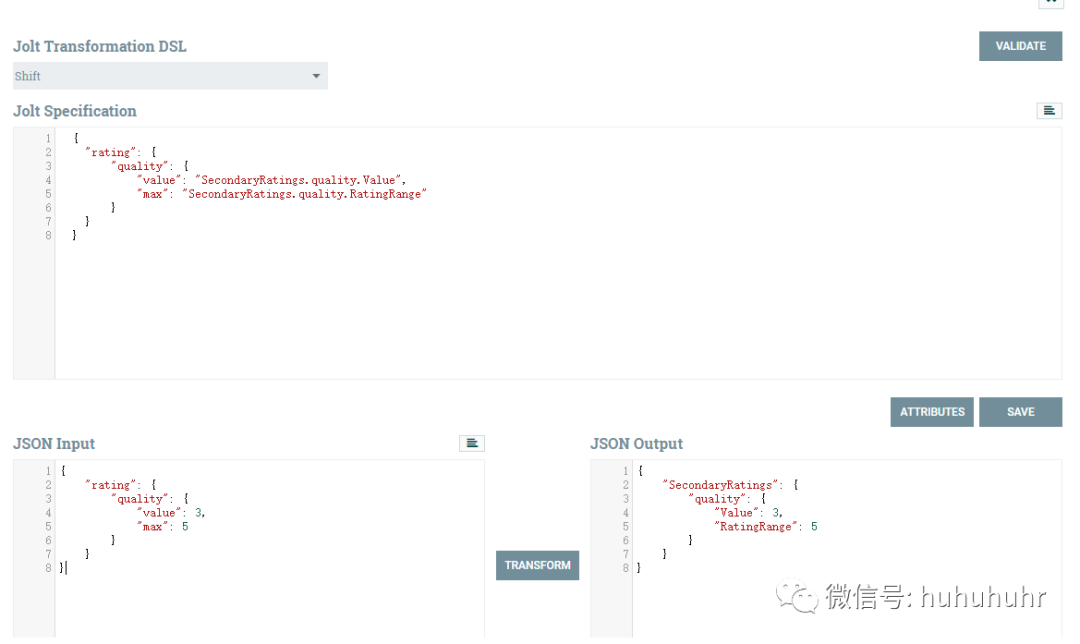
举例一:字段映射
input json
{"rating":{"quality":{"value":3,"max":5}}}
Jolt Specification
{"rating":{"quality":{"value":"SecondaryRatings.quality.Value","max":"SecondaryRatings.quality.RatingRange"}}}
把原来数据结构中3写到新数据结构,新结构点记坐标"SecondaryRatings.quality.Value"
// copy 5 to "SecondaryRatings.quality.RatingRange"
output json
{"SecondaryRatings":{"quality":{"Value":3,"RatingRange":5}}}
今天这个学习给我打开了nifi使用的一扇新的大门
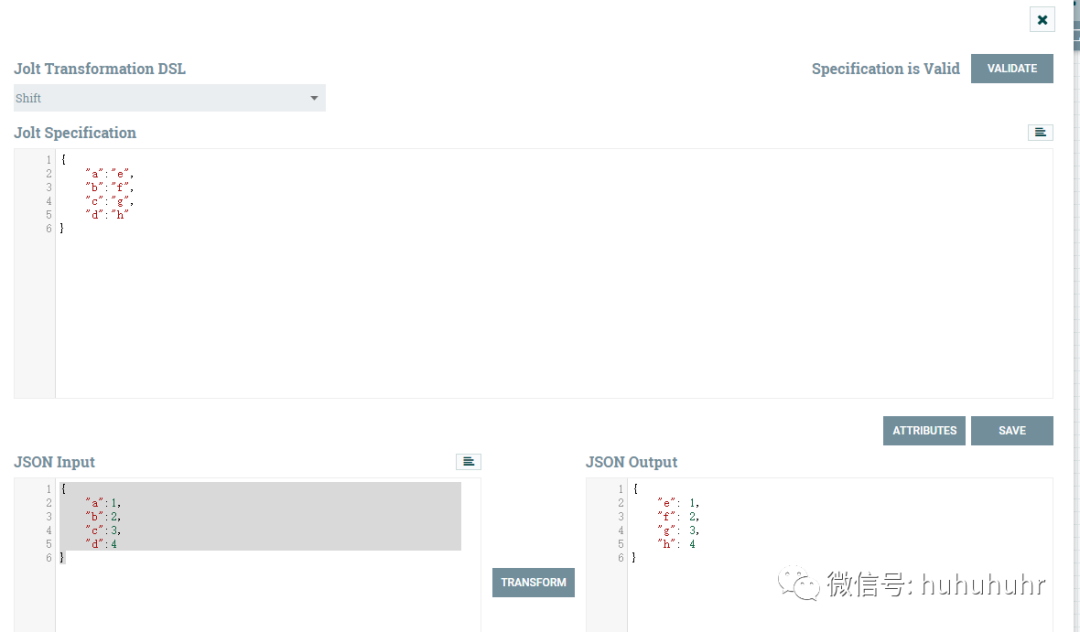
假如原表字段a,b,c,d映射到目标表e,f,g,h原有项目我可能在sql那边去处理,但是如果下游一些数据的字段要换一换怎么办?
写一个Jolt Specification这个映射轻松达到我的字段映射目的
{"a":"e","b":"f","c":"g","d":"h"}
shift的厉害之处,难道只局限在字段映射或者定向修改数据,当然不是,shift最厉害在于其通配符。
举例二:字段映射
input json
{"rating": {"primary": {"value": 3,"max": 5},"quality": {"value": 3,"max": 5},"sharpness": {"value": 7,"max": 10}}}
Jolt Specification
{"rating": {"primary": {"value": "Rating","max": "RatingRange"},"*": {"value": "SecondaryRatings.&1.Value","max": "SecondaryRatings.&1.Range","$": "SecondaryRatings.&1.Id"}}}
output json
{"Rating": 3,"RatingRange": 5,"SecondaryRatings": {"quality": {"Id": "quality","Value": 3,"Range": 5},"sharpness": {"Id": "sharpness","Value": 7,"Range": 10}}}
分析Jolt Specification
{"rating": {"primary": {原来json数据的rating.primay.value=Ratingoutput -> "Rating" : 3"value": "Rating","max": "RatingRange"//原来json数据的rating.primay.max=RatingRange},"*": {// match input data like "rating.[anything-other-than-primary]""value": "SecondaryRatings.&1.Value",// the data at "rating.*.value" goes to "SecondaryRatings.*.Value""max": "SecondaryRatings.&1.Range",// the data at "rating.*.max" goes to "SecondaryRatings.*.Range""$": "SecondaryRatings.&1.Id"// Special operator $ means, use the value of the input key itself as the data}}}
| 通配符 | 含义 |
| * | 同层级key模糊匹配,除了已经明确能直接匹配到的结构key。 例如:上面的json数据结构中,与primary同层级有quality和sharpness,因为Jolt Specification已经出现了primary,则*可模糊匹配该层级除了primary的其他key |
| $ | use the value of the input key itself as the data 使用输入key本身的值作为数据。 例如"$": "SecondaryRatings.&1.Id" 因为$上一层是*,代表quality,sharpness。 由于$代表输入key本身,所以Id只会是quality或者sharpness,新json数据结构由SecondaryRatings.&1.Id这个决定。 |
| @ | 和$类似,$作用原json的key,@作用原json的value |
| &/&1/&2 | &和&1效果一致 &1代表当前json层级的上一层级key &2代表当前json层级的上两层级key &n当向上没有层级表示,默认是root |
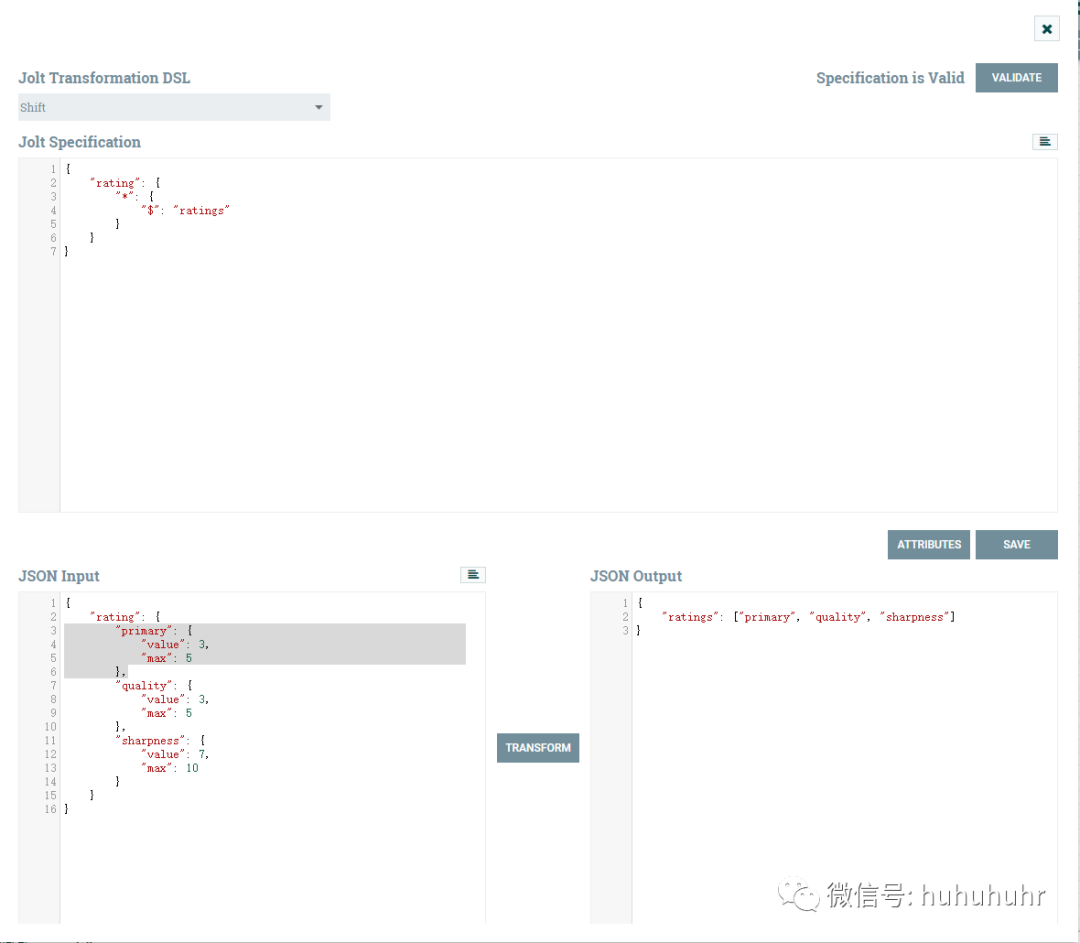
例三:a list of the input keys
input json
{"rating":{"primary":{"value":3,"max":5},"quality":{"value":3,"max":5},"sharpness":{"value":7,"max":10}}}
Jolt Specification
{"rating":{"*":{"$":"ratings"}}}
output json
{"ratings": ["primary", "quality", "sharpness"]}
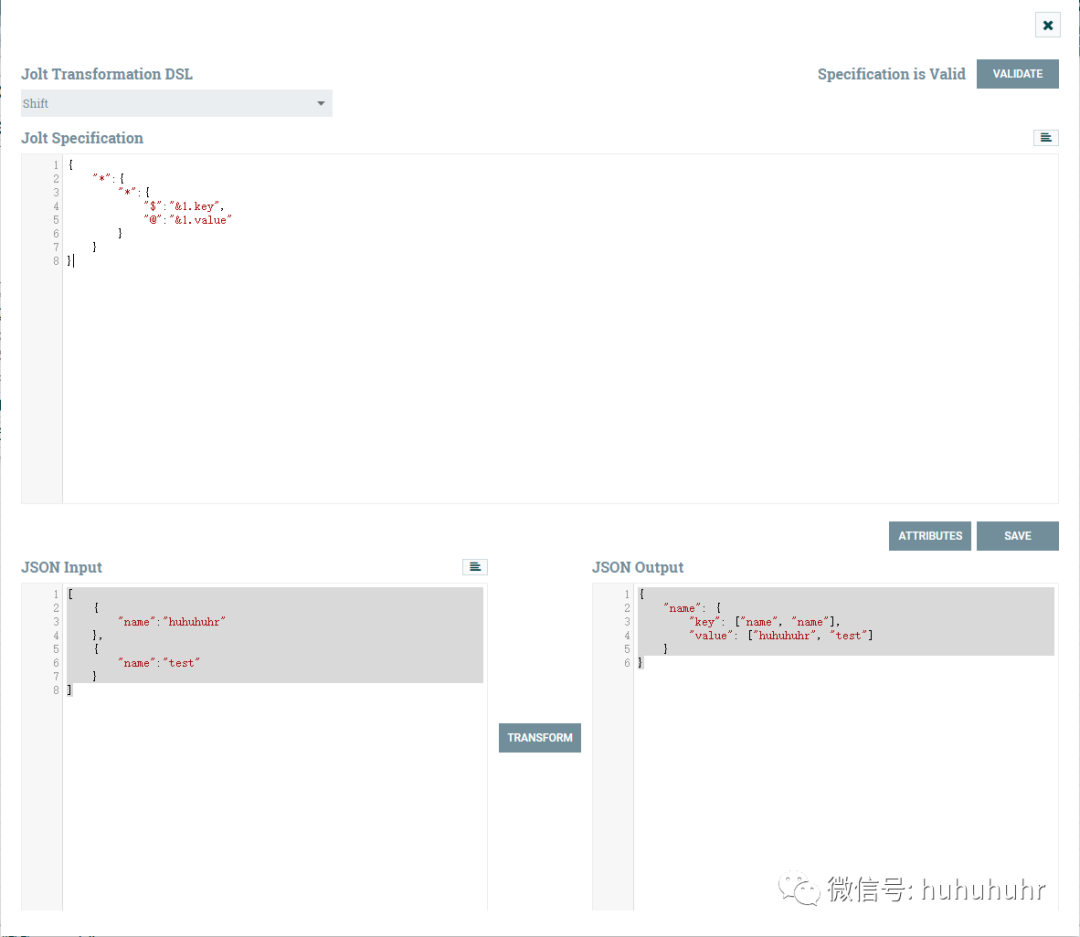
例四:put both the input value and the input key somewhere in the output JSON
input json
[{"name":"huhuhuhr"},{"name":"test"}]
Jolt Specification
{"*":{"*":{"$":"&1.key","@":"&1.value"}}}
output json
{"name": {"key": ["name", "name"],"value": ["huhuhuhr", "test"]}}
例五:put both the input value and the input key somewhere in the output JSON
input json
{"foo":"place.to.put.value"}
Jolt Specification
{"foo": {"$": "place.to.put.key","@": "place.to.put.value"}}
output json
{"place": {"to": {"put": {"key": "foo","value": "place.to.put.value"}}}}
例六:Handling Arrays in the input JSON
input json
{"Photos": ["AAA.jpg", "BBB.jpg"]}
Jolt Specification
{"Photos":{"0":"photo-&-url","1":"photo-&-url","2":"photo-&-url"}}
output json
{"photo-1-url":"BBB.jpg","photo-0-url":"AAA.jpg"}
例七:Handling Arrays in the output JSON
input json
{"photo-0-id": "1","photo-0-url": "http://bob.com/0001/327704/photo1.jpg","photo-1-id": "2","photo-1-url": "http://bob.com/0001/327704/photo2.jpg","photo-2-id": "3","photo-2-url": "http://bob.com/0001/327704/photo3.jpg"}
Jolt Specification
{"photo-*-id": "Photos[&(0,1)].Id","photo-*-url": "Photos[&(0,1)].Url"}
output json
{"Photos": [{"Id": "1","Url": "http://bob.com/0001/327704/photo1.jpg"}, {"Id": "2","Url": "http://bob.com/0001/327704/photo2.jpg"}, {"Id": "3","Url": "http://bob.com/0001/327704/photo3.jpg"}]}
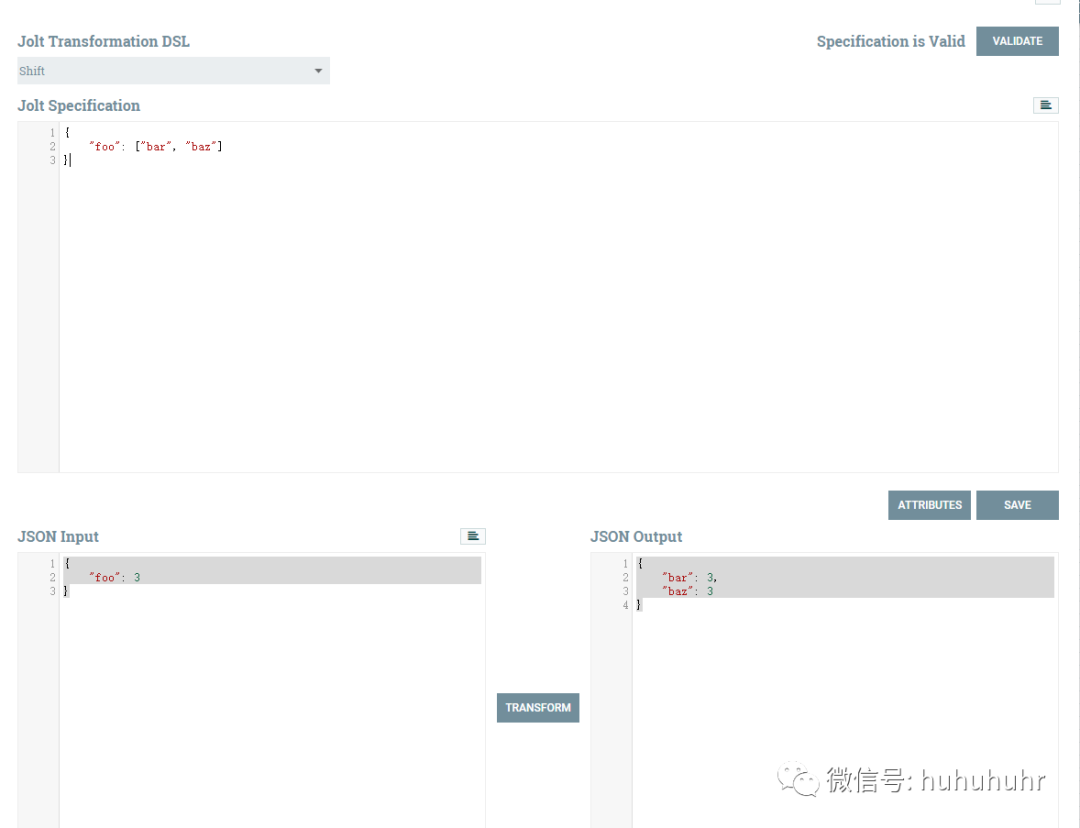
例八:JSON arrays in the spec file
input json
{"foo": 3}
Jolt Specification
{"foo": ["bar", "baz"]}
output json
{"bar": 3,"baz": 3}
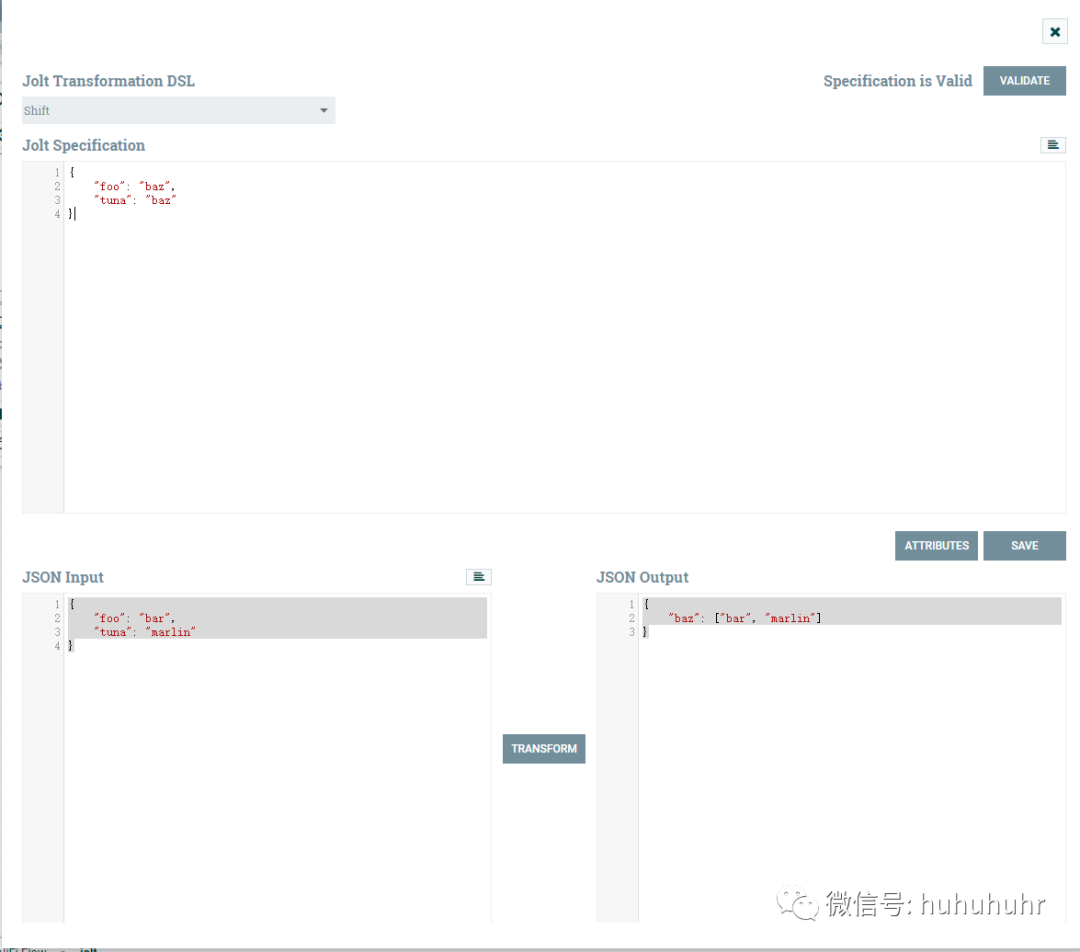
例九:Implicit Array creation in the output JSON
input json
{"foo": "bar","tuna": "marlin"}
Jolt Specification
{"foo": "baz","tuna": "baz"}
output json
{"baz": ["bar", "marlin"]}
例十:json生成array
input json
[{"id":"1","url":"http://bob.com/0001/327704/photo1.jpg"},{"id":"2","url":"http://bob.com/0001/327704/photo2.jpg"},{"id":"3","url":"http://bob.com/0001/327704/photo3.jpg"}]
Jolt Specification
{"*": {"id": "Photos.&","url": "Photos.&"}}
output json
{"Photos": {"id": ["1", "2", "3"],"url": ["http://bob.com/0001/327704/photo1.jpg","http://bob.com/0001/327704/photo2.jpg","http://bob.com/0001/327704/photo3.jpg"]}}
例十一:json映射
input json
[{"id":"1","url":"http://bob.com/0001/327704/photo1.jpg"},{"id":"2","url":"http://bob.com/0001/327704/photo2.jpg"},{"id":"3","url":"http://bob.com/0001/327704/photo3.jpg"}]
Jolt Specification
{"*": {"id": "Photos.&1.&","url": "Photos.&1.&"}}
output json
{"Photos": {"0": {"id": "1","url": "http://bob.com/0001/327704/photo1.jpg"},"1": {"id": "2","url": "http://bob.com/0001/327704/photo2.jpg"},"2": {"id": "3","url": "http://bob.com/0001/327704/photo3.jpg"}}}
