暂无图片
暂无图片
暂无图片
暂无图片
暂无图片

局部规划器-TebLocalPlannerROS

慢慢的回味 2021-10-18
2320

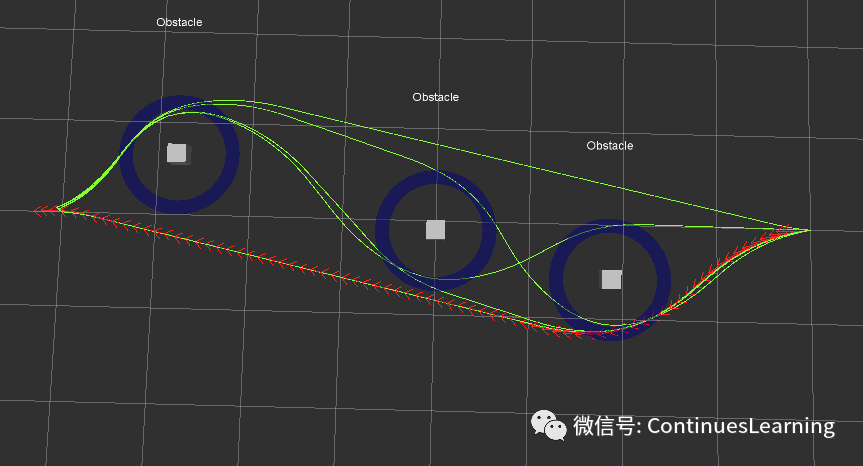
由于Teb算法能很好的支持阿克曼小车,即模型类似于汽车一样的机器人,这儿使用TebLocalPlannerROS进行局部规划。Teb局部规划器包(teb_local_planner)是作为一个局部规划器(base_local_planner)插件的形式融入2D导航栈的。它基于时间的弹性算法来优化局部轨迹,满足:轨迹的时间尽量短即速度和加速度尽量大;和障碍物能明显分离;以及必须满足机器人动力学约束。


Content:

  1. 局部规划器初始化

  2. 计算速度命令

  3. 规划逻辑

  4. 构建图并优化

  5. 计算速度


在Move Base初始化中通过参数指定base_local_planner为teb_local_planner/TebLocalPlannerROS


//默认的局部规划器为TrajectoryPlannerROS
private_nh.param("base_local_planner", local_planner, std::string("base_local_planner/TrajectoryPlannerROS"));
 
//create a local planner
try {
tc_ = blp_loader_.createInstance(local_planner);
ROS_INFO("Created local_planner %s", local_planner.c_str());
//初始化局部规划器
tc_->initialize(blp_loader_.getName(local_planner), &tf_, controller_costmap_ros_);
} catch (const pluginlib::PluginlibException& ex) {
ROS_FATAL("Failed to create the %s planner, are you sure it is properly registered and that the containing library is built? Exception: %s", local_planner.c_str(), ex.what());
exit(1);
}

Move Base中通过调用tc_->computeVelocityCommands(cmd_vel)完成速度命令计算。

局部规划器初始化

初始化局部规划器节点等。类TebLocalPlannerROS在代码文件teb_local_planner_ros.cpp中。

void TebLocalPlannerROS::initialize(std::string name, tf2_ros::Buffer* tf, costmap_2d::Costmap2DROS* costmap_ros)
{
// check if the plugin is already initialized
if(!initialized_)
{
// create Node Handle with name of plugin (as used in move_base for loading)
ros::NodeHandle nh("~/" + name);
 
// get parameters of TebConfig via the nodehandle and override the default config
//从节点参数中获取参数值覆盖默认值
cfg_.loadRosParamFromNodeHandle(nh);
 
// reserve some memory for obstacles
obstacles_.reserve(500);
 
// create visualization instance
visualization_ = TebVisualizationPtr(new TebVisualization(nh, cfg_));
//获取小车的参数,这些参数将用于模型优化,路径计算,比如阿克曼小车的最小转弯半径
// create robot footprint/contour model for optimization
RobotFootprintModelPtr robot_model = getRobotFootprintFromParamServer(nh);
//这儿我们解读TebOptimalPlanner分支,HomotopyClassPlanner可以同时计算出多条轨迹方案
// create the planner instance
if (cfg_.hcp.enable_homotopy_class_planning)
{
planner_ = PlannerInterfacePtr(new HomotopyClassPlanner(cfg_, &obstacles_, robot_model, visualization_, &via_points_));
ROS_INFO("Parallel planning in distinctive topologies enabled.");
}
else
{
planner_ = PlannerInterfacePtr(new TebOptimalPlanner(cfg_, &obstacles_, robot_model, visualization_, &via_points_));
ROS_INFO("Parallel planning in distinctive topologies disabled.");
}
 
// init other variables
//得到坐标转换对象和代价地图
tf_ = tf;
costmap_ros_ = costmap_ros;
costmap_ = costmap_ros_->getCostmap(); // locking should be done in MoveBase.
 
costmap_model_ = boost::make_shared<base_local_planner::CostmapModel>(*costmap_);
 
global_frame_ = costmap_ros_->getGlobalFrameID();
cfg_.map_frame = global_frame_; // TODO
robot_base_frame_ = costmap_ros_->getBaseFrameID();
 
//Initialize a costmap to polygon converter
if (!cfg_.obstacles.costmap_converter_plugin.empty())
{
try
{
costmap_converter_ = costmap_converter_loader_.createInstance(cfg_.obstacles.costmap_converter_plugin);
std::string converter_name = costmap_converter_loader_.getName(cfg_.obstacles.costmap_converter_plugin);
// replace '::' by '/' to convert the c++ namespace to a NodeHandle namespace
boost::replace_all(converter_name, "::", "/");
costmap_converter_->setOdomTopic(cfg_.odom_topic);
costmap_converter_->initialize(ros::NodeHandle(nh, "costmap_converter/" + converter_name));
costmap_converter_->setCostmap2D(costmap_);
 
costmap_converter_->startWorker(ros::Rate(cfg_.obstacles.costmap_converter_rate), costmap_, cfg_.obstacles.costmap_converter_spin_thread);
ROS_INFO_STREAM("Costmap conversion plugin " << cfg_.obstacles.costmap_converter_plugin << " loaded.");
}
catch(pluginlib::PluginlibException& ex)
{
ROS_WARN("The specified costmap converter plugin cannot be loaded. All occupied costmap cells are treaten as point obstacles. Error message: %s", ex.what());
costmap_converter_.reset();
}
}
else
ROS_INFO("No costmap conversion plugin specified. All occupied costmap cells are treaten as point obstacles.");
 
//根据小车自身形状,计算最小最大距离,小车是有大小的,距离必须减掉这个最小距离
// Get footprint of the robot and minimum and maximum distance from the center of the robot to its footprint vertices.
footprint_spec_ = costmap_ros_->getRobotFootprint();
costmap_2d::calculateMinAndMaxDistances(footprint_spec_, robot_inscribed_radius_, robot_circumscribed_radius);
 
// init the odom helper to receive the robot's velocity from odom messages
//初始化里程计,用来获取小车的速度
odom_helper_.setOdomTopic(cfg_.odom_topic);
 
//配置动态参数重配置,可以在小车运行的时候修改Teb参数值
// setup dynamic reconfigure
dynamic_recfg_ = boost::make_shared< dynamic_reconfigure::Server<TebLocalPlannerReconfigureConfig> >(nh);
dynamic_reconfigure::Server<TebLocalPlannerReconfigureConfig>::CallbackType cb = boost::bind(&TebLocalPlannerROS::reconfigureCB, this, _1, _2);
dynamic_recfg_->setCallback(cb);
 
// validate optimization footprint and costmap footprint
validateFootprints(robot_model->getInscribedRadius(), robot_inscribed_radius_, cfg_.obstacles.min_obstacle_dist);
 
// setup callback for custom obstacles
custom_obst_sub_ = nh.subscribe("obstacles", 1, &TebLocalPlannerROS::customObstacleCB, this);
 
// setup callback for custom via-points
via_points_sub_ = nh.subscribe("via_points", 1, &TebLocalPlannerROS::customViaPointsCB, this);
 
// initialize failure detector
ros::NodeHandle nh_move_base("~");
double controller_frequency = 5;
nh_move_base.param("controller_frequency", controller_frequency, controller_frequency);
failure_detector_.setBufferLength(std::round(cfg_.recovery.oscillation_filter_duration*controller_frequency));
 
// set initialized flag
initialized_ = true;
 
ROS_DEBUG("teb_local_planner plugin initialized.");
}
else
{
ROS_WARN("teb_local_planner has already been initialized, doing nothing.");
}
}
计算速度命令

实现base_local_planner的computeVelocityCommands方法,用于根据当前位姿和速度计算下一速度命令。pose和velocity分别为小车当前位姿和速度,不过这儿没用,而是直接从里程计里重新获取。cmd_vel为返回的速度命令。

uint32_t TebLocalPlannerROS::computeVelocityCommands(const geometry_msgs::PoseStamped& pose,
const geometry_msgs::TwistStamped& velocity,
geometry_msgs::TwistStamped &cmd_vel,
std::string &message)
{
// check if plugin initialized
if(!initialized_)
{
ROS_ERROR("teb_local_planner has not been initialized, please call initialize() before using this planner");
message = "teb_local_planner has not been initialized";
return mbf_msgs::ExePathResult::NOT_INITIALIZED;
}
 
//初始化返回的速度命令
static uint32_t seq = 0;
cmd_vel.header.seq = seq++;
cmd_vel.header.stamp = ros::Time::now();
cmd_vel.header.frame_id = robot_base_frame_;
cmd_vel.twist.linear.x = cmd_vel.twist.linear.y = cmd_vel.twist.angular.z = 0;
goal_reached_ = false;
 
// Get robot pose 获取小车位置
geometry_msgs::PoseStamped robot_pose;
costmap_ros_->getRobotPose(robot_pose);
robot_pose_ = PoseSE2(robot_pose.pose);
 
// Get robot velocity 从里程计中获取小车当前速度
geometry_msgs::PoseStamped robot_vel_tf;
odom_helper_.getRobotVel(robot_vel_tf);
robot_vel_.linear.x = robot_vel_tf.pose.position.x;
robot_vel_.linear.y = robot_vel_tf.pose.position.y;
robot_vel_.angular.z = tf2::getYaw(robot_vel_tf.pose.orientation);
//修剪plan,去掉已经行驶过的路径
// prune global plan to cut off parts of the past (spatially before the robot)
pruneGlobalPlan(*tf_, robot_pose, global_plan_, cfg_.trajectory.global_plan_prune_distance);
 
//从全局规划中获取在当前位姿的局部转换全局规划transformed_plan(离当前位姿小于某个距离的邻接点)。
//下面局部规划器将在transformed_plan的限制下进行局部轨迹规划。即从全局的粗规划得到当前的局部细规划。
// Transform global plan to the frame of interest (w.r.t. the local costmap)
std::vector<geometry_msgs::PoseStamped> transformed_plan;
int goal_idx;
geometry_msgs::TransformStamped tf_plan_to_global;
if (!transformGlobalPlan(*tf_, global_plan_, robot_pose, *costmap_, global_frame_, cfg_.trajectory.max_global_plan_lookahead_dist,
transformed_plan, &goal_idx, &tf_plan_to_global))
{
ROS_WARN("Could not transform the global plan to the frame of the controller");
message = "Could not transform the global plan to the frame of the controller";
return mbf_msgs::ExePathResult::INTERNAL_ERROR;
}
 
//把当前transformed_plan经过的点添加进via_points_
// update via-points container
if (!custom_via_points_active_)
updateViaPointsContainer(transformed_plan, cfg_.trajectory.global_plan_viapoint_sep);
 
// check if global goal is reached
//通过计算当前机器人位姿robot_pose_和全局目标global_goal的欧几里得距离,检查是否到目的点,包括位置(小于xy_goal_tolerance)和方向(小于yaw_goal_tolerance)。
//如果距离小于容错距离并且容错配置不用完成全局规划(!cfg_.goal_tolerance.complete_global_plan)或者当前经过点为空(via_points_.size() == 0),则认为目标到达,退出局部规划器。
geometry_msgs::PoseStamped global_goal;
tf2::doTransform(global_plan_.back(), global_goal, tf_plan_to_global);
double dx = global_goal.pose.position.x - robot_pose_.x();
double dy = global_goal.pose.position.y - robot_pose_.y();
double delta_orient = g2o::normalize_theta( tf2::getYaw(global_goal.pose.orientation) - robot_pose_.theta() );
if(fabs(std::sqrt(dx*dx+dy*dy)) < cfg_.goal_tolerance.xy_goal_tolerance
&& fabs(delta_orient) < cfg_.goal_tolerance.yaw_goal_tolerance
&& (!cfg_.goal_tolerance.complete_global_plan || via_points_.size() == 0))
{
goal_reached_ = true;
return mbf_msgs::ExePathResult::SUCCESS;
}
 
 
// check if we should enter any backup mode and apply settings
configureBackupModes(transformed_plan, goal_idx);
 
//如果transformed_plan为空,则不能做局部规划,退出局部规划器。
// Return false if the transformed global plan is empty
if (transformed_plan.empty())
{
ROS_WARN("Transformed plan is empty. Cannot determine a local plan.");
message = "Transformed plan is empty";
return mbf_msgs::ExePathResult::INVALID_PATH;
}
 
//获取当前局部规划器的机器人目标点
// Get current goal point (last point of the transformed plan)
robot_goal_.x() = transformed_plan.back().pose.position.x;
robot_goal_.y() = transformed_plan.back().pose.position.y;
// Overwrite goal orientation if needed
if (cfg_.trajectory.global_plan_overwrite_orientation)
{
robot_goal_.theta() = estimateLocalGoalOrientation(global_plan_, transformed_plan.back(), goal_idx, tf_plan_to_global);
// overwrite/update goal orientation of the transformed plan with the actual goal (enable using the plan as initialization)
tf2::Quaternion q;
q.setRPY(0, 0, robot_goal_.theta());
tf2::convert(q, transformed_plan.back().pose.orientation);
}
else
{
robot_goal_.theta() = tf2::getYaw(transformed_plan.back().pose.orientation);
}
 
// overwrite/update start of the transformed plan with the actual robot position (allows using the plan as initial trajectory)
if (transformed_plan.size()==1) // plan only contains the goal
{
transformed_plan.insert(transformed_plan.begin(), geometry_msgs::PoseStamped()); // insert start (not yet initialized)
}
transformed_plan.front() = robot_pose; // update start
 
//清空当前的障碍数组obstacles_以待更新
// clear currently existing obstacles
obstacles_.clear();
 
//从代价地图中添加障碍物到obstacles_中
// Update obstacle container with costmap information or polygons provided by a costmap_converter plugin
if (costmap_converter_)
updateObstacleContainerWithCostmapConverter();
else
updateObstacleContainerWithCostmap();
 
//如果有自定义障碍,也添加到obstacles_中
// also consider custom obstacles (must be called after other updates, since the container is not cleared)
updateObstacleContainerWithCustomObstacles();
 
 
// Do not allow config changes during the following optimization step
boost::mutex::scoped_lock cfg_lock(cfg_.configMutex());
 
// Now perform the actual planning
// 调用TebOptimalPlanner::plan方法进行局部规划,下节具体讲解这个方法。
// bool success = planner_->plan(robot_pose_, robot_goal_, robot_vel_, cfg_.goal_tolerance.free_goal_vel); // straight line init
bool success = planner_->plan(transformed_plan, &robot_vel_, cfg_.goal_tolerance.free_goal_vel);
if (!success)
{
planner_->clearPlanner(); // force reinitialization for next time
ROS_WARN("teb_local_planner was not able to obtain a local plan for the current setting.");
 
++no_infeasible_plans_; // increase number of infeasible solutions in a row
time_last_infeasible_plan_ = ros::Time::now();
last_cmd_ = cmd_vel.twist;
message = "teb_local_planner was not able to obtain a local plan";
return mbf_msgs::ExePathResult::NO_VALID_CMD;
}
 
//更新机器人的内半径robot_inscribed_radius_和机器人的外半径robot_circumscribed_radius
// Check feasibility (but within the first few states only)
if(cfg_.robot.is_footprint_dynamic)
{
// Update footprint of the robot and minimum and maximum distance from the center of the robot to its footprint vertices.
footprint_spec_ = costmap_ros_->getRobotFootprint();
costmap_2d::calculateMinAndMaxDistances(footprint_spec_, robot_inscribed_radius_, robot_circumscribed_radius);
}
 
//检查轨迹是否可行,比如拐弯必须满足机器人的内半径和外半径不能碰到障碍物,不能出地图。
bool feasible = planner_->isTrajectoryFeasible(costmap_model_.get(), footprint_spec_, robot_inscribed_radius_, robot_circumscribed_radius, cfg_.trajectory.feasibility_check_no_poses);
if (!feasible)
{
cmd_vel.twist.linear.x = cmd_vel.twist.linear.y = cmd_vel.twist.angular.z = 0;
 
// now we reset everything to start again with the initialization of new trajectories.
planner_->clearPlanner();
ROS_WARN("TebLocalPlannerROS: trajectory is not feasible. Resetting planner...");
 
++no_infeasible_plans_; // increase number of infeasible solutions in a row
time_last_infeasible_plan_ = ros::Time::now();
last_cmd_ = cmd_vel.twist;
message = "teb_local_planner trajectory is not feasible";
return mbf_msgs::ExePathResult::NO_VALID_CMD;
}
 
// Get the velocity command for this sampling interval
//通过规划的轨迹,获取速度命令,包括x,y,z分量和方向,下节具体讲解这个方法。
if (!planner_->getVelocityCommand(cmd_vel.twist.linear.x, cmd_vel.twist.linear.y, cmd_vel.twist.angular.z, cfg_.trajectory.control_look_ahead_poses))
{
planner_->clearPlanner();
ROS_WARN("TebLocalPlannerROS: velocity command invalid. Resetting planner...");
++no_infeasible_plans_; // increase number of infeasible solutions in a row
time_last_infeasible_plan_ = ros::Time::now();
last_cmd_ = cmd_vel.twist;
message = "teb_local_planner velocity command invalid";
return mbf_msgs::ExePathResult::NO_VALID_CMD;
}
//使速度变得更加平滑
// Saturate velocity, if the optimization results violates the constraints (could be possible due to soft constraints).
saturateVelocity(cmd_vel.twist.linear.x, cmd_vel.twist.linear.y, cmd_vel.twist.angular.z,
cfg_.robot.max_vel_x, cfg_.robot.max_vel_y, cfg_.robot.max_vel_theta, cfg_.robot.max_vel_x_backwards);
 
// convert rot-vel to steering angle if desired (carlike robot).
// The min_turning_radius is allowed to be slighly smaller since it is a soft-constraint
// and opposed to the other constraints not affected by penalty_epsilon. The user might add a safety margin to the parameter itself.
if (cfg_.robot.cmd_angle_instead_rotvel)
{
cmd_vel.twist.angular.z = convertTransRotVelToSteeringAngle(cmd_vel.twist.linear.x, cmd_vel.twist.angular.z,
cfg_.robot.wheelbase, 0.95*cfg_.robot.min_turning_radius);
if (!std::isfinite(cmd_vel.twist.angular.z))
{
cmd_vel.twist.linear.x = cmd_vel.twist.linear.y = cmd_vel.twist.angular.z = 0;
last_cmd_ = cmd_vel.twist;
planner_->clearPlanner();
ROS_WARN("TebLocalPlannerROS: Resulting steering angle is not finite. Resetting planner...");
++no_infeasible_plans_; // increase number of infeasible solutions in a row
time_last_infeasible_plan_ = ros::Time::now();
message = "teb_local_planner steering angle is not finite";
return mbf_msgs::ExePathResult::NO_VALID_CMD;
}
}
 
// a feasible solution should be found, reset counter
no_infeasible_plans_ = 0;
 
// store last command (for recovery analysis etc.)
last_cmd_ = cmd_vel.twist;
 
// Now visualize everything
planner_->visualize();
visualization_->publishObstacles(obstacles_);
visualization_->publishViaPoints(via_points_);
visualization_->publishGlobalPlan(global_plan_);
return mbf_msgs::ExePathResult::SUCCESS;
}
规划逻辑

initial_plan为全局Plan中局部部分,start_vel为开始速度,free_goal_vel表示是否允许目标点速度不为0,只要initial_plan的Goal不是全局的Goal,自然允许free_goal_vel为true。

bool TebOptimalPlanner::plan(const std::vector<geometry_msgs::PoseStamped>& initial_plan, const geometry_msgs::Twist* start_vel, bool free_goal_vel)
{
ROS_ASSERT_MSG(initialized_, "Call initialize() first.");
if (!teb_.isInit())
{
//初始化轨迹,在起点到目标点之间抽样出规定的位置点和时间差值。
teb_.initTrajectoryToGoal(initial_plan, cfg_->robot.max_vel_x, cfg_->robot.max_vel_theta, cfg_->trajectory.global_plan_overwrite_orientation,
cfg_->trajectory.min_samples, cfg_->trajectory.allow_init_with_backwards_motion);
}
else // warm start
{
PoseSE2 start_(initial_plan.front().pose);
PoseSE2 goal_(initial_plan.back().pose);
if (teb_.sizePoses()>0
&& (goal_.position() - teb_.BackPose().position()).norm() < cfg_->trajectory.force_reinit_new_goal_dist
&& fabs(g2o::normalize_theta(goal_.theta() - teb_.BackPose().theta())) < cfg_->trajectory.force_reinit_new_goal_angular) // actual warm start!
teb_.updateAndPruneTEB(start_, goal_, cfg_->trajectory.min_samples); // update TEB
else // goal too far away -> reinit
{
ROS_DEBUG("New goal: distance to existing goal is higher than the specified threshold. Reinitalizing trajectories.");
teb_.clearTimedElasticBand();
teb_.initTrajectoryToGoal(initial_plan, cfg_->robot.max_vel_x, cfg_->robot.max_vel_theta, cfg_->trajectory.global_plan_overwrite_orientation,
cfg_->trajectory.min_samples, cfg_->trajectory.allow_init_with_backwards_motion);
}
}
if (start_vel)
setVelocityStart(*start_vel);
if (free_goal_vel)
setVelocityGoalFree();
else
vel_goal_.first = true; // we just reactivate and use the previously set velocity (should be zero if nothing was modified)
//通过构建一个由顶点和边构成的图,然后用G2O优化得到最优的轨迹。
// now optimize
return optimizeTEB(cfg_->optim.no_inner_iterations, cfg_->optim.no_outer_iterations);
}
bool TebOptimalPlanner::optimizeTEB(int iterations_innerloop, int iterations_outerloop, bool compute_cost_afterwards,
double obst_cost_scale, double viapoint_cost_scale, bool alternative_time_cost)
{
if (cfg_->optim.optimization_activate==false)
return false;
 
bool success = false;
optimized_ = false;
 
double weight_multiplier = 1.0;
 
// TODO(roesmann): we introduced the non-fast mode with the support of dynamic obstacles
// (which leads to better results in terms of x-y-t homotopy planning).
// however, we have not tested this mode intensively yet, so we keep
// the legacy fast mode as default until we finish our tests.
bool fast_mode = !cfg_->obstacles.include_dynamic_obstacles;
 
for(int i=0; i<iterations_outerloop; ++i)
{
if (cfg_->trajectory.teb_autosize)
{
//teb_.autoResize(cfg_->trajectory.dt_ref, cfg_->trajectory.dt_hysteresis, cfg_->trajectory.min_samples, cfg_->trajectory.max_samples);
teb_.autoResize(cfg_->trajectory.dt_ref, cfg_->trajectory.dt_hysteresis, cfg_->trajectory.min_samples, cfg_->trajectory.max_samples, fast_mode);
 
}
//生成G2O图
success = buildGraph(weight_multiplier);
if (!success)
{
clearGraph();
return false;
}
//优化G2O图
success = optimizeGraph(iterations_innerloop, false);
if (!success)
{
clearGraph();
return false;
}
optimized_ = true;
 
if (compute_cost_afterwards && i==iterations_outerloop-1) // compute cost vec only in the last iteration
computeCurrentCost(obst_cost_scale, viapoint_cost_scale, alternative_time_cost);
 
clearGraph();
 
weight_multiplier *= cfg_->optim.weight_adapt_factor;
}
 
return true;
}
构建图并优化

使用g2o构建一个图并优化:

bool TebOptimalPlanner::buildGraph(double weight_multiplier)
{
if (!optimizer_->edges().empty() || !optimizer_->vertices().empty())
{
ROS_WARN("Cannot build graph, because it is not empty. Call graphClear()!");
return false;
}
//添加顶点,待优化的对象
// add TEB vertices
AddTEBVertices();
//下面的都是边,方程的约束项,每个边都有computeError()方法来计算error,图优化的目的就是尽可能的使总体error最小 。
// add Edges (local cost functions)
if (cfg_->obstacles.legacy_obstacle_association)
AddEdgesObstaclesLegacy(weight_multiplier);
else
//添加一个EdgeObstacle边,其计算error的方法如下:
// void computeError()
// {
// const VertexPose* bandpt = static_cast<const VertexPose*>(_vertices[0]);
// double dist = robot_model_->calculateDistance(bandpt->pose(), _measurement);
// _error[0] = penaltyBoundFromBelow(dist, cfg_->obstacles.min_obstacle_dist, cfg_->optim.penalty_epsilon);
//_measurement为obstacle的位置,通过计算出机器人将要路过的点和障碍物的距离dist,判断其是否大于规定的最小距离(min_obstacle_dist+penalty_epsilon),
//是就返回0为错误,否则返回一个大于0的数表示错误。
AddEdgesObstacles(weight_multiplier);
 
if (cfg_->obstacles.include_dynamic_obstacles)
AddEdgesDynamicObstacles();
 
//添加轨迹需要途经点的约束EdgeViaPoint,其计算error的方法如下:
// void computeError()
// {
// const VertexPose* bandpt = static_cast<const VertexPose*>(_vertices[0]);
// _error[0] = (bandpt->position() - *_measurement).norm();
//error通过计算轨迹点和经过点的距离来表示,因为是途经点,所以这儿要求其必须距离越小越好。
AddEdgesViaPoints();
 
//添加速度约束EdgeVelocity,其计算error的方法如下:
// void computeError()
// {
// const VertexPose* conf1 = static_cast<const VertexPose*>(_vertices[0]);
// const VertexPose* conf2 = static_cast<const VertexPose*>(_vertices[1]);
// const VertexTimeDiff* deltaT = static_cast<const VertexTimeDiff*>(_vertices[2]);
// const Eigen::Vector2d deltaS = conf2->estimate().position() - conf1->estimate().position();
// double dist = deltaS.norm();
// const double angle_diff = g2o::normalize_theta(conf2->theta() - conf1->theta());
// if (cfg_->trajectory.exact_arc_length && angle_diff != 0)
// {
// double radius = dist/(2*sin(angle_diff/2));
// dist = fabs( angle_diff * radius ); // actual arg length!
// }
// double vel = dist / deltaT->estimate();
// vel *= fast_sigmoid( 100 * (deltaS.x()*cos(conf1->theta()) + deltaS.y()*sin(conf1->theta())) ); // consider direction
// const double omega = angle_diff / deltaT->estimate();
// _error[0] = penaltyBoundToInterval(vel, -cfg_->robot.max_vel_x_backwards, cfg_->robot.max_vel_x,cfg_->optim.penalty_epsilon);
// _error[1] = penaltyBoundToInterval(omega, cfg_->robot.max_vel_theta,cfg_->optim.penalty_epsilon);
//_error[0]表示速度vel必须在最小(-cfg_->robot.max_vel_x_backwards)和最大(cfg_->robot.max_vel_x)之间。
//_error[1]表示角度变化omega必须在最小(-cfg_->robot.max_vel_theta)和最大(cfg_->robot.max_vel_theta)之间。
AddEdgesVelocity();
 
//同速度约束差不多,添加加速度约束EdgeAcceleration,线加速度和角加速度必须在区间之内。
AddEdgesAcceleration();
 
//添加时间约束EdgeTimeOptimal,到下一点的时间越小越好。
AddEdgesTimeOptimal();
 
//添加当前点到下一点的路径约束EdgeShortestPath,距离越小越好。
AddEdgesShortestPath();
 
if (cfg_->robot.min_turning_radius == 0 || cfg_->optim.weight_kinematics_turning_radius == 0)
AddEdgesKinematicsDiffDrive(); // we have a differential drive robot
else
//如果是汽车类型的机器人,还得添加最小转弯半径约束EdgeKinematicsCarlike:
// void computeError()
// {
// const VertexPose* conf1 = static_cast<const VertexPose*>(_vertices[0]);
// const VertexPose* conf2 = static_cast<const VertexPose*>(_vertices[1]);
// Eigen::Vector2d deltaS = conf2->position() - conf1->position();
// _error[0] = fabs( ( cos(conf1->theta())+cos(conf2->theta()) ) * deltaS[1] - ( sin(conf1->theta())+sin(conf2->theta()) ) * deltaS[0] );
// // limit minimum turning radius
// double angle_diff = g2o::normalize_theta( conf2->theta() - conf1->theta() );
// if (angle_diff == 0)
// _error[1] = 0; // straight line motion
// else if (cfg_->trajectory.exact_arc_length) // use exact computation of the radius
// _error[1] = penaltyBoundFromBelow(fabs(deltaS.norm()/(2*sin(angle_diff/2))), cfg_->robot.min_turning_radius, 0.0);
// else
// _error[1] = penaltyBoundFromBelow(deltaS.norm() / fabs(angle_diff), cfg_->robot.min_turning_radius, 0.0);
//_error[0]表示角度越大错误越小,_error[1]表示如果超过最小转弯半径越多错误越大,即这两个错误约束角度变化最大为最小转弯半径为最优。
AddEdgesKinematicsCarlike(); // we have a carlike robot since the turning radius is bounded from below.
 
AddEdgesPreferRotDir();
 
if (cfg_->optim.weight_velocity_obstacle_ratio > 0)
AddEdgesVelocityObstacleRatio();
 
return true;
}
 
//调用G2O优化器进行优化图
bool TebOptimalPlanner::optimizeGraph(int no_iterations,bool clear_after)
{
if (cfg_->robot.max_vel_x<0.01)
{
ROS_WARN("optimizeGraph(): Robot Max Velocity is smaller than 0.01m/s. Optimizing aborted...");
if (clear_after) clearGraph();
return false;
}
 
if (!teb_.isInit() || teb_.sizePoses() < cfg_->trajectory.min_samples)
{
ROS_WARN("optimizeGraph(): TEB is empty or has too less elements. Skipping optimization.");
if (clear_after) clearGraph();
return false;
}
 
optimizer_->setVerbose(cfg_->optim.optimization_verbose);
optimizer_->initializeOptimization();
 
int iter = optimizer_->optimize(no_iterations);
 
// Save Hessian for visualization
// g2o::OptimizationAlgorithmLevenberg* lm = dynamic_cast<g2o::OptimizationAlgorithmLevenberg*> (optimizer_->solver());
// lm->solver()->saveHessian("~/MasterThesis/Matlab/Hessian.txt");
 
if(!iter)
{
ROS_ERROR("optimizeGraph(): Optimization failed! iter=%i", iter);
return false;
}
 
if (clear_after) clearGraph();
 
return true;
}
计算速度

通过调用getVelocityCommand,从优化后的位置中选择look_ahead_poses和当前位置计算deltaS和deltaT,最后得到vx, vy和方向omega。

void TebOptimalPlanner::extractVelocity(const PoseSE2& pose1, const PoseSE2& pose2, double dt, double& vx, double& vy, double& omega) const
{
if (dt == 0)
{
vx = 0;
vy = 0;
omega = 0;
return;
}
 
Eigen::Vector2d deltaS = pose2.position() - pose1.position();
 
if (cfg_->robot.max_vel_y == 0) // nonholonomic robot
{
Eigen::Vector2d conf1dir( cos(pose1.theta()), sin(pose1.theta()) );
// translational velocity
double dir = deltaS.dot(conf1dir);
vx = (double) g2o::sign(dir) * deltaS.norm()/dt;
vy = 0;
}
else // holonomic robot
{
// transform pose 2 into the current robot frame (pose1)
// for velocities only the rotation of the direction vector is necessary.
// (map->pose1-frame: inverse 2d rotation matrix)
double cos_theta1 = std::cos(pose1.theta());
double sin_theta1 = std::sin(pose1.theta());
double p1_dx = cos_theta1*deltaS.x() + sin_theta1*deltaS.y();
double p1_dy = -sin_theta1*deltaS.x() + cos_theta1*deltaS.y();
vx = p1_dx / dt;
vy = p1_dy / dt;
}
 
// rotational velocity
double orientdiff = g2o::normalize_theta(pose2.theta() - pose1.theta());
omega = orientdiff/dt;
}
 
bool TebOptimalPlanner::getVelocityCommand(double& vx, double& vy, double& omega, int look_ahead_poses) const
{
if (teb_.sizePoses()<2)
{
ROS_ERROR("TebOptimalPlanner::getVelocityCommand(): The trajectory contains less than 2 poses. Make sure to init and optimize/plan the trajectory fist.");
vx = 0;
vy = 0;
omega = 0;
return false;
}
look_ahead_poses = std::max(1, std::min(look_ahead_poses, teb_.sizePoses() - 1));
double dt = 0.0;
for(int counter = 0; counter < look_ahead_poses; ++counter)
{
dt += teb_.TimeDiff(counter);
if(dt >= cfg_->trajectory.dt_ref * look_ahead_poses) // TODO: change to look-ahead time? Refine trajectory?
{
look_ahead_poses = counter + 1;
break;
}
}
if (dt<=0)
{
ROS_ERROR("TebOptimalPlanner::getVelocityCommand() - timediff<=0 is invalid!");
vx = 0;
vy = 0;
omega = 0;
return false;
}
 
// Get velocity from the first two configurations
extractVelocity(teb_.Pose(0), teb_.Pose(look_ahead_poses), dt, vx, vy, omega);
return true;
}


文章转载自慢慢的回味,如果涉嫌侵权,请发送邮件至:contact@modb.pro进行举报,并提供相关证据,一经查实,墨天轮将立刻删除相关内容。

评论