



PostgreSQL可通过pg_ctl start -D pgdata启动节点,我们看一下主节点启动流程。为了便于调试,我们以postgres -D pgdata命令启动数据库并进行调试分析。
启动主流程
我们分析一下启动的时候,需要做那些工作,数据库启动时,需要先判断版本是否兼容,pg_control文件是否存在,也就是说要判断一些启动的必要条件是否满足。然后启动日志,startup等进程。 在接受客户端连接之前,需要先启动startup进程,进行故障恢复,这是因为系统关闭的时候,不一定是正常关闭的,可能是因为故障而退出,退出的时候,内存中的脏页不一定被刷入磁盘中,这时候就需要启动startup进程,对WAL日志进行回放,回放完后,再进入ServerLoop,接受客户端的连接并处理SQL请求。
// main.c  postgres进程主入口
main()
--> MemoryContextInit()          // 初始化内存上下文: TopMemoryContext、ErrorContext
--> PostmasterMain(argc, argv);  // Postmaster main entry point
    --> pqsignal_pm(SIGCHLD, reaper);	/* handle child termination */ // 注册信号处理函数
    --> checkDataDir();          // 检查数据目录
        --> ValidatePgVersion(DataDir); // 检查PG_VERSION文件,PG实例版本是否与程序兼容
    --> checkControlFile();             // 检查pg_control文件
    --> CreateDataDirLockFile(true);    // 创建postmaster.pid文件
    --> LocalProcessControlFile(false); // 读pg_control,到ControlFileData中
        --> ReadControlFile();
    --> process_shared_preload_libraries();    // 加载插件
        --> load_libraries(shared_preload_libraries_string, "shared_preload_libraries", false);
            --> load_file(filename, restricted);
                --> internal_load_library(fullname);
    --> SysLogger_Start();  // 启动日志进程 logger
    --> RemovePgTempFiles();
    --> pgstat_init();
    --> autovac_init();
    --> load_hba()
    --> StartupDataBase();    // 启动startup进程 StartChildProcess
        --> AuxiliaryProcessMain(ac, av);
            --> StartupProcessMain()
                --> StartupXLOG();
    --> maybe_start_bgworkers();
    --> ServerLoop();
        for(;;)
        {
            // #define PG_SETMASK(mask)	sigprocmask(SIG_SETMASK, mask, NULL)
            // UnBlockSig is the set of signals to block when we don't want to block signals.
            PG_SETMASK(&UnBlockSig);    // 设置/解除阻塞信号, 触发reaper,创建checkpointer, bgwriter,walwriter进程
            // 等待客户端连接
            selres = select(nSockets, &rmask, NULL, NULL, &timeout);

            ConnCreate(ListenSocket[i]);

            BackendStartup(port);
            --> canAcceptConnections(BACKEND_TYPE_NORMAL);
            --> BackendRun(port);
                --> PostgresMain(ac, av, port->database_name, port->user_name);
                    --> InitPostgres(dbname, InvalidOid, username, InvalidOid, NULL, false);
                    	  for (;;)
	                      {
                            ReadCommand(&input_message);
                            // SQL 解析,优化,执行
                            // exec_simple_query(query_string);
                        }
         }
startup进程
startup进程启动的几种情况:
- 数据库启动的时候,进行故障恢复
- 备机,不断的接收主节点的WAL日志并进行回放
- PITR,回放到指定时间点
可以说,启动阶段,非常重要的一个过程就是故障恢复,这是保障数据库正确性的一个非常关键的点。我们这里分析一下。
startup启动后,依据standby.signal和recovery.signal去判断进入何种状态,如果都不存在,则进行故障恢复,如果standby.signal存在,则表示当前为备机,如果recovery.signal文件存在,则代表当前数据库正在进行的是PITR操作,需根据recovery_target对日志进行回放。
下一个问题就是,从哪里进行回放?即:故障恢复的起点是最近的一次检查点,这个检查点保存在pg_control中,每次创建检查点时都会更新pg_control中的信息。 我们看下面的代码:
StartupProcessMain(void)
--> StartupXLOG();
    --> ValidateXLOGDirectoryStructure();   // 检查pg_wal是否存在
    -->	readRecoverySignalFile();           // 依据standby.signal和recovery.signal是否存在,判断进入何种状态
	  --> validateRecoveryParameters();
    if (read_backup_label(&checkPointLoc, &backupEndRequired, &backupFromStandby))
    {
        // 如果backup_label文件存在,则表示从备份文件中进行恢复(例如使用pg_basebackup进行备份)
        // 此种情况,设置backup_label,而不是用pg_control,为啥呢?下面就是解释
         /*
          * If we see a backup_label during recovery, we assume that we are recovering
          * from a backup dump file, and we therefore roll forward from the checkpoint
          * identified by the label file, NOT what pg_control says.  This avoids the
          * problem that pg_control might have been archived one or more checkpoints
          * later than the start of the dump, and so if we rely on it as the start
          * point, we will fail to restore a consistent database state.
          */
    }
    else
    {
        /* Get the last valid checkpoint record. */
        checkPointLoc = ControlFile->checkPoint;            // 从pg_control中获取检查点信息
        RedoStartLSN = ControlFile->checkPointCopy.redo;
        record = ReadCheckpointRecord(xlogreader, checkPointLoc, 1, true);
                 --> XLogBeginRead(xlogreader, RecPtr);     // Begin reading WAL at 'RecPtr'.
                 --> ReadRecord(xlogreader, LOG, true);     // Attempt to read the next XLOG record.
                     for (;;)
                     {
                          XLogReadRecord(xlogreader, &errormsg);    // Attempt to read an XLOG record.
                     }
    }

    --> RelationCacheInitFileRemove();
    --> StartupReplicationSlots();
    --> StartupReorderBuffer();
    --> StartupReplicationOrigin();
    if (InRecovery)
    {
        UpdateControlFile();
        --> update_controlfile(DataDir, ControlFile, true);

         /*
          * Find the first record that logically follows the checkpoint --- it
          * might physically precede it, though.
          */
        if (checkPoint.redo < RecPtr)
        {
            /* back up to find the record */
            XLogBeginRead(xlogreader, checkPoint.redo);
            record = ReadRecord(xlogreader, PANIC, false);
        }
        else
        {
            /* just have to read next record after CheckPoint */
            record = ReadRecord(xlogreader, LOG, false);
        }

        // main redo apply loop
        do
        {
            /* Now apply the WAL record itself */
            RmgrTable[record->xl_rmid].rm_redo(xlogreader);   // 执行redo操作, 真正的恢复操作

            /* Else, try to fetch the next WAL record */
				    record = ReadRecord(xlogreader, LOG, false);
        } while (record != NULL);

        /* Allow resource managers to do any required cleanup. */
        for (rmid = 0; rmid <= RM_MAX_ID; rmid++)
        {
          if (RmgrTable[rmid].rm_cleanup != NULL)
            RmgrTable[rmid].rm_cleanup();
        }
    }
startup进程主流程:
/* ----------------------------------
 *	Startup Process main entry point
 * ----------------------------------
 */
void
StartupProcessMain(void)
{
	/* Arrange to clean up at startup process exit */
	on_shmem_exit(StartupProcExit, 0);

	/*
	 * Properly accept or ignore signals the postmaster might send us.
	 */
	pqsignal(SIGHUP, StartupProcSigHupHandler); /* reload config file */
	pqsignal(SIGINT, SIG_IGN);	/* ignore query cancel */
	pqsignal(SIGTERM, StartupProcShutdownHandler);	/* request shutdown */
	/* SIGQUIT handler was already set up by InitPostmasterChild */
	InitializeTimeouts();		/* establishes SIGALRM handler */
	pqsignal(SIGPIPE, SIG_IGN);
	pqsignal(SIGUSR1, procsignal_sigusr1_handler);
	pqsignal(SIGUSR2, StartupProcTriggerHandler);

	/*
	 * Reset some signals that are accepted by postmaster but not here
	 */
	pqsignal(SIGCHLD, SIG_DFL);

	/*
	 * Register timeouts needed for standby mode
	 */
	RegisterTimeout(STANDBY_DEADLOCK_TIMEOUT, StandbyDeadLockHandler);
	RegisterTimeout(STANDBY_TIMEOUT, StandbyTimeoutHandler);
	RegisterTimeout(STANDBY_LOCK_TIMEOUT, StandbyLockTimeoutHandler);

	/*
	 * Unblock signals (they were blocked when the postmaster forked us)
	 */
	PG_SETMASK(&UnBlockSig);

	/*
	 * Do what we came for.
	 */
	StartupXLOG();

	/*
	 * Exit normally. Exit code 0 tells postmaster that we completed recovery
	 * successfully.
	 */
	proc_exit(0);
}
ServerLoop函数详解
这里,补充一下,为什么PG中,如果checkpointer,bgwriter等进程崩溃或杀掉后,PG自己就能将进程给重新拉起来,代码如下。可以看到,在ServerLoop循环中,不断检查checkpointer,bgwriter进程是否存在,如果不存在了,就立刻再启动该进程。
static int ServerLoop(void)
{
	fd_set		readmask;
	int			nSockets;

	nSockets = initMasks(&readmask);

	for (;;)
	{
		fd_set		rmask;
		int			selres;
		time_t		now;

		/*
		 * Wait for a connection request to arrive.
		 *
		 * We block all signals except while sleeping. That makes it safe for
		 * signal handlers, which again block all signals while executing, to
		 * do nontrivial work.
		 *
		 * If we are in PM_WAIT_DEAD_END state, then we don't want to accept
		 * any new connections, so we don't call select(), and just sleep.
		 */
		memcpy((char *) &rmask, (char *) &readmask, sizeof(fd_set));

		if (pmState == PM_WAIT_DEAD_END)
		{
			PG_SETMASK(&UnBlockSig);

			pg_usleep(100000L); /* 100 msec seems reasonable */
			selres = 0;

			PG_SETMASK(&BlockSig);
		}	else {
			/* must set timeout each time; some OSes change it! */
			struct timeval timeout;

			/* Needs to run with blocked signals! */
			DetermineSleepTime(&timeout);

			PG_SETMASK(&UnBlockSig);

			selres = select(nSockets, &rmask, NULL, NULL, &timeout);

			PG_SETMASK(&BlockSig);
		}

		/* New connection pending on any of our sockets? If so, fork a child process to deal with it. */
		if (selres > 0)
		{
			int			i;

			for (i = 0; i < MAXLISTEN; i++)
			{
				if (ListenSocket[i] == PGINVALID_SOCKET)
					break;
				if (FD_ISSET(ListenSocket[i], &rmask))
				{
					Port	   *port;

					port = ConnCreate(ListenSocket[i]);
					if (port)
					{
						BackendStartup(port);

						/* We no longer need the open socket or port structure in this process */
						StreamClose(port->sock);
						ConnFree(port);
					}
				}
			}
		}

		/* If we have lost the log collector, try to start a new one */
		if (SysLoggerPID == 0 && Logging_collector)
			SysLoggerPID = SysLogger_Start();

		/* If no background writer process is running, and we are not in a
		 * state that prevents it, start one.  It doesn't matter if this
		 * fails, we'll just try again later.  Likewise for the checkpointer. */
		if (pmState == PM_RUN || pmState == PM_RECOVERY || pmState == PM_HOT_STANDBY)
		{
			if (CheckpointerPID == 0)
				CheckpointerPID = StartCheckpointer();
			if (BgWriterPID == 0)
				BgWriterPID = StartBackgroundWriter();
		}

		/*Likewise, if we have lost the walwriter process, try to start a new one.*/
		if (WalWriterPID == 0 && pmState == PM_RUN)
			WalWriterPID = StartWalWriter();

		/* If we have lost the autovacuum launcher, try to start a new one. We
		 * don't want autovacuum to run in binary upgrade mode because
		 * autovacuum might update relfrozenxid for empty tables before the
		 * physical files are put in place. */
		if (!IsBinaryUpgrade && AutoVacPID == 0 && (AutoVacuumingActive() || start_autovac_launcher) &&	pmState == PM_RUN)
		{
			AutoVacPID = StartAutoVacLauncher();
			if (AutoVacPID != 0)
				start_autovac_launcher = false; /* signal processed */
		}

		/* If we have lost the stats collector, try to start a new one */
		if (PgStatPID == 0 &&
			(pmState == PM_RUN || pmState == PM_HOT_STANDBY))
			PgStatPID = pgstat_start();

		/* If we have lost the archiver, try to start a new one. */
		if (PgArchPID == 0 && PgArchStartupAllowed())
			PgArchPID = StartArchiver();

		/* If we need to signal the autovacuum launcher, do so now */
		if (avlauncher_needs_signal)
		{
			avlauncher_needs_signal = false;
			if (AutoVacPID != 0)
				kill(AutoVacPID, SIGUSR2);
		}

		/* If we need to start a WAL receiver, try to do that now */
		if (WalReceiverRequested)
			MaybeStartWalReceiver();

		/* Get other worker processes running, if needed */
		if (StartWorkerNeeded || HaveCrashedWorker)
			maybe_start_bgworkers();

      // ...
	}
}
其他
这里附一张阿里云分享的一张PPT,对PostgreSQL启动流程的梳理,详细文档参考PostgreSQL体系结构。
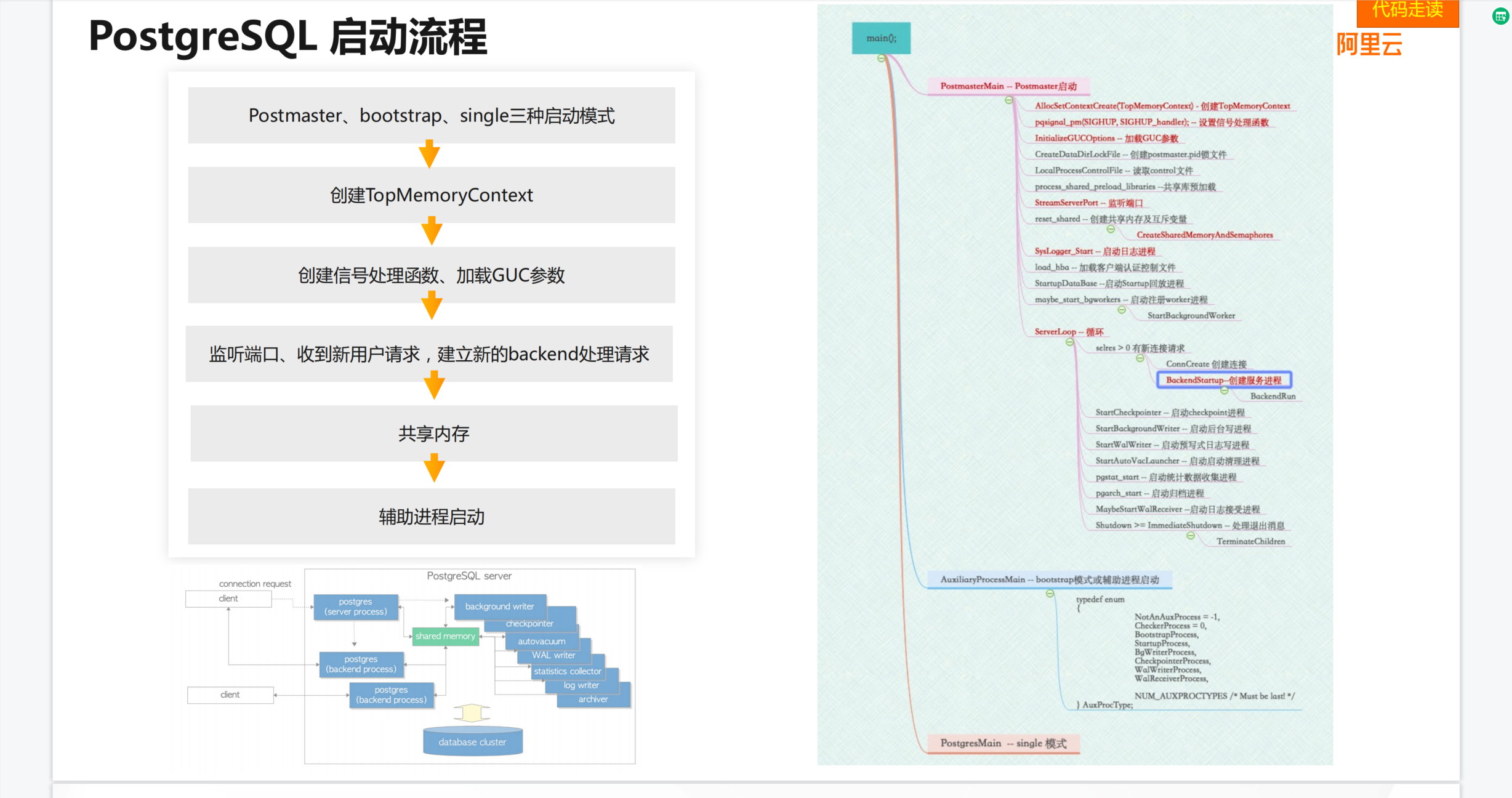
参考文档:
PostgreSQL 如何从崩溃状态恢复(上)
PostgreSQL的信号处理机制
Sigprocmask 函数|学习笔记
