PgSQL的优化器为一个查询生成一个执行效率相对较高的物理执行计划树。执行效率的高低依赖于代价估算。比如估算查询返回的记录条数、记录宽度等,就可以计算出IO开销;也可以根据要执行的物理操作估算出CPU代价。那么估算依赖的信息来源哪呢?系统表pg_statistic(列级别统计信息)为代价估算提供了关键统计信息。Analyze操作或者vacuum进行了统计信息采集,并将对数据按列进行分析,得到每列的数据分布、最常见值、频率等信息,更新到pg_statistic表。当然还有表级别的统计信息,存储在系统表pg_class:relptuples表示表的总元组数,relpages表示总页面数,等。
Analyze具体都做哪些事呢?本文先介绍下统计信息系统表。
1、pg_statistic
首先需要了解analyze都输出哪些信息到系统表。也就是pg_statistic系统表每列的含义。
postgres=# \d+ pg_statistic
                         数据表 "pg_catalog.pg_statistic"
    栏位     |   类型   | 校对规则 |  可空的  | 预设 |   存储   | 统计目标 | 描述
-------------+----------+----------+----------+------+----------+----------+------
 starelid    | oid      |          | not null |      | plain    |          |
 staattnum   | smallint |          | not null |      | plain    |          |
 stainherit  | boolean  |          | not null |      | plain    |          |
 stanullfrac | real     |          | not null |      | plain    |          |
 stawidth    | integer  |          | not null |      | plain    |          |
 stadistinct | real     |          | not null |      | plain    |          |
 stakind1    | smallint |          | not null |      | plain    |          |
 stakind2    | smallint |          | not null |      | plain    |          |
 stakind3    | smallint |          | not null |      | plain    |          |
 stakind4    | smallint |          | not null |      | plain    |          |
 stakind5    | smallint |          | not null |      | plain    |          |
 staop1      | oid      |          | not null |      | plain    |          |
 staop2      | oid      |          | not null |      | plain    |          |
 staop3      | oid      |          | not null |      | plain    |          |
 staop4      | oid      |          | not null |      | plain    |          |
 staop5      | oid      |          | not null |      | plain    |          |
 stacoll1    | oid      |          | not null |      | plain    |          |
 stacoll2    | oid      |          | not null |      | plain    |          |
 stacoll3    | oid      |          | not null |      | plain    |          |
 stacoll4    | oid      |          | not null |      | plain    |          |
 stacoll5    | oid      |          | not null |      | plain    |          |
 stanumbers1 | real[]   |          |          |      | extended |          |
 stanumbers2 | real[]   |          |          |      | extended |          |
 stanumbers3 | real[]   |          |          |      | extended |          |
 stanumbers4 | real[]   |          |          |      | extended |          |
 stanumbers5 | real[]   |          |          |      | extended |          |
 stavalues1  | anyarray |          |          |      | extended |          |
 stavalues2  | anyarray |          |          |      | extended |          |
 stavalues3  | anyarray |          |          |      | extended |          |
 stavalues4  | anyarray |          |          |      | extended |          |
 stavalues5  | anyarray |          |          |      | extended |          |
索引:
    "pg_statistic_relid_att_inh_index" UNIQUE, btree (starelid, staattnum, stainherit)
访问方法 heap
Catalog定义在pg_statistic.h中:
 *		pg_statistic definition.  cpp turns this into
 *		typedef struct FormData_pg_statistic
 * ----------------
 */
CATALOG(pg_statistic,2619,StatisticRelationId)
{
	/* These fields form the unique key for the entry: */
	Oid			starelid;		/* relation containing attribute */
	int16		staattnum;		/* attribute (column) stats are for */
	bool		stainherit;		/* true if inheritance children are included */

	/* the fraction of the column's entries that are NULL: */
	float4		stanullfrac;

	/*
	 * stawidth is the average width in bytes of non-null entries.  For
	 * fixed-width datatypes this is of course the same as the typlen, but for
	 * var-width types it is more useful.  Note that this is the average width
	 * of the data as actually stored, post-TOASTing (eg, for a
	 * moved-out-of-line value, only the size of the pointer object is
	 * counted).  This is the appropriate definition for the primary use of
	 * the statistic, which is to estimate sizes of in-memory hash tables of
	 * tuples.
	 */
	int32		stawidth;

	/* ----------------
	 * stadistinct indicates the (approximate) number of distinct non-null
	 * data values in the column.  The interpretation is:
	 *		0		unknown or not computed
	 *		> 0		actual number of distinct values
	 *		< 0		negative of multiplier for number of rows
	 * The special negative case allows us to cope with columns that are
	 * unique (stadistinct = -1) or nearly so (for example, a column in which
	 * non-null values appear about twice on the average could be represented
	 * by stadistinct = -0.5 if there are no nulls, or -0.4 if 20% of the
	 * column is nulls).  Because the number-of-rows statistic in pg_class may
	 * be updated more frequently than pg_statistic is, it's important to be
	 * able to describe such situations as a multiple of the number of rows,
	 * rather than a fixed number of distinct values.  But in other cases a
	 * fixed number is correct (eg, a boolean column).
	 * ----------------
	 */
	float4		stadistinct;

	/* ----------------
	 * To allow keeping statistics on different kinds of datatypes,
	 * we do not hard-wire any particular meaning for the remaining
	 * statistical fields.  Instead, we provide several "slots" in which
	 * statistical data can be placed.  Each slot includes:
	 *		kind			integer code identifying kind of data (see below)
	 *		op				OID of associated operator, if needed
	 *		coll			OID of relevant collation, or 0 if none
	 *		numbers			float4 array (for statistical values)
	 *		values			anyarray (for representations of data values)
	 * The ID, operator, and collation fields are never NULL; they are zeroes
	 * in an unused slot.  The numbers and values fields are NULL in an
	 * unused slot, and might also be NULL in a used slot if the slot kind
	 * has no need for one or the other.
	 * ----------------
	 */

	int16		stakind1;
	int16		stakind2;
	int16		stakind3;
	int16		stakind4;
	int16		stakind5;

	Oid			staop1;
	Oid			staop2;
	Oid			staop3;
	Oid			staop4;
	Oid			staop5;

	Oid			stacoll1;
	Oid			stacoll2;
	Oid			stacoll3;
	Oid			stacoll4;
	Oid			stacoll5;

#ifdef CATALOG_VARLEN			/* variable-length fields start here */
	float4		stanumbers1[1];
	float4		stanumbers2[1];
	float4		stanumbers3[1];
	float4		stanumbers4[1];
	float4		stanumbers5[1];

	/*
	 * Values in these arrays are values of the column's data type, or of some
	 * related type such as an array element type.  We presently have to cheat
	 * quite a bit to allow polymorphic arrays of this kind, but perhaps
	 * someday it'll be a less bogus facility.
	 */
	anyarray	stavalues1;
	anyarray	stavalues2;
	anyarray	stavalues3;
	anyarray	stavalues4;
	anyarray	stavalues5;
#endif
} FormData_pg_statistic;列描述:
1)starelid表示当前列所属的表或者索引
2)staattnum表示本行统计细腻些属于上面表或者索引的第几列
3)stainherit表示统计信息是否包含子列。通常情况下,analyze后每个表列都会有一个条目,并且stainerit为false。如果该表有分区子表,那么还会创建stainherit=true的第2条记录。其实stainherit=true,可以认为是父表,也就是这一行是所有子表的列的统计信息,而stainherit=false,则认为是叶子表,仅表示该子表的列的统计信息。
4)stanullfrac表示该列中NULL个数的比例
5)stawidth表示该列非空值的平均宽度
6)stadistinct表示列中非空值唯一值个数,即去重后的个数或比例。>0表示唯一值个数。=0表示唯一值个数未知。<0表示其绝对值去重后个数占总个数的比例,比如80%的个数是非NULL,平均每个非NULL值出现2次,那么这个是就可以表示为-0.4
7)stakindN用来表示统计信息的形式,即后面number、values所表示的数据的用途,用于生成pg_stats.统计信息形式的定义如下:
#define STATISTIC_KIND_MCV 1
#define STATISTIC_KIND_HISTOGRAM 2
#define STATISTIC_KIND_CORRELATION 3
#define STATISTIC_KIND_MCELEM 4
#define STATISTIC_KIND_DECHIST 5
#define STATISTIC_KIND_RANGE_LENGTH_HISTOGRAM 6
#define STATISTIC_KIND_BOUNDS_HISTOGRAM 7
PG数据库对每个属性列的统计目前最多只能应用5(STATISTIC_NUM_SLOTS)种统计方法,因此在pg_statistic中会有stakind1--stakind5、staop1--staop5、stanumbers1--stanumbers5以及stavalues1--stavalues5共5个slot。如果stakind不为0,则表示该对应slot有统计信息。第一个统计方法的信息会先记录到第一个slot中(stakind1、staop1、statnumber1、stavalues1),第2个统计方法信息会记录到第二个slot中(stakind2、staop2、statnumber2、stavalues2),依次类推,可有存5个统计方法信息。而stakindi的值则为上述统计信息形式的宏定义。比如1表示MCV值;2表示直方图的值;3表示相关性的值等。Kind的范围:1-99:内核占用;100-199,PostGIS占用;200-299,ESRI ST_Geometry几何系统占用;300-9999,未来公共占用。
8)staopN用来表示该统计值支持的操作,如“=”或者“<”
9)stacollN用来表示统计信息的排序规则
10)stanumbersN用来表示如果是MCV类型,这里就是下面对应stavaluesN出现的概率值
11)stavaluesN用来表示统计值数组
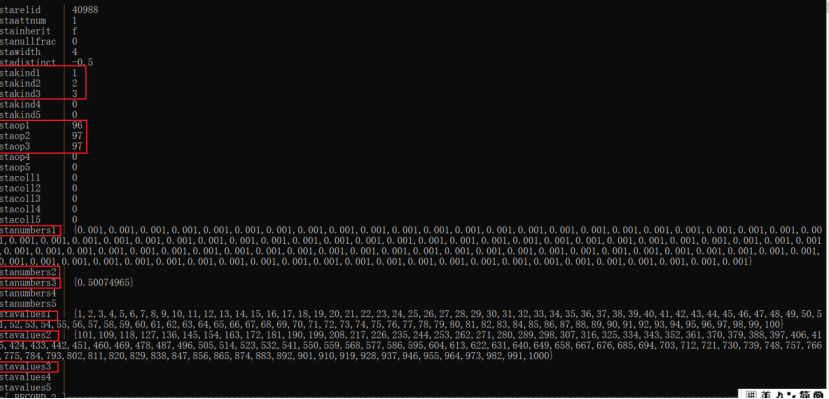
例:表t4有两列,分别插入两次1--1000的值。
create table t4(id1 int,id2 int);insert into t4 select generate_series(1,1000),generate_series(1,1000);insert into t4 select * from t4;说明:
id1列应用了3个统计方法,占了3个slot,分别是MCV(1)、直方图(2)、相关系数(3)
stakind1为1,表示使用MCV,stanumbers1保存的是高频值数组,数组中记录的是每个高频值占用的频率值,而stavalues1则保存的是高频数数组对应的数值。
stakind3为3,表示使用相关性,stanumbers3中保存的是相关系数。若相关系数为1,则表示数据分布和排序(按物理位置)后的数据分布完全正相关。
stakind2为2,表示使用直方图,stavalues2保存的是直方图每个slot的边界值。因为用的是等频直方图,只需要记录每个桶边界值,就可以获取的每个桶的平均比例。