



本篇详细介绍一下新的基于Hypergraph的算法DPhyp。
例如:R1.a + R2.b + R3.c = R4.d + R5.e + R6.f ;只支持inner joins;
select *
from R1 r1, R2 r2, R3 r3,
R4 r4, R5 r5, R6 r6
where r1.a=r2.a and r2.b=r3.c and
r4.d=r5.d and r5.e=r6.e and
abs(r1.f + r3.f )
= abs(r4.g + r6.g)
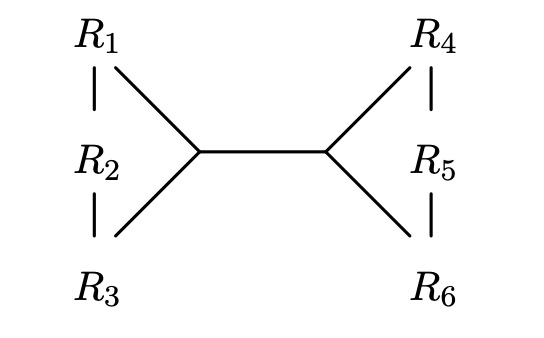
介绍算法先介绍下基本概念超图(hypergraph)相比普通的图,其特点是图中的节点是一个集合,称为超节点(hypernode),图中的边所连接的是超节点,即连接两个集合。这类边称为超边(hyperedge)。超图就是由超节点和超边作为最基本元素而构成的。有了超图那么上面的Join Graph可以变成:
由于使用DPccp和Top-Down Partition Search,不能够解决outer join,antijoin的不能自由重排的算法。
MySQL目前采用Bitmap(64bit)来表示,假设Join table个数不会超过61个,看下它的定义
+struct Hyperedge {
+  // The endpoints (hypernodes) of this hyperedge. See the comment about
+  // duplicated edges in Node.
+  //
+  // left and right may not overlap, and both must have at least one bit set.
+  NodeMap left;
+  NodeMap right;
+};
+
+struct Hypergraph {
+  std::vector<Node> nodes;  // Maximum 8*sizeof(NodeMap) elements.
+  std::vector<Hyperedge> edges;
+
+  void AddNode();
+  void AddEdge(NodeMap left, NodeMap right);
+};
基本算法流程如下:
- 找到一个图中种子节点Ri
- 不断增加i去找hyperedges,不考虑不连接的和已经处理过的。
- 对于每一个连通子图subgraph (csg),再重复1和2步骤,找出一个仍然可以连通子图(complement, cmp),然后连接这个图的cmp成为更大的连通子图(csg-cmp-pair).
- 当找到一个csg-cmp-pair,就形成一个可以进行估算的subjoin
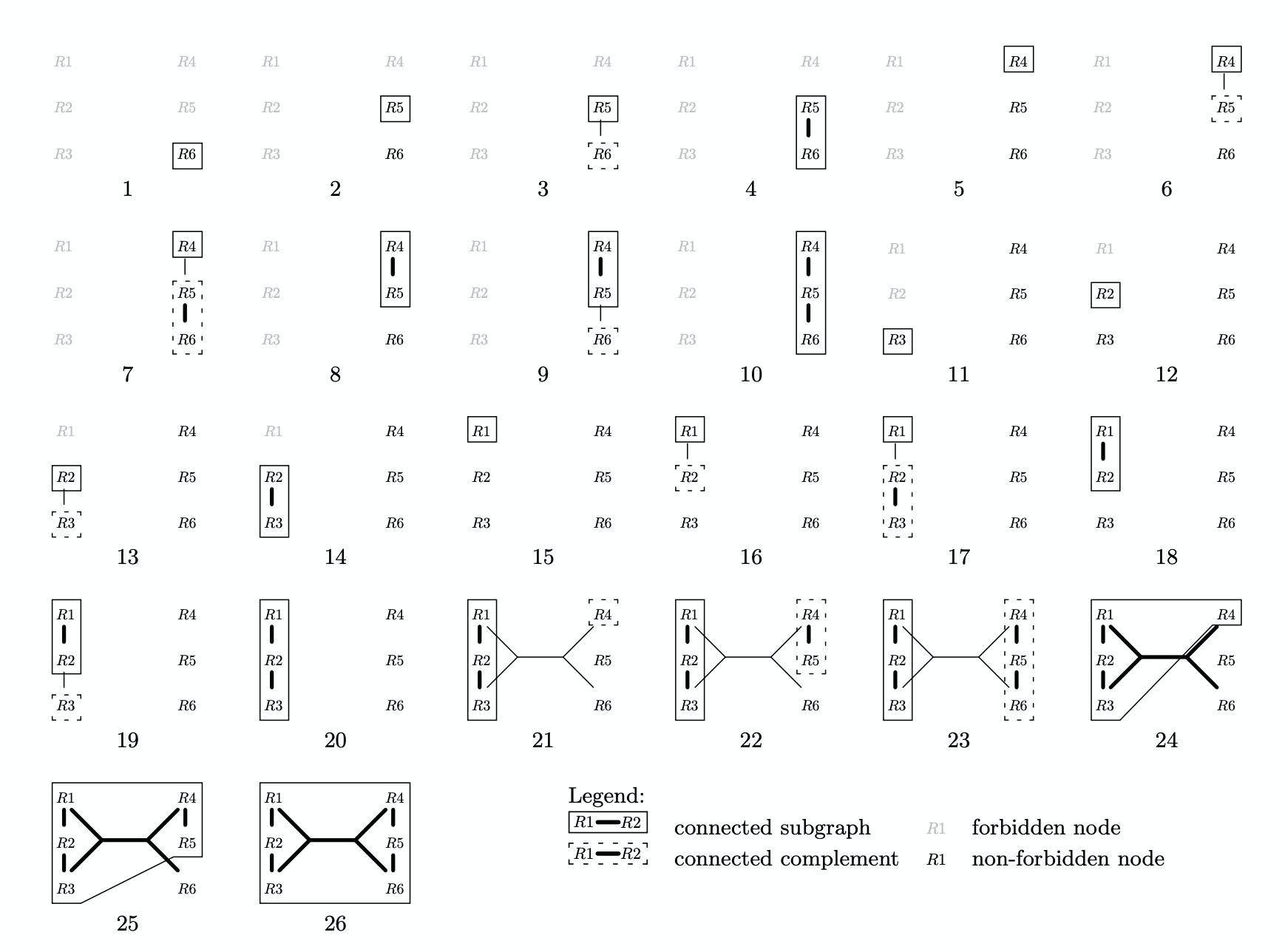
感兴趣可以阅读相应的论文和MySQL的代码(sql/join_optimizer)。
QEP_TAB和执行器Iterator解藕,重新来设置InnoDB row buffer
众所周知,QEB_TAB结构上承载了很多信息,除了上面表访问和Join方法的信息之外,还有InnoDB row buffer、表访问的优化访问方式(ref/range/loose scan/first match/materialize)、附加属性(having/distinct/sort/icp/lateral derived/mrr/cte)、基本物理表结构TABLE_LIST等。作为删除QEP_TAB的基础,首先先做了和执行器的解藕工作,Iterator和QEP_TAB分离。
 class TableScanIterator final : public TableRowIterator {
  public:
-  // Accepts nullptr for qep_tab; qep_tab is used only for setting up record
-  // buffers.
-  //
-  // The pushed condition can be nullptr.
+  // “expected_rows” is used for scaling the record buffer.
+  // If zero or less, no record buffer will be set up.
   //
   // "examined_rows", if not nullptr, is incremented for each successful Read().
-  TableScanIterator(THD *thd, TABLE *table, QEP_TAB *qep_tab,
+  TableScanIterator(THD *thd, TABLE *table, double expected_rows,
                     ha_rows *examined_rows);
接下来解藕
-static bool init_index_and_record_buffer(const QEP_TAB *qep_tab, handler *file,
+static bool init_index(TABLE *table, handler *file, uint idx, bool sorted) {

-bool set_record_buffer(const QEP_TAB *tab);
+bool set_record_buffer(TABLE *table, double expected_rows_to_fetch);

=>

-  return init_index_and_record_buffer(m_qep_tab, m_qep_tab->table()->file,
-                                      m_ref->key, m_use_order);
+  if (table()->file->inited) return false;
+  if (init_index(table(), table()->file, m_ref->key, m_use_order)) {
+    return true;
+  }
+  return set_record_buffer(table(), m_expected_rows);
实现CostingReceiver和转化查询块select_lex成为超图hypergraph
MySQL 8.0.23提供了支持hypergraph的优化器模型的第一个原型版本,通过set optimizer_switch=”hypergraph_optimizer=on”;来打开,主要和原有的优化器区别在于:
- 不再局限于左深树的执行计划
- 用DPhyp动态规划算法代替了强力算和启发式的剪枝方式,减少了搜索空间,当然还有一些限制
- Hash join成为主要的选择方式
- 直接和AccessPath互通,而非直接生成Iterators
主要通过FindBestQueryPlan函数来实现,逻辑如下:
- 先判断是否属于新优化器可以支持的Query语法(CheckSupportedQuery),不支持的直接返回错误ER_HYPERGRAPH_NOT_SUPPORTED_YET
- 转化top_join_list变成JoinHypergraph结构。由于Hypergraph是比较独立的算法层面的实现,JoinHypergraph结构用来更好的把数据库的结构包装到Hypergraph的edges和nodes的概念上的。
- 通过EnumerateAllConnectedPartitions实现论文中的DPhyp算法
- CostingReceiver类包含了过去JOIN planning的主要逻辑,包括根据cost选择相应的访问路径,根据DPhyp生成的子计划进行评估,保留cost最小的子计划。
- 得到root_path后,接下来处理group/agg/having/sort/limit的。对于Group by操作,目前Hypergraph使用sorting first + streaming aggregation的方式。
FindBestQueryPlan最终返回确定的执行计划root_path后,通过CreateIteratorFromAccessPath函数生成对应的执行Iterator树,在Iterator执行器中执行。
举例说明:
两个连通子图

root:test> explain format=tree select * from t1,t2,t3,t4 where t2.f2 = t1.a and t1.a = t3.a;
+------------------------------------------------------------------------------------------------------------------------------------------------------------------------------------------------------------------------------------------------------------------------------------------------------------------------------------------------------------------------------------------------------------------------------------------------------------------+
| EXPLAIN                                                                                                                                                                                                                                                                                                                                                                                                                                                          |
+------------------------------------------------------------------------------------------------------------------------------------------------------------------------------------------------------------------------------------------------------------------------------------------------------------------------------------------------------------------------------------------------------------------------------------------------------------------+
| -> Hash cartesian product (no condition)  (cost=1.83 rows=2)
    -> Inner hash join (t2.f2 = t1.a)  (cost=1.55 rows=2)
        -> Table scan on t2  (cost=0.25 rows=2)
        -> Hash
            -> Inner hash join (t1.a = t3.a)  (cost=1.27 rows=1)
                -> Table scan on t1  (cost=1.00 rows=1)
                -> Hash
                    -> Table scan on t3  (cost=0.25 rows=1)
    -> Hash
        -> Table scan on t4  (cost=0.25 rows=1)
 |

一个连通子图

root:test> explain format=tree select * from t1,t2,t3,t4 where t2.f2 = t1.a and t1.a = t3.a and t2.f2 = t4.pk and t1.a = t4.pk;
+----------------------------------------------------------------------------------------------------------------------------------------------------------------------------------------------------------------------------------------------------------------------------------------------------------------------------------------------------------------------------------------------------------------------------------------------------------------------------+
| EXPLAIN                                                                                                                                                                                                                                                                                                                                                                                                                                                                    |
+----------------------------------------------------------------------------------------------------------------------------------------------------------------------------------------------------------------------------------------------------------------------------------------------------------------------------------------------------------------------------------------------------------------------------------------------------------------------------+
| -> Inner hash join (t2.f2 = t4.pk), (t1.a = t4.pk)  (cost=1.83 rows=2)
    -> Inner hash join (t2.f2 = t1.a)  (cost=1.55 rows=2)
        -> Table scan on t2  (cost=0.25 rows=2)
        -> Hash
            -> Inner hash join (t1.a = t3.a)  (cost=1.27 rows=1)
                -> Table scan on t1  (cost=1.00 rows=1)
                -> Hash
                    -> Table scan on t3  (cost=0.25 rows=1)
    -> Hash
        -> Table scan on t4  (cost=0.25 rows=1)
 |
通过打开opt_trace来看下整个过程
{
  "steps": [
    {
      "join_preparation": {
        "select#": 1,
        "steps": [
          {
            "expanded_query": "/* select#1 */ select `t1`.`a` AS `a`,`t2`.`f2` AS `f2`,`t3`.`a` AS `a`,`t3`.`b` AS `b`,`t4`.`pk` AS `pk`,`t4`.`col_int_nokey` AS `col_int_nokey`,`t4`.`col_int_key` AS `col_int_key`,`t4`.`col_varchar_nokey` AS `col_varchar_nokey` from `t1` join `t2` join `t3` join `t4` where ((`t2`.`f2` = `t1`.`a`) and (`t2`.`f2` = `t4`.`col_int_key`))"
          }
        ]
      }
    },
    {
      "join_optimization": {
        "select#": 1,
        "steps": [
          {
            "condition_processing": {
              "condition": "WHERE",
              "original_condition": "((`t2`.`f2` = `t1`.`a`) and (`t2`.`f2` = `t4`.`col_int_key`))",
              "steps": [
                {
                  "transformation": "equality_propagation",
                  "resulting_condition": "((`t2`.`f2` = `t1`.`a`) and (`t2`.`f2` = `t4`.`col_int_key`))"
                },
                {
                  "transformation": "trivial_condition_removal",
                  "resulting_condition": "((`t2`.`f2` = `t1`.`a`) and (`t2`.`f2` = `t4`.`col_int_key`))"
                }
              ]
            }
          },
          {
            "substitute_generated_columns": {
            }
          },
          {
            "join_optimizer": [
              "Join list after simplification:",
              "* t4  join_type=inner",
              "* t3  join_type=inner",
              "* t2  join_type=inner",
              "* t1  join_type=inner",
              "",
              "Made this relational tree; WHERE condition is ((t2.f2 = t1.a) and (t2.f2 = t4.col_int_key)):",
              "* Inner join (no join conditions)",
              "  * Inner join (no join conditions)",
              "    * Inner join (no join conditions)",
              "      * t1",
              "      * t2",
              "    * t3",
              "  * t4",
              "",
              "After pushdown; remaining WHERE conditions are (none):",
              "* Inner join (equijoin condition = (t2.f2 = t4.col_int_key))",
              "  * Cartesian product",
              "    * Inner join (equijoin condition = (t2.f2 = t1.a))",
              "      * t1",
              "      * t2",
              "    * t3",
              "  * t4",
              "",
              "Selectivity of join (t2.f2 = t1.a):",
              " - found an index in t1.a for (t2.f2 = t1.a), selectivity = 1.000",
              "Selectivity of join [cartesian product]:",
              "Selectivity of join (t2.f2 = t4.col_int_key):",
              " - found an index in t4.col_int_key for (t2.f2 = t4.col_int_key), selectivity = 1.000",
              "",
              "Constructed hypergraph:",
              "digraph G {  # 3 edges",
              "  t1 -> t2 [label=\"(t2.f2 = t1.a)\"]",
              "  e2 [shape=circle,width=.001,height=.001,label=\"\"]",
              "  t1 -> e2 [arrowhead=none,label=\"\"]",
              "  t2 -> e2 [arrowhead=none,label=\"\"]",
              "  e2 -> t3 [label=\"[cartesian product]\"]",
              "  t2 -> t4 [label=\"(t2.f2 = t4.col_int_key)\"]",
              "}",
              "",
              "Enumerating subplans:",
              "Found node t4 [rows=1, cost=0.2]",
              "Found node t3 [rows=1, cost=0.2]",
              "Found node t2 [rows=2, cost=0.2]",
              "Found sets {t2} and {t4}, connected by condition (t2.f2 = t4.col_int_key) [rows=2, cost=0.5]",
              " - first alternative for this join, keeping",
              "Found node t1 [rows=1, cost=1.0]",
              "Found sets {t2} and {t1}, connected by condition (t2.f2 = t1.a) [rows=2, cost=1.3]",
              " - first alternative for this join, keeping",
              "Found sets {t2,t4} and {t1}, connected by condition (t2.f2 = t1.a) [rows=2, cost=1.6]",
              " - first alternative for this join, keeping",
              "Found sets {t1,t2} and {t4}, connected by condition (t2.f2 = t4.col_int_key) [rows=2, cost=1.6]",
              " - more expensive than old cost 1.6, discarding",
              "Found sets {t1,t2} and {t3}, connected by condition [cartesian product] [rows=2, cost=1.6]",
              " - first alternative for this join, keeping",
              "Found sets {t1,t2,t3} and {t4}, connected by condition (t2.f2 = t4.col_int_key) [rows=2, cost=1.8]",
              " - first alternative for this join, keeping",
              "Found sets {t1,t2,t4} and {t3}, connected by condition [cartesian product] [rows=2, cost=1.8]",
              " - more expensive than old cost 1.8, discarding",
              "",
              "Enumerated 9 subplans."
            ]
          }
        ]
      }
    }
  ]
}
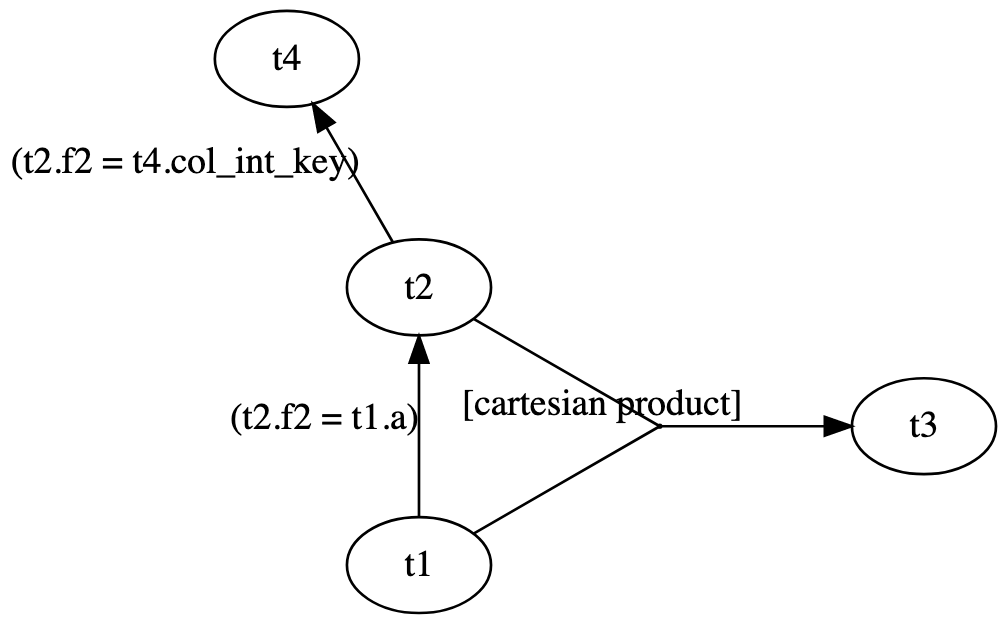
可以看到官方MySQL还提供了查看Graph图的Json格式可视化脚本,我们可以通过online graph看到连通图:
参考资料:
