




1.前言
PostgreSQL中,要想看看表的定义或者索引的定义或者函数存储过程的定义,基本上已有的功能也还算够用。唯独表的定义获取不是那么直观,对吧?
我在自己实现的一套工具JMyETL以及XSQL当中,是直接使用JDBC提取元信息,然后按照标准的SQL语法生成建表语句。那种是通用的做法,也是一些第三方工具的标准做法,但是比较费人力。以后在机会合适的时候,我会将它们以某种形式开放出来,对于跨DBMS的数据移值还是非常有用的。
下边尝试直接使用PostgreSQL中的已有功能进行一些探索。
2.实例
2.1表的定义
目前,如果不做任何调整,我们可以通过元命令:\d+ 大致看到表的定义是下边这个样子的:
表原始建表语句:
1postgres=# create table t2(id int, col2 text) tablespace myts;
2CREATE TABLE
3postgres=# insert into t2 select n, md5(random()::text) || n from  generate_series(1,10000) as n;
4INSERT 0 10000
1、元命令查看:
1postgres=# \d+ t2
2                                            Table "public.t2"
3 Column |  Type   | Collation | Nullable | Default | Storage  | Compression | Stats target | Description
4--------+---------+-----------+----------+---------+----------+-------------+--------------+-------------
5 id     | integer |           |          |         | plain    |             |              |
6 col2   | text    |           |          |         | extended |             |              |
7Tablespace: "myts"
8Access method: heap
如果只是想了解一下表的基本信息,它也已经足够 。可是要得到建表语句,这些是不够的。
2、命令行查看
我们可以借用pg_dump命令来看看,借用下边两个选项
1-s, --schema-only            dump only the schema, no data
2-t, --table=PATTERN          dump the specified table(s) only
实例:
1pg_dump -d postgres -s -t t2 | egrep -v "^--|^$|^SET"
2结果:
3SELECT pg_catalog.set_config('search_path', '', false);
4CREATE TABLE public.t2 (
5    id integer,
6    col2 text
7);
8ALTER TABLE public.t2 OWNER TO postgres;
9CREATE INDEX idx_t2_col2 ON public.t2 USING btree (col2);
或者直接在psql里头执行:
1postgres=# \! pg_dump -d postgres -s -t t2 | egrep -v "^--|^$|^SET"
2SELECT pg_catalog.set_config('search_path', '', false);
3CREATE TABLE public.t2 (
4    id integer,
5    col2 text
6);
7ALTER TABLE public.t2 OWNER TO postgres;
8CREATE INDEX idx_t2_col2 ON public.t2 USING btree (col2);
初看着,效果似乎还不错。
3、弄一个函数试试
我们再读读文档:https://www.postgresql.org/docs/current/functions-info.html, 也许自己可以试着写一个, stackoverflow上边有现成的,而https://github.com/filiprem/pg-tools 上边也有相关的代码片段。直接拿来看下:
 1CREATE OR REPLACE FUNCTION tabledef(oid) RETURNS text
 2LANGUAGE sql STRICT AS $$
 3/* snatched from https://github.com/filiprem/pg-tools */
 4WITH attrdef AS (
 5    SELECT
 6        n.nspname,
 7        c.relname,
 8        pg_catalog.array_to_string(c.reloptions || array(select 'toast.' || x from pg_catalog.unnest(tc.reloptions) x), ', ') as relopts,
 9        c.relpersistence,
10        a.attnum,
11        a.attname,
12        pg_catalog.format_type(a.atttypid, a.atttypmod) as atttype,
13        (SELECT substring(pg_catalog.pg_get_expr(d.adbin, d.adrelid, true) for 128) FROM pg_catalog.pg_attrdef d
14            WHERE d.adrelid = a.attrelid AND d.adnum = a.attnum AND a.atthasdef) as attdefault,
15        a.attnotnull,
16        (SELECT c.collname FROM pg_catalog.pg_collation c, pg_catalog.pg_type t
17            WHERE c.oid = a.attcollation AND t.oid = a.atttypid AND a.attcollation <> t.typcollation) as attcollation,
18        a.attidentity,
19        a.attgenerated
20    FROM pg_catalog.pg_attribute a
21    JOIN pg_catalog.pg_class c ON a.attrelid = c.oid
22    JOIN pg_catalog.pg_namespace n ON c.relnamespace = n.oid
23    LEFT JOIN pg_catalog.pg_class tc ON (c.reltoastrelid = tc.oid)
24    WHERE a.attrelid = $1
25        AND a.attnum > 0
26        AND NOT a.attisdropped
27    ORDER BY a.attnum
28),
29coldef AS (
30    SELECT
31        attrdef.nspname,
32        attrdef.relname,
33        attrdef.relopts,
34        attrdef.relpersistence,
35        pg_catalog.format(
36            '%I %s%s%s%s%s',
37            attrdef.attname,
38            attrdef.atttype,
39            case when attrdef.attcollation is null then '' else pg_catalog.format(' COLLATE %I', attrdef.attcollation) end,
40            case when attrdef.attnotnull then ' NOT NULL' else '' end,
41            case when attrdef.attdefault is null then ''
42                else case when attrdef.attgenerated = 's' then pg_catalog.format(' GENERATED ALWAYS AS (%s) STORED', attrdef.attdefault)
43                    when attrdef.attgenerated <> '' then ' GENERATED AS NOT_IMPLEMENTED'
44                    else pg_catalog.format(' DEFAULT %s', attrdef.attdefault)
45                end
46            end,
47            case when attrdef.attidentity<>'' then pg_catalog.format(' GENERATED %s AS IDENTITY',
48                    case attrdef.attidentity when 'd' then 'BY DEFAULT' when 'a' then 'ALWAYS' else 'NOT_IMPLEMENTED' end)
49                else '' end
50        ) as col_create_sql
51    FROM attrdef
52    ORDER BY attrdef.attnum
53),
54tabdef AS (
55    SELECT
56        coldef.nspname,
57        coldef.relname,
58        coldef.relopts,
59        coldef.relpersistence,
60        string_agg(coldef.col_create_sql, E',\n    ') as cols_create_sql
61    FROM coldef
62    GROUP BY
63        coldef.nspname, coldef.relname, coldef.relopts, coldef.relpersistence
64)
65SELECT
66    format(
67        'CREATE%s TABLE %I.%I%s%s%s;',
68        case tabdef.relpersistence when 't' then ' TEMP' when 'u' then ' UNLOGGED' else '' end,
69        tabdef.nspname,
70        tabdef.relname,
71        coalesce(
72            (SELECT format(E'\n    PARTITION OF %I.%I %s\n', pn.nspname, pc.relname,
73                pg_get_expr(c.relpartbound, c.oid))
74                FROM pg_class c JOIN pg_inherits i ON c.oid = i.inhrelid
75                JOIN pg_class pc ON pc.oid = i.inhparent
76                JOIN pg_namespace pn ON pn.oid = pc.relnamespace
77                WHERE c.oid = $1),
78            format(E' (\n    %s\n)', tabdef.cols_create_sql)
79        ),
80        case when tabdef.relopts <> '' then format(' WITH (%s)', tabdef.relopts) else '' end,
81        coalesce(E'\nPARTITION BY '||pg_get_partkeydef($1), '')
82    ) as table_create_sql
83FROM tabdef
84$$;
调用实例:
 1postgres=# SELECT tabledef('test1'::regclass);
 2          tabledef
 3-----------------------------
 4 CREATE TABLE public.test1 (+
 5     a integer              +
 6 );
 7(1 row)
 8
 9postgres=# SELECT tabledef('t2'::regclass);
10         tabledef
11--------------------------
12 CREATE TABLE public.t2 (+
13     id integer,         +
14     col2 text           +
15 );
16(1 row)
看起来也不错的。只是里边如果有指定tablespace之类的,就信息不太全。但是它能适用于绝大多数情况。
当然,还有一个插件:pgddl,也能达到目的,不再赘述,可自行试用。
2.2索引的定义
假定索引定义为:
1postgres=# create index idx_t2_col2 on t2(col2);
2CREATE INDEX
则可以用元命令\di+, 查看它的基本信息:
1postgres=# \di+ idx_t2_col2
2                                          List of relations
3 Schema |    Name     | Type  |  Owner   | Table | Persistence | Access method |  Size  | Description
4--------+-------------+-------+----------+-------+-------------+---------------+--------+-------------
5 public | idx_t2_col2 | index | postgres | t2    | permanent   | btree         | 592 kB |
6(1 row)
要得到完整的索引创建的语句,可以使用PG中自带的系统函数(pg_get_indexdef),输入参数是index对象的OID。
 1postgres=# select oid, relname, relkind from pg_class where relname = 'idx_t2_col2';
 2  oid  |   relname   | relkind
 3-------+-------------+---------
 4 16401 | idx_t2_col2 | i
 5(1 row)
 6
 7postgres=#  select * from pg_get_indexdef(16401);
 8                     pg_get_indexdef
 9----------------------------------------------------------
10 CREATE INDEX idx_t2_col2 ON public.t2 USING btree (col2)
11(1 row)
提示,因为我们知道对象名:idx_t2_col2, 它在pg_class中有记录,我们可以直接使用类型转换 'idx_t2_col2'::regclass
这样,可以一次得到结果:
1postgres=# select * from pg_get_indexdef('idx_t2_col2'::regclass);
2                     pg_get_indexdef
3----------------------------------------------------------
4 CREATE INDEX idx_t2_col2 ON public.t2 USING btree (col2)
5(1 row)
那么要得到一张表't2'所有的索引名呢?查询视图:pg_indexes。这个也很有用,对不对?
1postgres=# select * from pg_indexes where tablename = 't2';
2 schemaname | tablename |  indexname  | tablespace |                         indexdef
3------------+-----------+-------------+------------+----------------------------------------------------------
4 public     | t2        | idx_t2_col2 |            | CREATE INDEX idx_t2_col2 ON public.t2 USING btree (col2)
5(1 row)
pg_indexes视图的原始定义是:
 1SELECT
 2    n.nspname AS schemaname,
 3    c.relname AS tablename,
 4    i.relname AS indexname,
 5    t.spcname AS tablespace,
 6    pg_get_indexdef(i.oid) AS indexdef
 7FROM pg_index x
 8    JOIN pg_class c ON c.oid = x.indrelid
 9    JOIN pg_class i ON i.oid = x.indexrelid
10    LEFT JOIN pg_namespace n ON n.oid = c.relnamespace
11    LEFT JOIN pg_tablespace t ON t.oid = i.reltablespace
12WHERE (c.relkind = ANY (ARRAY['r'::"char", 'm'::"char"])) AND i.relkind = 'i'::"char";
2.3函数或存储过程的定义
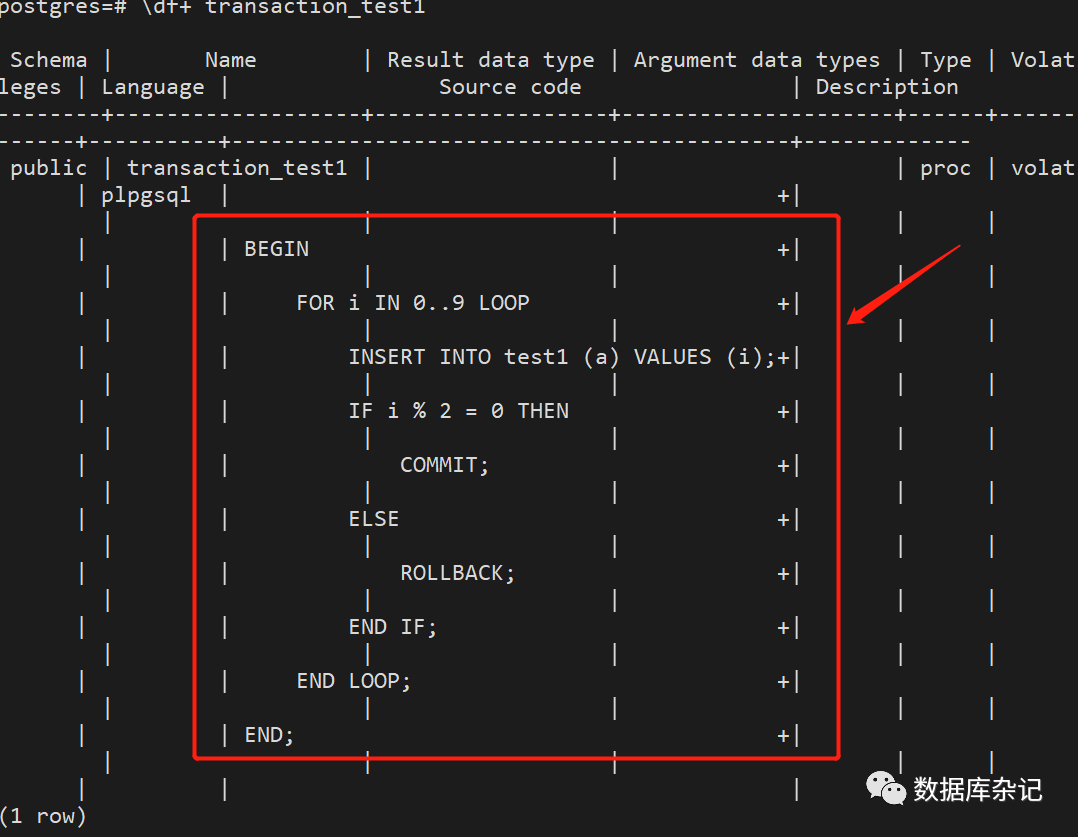
我们就以下这典型的函数为例:
 1CREATE TABLE test1(a int);
 2
 3CREATE PROCEDURE transaction_test1()
 4LANGUAGE plpgsql
 5AS $$
 6BEGIN
 7    FOR i IN 0..9 LOOP
 8        INSERT INTO test1 (a) VALUES (i);
 9        IF i % 2 = 0 THEN
10            COMMIT;
11        ELSE
12            ROLLBACK;
13        END IF;
14    END LOOP;
15END;
16$$;
17
18CALL transaction_test1();
19
20CREATE OR REPLACE FUNCTION random_string( int ) RETURNS TEXT as $$
21    SELECT string_agg(substring('abcdefghijklmnopqrstuvwxyzABCDEFGHIJKLMNOPQRSTUVWXYZ', round(random() * 52 + 0.5)::integer, 1), '')
22        FROM generate_series(1, $1);
23$$ language sql;
1、元命令获取信息:
 1postgres=# \df+ random_string
 2
 3    List of functions
 4 Schema |     Name      | Result data type | Argument data types | Type | Volatility | Parallel |  Owner   | Security | Access privilege
 5s | Language |                                                             Source code
 6            | Description
 7--------+---------------+------------------+---------------------+------+------------+----------+----------+----------+-----------------
 8--+----------+--------------------------------------------------------------------------------------------------------------------------
 9------------+-------------
10 public | random_string | text             | integer             | func | volatile   | unsafe   | postgres | invoker  |
11  | sql      |
12           +|
13        |               |                  |                     |      |            |          |          |          |
14  |          |     SELECT string_agg(substring('abcdefghijklmnopqrstuvwxyzABCDEFGHIJKLMNOPQRSTUVWXYZ', round(random() * 52 + 0.5)::integ
15er, 1), '')+|
16        |               |                  |                     |      |            |          |          |          |
17  |          |         FROM generate_series(1, $1);
18           +|
19        |               |                  |                     |      |            |          |          |          |
20  |          |
21            |
22(1 row)
2、使用系统函数
直接使用函数:pg_get_functiondef(oid)
 1postgres=# select * from  pg_get_functiondef('transaction_test1'::regproc);
 2                   pg_get_functiondef
 3--------------------------------------------------------
 4 CREATE OR REPLACE PROCEDURE public.transaction_test1()+
 5  LANGUAGE plpgsql                                     +
 6 AS $procedure$                                        +
 7 BEGIN                                                 +
 8     FOR i IN 0..9 LOOP                                +
 9         INSERT INTO test1 (a) VALUES (i);             +
10         IF i % 2 = 0 THEN                             +
11             COMMIT;                                   +
12         ELSE                                          +
13             ROLLBACK;                                 +
14         END IF;                                       +
15     END LOOP;                                         +
16 END;                                                  +
17 $procedure$                                           +
18
19(1 row)
20
21postgres=#  select * from  pg_get_functiondef('random_string'::regproc);
22                                                          pg_get_functiondef
23--------------------------------------------------------------------------------------------------------------------------------------
24 CREATE OR REPLACE FUNCTION public.random_string(integer)
25  RETURNS text
26  LANGUAGE sql
27 AS $function$
28     SELECT string_agg(substring('abcdefghijklmnopqrstuvwxyzABCDEFGHIJKLMNOPQRSTUVWXYZ', round(random() * 52 + 0.5)::integer, 1), '')+
29         FROM generate_series(1, $1);
30 $function$
31(1 row)
2.4视图的定义
 1postgres=# \df pg_get_viewdef
 2                              List of functions
 3   Schema   |      Name      | Result data type | Argument data types | Type
 4------------+----------------+------------------+---------------------+------
 5 pg_catalog | pg_get_viewdef | text             | oid                 | func
 6 pg_catalog | pg_get_viewdef | text             | oid, boolean        | func
 7 pg_catalog | pg_get_viewdef | text             | oid, integer        | func
 8 pg_catalog | pg_get_viewdef | text             | text                | func
 9 pg_catalog | pg_get_viewdef | text             | text, boolean       | func
10(5 rows)
11
12postgres=# create view t2_v as select * from t2;
13CREATE VIEW
1、元命令方式:
1postgres=# \dv+ t2_v
2                           List of relations
3 Schema | Name | Type |  Owner   | Persistence |  Size   | Description
4--------+------+------+----------+-------------+---------+-------------
5 public | t2_v | view | postgres | permanent   | 0 bytes |
6(1 row)
2、查询视图方式:
1postgres=# select * from pg_views where viewname = 't2_v';
2 schemaname | viewname | viewowner |   definition
3------------+----------+-----------+----------------
4 public     | t2_v     | postgres  |  SELECT t2.id,+
5            |          |           |     t2.col2   +
6            |          |           |    FROM t2;
7(1 row)
3、系统函数方式:
1postgres=# select * from pg_get_viewdef('t2_v'::regclass);
2 pg_get_viewdef
3----------------
4  SELECT t2.id,+
5     t2.col2   +
6    FROM t2;
7(1 row)
3.总结
有点闹不明白,PostgreSQL这是闹哪一出,它可以有index, proc, view ddl完整的支持,可是一个普普通通的Table的DDL语句功能,竟然没有。一定要通过pg_dump之类的原始命令。或者,设计者以为直接一个元命令\d, \d+之类的,能看到各列的元信息就够了。但这个对于某些层面的应用开发而言,却是非常不方便的。
要实现这个功能,在现在的PG代码的基础上去搞,应该基本上不费什么劲,毕竟pg_dump里头全都能给你弄出来。
先总结这么多,理想的情况是,有一个函数:pg_get_table_ddl('abcde'::regclass), 然后它会把相关的index, view以及依赖的proc/fun DDL全部给你显示出来。
后边有时间再总结一下,弄出一个PostgreSQL中DDL的获取方法(二)
4.参考
[1] https://stackoverflow.com/questions/1846542/postgresql-get-table-definition-pg-get-tabledef
[2] https://github.com/lacanoid/pgddl
[3] https://www.postgresql.org/docs/current/functions-info.html
