



1.ROUND (number)
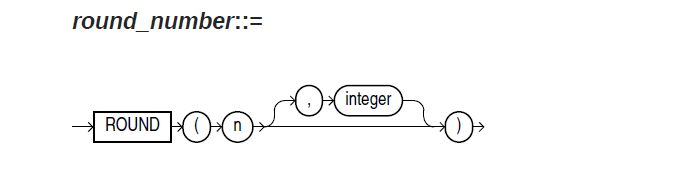
ROUND returns n rounded to integer places to the right of the decimal point. If you omit integer, then n is rounded to zero places. If integer is negative, then n is rounded off to the left of the decimal point.
n can be any numeric data type or any nonnumeric data type that can be implicitly converted to a numeric data type. If you omit integer, then the function returns the value ROUND(n, 0) in the same data type as the numeric data type of n. If you include integer, then the function returns NUMBER.
ROUND is implemented using the following rules:
- If n is 0, then ROUND always returns 0 regardless of integer.
- If n is negative, then ROUND(n, integer) returns -ROUND(-n, integer).
- If n is positive, then.TRUNC (number)
ROUND(n, integer) = FLOOR(n * POWER(10, integer) + 0.5) * POWER(10, -integer)
ROUND applied to a NUMBER value may give a slightly different result from ROUND applied to the same value expressed in floating-point.
The different results arise from differences in internal representations of NUMBER and floating point values.
The difference will be 1 in the rounded digit if a difference occurs.
2.TRUNC (number)
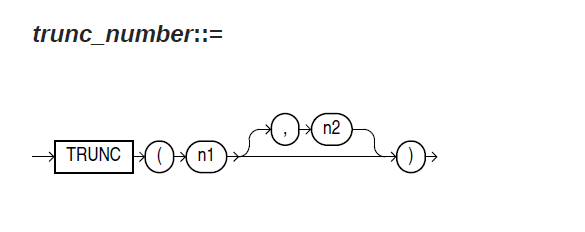
The TRUNC (number) function returns n1 truncated to n2 decimal places. If n2 is omitted, then n1 is truncated to 0 places. n2 can be negative to truncate (make zero) n2 digits left of the decimal point.
This function takes as an argument any numeric data type or any nonnumeric data type that can be implicitly converted to a numeric data type. If you omit n2, then the function returns the same data type as the numeric data type of the argument. If you include n2, then the function returns NUMBER.
