



对CBO的调用
前面已提到,在MySQL的常规优化流程中,完成查询改写操作后会进入CBO的模块(对应JOIN::optimize函数),执行每个query block的物理优化,这个过程中,基于统计信息+代价模型,MySQL会基于代价,考虑每个query block内部可能的单表访问方式、join顺序、join算法等,从中选择代价最低的最优方案。 这种计算代价的能力,对于CBQT也是非常重要的,因为我们需要有“基于代价决定改写是否应用”的能力,也就是说在枚举过程中,如果一个改写不确定是否会更优,需要能够让CBO告知改写前/后的代价,通过比较来决定。这就要求我们能够在迭代过程中反复调用CBO组件,理论上把它当做一个黑盒,一个可以计算代价的黑盒。
CBO的抽象与精简
MySQL的原始CBO组件是非常重的,熟悉MySQL代码的同学应该了解JOIN::optimize函数中完成的工作,除了计算代价,他还需要做一系列事前、事后的动作,包括:
- 等值、常量传递和一些类型转换处理等
- 计算必要统计信息
- 枚举最优计划并计算代价
- 生成物理执行计划
整个过程很长,如果我们把这些都包含进来,势必造成枚举过程效率过低,因此第一个动作就是对CBO做抽象和精简,实现一个Mini-CBO的组件,它只做为计算代价的最小化动作,尽可能降低调用的开销。 我们把Mini-CBO实现为一个黑盒,传递给它一个query plan的子树,返回这颗子树的最优代价。
CBO的重入与复用
对于Mini-CBO的反复调用,也暴露了一些进一步提升效率的机会,即从各个粒度上,实现对代价计算的复用,尽量避免执行重复的优化过程。这个粒度从小到大是:
- Table level,对于每个table,MySQL会基于谓词,考虑可能的range访问方式,这个过程中会估算range scan要扫描的行数,而这是通过index dive的动态采样来完成的,我们通过缓存+复用dive的结果,即可以节省反复读取page的开销,也可以避免由于采样导致的优化效果不稳定问题。
- Join level,对于一个连续的join序列+join条件,也会缓存其对应的最佳join方式和join代价,后续再遇到直接获取对应代价值,避免了昂贵的join顺序枚举。
- Query Block level,当一个输入的query tree子树中,一些query block与之前计算过的block相同,我们也会复用之前计算的结果,更大幅度提升重入的效率。
- Query Tree Level,query block level的复用一定程度上也意味着query tree的局部复用
Query Tree的复制
在前面介绍枚举框架的图中,我们看到一个object,会同时考虑应用一个改写rule或不应用该rule,这是基于query tree的clone能力来实现的。 具体来说,当Rewriter考虑对一个object应用当前改写Rule时,会先对整个query tree做一次clone,生成一个新tree,并基于新tree完成改写动作,然后将新tree输入到Mini-CBO中计算代价,同时原有的不做改写的tree也会进入Mini-CBO计算代价,通过比较两个结果,保留2颗query tree的一个作为winner,进入下一个步骤。
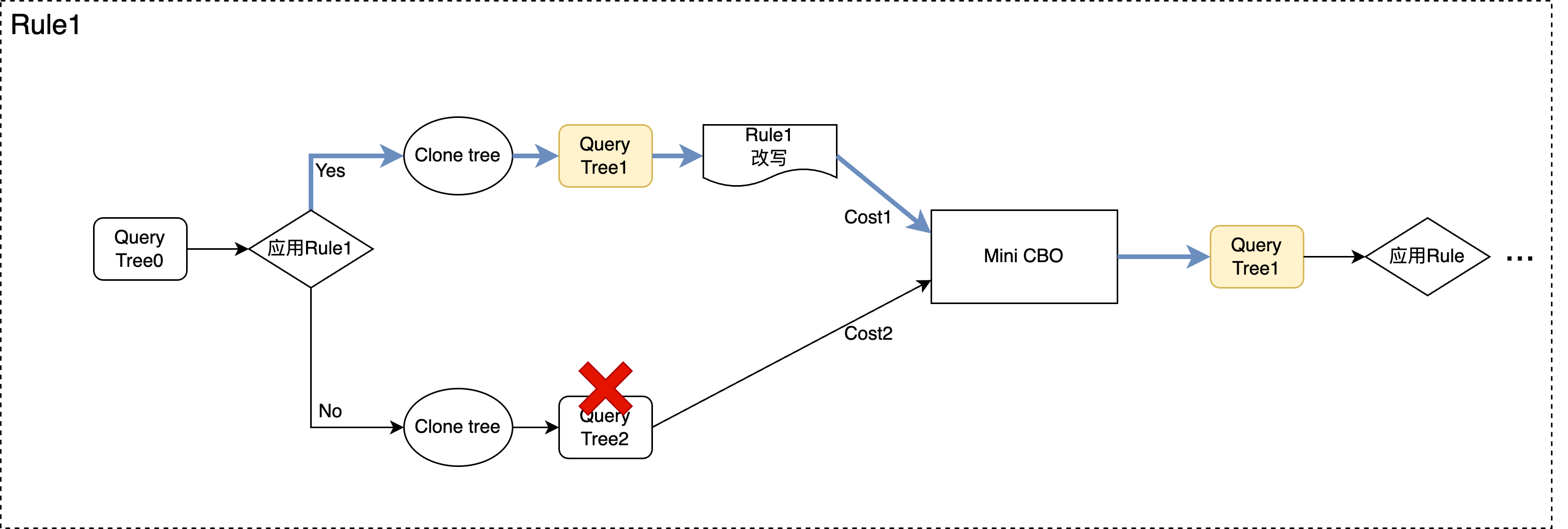
从query tree的角度来看,流程如上图,对于每个需要基于代价确定的改写规则,都需要经过Mini-CBO的”裁决”来选中winner。 当然从原理和工程上,这里还有很多要处理的事情,例如
- 基于启发式的改写规则与基于代价的改写规则如何交互和影响
- 基于代价的规则之间的Interleaving和Juxtaposition (可参考Oracle paper)
- 流程中针对clone的优化
这些细节这里就不赘述了。
示例
目前我们实现了标量子查询转物化表、GroupBy解关联子查询、物化表合并、子查询折叠等四种基于代价的变换规则以及子查询转SemiJoin、window_function解关联子查询等八种启发式变换规则。下面使用TPCH的数据构造两个场景说明CBQT框架的优势。 测试环境为PolarDB线上实例,规格为polar.mysql.g2.large(4C8G);测试数据为TPCH 1G的数据。
自动选择代价更低的计划
以TPCH Q17为例。 Q17查询为:
select
  sum(l_extendedprice) / 7.0 as avg_yearly
from
  lineitem,
  part
where
  p_partkey = l_partkey
  and p_brand = 'Brand#12'
  and p_container = 'JUMBO BOX'
  and l_quantity < (
    select
      0.2 * avg(l_quantity)
    from
      lineitem
    where
      l_partkey = p_partkey
  )
limit 1;
对于这个查询,子查询可以直接按照语义以关联的形式迭代执行或者通过GroupBy解关联后进行执行,而何种方式性能更好取决于具体场景,比如索引、数据量等。在TPCH-1G数据下,没有二级索引时,Q17通过GroupBy解关联执行的效率是更高的,对比如下。 关联执行 计划:
mysql> explain format=tree select   sum(l_extendedprice) / 7.0 as avg_yearly from   lineitem,   part where   p_partkey = l_partkey   and p_brand = 'Brand#12'   and p_container = 'JUMBO BOX'   and l_quantity < (     select       0.2 * avg(l_quantity)     from       lineitem     where       l_partkey = p_partkey   ) limit 1;
+-----------------------------------------------------------------------------------------------------------------------------------------------------+
| EXPLAIN
+-----------------------------------------------------------------------------------------------------------------------------------------------------+
| -> Limit: 1 row(s)
    -> Aggregate: sum(lineitem.L_EXTENDEDPRICE)
        -> Nested loop inner join  (cost=7194628.66 rows=297103)
            -> Table scan on lineitem  (cost=660507.64 rows=5942055)
            -> Filter: ((part.P_BRAND = 'Brand#12') and (part.P_CONTAINER = 'JUMBO BOX') and (lineitem.L_QUANTITY < (select #2)))  (cost=1.00 rows=0)
                -> Single-row index lookup on part using PRIMARY (P_PARTKEY=lineitem.L_PARTKEY)  (cost=1.00 rows=1)
                -> Select #2 (subquery in condition; dependent)
                    -> Aggregate: avg(lineitem.L_QUANTITY)
                        -> Filter: (lineitem.L_PARTKEY = part.P_PARTKEY)  (cost=125722.69 rows=594206)
                            -> Table scan on lineitem  (cost=125722.69 rows=5942055)
执行时间:7579.54s

解关联执行 计划:
mysql> explain format=tree select   sum(l_extendedprice) / 7.0 as avg_yearly from   lineitem,   part where   p_partkey = l_partkey   and p_brand = 'Brand#12'   and p_container = 'JUMBO BOX'   and l_quantity < (     select       0.2 * avg(l_quantity)     from       lineitem     where       l_partkey = p_partkey   ) limit 1;
+-----------------------------------------------------------------------------------------------------------------------+
| EXPLAIN
+-----------------------------------------------------------------------------------------------------------------------+
| -> Limit: 1 row(s)
    -> Aggregate: sum(lineitem.L_EXTENDEDPRICE)
        -> Nested loop inner join
            -> Nested loop inner join  (cost=7194628.66 rows=297103)
                -> Table scan on lineitem  (cost=660507.64 rows=5942055)
                -> Filter: ((part.P_BRAND = 'Brand#12') and (part.P_CONTAINER = 'JUMBO BOX'))  (cost=1.00 rows=0)
                    -> Single-row index lookup on part using PRIMARY (P_PARTKEY=lineitem.L_PARTKEY)  (cost=1.00 rows=1)
            -> Filter: (lineitem.L_QUANTITY < (0.2 * derived_1_2.Name_exp_1))
                -> Index lookup on derived_1_2 using <auto_key0> (Name_exp_2=lineitem.L_PARTKEY)
                    -> Materialize
                        -> Table scan on <temporary>
                            -> Aggregate using temporary table
                                -> Table scan on lineitem  (cost=660507.64 rows=5942055)
执行时间:25.45s

可以看到解关联执行只需要25s左右,性能是不解关联执行的数百倍。 如果在各个表上有二级索引,那么不解关联的性能会更好,对比如下。
解关联执行 计划:
mysql> explain format=tree select   sum(l_extendedprice) / 7.0 as avg_yearly from   lineitem,   part where   p_partkey = l_partkey   and p_brand = 'Brand#12'   and p_container = 'JUMBO BOX'   and l_quantity < (     select       0.2 * avg(l_quantity)     from       lineitem     where       l_partkey = p_partkey   ) limit 1;
+-------------------------------------------------------------------------------------------------------------------------+
| EXPLAIN
+-------------------------------------------------------------------------------------------------------------------------+
| -> Limit: 1 row(s)
    -> Aggregate: sum(lineitem.L_EXTENDEDPRICE)
        -> Nested loop inner join
            -> Nested loop inner join  (cost=40024.75 rows=57147)
                -> Filter: ((part.P_BRAND = 'Brand#12') and (part.P_CONTAINER = 'JUMBO BOX'))  (cost=19835.90 rows=1930)
                    -> Table scan on part  (cost=19835.90 rows=192989)
                -> Index lookup on lineitem using LINEITEM_FK2 (L_PARTKEY=part.P_PARTKEY)  (cost=7.50 rows=30)
            -> Filter: (lineitem.L_QUANTITY < (0.2 * derived_1_2.Name_exp_1))
                -> Index lookup on derived_1_2 using <auto_key0> (Name_exp_2=part.P_PARTKEY)
                    -> Materialize
                        -> Group aggregate: avg(lineitem.L_QUANTITY)
                            -> Index scan on lineitem using LINEITEM_FK2  (cost=593311.60 rows=5799036)
执行时间:20.58s 
关联执行 计划:
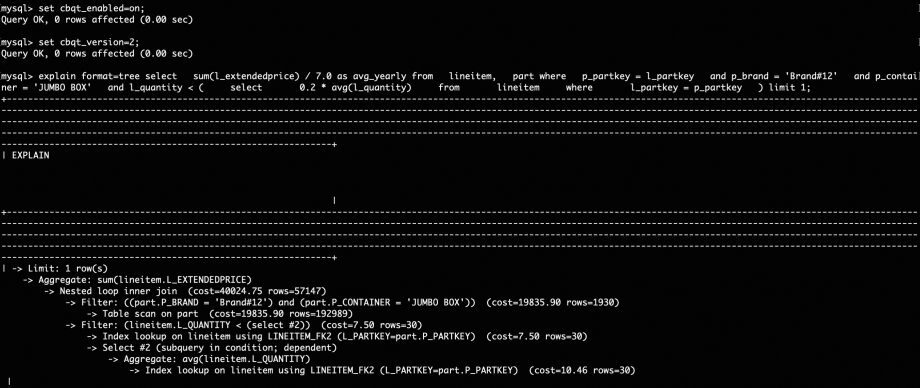
mysql> explain format=tree select sum(l_extendedprice) / 7.0 as avg_yearly from lineitem, part where p_partkey = l_partkey and p_brand = 'Brand#12' and p_container = 'JUMBO BOX' and l_quantity < ( select 0.2 * avg(l_quantity) from lineitem where l_partkey = p_partkey ) limit 1; +---------------------------------------------------------------------------------------------------------------------+ | EXPLAIN +---------------------------------------------------------------------------------------------------------------------+ | -> Limit: 1 row(s) -> Aggregate: sum(lineitem.L_EXTENDEDPRICE) -> Nested loop inner join (cost=40024.75 rows=57147) -> Filter: ((part.P_BRAND = 'Brand#12') and (part.P_CONTAINER = 'JUMBO BOX')) (cost=19835.90 rows=1930) -> Table scan on part (cost=19835.90 rows=192989) -> Filter: (lineitem.L_QUANTITY < (select #2)) (cost=7.50 rows=30) -> Index lookup on lineitem using LINEITEM_FK2 (L_PARTKEY=part.P_PARTKEY) (cost=7.50 rows=30) -> Select #2 (subquery in condition; dependent) -> Aggregate: avg(lineitem.L_QUANTITY) -> Index lookup on lineitem using LINEITEM_FK2 (L_PARTKEY=part.P_PARTKEY) (cost=10.46 rows=30)执行时间:0.42s

可以看到解关联执行的查询性能相对关联执行的查询性能下降明显。
而CBQT框架能够根据查询代价自动确定是否采用解关联执行,对于上述场景下的Q17。 在有索引时的计划选择为:
在没有索引时的选择为:
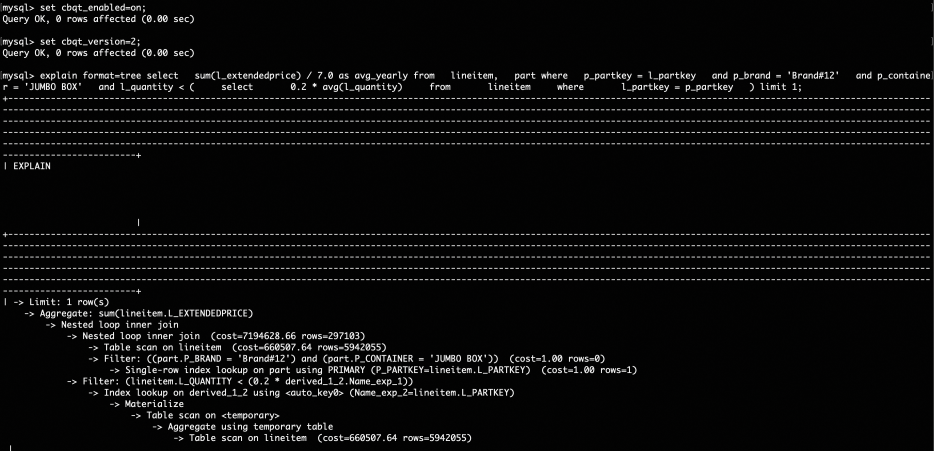
可以看到CBQT都能够自动选出最优的计划,不需要DBA基于经验人工对不同场景单独进行配置。
反复枚举变换
CBQT框架的另一个优势在于能够变换规则是反复枚举的,某些不可用的变换规则在其他规则应用后可能变得可用了,从而可以选出一个更优的计划,
例如下述查询:
SELECT * FROM part WHERE P_PARTKEY IN ( SELECT L_PARTKEY FROM lineitem WHERE L_TAX < 100 ) OR P_PARTKEY IN ( SELECT L_PARTKEY FROM lineitem WHERE L_TAX < 200 );由于两个子查询是由OR连接的,因此在PolarDB中无法直接转为semijoin,如果不做任何变换其计划如下:
mysql> explain format=tree select count(*) from part where P_PARTKEY in (select L_PARTKEY from lineitem where L_TAX < 100) or P_PARTKEY in (select L_PARTKEY from lineitem where L_TAX < 200); +----------------------------------------------------------------------------------------------------------------------------------------------------------------------------------------------+ | EXPLAIN +----------------------------------------------------------------------------------------------------------------------------------------------------------------------------------------------+ | -> Aggregate: count(0) -> Filter: (<in_optimizer>(part.P_PARTKEY,part.P_PARTKEY in (select #2)) or <in_optimizer>(part.P_PARTKEY,part.P_PARTKEY in (select #3))) (cost=20310.00 rows=198050) -> Index scan on part using PRIMARY (cost=20310.00 rows=198050) -> Select #2 (subquery in condition; run only once) -> Filter: ((part.P_PARTKEY = `<materialized_subquery>`.L_PARTKEY)) -> Limit: 1 row(s) -> Index lookup on <materialized_subquery> using <auto_distinct_key> (L_PARTKEY=part.P_PARTKEY) -> Materialize with deduplication -> Filter: (lineitem.L_TAX < 100.00) (cost=555350.80 rows=1808695) -> Table scan on lineitem (cost=555350.80 rows=5426628) -> Select #3 (subquery in condition; run only once) -> Filter: ((part.P_PARTKEY = `<materialized_subquery>`.L_PARTKEY)) -> Limit: 1 row(s) -> Index lookup on <materialized_subquery> using <auto_distinct_key> (L_PARTKEY=part.P_PARTKEY) -> Materialize with deduplication -> Filter: (lineitem.L_TAX < 200.00) (cost=555350.80 rows=1808695) -> Table scan on lineitem (cost=555350.80 rows=5426628)但是可以观察到这两个子查询只有WHERE条件不一样,因此可以做子查询的折叠,折叠后的查询形式如下:
SELECT * FROM part WHERE P_PARTKEY IN ( SELECT L_PARTKEY FROM lineitem WHERE L_TAX < 100 OR L_TAX < 200 );子查询折叠后的计划如下:
mysql> explain format=tree select count(*) from part where P_PARTKEY in (select L_PARTKEY from lineitem where L_TAX < 100) or P_PARTKEY in (select L_PARTKEY from lineitem where L_TAX < 200); +----------------------------------------------------------------------------------------------------------------------------------------------------------------------------------------------+ | EXPLAIN +----------------------------------------------------------------------------------------------------------------------------------------------------------------------------------------------+ | -> Aggregate: count(0) -> Filter: <in_optimizer>(part.P_PARTKEY,part.P_PARTKEY in (select #3)) (cost=20310.00 rows=198050) -> Index scan on part using PRIMARY (cost=20310.00 rows=198050) -> Select #3 (subquery in condition; run only once) -> Filter: ((part.P_PARTKEY = `<materialized_subquery>`.L_PARTKEY)) -> Limit: 1 row(s) -> Index lookup on <materialized_subquery> using <auto_distinct_key> (L_PARTKEY=part.P_PARTKEY) -> Materialize with deduplication -> Filter: ((lineitem.L_TAX < 100.00) or (lineitem.L_TAX < 200.00)) (cost=555350.80 rows=3014552) -> Table scan on lineitem (cost=555350.80 rows=5426628)此时只有一个子查询了,符合了子查询转semijoin的条件,因此可以进一步变换为semijoin的形式,其计划如下:
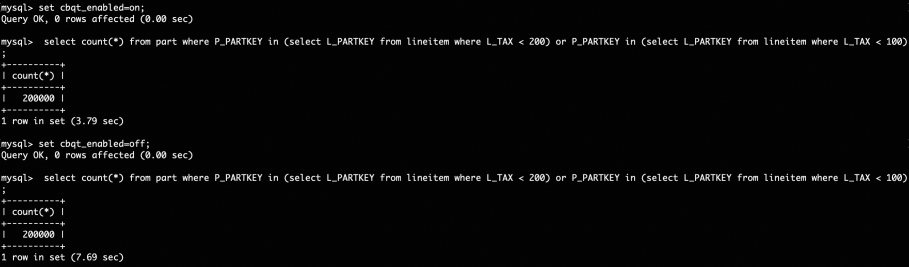
mysql> explain format=tree select count(*) from part where P_PARTKEY in (select L_PARTKEY from lineitem where L_TAX < 100) or P_PARTKEY in (select L_PARTKEY from lineitem where L_TAX < 200); +--------------------------------------------------------------------------------------------------------------------------------------------------------------------------------------------+ | EXPLAIN +--------------------------------------------------------------------------------------------------------------------------------------------------------------------------------------------+ | -> Aggregate: count(0) -> Nested loop inner join -> Filter: (part.P_PARTKEY is not null) (cost=20310.00 rows=198050) -> Index scan on part using PRIMARY (cost=20310.00 rows=198050) -> Single-row index lookup on <subquery3> using <auto_distinct_key> (L_PARTKEY=part.P_PARTKEY) -> Materialize with deduplication -> Filter: ((lineitem.L_TAX < 100.00) or (lineitem.L_TAX < 200.00)) (cost=555350.80 rows=3014552) -> Table scan on lineitem (cost=555350.80 rows=5426628)在TPCH-1G数据量下,对于该查询,使用CBQT框架进行改写的效果对比如下图:
可以看到使用CBQT框架进行改写后,查询性能提升了接近一倍。
展望
新的改写框架目前在PolarDB 8.0.22版本已上线,可以通过cbqt_enabled开关做总体的开启和关闭,此外类似optimizer_switch,我们也提供了cbqt_rule_switch这个参数,来控制各个改写动作是否在CBQT框架中生效。 目前的改写框架已基本成型,但还有很多事情需要做,这个框架是PolarDB新一代查询优化器的基础设施,其后续能支持的功能是非常灵活宽广的。一些近期/中期的目标如下:
- 持续增加更多的查询改写能力,覆盖更多用户场景,提升查询执行效果
- 优化Rewriter枚举过程中的效率,通过引入Partial Clone等能力降低复制和CBO的代价
- 利用反复枚举的能力,实现针对PolarDB异构引擎异构计划在优化过程中的融合,更高效的生成针对多引擎的混合执行计划,例如找到最优的行/列存混合计划形态
…
