



Spring嵌套事物的执行过程异常(UnexpectedRollbackException)的分析,需要注意一下两点:
这里不是指传播性Propagation.NESTED嵌套事物,而是指方法间调用嵌套不同传播性事物
Spring AOP一个类方法之间的调用不会走代理类,可以通过以下两种方式可以获取到当前代理对象
@EnableAspectProxy#exposeProxy()为true
xml配置<aop:aspectj-autoproxy expose-proxy="true"/>
通过以上两种方式暴露代理对象,通过AopContext.currentProxy()可以获取到当前代理对象
<?xml version="1.0" encoding="UTF-8"?>
<beans xmlns="http://www.springframework.org/schema/beans"
       xmlns:xsi="http://www.w3.org/2001/XMLSchema-instance"
       xmlns:aop="http://www.springframework.org/schema/aop"
       xmlns:context="http://www.springframework.org/schema/context"
       xmlns:tx="http://www.springframework.org/schema/tx"
       xsi:schemaLocation="http://www.springframework.org/schema/beans
                https://www.springframework.org/schema/beans/spring-beans-2.0.xsd
                http://www.springframework.org/schema/aop
                https://www.springframework.org/schema/aop/spring-aop-2.0.xsd
                http://www.springframework.org/schema/context
                https://www.springframework.org/schema/context/spring-context.xsd
                http://www.springframework.org/schema/tx
                https://www.springframework.org/schema/tx/spring-tx.xsd">


    <context:component-scan base-package="com.zli.tx"/>

    <bean id="dataSource"
          class="org.springframework.jdbc.datasource.DriverManagerDataSource">
        <property name="driverClassName" value="${jdbc.driverClassName}"/>
        <property name="url" value="${jdbc.url}"/>
        <property name="username" value="${jdbc.username}"/>
        <property name="password" value="${jdbc.password}"/>
    </bean>

    <context:property-placeholder location="jdbc.properties"/>

    <!-- 暴露代理对象 可以通过AopContext.currentProxy获取当前代理类-->
    <aop:aspectj-autoproxy expose-proxy="true"/>


    <bean id="transactionManager" class="org.springframework.jdbc.datasource.DataSourceTransactionManager">
        <property name="dataSource" ref="dataSource"/>
    </bean>

    <tx:annotation-driven transaction-manager="transactionManager"/>

</beans>
@Service
public class DemoServiceImpl implements DemoService {

    @Resource
    private DataSource dataSource;

    @Transactional(rollbackFor = Exception.class)
    @Override
    public void save() throws Exception {
        System.out.println("-------save before--------");

        executeSQL("insert into auth_user(id, name, account, pwd) values(1, 'Jack', 'user', '123456')");

        // 方法间调用不走代理对象,而且通过当前对象this调用
        // 此处通过暴露后的代理类型调用
        ((DemoService) AopContext.currentProxy()).firstUpdate();

        System.out.println("-------save after--------");
    }

    @Transactional(propagation = Propagation.REQUIRES_NEW, rollbackFor = Exception.class)
    @Override
    public void firstUpdate() throws Exception {
        System.out.println("-------firstUpdate before--------");

        try {
            executeSQL("insert into auth_user(id, name, account, pwd) values(2, 'John', 'user', '123456')");

            ((DemoService) AopContext.currentProxy()).secondUpdate();
        }catch (Exception e) {

        }

        System.out.println("-------firstUpdate after--------");
    }

    @Transactional(rollbackFor = Exception.class)
    @Override
    public void secondUpdate() throws Exception {
        System.out.println("-------secondUpdate before--------");

        executeSQL("insert into auth_user(id, name, account, pwd) values(3, 'Fake', 'user', '123456')");
        System.out.println("-------secondUpdate after--------");
        throw new Exception();
    }


    /**
     * 获取数据库连接执行sql
     * @param sql
     */
    public void executeSQL(String sql) {
        Connection connection = DataSourceUtils.getConnection(dataSource);
        try {
            connection.createStatement().executeUpdate(sql);
        }
        catch (SQLException throwables) {
            throw new RuntimeException(throwables);
        }
    }
}
public class DataAccessObjectTests {


    @Test
    public void txPropagationTest() throws Exception {
        ClassPathXmlApplicationContext applicationContext = new ClassPathXmlApplicationContext("classpath*:META-INF/tx-context.xml");

        DemoService demoService = applicationContext.getBean(DemoService.class);
        // 执行保存
        demoService.save();

        applicationContext.close();
    }
}
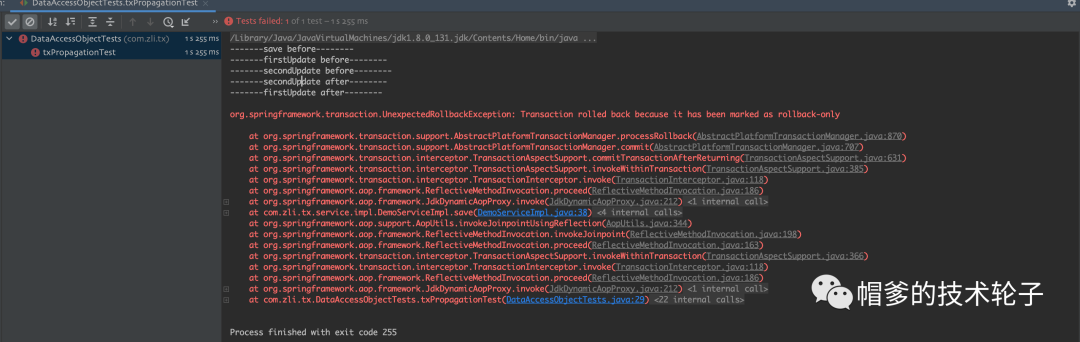
执行后报的异常,全局回滚,接下来分析为什么会报该异常,事物如何全局回滚的
首先参考一下官方的声明式事物实现图
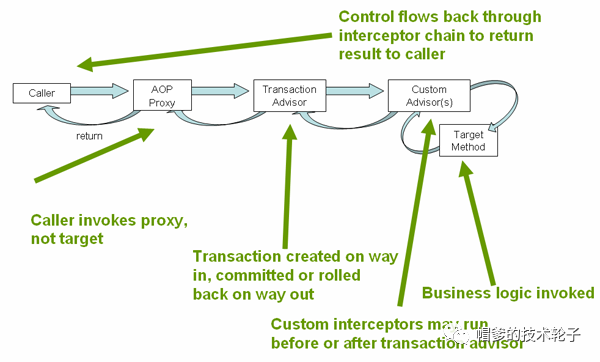
1.当执行save方法时,会通过Advisor对进行方法拦截(事物拦截核心类TransactionInterceptor);动态代理(JDK、CGLIB)对象会调用TransactionInterceptor该类的invoke方法,然后执行目标对象方法
 1public class TransactionInterceptor extends TransactionAspectSupport implements MethodInterceptor, Serializable {
 2    ...
 3
 4    @Override
 5    @Nullable
 6    public Object invoke(MethodInvocation invocation) throws Throwable {
 7        // Work out the target class: may be {@code null}.
 8        // The TransactionAttributeSource should be passed the target class
 9        // as well as the method, which may be from an interface.
10
11        // targetClass 可能为null,方法来自接口
12        Class<?> targetClass = (invocation.getThis() != null ? AopUtils.getTargetClass(invocation.getThis()) : null);
13        // 位置1
14        // Adapt to TransactionAspectSupport's invokeWithinTransaction...
15        return invokeWithinTransaction(invocation.getMethod(), targetClass, invocation::proceed);
16    }
17    ...
18}
 1public abstract class TransactionAspectSupport implements BeanFactoryAware, InitializingBean {
 2...
 3
 4@Nullable
 5    protected Object invokeWithinTransaction(Method method, @Nullable Class<?> targetClass,
 6            final InvocationCallback invocation) throws Throwable {
 7
 8        // 获取事物属性资源,如AnnotationTransactionAttributeSource
 9        // If the transaction attribute is null, the method is non-transactional.
10        TransactionAttributeSource tas = getTransactionAttributeSource();
11        // 获取事物定义的属性,如propagation、isolation、transactionManager等
12        final TransactionAttribute txAttr = (tas != null ? tas.getTransactionAttribute(method, targetClass) : null);
13        // 获取事物管理器,这里获取xml配置的DataSourceTransactionManager事物管理器
14        final TransactionManager tm = determineTransactionManager(txAttr);
15
16        // 响应式事物管理器
17        ...
18
19        //
20        PlatformTransactionManager ptm = asPlatformTransactionManager(tm);
21        // 获取方法定义连接点,主要用于当作事物名称
22        final String joinpointIdentification = methodIdentification(method, targetClass, txAttr);
23
24        // 声明式事物
25        if (txAttr == null || !(ptm instanceof CallbackPreferringPlatformTransactionManager)) {
26            // 位置2
27            // 如果需要则创建事物
28            // Standard transaction demarcation with getTransaction and commit/rollback calls.
29            TransactionInfo txInfo = createTransactionIfNecessary(ptm, txAttr, joinpointIdentification);
30
31            Object retVal;
32            try {
33                // 方法1 → 方法2 → 方法3
34                //                    ↓
35                // 方法1 ← 方法2 ← 方法3
36
37                // 这里是一个环绕通知,通常会调用下一个调用链,即调用目标对象方法
38                // This is an around advice: Invoke the next interceptor in the chain.
39                // This will normally result in a target object being invoked.
40                retVal = invocation.proceedWithInvocation();
41            }
42            catch (Throwable ex) {
43                // 位置3
44                // target invocation exception
45                // 异常后处理事物回滚,如果目标对象方法catch了异常,就不会触发该方法
46                completeTransactionAfterThrowing(txInfo, ex);
47                throw ex;
48            }
49            finally {
50                // 将当前线程的事物信息重置到上一次的事物信息,即oldTransactionInfo
51                cleanupTransactionInfo(txInfo);
52            }
53
54            if (vavrPresent && VavrDelegate.isVavrTry(retVal)) {
55                // Set rollback-only in case of Vavr failure matching our rollback rules...
56                TransactionStatus status = txInfo.getTransactionStatus();
57                if (status != null && txAttr != null) {
58                    retVal = VavrDelegate.evaluateTryFailure(retVal, txAttr, status);
59                }
60            }
61
62            // 位置4
63            // 提交事物
64            commitTransactionAfterReturning(txInfo);
65            return retVal;
66        }
67        else {
68            final ThrowableHolder throwableHolder = new ThrowableHolder();
69
70            // 编程式事物
71            ...
72        }
73    }
74
75    ...
76}
public abstract class TransactionAspectSupport implements BeanFactoryAware, InitializingBean {
...
protected TransactionInfo createTransactionIfNecessary(@Nullable PlatformTransactionManager tm,
@Nullable TransactionAttribute txAttr, final String joinpointIdentification) {
// 如果未指定名称,则将方法标识用作事务名称。
// If no name specified, apply method identification as transaction name.
if (txAttr != null && txAttr.getName() == null) {
txAttr = new DelegatingTransactionAttribute(txAttr) {
@Override
public String getName() {
return joinpointIdentification;
}
};
}
TransactionStatus status = null;
if (txAttr != null) {
if (tm != null) {// 位置2.1
// 通过事物管理器获取事物状态
status = tm.getTransaction(txAttr);
}
else {
if (logger.isDebugEnabled()) {
logger.debug("Skipping transactional joinpoint [" + joinpointIdentification +
"] because no transaction manager has been configured");
}
}
}
// 预处理事物信息,封装TransactionInfo
return prepareTransactionInfo(tm, txAttr, joinpointIdentification, status);
}
...
}
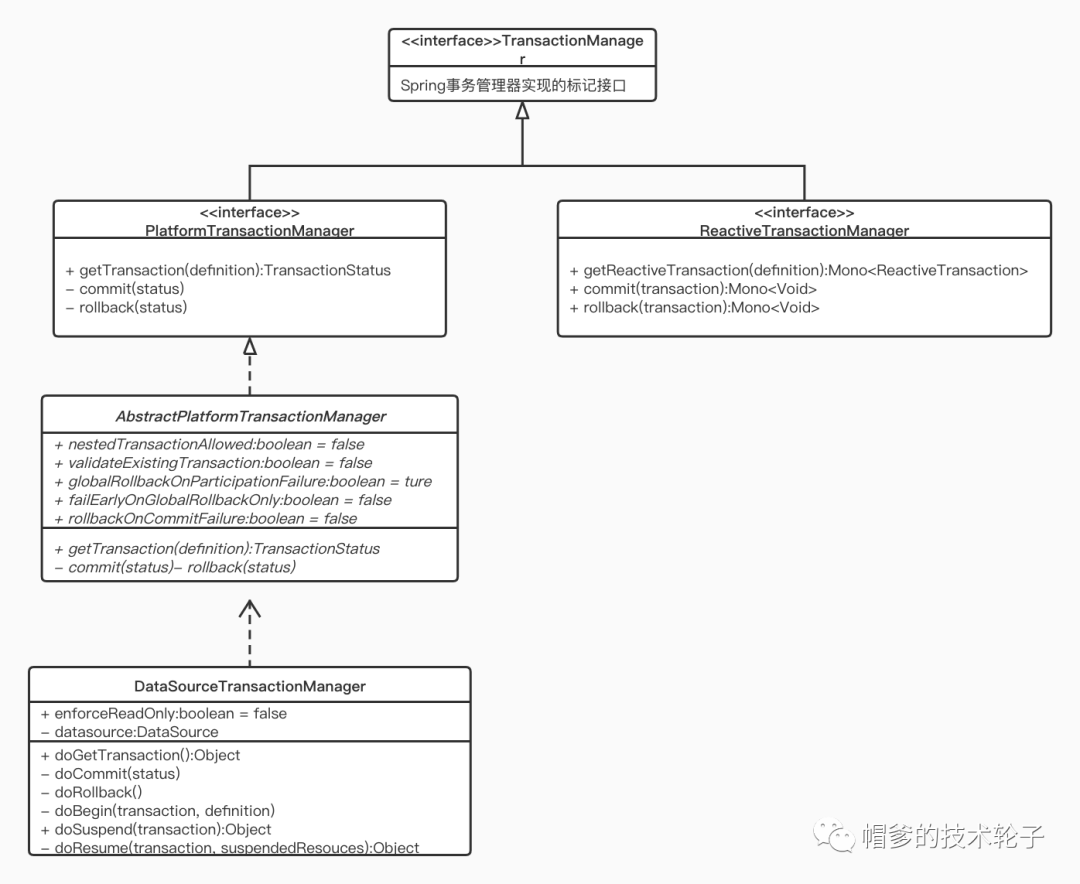
2.分析位置2.1,通过DataSourceTransactionManager事物管理器获取事物状态,下图为是事物管理器的抽象实现
 1public abstract class AbstractPlatformTransactionManager implements PlatformTransactionManager, Serializable {
 2    ...
 3
 4    @Override
 5    public final TransactionStatus getTransaction(@Nullable TransactionDefinition definition)
 6            throws TransactionException {
 7
 8        // Use defaults if no transaction definition given.
 9        TransactionDefinition def = (definition != null ? definition : TransactionDefinition.withDefaults());
10
11        // 从DataSourceTransactionManager获取一个事物对象,封装事物持有者Holder(封装连接、SavePoint等)
12        // 从TransactionSynchronizationManager#getSource获取当前线程资源,第一次进来为空
13        Object transaction = doGetTransaction();
14        boolean debugEnabled = logger.isDebugEnabled();
15
16        // 位置2.2
17        // 如果当前存在事物
18        if (isExistingTransaction(transaction)) {
19            // 处理存在的事物
20            // Existing transaction found -> check propagation behavior to find out how to behave.
21            return handleExistingTransaction(def, transaction, debugEnabled);
22        }
23
24        // Check definition settings for new transaction.
25        if (def.getTimeout() < TransactionDefinition.TIMEOUT_DEFAULT) {
26            throw new InvalidTimeoutException("Invalid transaction timeout", def.getTimeout());
27        }
28
29        // 支持当前事务,假设当前没有事务,就抛出异常
30        // No existing transaction found -> check propagation behavior to find out how to proceed.
31        if (def.getPropagationBehavior() == TransactionDefinition.PROPAGATION_MANDATORY) {
32            throw new IllegalTransactionStateException(
33                    "No existing transaction found for transaction marked with propagation 'mandatory'");
34        }
35        else if (def.getPropagationBehavior() == TransactionDefinition.PROPAGATION_REQUIRED ||
36                def.getPropagationBehavior() == TransactionDefinition.PROPAGATION_REQUIRES_NEW ||
37                def.getPropagationBehavior() == TransactionDefinition.PROPAGATION_NESTED) {
38            // 位置2.3
39            // 当前不存在事物也挂起
40            SuspendedResourcesHolder suspendedResources = suspend(null);
41            if (debugEnabled) {
42                logger.debug("Creating new transaction with name [" + def.getName() + "]: " + def);
43            }
44            try {
45                // 位置2.4
46                // 创建事物
47                return startTransaction(def, transaction, debugEnabled, suspendedResources);
48            }
49            catch (RuntimeException | Error ex) {
50                resume(null, suspendedResources);
51                throw ex;
52            }
53        }
54        else {
55            // Create "empty" transaction: no actual transaction, but potentially synchronization.
56            if (def.getIsolationLevel() != TransactionDefinition.ISOLATION_DEFAULT && logger.isWarnEnabled()) {
57                logger.warn("Custom isolation level specified but no actual transaction initiated; " +
58                        "isolation level will effectively be ignored: " + def);
59            }
60
61            // 创建空事物
62            boolean newSynchronization = (getTransactionSynchronization() == SYNCHRONIZATION_ALWAYS);
63            return prepareTransactionStatus(def, null, true, newSynchronization, debugEnabled, null);
64        }
65    }
66
67    ...
68}
 1public abstract class AbstractPlatformTransactionManager implements PlatformTransactionManager, Serializable {
 2    ...
 3
 4   private TransactionStatus startTransaction(TransactionDefinition definition, Object transaction,
 5            boolean debugEnabled, @Nullable SuspendedResourcesHolder suspendedResources) {
 6
 7        // 是否新的同步,transactionSynchronization默认是0
 8        boolean newSynchronization = (getTransactionSynchronization() != SYNCHRONIZATION_NEVER);
 9        // 创建一个默认新事物状态
10        DefaultTransactionStatus status = newTransactionStatus(
11                definition, transaction, true, newSynchronization, debugEnabled, suspendedResources);
12
13        // 位置2.4.1
14        // 开始事物
15        // 以DataSourceTransactionManager为例,将连接设置为非自动提交、只读等
16        doBegin(transaction, definition);
17
18        // 位置2.4.2
19        // 预处理需要初始化事务同步
20        prepareSynchronization(status, definition);
21        return status;
22    }
23
24    protected void prepareSynchronization(DefaultTransactionStatus status, TransactionDefinition definition) {
25        // 如果是新事物
26        if (status.isNewSynchronization()) {
27            // 标记当前线程事物是否存活
28            TransactionSynchronizationManager.setActualTransactionActive(status.hasTransaction());
29            // 设置当前线程事物隔离级别
30            TransactionSynchronizationManager.setCurrentTransactionIsolationLevel(
31                    definition.getIsolationLevel() != TransactionDefinition.ISOLATION_DEFAULT ?
32                            definition.getIsolationLevel() : null);
33            // 设置当前线程事物只读
34            TransactionSynchronizationManager.setCurrentTransactionReadOnly(definition.isReadOnly());
35            // 设置当前线程事物名称
36            TransactionSynchronizationManager.setCurrentTransactionName(definition.getName());
37            // 初始化当前线程事物同步器
38            TransactionSynchronizationManager.initSynchronization();
39        }
40    }
41    ...
42}
 1public abstract class AbstractPlatformTransactionManager implements PlatformTransactionManager, Serializable {
 2    ...
 3
 4    private TransactionStatus handleExistingTransaction(
 5            TransactionDefinition definition, Object transaction, boolean debugEnabled)
 6            throws TransactionException {
 7
 8        ...
 9
10        // 位置2.2.1
11        // 新建事务,假设当前存在事务。把当前事务挂起
12        if (definition.getPropagationBehavior() == TransactionDefinition.PROPAGATION_REQUIRES_NEW) {
13            if (debugEnabled) {
14                logger.debug("Suspending current transaction, creating new transaction with name [" +
15                        definition.getName() + "]");
16            }
17            // 挂起当前线程存在的事物
18            SuspendedResourcesHolder suspendedResources = suspend(transaction);
19            try {
20                // 创建新事物
21                return startTransaction(definition, transaction, debugEnabled, suspendedResources);
22            }
23            catch (RuntimeException | Error beginEx) {
24                resumeAfterBeginException(transaction, suspendedResources, beginEx);
25                throw beginEx;
26            }
27        }
28
29        // 如果当前存在事务,则在嵌套事务内执行。如果当前没有事务,则进行与PROPAGATION_REQUIRED类似的操作
30        if (definition.getPropagationBehavior() == TransactionDefinition.PROPAGATION_NESTED) {
31            if (!isNestedTransactionAllowed()) {
32                throw new NestedTransactionNotSupportedException(
33                        "Transaction manager does not allow nested transactions by default - " +
34                        "specify 'nestedTransactionAllowed' property with value 'true'");
35            }
36            if (debugEnabled) {
37                logger.debug("Creating nested transaction with name [" + definition.getName() + "]");
38            }
39            // 嵌套事物是否使用SavePoint
40            if (useSavepointForNestedTransaction()) {
41                // Create savepoint within existing Spring-managed transaction,
42                // through the SavepointManager API implemented by TransactionStatus.
43                // Usually uses JDBC 3.0 savepoints. Never activates Spring synchronization.
44                DefaultTransactionStatus status =
45                        prepareTransactionStatus(definition, transaction, false, false, debugEnabled, null);
46                // 在现有事物中创建一个SavePoint
47                status.createAndHoldSavepoint();
48                return status;
49            }
50            else {
51                // Nested transaction through nested begin and commit/rollback calls.
52                // Usually only for JTA: Spring synchronization might get activated here
53                // in case of a pre-existing JTA transaction.
54                return startTransaction(definition, transaction, debugEnabled, null);
55            }
56        }
57
58        // Assumably PROPAGATION_SUPPORTS or PROPAGATION_REQUIRED.
59        if (debugEnabled) {
60            logger.debug("Participating in existing transaction");
61        }
62        // 校验事物隔离级别、只读
63        ...
64
65        // 位置2.2.2
66        // 创建事物(同一个事物)
67        boolean newSynchronization = (getTransactionSynchronization() != SYNCHRONIZATION_NEVER);
68        return prepareTransactionStatus(definition, transaction, false, newSynchronization, debugEnabled, null);
69    }
70
71    ...
72}
1public abstract class TransactionAspectSupport implements BeanFactoryAware, InitializingBean {2 ...
3
4 protected void completeTransactionAfterThrowing(@Nullable TransactionInfo txInfo, Throwable ex) {
5 if (txInfo != null && txInfo.getTransactionStatus() != null) {
6 if (logger.isTraceEnabled()) {
7 logger.trace("Completing transaction for [" + txInfo.getJoinpointIdentification() +
8 "] after exception: " + ex);
9 }
10 // 判断异常需要回滚的
11 if (txInfo.transactionAttribute != null && txInfo.transactionAttribute.rollbackOn(ex)) {
12 try {
13 // 位置3.1
14 // 回滚
15 txInfo.getTransactionManager().rollback(txInfo.getTransactionStatus());
16 }
17 catch (TransactionSystemException ex2) {
18 logger.error("Application exception overridden by rollback exception", ex);
19 ex2.initApplicationException(ex);
20 throw ex2;
21 }
22 catch (RuntimeException | Error ex2) {
23 logger.error("Application exception overridden by rollback exception", ex);
24 throw ex2;
25 }
26 }
27 else {
28 // 位置3.2
29 // 忽略的异常不会回滚
30 // 但是如果事物标记为回滚,则仍为回滚
31 // We don't roll back on this exception.
32 // Will still roll back if TransactionStatus.isRollbackOnly() is true.
33 try {
34 // 提交
35 txInfo.getTransactionManager().commit(txInfo.getTransactionStatus());
36 }
37 catch (TransactionSystemException ex2) {
38 logger.error("Application exception overridden by commit exception", ex);
39 ex2.initApplicationException(ex);
40 throw ex2;
41 }
42 catch (RuntimeException | Error ex2) {
43 logger.error("Application exception overridden by commit exception", ex);
44 throw ex2;
45 }
46 }
47 }
48 }
49 ...
50}
1public abstract class AbstractPlatformTransactionManager implements PlatformTransactionManager, Serializable {
2
3 ...
4
5 @Override
6 public final void rollback(TransactionStatus status) throws TransactionException {
7 if (status.isCompleted()) {
8 throw new IllegalTransactionStateException(
9 "Transaction is already completed - do not call commit or rollback more than once per transaction");
10 }
11
12 DefaultTransactionStatus defStatus = (DefaultTransactionStatus) status;
13 // 处理回滚,非意外回滚
14 processRollback(defStatus, false);
15 }
16
17 private void processRollback(DefaultTransactionStatus status, boolean unexpected) {
18 try {
19 boolean unexpectedRollback = unexpected;
20
21 try {
22 // 回滚前触发回调事物同步器
23 // TransactionSynchronization#beforeCompletion
24 triggerBeforeCompletion(status);
25
26 // 嵌套事物
27 if (status.hasSavepoint()) {
28 if (status.isDebug()) {
29 logger.debug("Rolling back transaction to savepoint");
30 }
31 // 回滚到SavePoint
32 status.rollbackToHeldSavepoint();
33 }
34 // 新事物
35 else if (status.isNewTransaction()) {
36 if (status.isDebug()) {
37 logger.debug("Initiating transaction rollback");
38 }
39 // 模版方法,有子类实现
40 // 如DataSourceTransactionManager#doRollback
41 doRollback(status);
42 }
43 else {
44 // 多个事物
45 // Participating in larger transaction
46 // 是否存在事物
47 if (status.hasTransaction()) {
48 // isLocalRollbackOnly是否标记回滚
49 // isGlobalRollbackOnParticipationFailure是否标记全局回滚,默认为true
50 if (status.isLocalRollbackOnly() || isGlobalRollbackOnParticipationFailure()) {
51 if (status.isDebug()) {
52 logger.debug("Participating transaction failed - marking existing transaction as rollback-only");
53 }
54 // 位置3.1.1
55 // 设置回滚
56 doSetRollbackOnly(status);
57 }
58 else {
59 if (status.isDebug()) {
60 logger.debug("Participating transaction failed - letting transaction originator decide on rollback");
61 }
62 }
63 }
64 else {
65 logger.debug("Should roll back transaction but cannot - no transaction available");
66 }
67 // Unexpected rollback only matters here if we're asked to fail early
68 if (!isFailEarlyOnGlobalRollbackOnly()) {
69 unexpectedRollback = false;
70 }
71 }
72 }
73 catch (RuntimeException | Error ex) {
74 triggerAfterCompletion(status, TransactionSynchronization.STATUS_UNKNOWN);
75 throw ex;
76 }
77
78 // 回滚后触发回调事物同步器
79 triggerAfterCompletion(status, TransactionSynchronization.STATUS_ROLLED_BACK);
8081 // 位置3.1.2// 如果我们有一个仅全局回滚的标记,则引发UnexpectedRollbackException
82 // Raise UnexpectedRollbackException if we had a global rollback-only marker
83 if (unexpectedRollback) {
84 throw new UnexpectedRollbackException(
85 "Transaction rolled back because it has been marked as rollback-only");
86 }
87 }
88 finally {
89 cleanupAfterCompletion(status);
90 }
91 }
92
93 ...
94}
 1public abstract class AbstractPlatformTransactionManager implements PlatformTransactionManager, Serializable {
 2
 3    ...
 4
 5    @Override
 6    public final void commit(TransactionStatus status) throws TransactionException {
 7        if (status.isCompleted()) {
 8            throw new IllegalTransactionStateException(
 9                    "Transaction is already completed - do not call commit or rollback more than once per transaction");
10        }
11
12        DefaultTransactionStatus defStatus = (DefaultTransactionStatus) status;
13        // 标记回滚
14        if (defStatus.isLocalRollbackOnly()) {
15            if (defStatus.isDebug()) {
16                logger.debug("Transactional code has requested rollback");
17            }
18            processRollback(defStatus, false);
19            return;
20        }
21        // 位置4.1
22        // 全局回滚
23        // 如果是同一数据源则当前线程绑定的connection holder是一样的
24        if (!shouldCommitOnGlobalRollbackOnly() && defStatus.isGlobalRollbackOnly()) {
25            if (defStatus.isDebug()) {
26                logger.debug("Global transaction is marked as rollback-only but transactional code requested commit");
27            }
28            // 意外回滚
29            processRollback(defStatus, true);
30            return;
31        }
32
33        // 提交
34        processCommit(defStatus);
35    }
36
37    ...
38}
文章转载自帽爹的技术轮子,如果涉嫌侵权,请发送邮件至:contact@modb.pro进行举报,并提供相关证据,一经查实,墨天轮将立刻删除相关内容。
