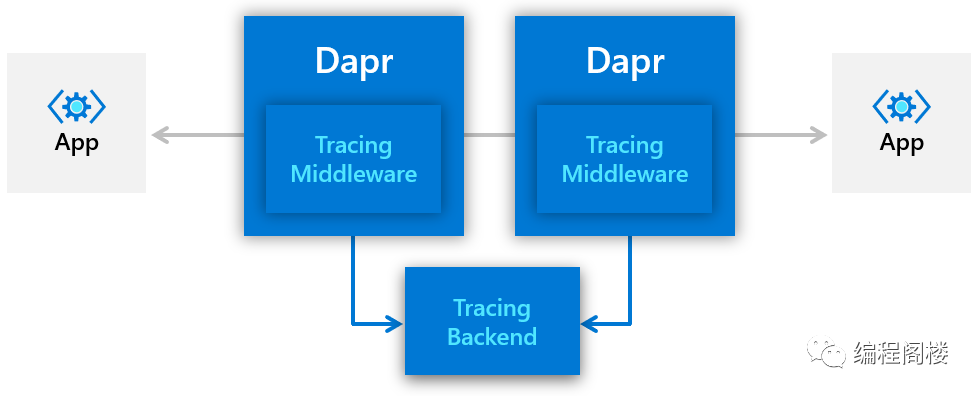
1. Service-to-service invocation(服务调用)
Dapr addresses these challenges by providing a service invocation API that acts as a combination of a reverse proxy with built-in service discovery, while leveraging built-in distributed tracing, metrics, error handling, encryption and more.
Dapr uses a sidecar architecture. To invoke an application using Dapr, you use the invoke
API on any Dapr instance. The sidecar programming model encourages each applications to talk to its own instance of Dapr. The Dapr instances discover and communicate with one another.
http://10.0.0.2:8000/neworder,按照传统的方式,直接HTTP POST这个API访问就得了,但在Dapr中,其提供了服务间方法调用的接口规范,需要按照
POST/GET/PUT/DELETE http://localhost:<daprPort>/v1.0/invoke/<appId>/method/<method-name>的格式进行访问。那假设pythonapp需要访问nodeapp的方法,就需要POST一个请求到
http://localhost:3500/v1.0/invoke/nodeapp/method/neworder。你可能会想为何多此一举呢?此举的意义何在呢?目的很简单,就是为了实现对服务间网络通信的控制以完成诸如服务发现、流量控制、重试熔断、安全访问等,而这相关的网络控制功能就是集成在Dapr的Sidecar中,以对应用透明的方式集成进来的。整体的服务调用流程如下图所示:
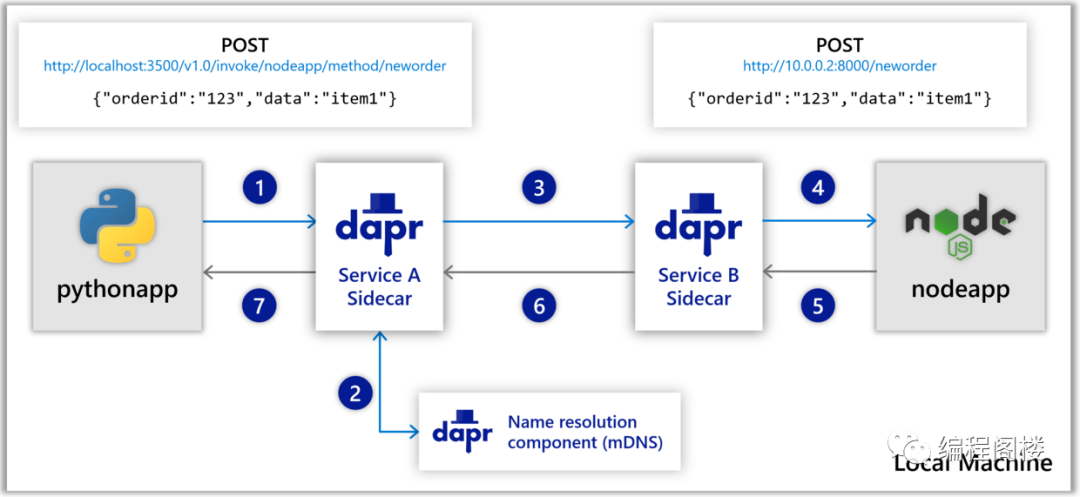
其中,服务发现机制:
2. state store(状态管理)
A state store in Dapr is described using a Component
file:
apiVersion: dapr.io/v1alpha1kind: Componentmetadata:name: statestorenamespace: defaultspec:type: state.<DATABASE>version: v1metadata:- name: <KEY>value: <VALUE>- name: <KEY>value: <VALUE>...
当前已支持的state store类型如下:
AWS DynamoDB
Aerospike
Azure Blob Storage
Azure CosmosDB
Azure Table Storage
Cassandra
Cloud Firestore (Datastore mode)
CloudState
Couchbase
Etcd
HashiCorp Consul
Hazelcast
Memcached
MongoDB
PostgreSQL
Redis
RethinkDB
SQL Server
Zookeeper
更多细节参见: Supported state stores
存储: POST http://localhost:<daprPort>/v1.0/state/<storename>读取: GET http://localhost:<daprPort>/v1.0/state/<storename>/<key>删除: DELETE http://localhost:<daprPort>/v1.0/state/<storename>/<key>以下是保存状态的举例: concurrency
用于指定并发选项:first-write-wins/last-write-wins(以第一次写入为准/以最后一次写入为准),默认以最后一次写入为准。consistency
用于指定一致性选项:strong/eventual(强一致性/最终一致性),默认为最终一致性。
curl -X POST http://localhost:3500/v1.0/state/starwars \-H "Content-Type: application/json" \-d '[{"key": "weapon","value": "DeathStar","etag": "xxxxx","options": {"concurrency": "first-write","consistency": "strong"}}]'
3. Pub/Sub(消息发布及订阅)
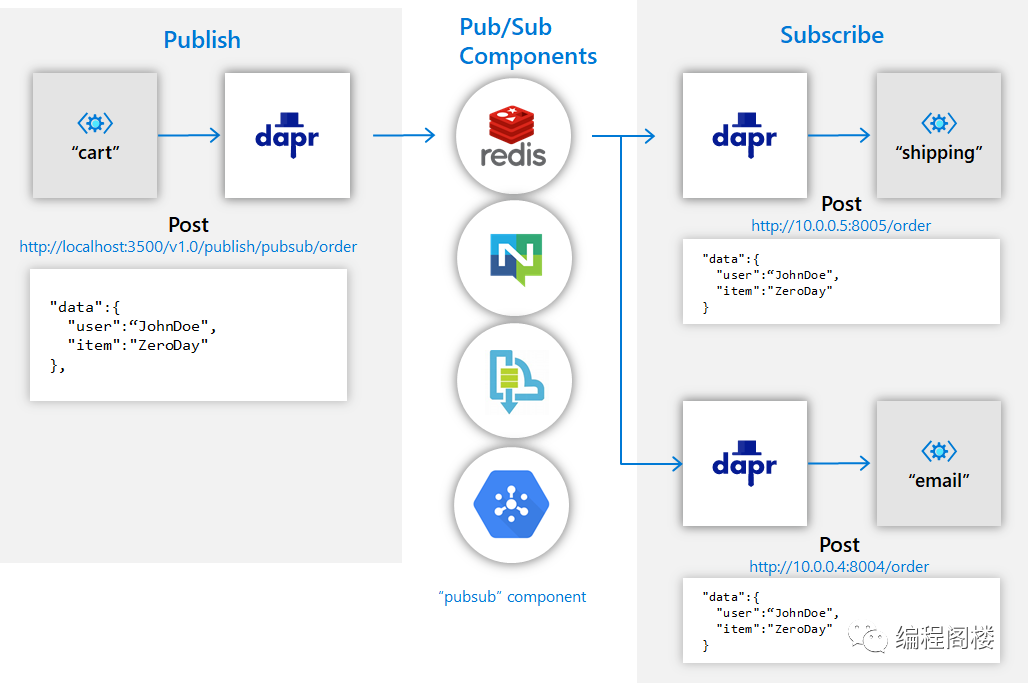
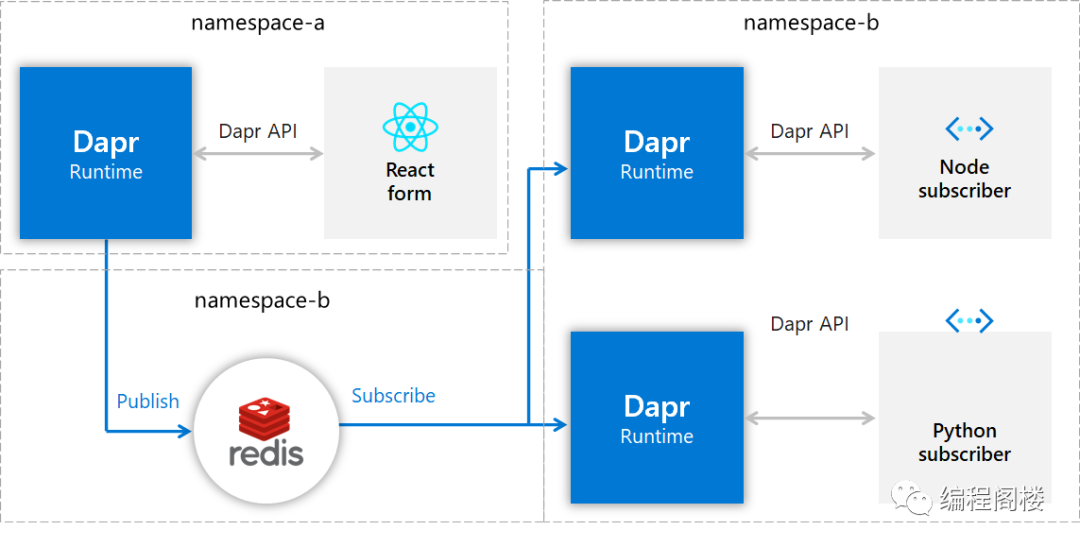
Dapr integrates with pub/sub message buses to provide applications with the ability to create event-driven, loosely coupled architectures where producers send events to consumers via topics.
发布订阅模式,主要是用于微服务间基于消息进行相互通信。你可能也会说,这也要拿出来说,我搞个RabbitMQ/RocketMQ就是了。是的,但我还是要说,Dapr提供了一致性的消息发布、订阅API,而无需关注具体使用的是何种Message Broker,从而和底层基础设施解耦。
发布:
POST http://localhost:<daprPort>/v1.0/publish/<pubsubname>/<topic>[?<metadata>]获取可订阅主题:
GET http://localhost:<appPort>/dapr/subscribe订阅:
POST http://localhost:<appPort>/<path>
4. secret stores
Dapr integrates with secret stores to provide apps and other components with secure storage and access to secrets such as access keys and passwords. Each secret store component has a name and this name is used when accessing a secret.
apiVersion: dapr.io/v1alpha1kind: Componentmetadata:name: secretstorenamespace: defaultspec:type: secretstores.<NAME>version: v1metadata:- name: <KEY>value: <VALUE>- name: <KEY>value: <VALUE>...
secret stores具有不同的特定配置项,如下配置的
AWS secrets:
apiVersion: dapr.io/v1alpha1kind: Componentmetadata:name: awssecretmanagernamespace: defaultspec:type: secretstores.aws.secretmanagerversion: v1metadata:- name: regionvalue: "[aws_region]"- name: accessKeyvalue: "[aws_access_key]"- name: secretKeyvalue: "[aws_secret_key]"- name: sessionTokenvalue: "[aws_session_token]"
5. bindings(资源绑定)
Using bindings, you can trigger your app with events coming in from external systems, or interface with external systems. This building block provides several benefits for you and your code:
Remove the complexities of connecting to, and polling from, messaging systems such as queues and message buses
Focus on business logic and not implementation details of how to interact with a system
Keep your code free from SDKs or libraries
Handle retries and failure recovery
Switch between bindings at run time
Build portable applications where environment-specific bindings are set-up and no code changes are required
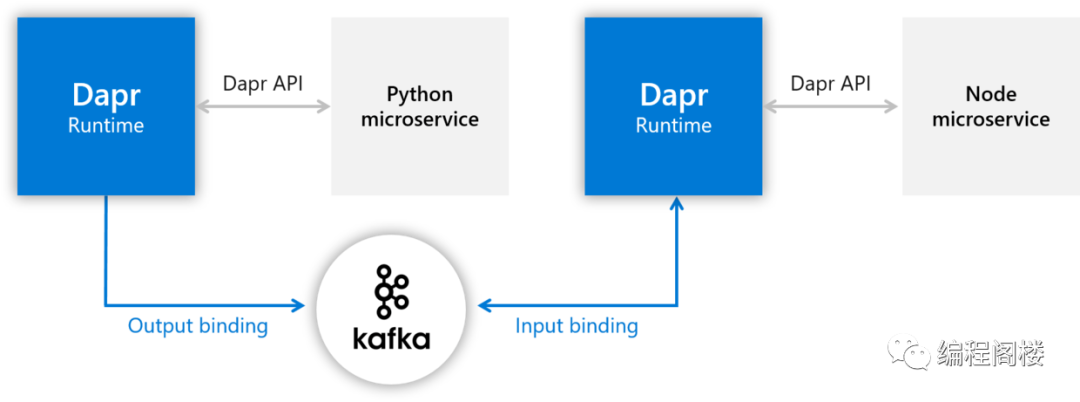
Input Bindings(输入绑定):当外部资源的事件发生时,借助输入绑定,你的应用即可通过特定的API: POST http://localhost:<appPort>/<name>
收到外部资源的事件,用于处理特定逻辑。Output Bindings(输出绑定):输出绑定允许你调用外部资源。比如,在订单处理场景中,在订单 创建成功后,可以将订单信息通过Dapr的绑定API: POST/PUT http://localhost: <daprPort>/v1.0/bindings/<name>
输出到Kafka特定队列上。
一个binding配置样例:
apiVersion: dapr.io/v1alpha1kind: Componentmetadata:name: sample-topicspec:type: bindings.kafkaversion: v1metadata:# Kafka broker connection setting- name: brokersvalue: [kafka broker address]# consumer configuration: topic and consumer group- name: topicsvalue: sample- name: consumerGroupvalue: group1# publisher configuration: topic- name: publishTopicvalue: sample- name: authRequiredvalue: "false
当前已支持的output binding components列表参见:bindings
6. Observability(可观测)