



❝开始讲算法的时候隐约有种回到20年前搞信息学奥赛拿的错觉,最近还真有人叫我开OI的班,技术扶贫怎么能收钱呢,虽然都开始扶贫大家的下一代了...
❞
串行排序
可能大家学算法的时候最开始学的就是排序算法, 而这些算法都是单机上的串行执行的排序算法。
冒泡和快排
这个就不用多解释了...
#include <stdio.h>
#include <stdlib.h>
#include <time.h>

#define swap(a, b) (a ^= b, b ^= a, a ^= b)
#define MAXN 10000

int cmpfunc(const void *a, const void *b)
{
    return (*(int *)a - *(int *)b);
}

void bubble_sort(int a[], int n)
{
    for (int j = 0; j < n - 1; j++)
    {
        for (int i = 0; i < n - 1 - j; i++)
            if (a[i] > a[i + 1])
            {
                swap(a[i], a[i + 1]);
            }
    }
}

int randInt(int min, int max)
{
    return rand() % (max - min) + min;
}

int main(int argc, char **argv)
{
    int n1[MAXN], n2[MAXN], n3[MAXN];
    struct timespec t1, t2;
    srand(time(NULL));

    for (int i = 0; i < MAXN; i++)
    {
        int value = randInt(0, 100000);
        n1[i] = value;
        n2[i] = value;
    }

    //bubble_sort
    clock_gettime(CLOCK_REALTIME, &t1);
    bubble_sort(n1, MAXN);
    clock_gettime(CLOCK_REALTIME, &t2);
    printf("bubble_sort:%ldns\n", (t2.tv_sec - t1.tv_sec) * 1000000000 + t2.tv_nsec - t1.tv_nsec);

    //quick_sort
    clock_gettime(CLOCK_REALTIME, &t1);
    qsort(n2, MAXN, sizeof(int), cmpfunc);
    clock_gettime(CLOCK_REALTIME, &t2);
    printf("quick_sort:%ldns\n", (t2.tv_sec - t1.tv_sec) * 1000000000 + t2.tv_nsec - t1.tv_nsec);
    return 0;
}
归并排序
这是一种简单的分治算法,通过将数据拆分成子序列,将子序列排序,然后将有序子列合并得到完全有序的序列。
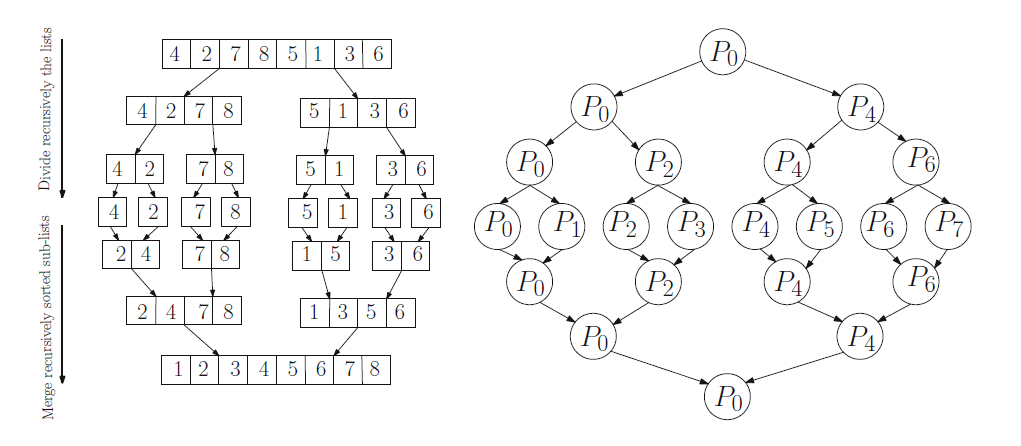
//merge A[head:mid], a[mid+1,tail], then write back to A[head:tail]
void merge(int arr[], int head, int mid, int tail)
{
    int i, j, k;
    int l_size = mid - head + 1;
    int r_size = tail - mid;

    //create temp array
    int *L = (int *)malloc((l_size) * sizeof(int));
    int *R = (int *)malloc((r_size) * sizeof(int));
    for (i = 0; i < l_size; i++)
        L[i] = arr[head + i];
    for (j = 0; j < r_size; j++)
        R[j] = arr[mid + 1 + j];
    i = 0;
    j = 0;
    k = head;

    //scan L and R
    while (i < l_size && j < r_size)
    {
        if (L[i] < R[j])
        {
            arr[k] = L[i];
            i++;
        }
        else
        {
            arr[k] = R[j];
            j++;
        }
        k++;
    }
    //copy remaining
    while (i < l_size)
    {
        arr[k] = L[i];
        i++;
        k++;
    }
    while (j < r_size)
    {
        arr[k] = R[j];
        j++;
        k++;
    }
    free(L);
    free(R);
}

void merge_sort(int arr[], int head, int tail)
{
    if (head < tail)
    {
        int mid = (head + tail) / 2;
        merge_sort(arr, head, mid);
        merge_sort(arr, mid + 1, tail);
        merge(arr, head, mid, tail);
    }
}
PSRS并行排序
Parallel Sorting by Regular Sampling, PSRS拼音输入法会自动联想成:破碎人生...真是有趣。这个算法分为四个阶段:
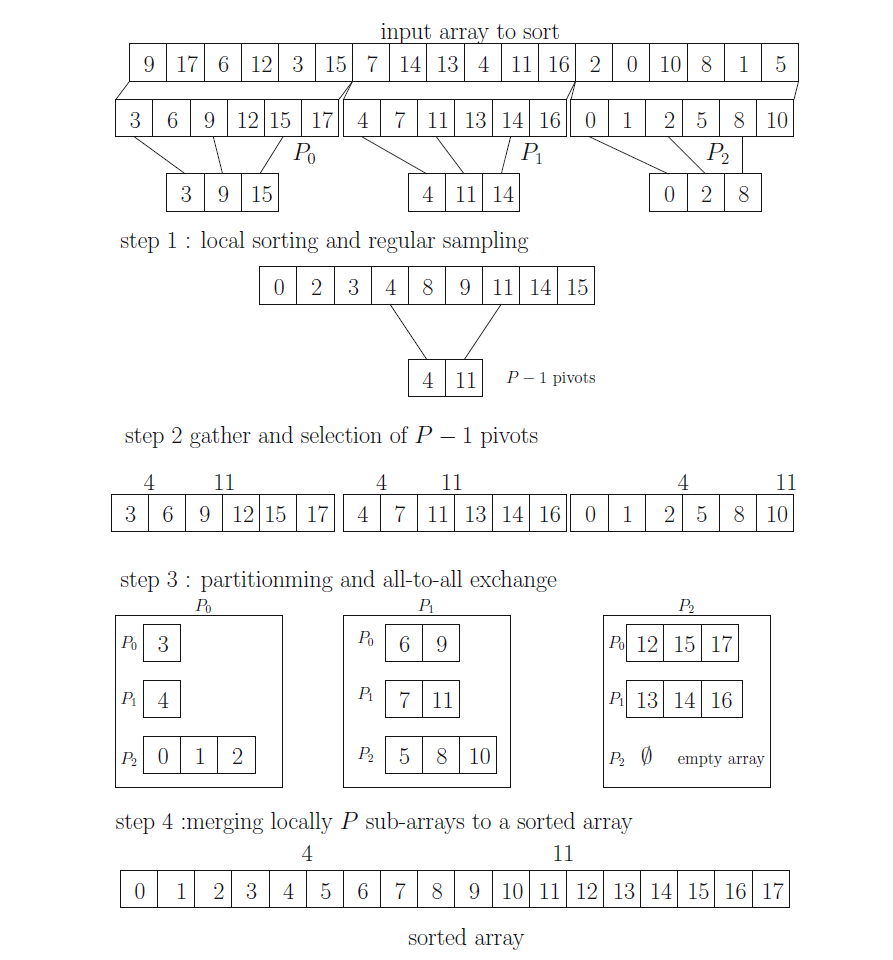
每个分区进程利用一个串行算法将本地数据排序 将本地数据正则采样,抽出关键值,然后对其归并排序后再进行正则采样 利用新的采样值对本地数据分区 合并数据,归并排序
分发数据
   //scatter source data to other nodes.
    int num_ele_per_node = MAXN / world_size;
    int mod = MAXN % world_size;
    int *sub_array = (int *)malloc(sizeof(int) * (num_ele_per_node + mod));

    int s_cnt[world_size];
    int s_offset[world_size];
    for (int i = 0; i < world_size; i++)
    {
        s_cnt[i] = num_ele_per_node;
        s_offset[i] = i * num_ele_per_node;
    }
    //剩余的分到最后一组
    s_cnt[world_size-1] = num_ele_per_node+mod;

    MPI_Scatterv(n4, s_cnt, s_offset, MPI_INT, sub_array, num_ele_per_node + mod, MPI_INT, 0, MPI_COMM_WORLD);
第一步,局部快排
    int group_len = s_cnt[world_rank];
    qsort(sub_array, group_len, sizeof(int), cmpfunc);
    int *samples = (int *)malloc(world_size * sizeof(int));
选择Regular Sample
    //step.1b select samples on each node
    int sq_world_size = world_size * world_size;
    for (int k = 1; k < world_size; k++)
        samples[k - 1] = sub_array[k * num_ele_per_node / world_size];

    //step.1c collect all samples
    int *global_samples = (int *)malloc(sq_world_size * sizeof(int));
    MPI_Gather(samples, world_size - 1, MPI_INT, global_samples, world_size - 1, MPI_INT, 0, MPI_COMM_WORLD);
选择全局分割点,并广播给其它各节点
  //step.1d select pivots
    int pivots[world_size];
    if (world_rank == 0)
    {
        qsort(global_samples, (world_size - 1) * world_size, sizeof(int), cmpfunc);
        for (int k = 1; k < world_size; k++)
            pivots[k - 1] = global_samples[k * (world_size - 1)];
    }
    //step.1e bcast pivots
    MPI_Bcast(pivots, world_size - 1, MPI_INT, 0, MPI_COMM_WORLD);
本地分割
    //step.2a split local array
    int index = 0;
    int p_cnt[world_size];
    for (int i = 0; i < world_size; i++)
        p_cnt[i] = 0;
    pivots[world_size - 1] = 2147483647;

    for (int i = 0; i < group_len; i++)
    {
        if (sub_array[i] <= pivots[index])
            p_cnt[index]++;
        else
        {
            i--;
            index++;
        }
    }
准备本地buffer和需要接收的数据
其中MPI_Alltoall是一个很经典的玩法,可以将每个节点的需要接收的数据同步。
    //step.2b exchange each segment length from p_cnt to r_cnt
    int r_cnt[world_size];
    MPI_Alltoall(p_cnt, 1, MPI_INT, r_cnt, 1, MPI_INT, MPI_COMM_WORLD);

    int r_offset[world_size];
    r_offset[0] = 0;
    s_offset[0] = 0;
    for (int i = 1; i < world_size; i++)
    {
        s_offset[i] = s_offset[i - 1] + p_cnt[i - 1];
        r_offset[i] = r_offset[i - 1] + r_cnt[i - 1];
    }

    int total_cnt = 0;
    for (int i = 0; i < world_size; i++)
        total_cnt += r_cnt[i];

    int *sub_array2 = (int *)malloc(total_cnt * sizeof(int));
    MPI_Alltoallv(sub_array, p_cnt, s_offset, MPI_INT, sub_array2, r_cnt, r_offset, MPI_INT, MPI_COMM_WORLD);
    merge_sort(sub_array2, 0, total_cnt - 1);
最后Gather拿到所有数据
    MPI_Gather(&total_cnt, 1, MPI_INT, r_cnt, 1, MPI_INT, 0, MPI_COMM_WORLD);
    r_offset[0] = 0;
    for (int i = 1; i < world_size; i++)
        r_offset[i] = r_offset[i - 1] + r_cnt[i - 1];

    MPI_Gatherv(sub_array2, total_cnt, MPI_INT, n5, r_cnt, r_offset, MPI_INT, 0, MPI_COMM_WORLD);
并行测试结果,可以见到当节点数大于2时就比qsort快了。
zartbot@zartbotWS:~/Desktop/mpi$ mpiexec -np 1 ./qs
mpi time:       30741448ns
quick_sort:     13068417ns
merge_sort:     19825194ns
zartbot@zartbotWS:~/Desktop/mpi$ mpiexec -np 2 ./qs
mpi time:       21733170ns
quick_sort:     13721354ns
merge_sort:     19732058ns
zartbot@zartbotWS:~/Desktop/mpi$ mpiexec -np 4 ./qs
mpi time:       13931970ns
quick_sort:     16625924ns
merge_sort:     20261184ns
zartbot@zartbotWS:~/Desktop/mpi$ mpiexec -np 8 ./qs
mpi time:        8299586ns
quick_sort:     16050739ns
merge_sort:     21257035ns
zartbot@zartbotWS:~/Desktop/mpi$ mpiexec -np 16 ./qs
mpi time:        4717631ns
quick_sort:     14314263ns
merge_sort:     21430261ns
zartbot@zartbotWS:~/Desktop/mpi$ mpiexec -np 24 ./qs
mpi time:        3984703ns
quick_sort:     22020000ns
merge_sort:     22696114ns
zartbot@zartbotWS:~/Desktop/mpi$ mpiexec -np 32 ./qs
mpi time:        3203447ns
quick_sort:     16230325ns
merge_sort:     21357250ns
zartbot@zartbotWS:~/Desktop/mpi$ mpiexec -np 48 ./qs
mpi time:        3565351ns
quick_sort:     15976286ns
merge_sort:     21657906ns
测试代码
#include <stdio.h>
#include <stdlib.h>
#include <time.h>
#include "mpi.h"

#define swap(a, b) (a ^= b, b ^= a, a ^= b)
#define MAXN 100000

int randInt(int min, int max)
{
    return rand() % (max - min) + min;
}

void bubble_sort(int arr[], int n)
{
    for (int j = 0; j < n - 1; j++)
    {
        for (int i = 0; i < n - 1 - j; i++)
            if (arr[i] > arr[i + 1])
            {
                swap(arr[i], arr[i + 1]);
            }
    }
}

int cmpfunc(const void *a, const void *b)
{
    return (*(int *)a - *(int *)b);
}

//merge A[head:mid], a[mid+1,tail], then write back to A[head:tail]
void merge(int arr[], int head, int mid, int tail)
{
    int i, j, k;
    int l_size = mid - head + 1;
    int r_size = tail - mid;

    //create temp array
    int *L = (int *)malloc((l_size) * sizeof(int));
    int *R = (int *)malloc((r_size) * sizeof(int));
    for (i = 0; i < l_size; i++)
        L[i] = arr[head + i];
    for (j = 0; j < r_size; j++)
        R[j] = arr[mid + 1 + j];
    i = 0;
    j = 0;
    k = head;

    //scan L and R
    while (i < l_size && j < r_size)
    {
        if (L[i] < R[j])
        {
            arr[k] = L[i];
            i++;
        }
        else
        {
            arr[k] = R[j];
            j++;
        }
        k++;
    }
    //copy remaining
    while (i < l_size)
    {
        arr[k] = L[i];
        i++;
        k++;
    }
    while (j < r_size)
    {
        arr[k] = R[j];
        j++;
        k++;
    }
    free(L);
    free(R);
}

void merge_sort(int arr[], int head, int tail)
{
    if (head < tail)
    {
        int mid = (head + tail) / 2;
        merge_sort(arr, head, mid);
        merge_sort(arr, mid + 1, tail);
        merge(arr, head, mid, tail);
    }
}

int main(int argc, char **argv)
{
    int n1[MAXN], n2[MAXN], n3[MAXN], n4[MAXN], n5[MAXN];

    double mpi_start_time, mpi_end_time;
    struct timespec t1, t2;
    srand(time(NULL));

    int world_rank, world_size;
    MPI_Init(&argc, &argv);
    MPI_Comm_size(MPI_COMM_WORLD, &world_size);
    MPI_Comm_rank(MPI_COMM_WORLD, &world_rank);

    //prepare random data
    if (world_rank == 0)
    {
        for (int i = 0; i < MAXN; i++)
        {
            int value = randInt(0, 100000);
            n1[i] = value;
            n2[i] = value;
            n3[i] = value;
            n4[i] = value;
            //printf("number[%d] is %d\n",i,number[i]);
        }
    }

    //scatter source data to other nodes.
    int num_ele_per_node = MAXN / world_size;
    int mod = MAXN % world_size;
    int *sub_array = (int *)malloc(sizeof(int) * (num_ele_per_node + mod));

    int s_cnt[world_size];
    int s_offset[world_size];
    for (int i = 0; i < world_size; i++)
    {
        s_cnt[i] = num_ele_per_node;
        s_offset[i] = i * num_ele_per_node;
    }
    //剩余的分到最后一组
    s_cnt[world_size-1] = num_ele_per_node+mod;

    MPI_Scatterv(n4, s_cnt, s_offset, MPI_INT, sub_array, num_ele_per_node + mod, MPI_INT, 0, MPI_COMM_WORLD);

    MPI_Barrier(MPI_COMM_WORLD);
    mpi_start_time = MPI_Wtime();

    //step.1a qsort sub array
    int group_len = s_cnt[world_rank];
    qsort(sub_array, group_len, sizeof(int), cmpfunc);
    int *samples = (int *)malloc(world_size * sizeof(int));

    //step.1b select samples on each node
    int sq_world_size = world_size * world_size;
    for (int k = 1; k < world_size; k++)
        samples[k - 1] = sub_array[k * num_ele_per_node / world_size];

    //step.1c collect all samples
    int *global_samples = (int *)malloc(sq_world_size * sizeof(int));
    MPI_Gather(samples, world_size - 1, MPI_INT, global_samples, world_size - 1, MPI_INT, 0, MPI_COMM_WORLD);

    //step.1d select pivots
    int pivots[world_size];
    if (world_rank == 0)
    {
        qsort(global_samples, (world_size - 1) * world_size, sizeof(int), cmpfunc);
        for (int k = 1; k < world_size; k++)
            pivots[k - 1] = global_samples[k * (world_size - 1)];
    }
    //step.1e bcast pivots
    MPI_Bcast(pivots, world_size - 1, MPI_INT, 0, MPI_COMM_WORLD);

    //step.2a split local array
    int index = 0;
    int p_cnt[world_size];
    for (int i = 0; i < world_size; i++)
        p_cnt[i] = 0;
    pivots[world_size - 1] = 2147483647;

    for (int i = 0; i < group_len; i++)
    {
        if (sub_array[i] <= pivots[index])
            p_cnt[index]++;
        else
        {
            i--;
            index++;
        }
    }

    //step.2b exchange each segment length from p_cnt to r_cnt
    int r_cnt[world_size];
    MPI_Alltoall(p_cnt, 1, MPI_INT, r_cnt, 1, MPI_INT, MPI_COMM_WORLD);

    int r_offset[world_size];
    r_offset[0] = 0;
    s_offset[0] = 0;
    for (int i = 1; i < world_size; i++)
    {
        s_offset[i] = s_offset[i - 1] + p_cnt[i - 1];
        r_offset[i] = r_offset[i - 1] + r_cnt[i - 1];
    }

    int total_cnt = 0;
    for (int i = 0; i < world_size; i++)
        total_cnt += r_cnt[i];

    int *sub_array2 = (int *)malloc(total_cnt * sizeof(int));
    MPI_Alltoallv(sub_array, p_cnt, s_offset, MPI_INT, sub_array2, r_cnt, r_offset, MPI_INT, MPI_COMM_WORLD);
    merge_sort(sub_array2, 0, total_cnt - 1);

    MPI_Gather(&total_cnt, 1, MPI_INT, r_cnt, 1, MPI_INT, 0, MPI_COMM_WORLD);
    r_offset[0] = 0;
    for (int i = 1; i < world_size; i++)
        r_offset[i] = r_offset[i - 1] + r_cnt[i - 1];

    MPI_Gatherv(sub_array2, total_cnt, MPI_INT, n5, r_cnt, r_offset, MPI_INT, 0, MPI_COMM_WORLD);

    MPI_Barrier(MPI_COMM_WORLD);
    mpi_end_time = MPI_Wtime();
    if (world_rank == 0)
    {
        printf("mpi time:%15.0fns\n", (mpi_end_time - mpi_start_time) * 1e9);
    }
    if (world_rank == 0)
    {
        /* bubble_sort
        clock_gettime(CLOCK_REALTIME, &t1);
        bubble_sort(n1, MAXN);
        clock_gettime(CLOCK_REALTIME, &t2);
        printf("bubble_sort:%ldns\n", (t2.tv_sec - t1.tv_sec) * 1000000000 + t2.tv_nsec - t1.tv_nsec);
        */
        //quick_sort
        clock_gettime(CLOCK_REALTIME, &t1);
        qsort(n2, MAXN, sizeof(int), cmpfunc);
        clock_gettime(CLOCK_REALTIME, &t2);
        printf("quick_sort:%13ldns\n", (t2.tv_sec - t1.tv_sec) * 1000000000 + t2.tv_nsec - t1.tv_nsec);

        //merge_sort
        clock_gettime(CLOCK_REALTIME, &t1);
        merge_sort(n3, 0, MAXN - 1);
        clock_gettime(CLOCK_REALTIME, &t2);
        printf("merge_sort:%13ldns\n", (t2.tv_sec - t1.tv_sec) * 1000000000 + t2.tv_nsec - t1.tv_nsec);

        //validate sort result
        for (int i = 0; i < MAXN; i++)
        {
            if (n2[i] != n5[i])
            {
                printf("number[%d] is %d-%d\n", i, n2[i], n5[i]);
            }
        }
    }

    MPI_Finalize();
    return 0;
}
文章转载自zartbot,如果涉嫌侵权,请发送邮件至:contact@modb.pro进行举报,并提供相关证据,一经查实,墨天轮将立刻删除相关内容。
