



主要针对一个WordCount的示例来对flink中关键组件如taskManager和jobMaster等服务的启动流程进行一个简要的分析。
示例代码
object WordCount {

  def main(args: Array[String]) {

    val params: ParameterTool = ParameterTool.fromArgs(args)

    // set up execution environment
    val env = ExecutionEnvironment.getExecutionEnvironment

    // make parameters available in the web interface
    env.getConfig.setGlobalJobParameters(params)
    val text =
      if (params.has("input")) {
        env.readTextFile(params.get("input"))
      } else {
        println("Executing WordCount example with default input data set.")
        println("Use --input to specify file input.")
        env.fromCollection(WordCountData.WORDS)
      }
//    text.flatMap(_.toLowerCase.split("\\W+").filter(p => p.nonEmpty)).map(a => (a,1)).groupBy(0).sum(1)
    val counts = text.flatMap { _.toLowerCase.split("\\W+") filter { _.nonEmpty } }
      .map { (_, 1) }
      .groupBy(0)
      .sum(1)

    if (params.has("output")) {
      counts.writeAsCsv(params.get("output"), "\n", " ")
      env.execute("Scala WordCount Example")
    } else {
      println("Printing result to stdout. Use --output to specify output path.")
      counts.print()
    }

  }
}
这是一个执行WordCount的操作,我们以这个demo为入口来对整个执行流程进行分析记录。
生成JobGraph流程
这里就先流水式地记录一下,之后的文章中再详细地进行分析。
org.apache.flink.api.scala.DataSet#print:
  def print(): Unit = {
    javaSet.print()
  }
org.apache.flink.api.java.DataSet#print()
public void print() throws Exception {
        List<T> elements = collect();
        for (T e: elements) {
            System.out.println(e);
        }
    }
org.apache.flink.api.java.DataSet#collect
public List<T> collect() throws Exception {
        final String id = new AbstractID().toString();
        final TypeSerializer<T> serializer = getType().createSerializer(getExecutionEnvironment().getConfig());

        this.output(new Utils.CollectHelper<>(id, serializer)).name("collect()");
        JobExecutionResult res = getExecutionEnvironment().execute();

        ArrayList<byte[]> accResult = res.getAccumulatorResult(id);
        if (accResult != null) {
执行和结果归集的过程。
org.apache.flink.api.java.ExecutionEnvironment#execute()
public JobExecutionResult execute() throws Exception {
        return execute(getDefaultName());
    }
org.apache.flink.api.java.ExecutionEnvironment#execute(java.lang.String)
    public JobExecutionResult execute(String jobName) throws Exception {
        final JobClient jobClient = executeAsync(jobName);

        try {
            if (configuration.getBoolean(DeploymentOptions.ATTACHED)) {
                lastJobExecutionResult = jobClient.getJobExecutionResult(userClassloader).get();
            } else {
                lastJobExecutionResult = new DetachedJobExecutionResult(jobClient.getJobID());
            }
    -----------------------------------------------------
job执行的方法。
org.apache.flink.api.java.ExecutionEnvironment#executeAsync(java.lang.String)
    @PublicEvolving
    public JobClient executeAsync(String jobName) throws Exception {
        checkNotNull(configuration.get(DeploymentOptions.TARGET), "No execution.target specified in your configuration file.");
        // StreamGraph与Plan都是Pipeline类型的
        // 生成执行计划
        final Plan plan = createProgramPlan(jobName);
        // pipeline执行工厂,
        final PipelineExecutorFactory executorFactory =
            executorServiceLoader.getExecutorFactory(configuration);

        checkNotNull(
            executorFactory,
            "Cannot find compatible factory for specified execution.target (=%s)",
            configuration.get(DeploymentOptions.TARGET));

        CompletableFuture<? extends JobClient> jobClientFuture = executorFactory
            .getExecutor(configuration)
            .execute(plan, configuration);

        try {
            JobClient jobClient = jobClientFuture.get();
            jobListeners.forEach(jobListener -> jobListener.onJobSubmitted(jobClient, null));
            return jobClient;
            --------------------
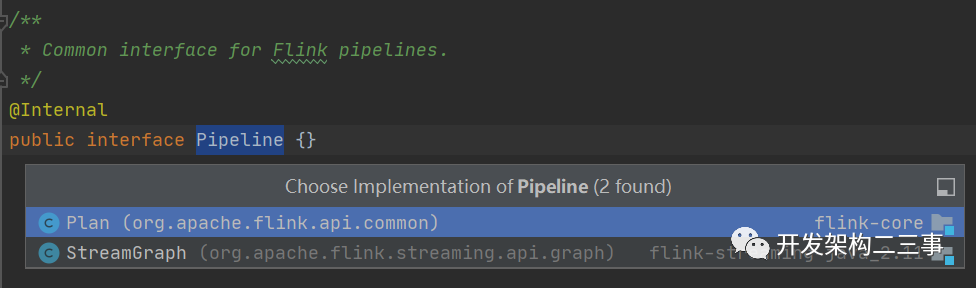
Pipeline有两个实现类:Plan和StreamGraph。当然在这个示例里生成的是Plan,在流式的情况下对应的就是StreamGraph类型。
继续往下看job的执行。
org.apache.flink.client.deployment.executors.LocalExecutor#execute
@Override
    public CompletableFuture<? extends JobClient> execute(Pipeline pipeline, Configuration configuration) throws Exception {
        checkNotNull(pipeline);
        checkNotNull(configuration);

        Configuration effectiveConfig = new Configuration();
        effectiveConfig.addAll(this.configuration);
        effectiveConfig.addAll(configuration);

        // we only support attached execution with the local executor.
        checkState(configuration.getBoolean(DeploymentOptions.ATTACHED));

        final JobGraph jobGraph = getJobGraph(pipeline, effectiveConfig);

        return PerJobMiniClusterFactory.createWithFactory(effectiveConfig, miniClusterFactory).submitJob(jobGraph);
    }
这里的pipeline会对应Plan或者StreamGraph,在getJobGraph方法中会将对应的Pipeline转换成JobGraph,然后通过submitJob方法提交。
org.apache.flink.client.program.PerJobMiniClusterFactory#submitJob
/**
     * Starts a {@link MiniCluster} and submits a job.
     */
    public CompletableFuture<? extends JobClient> submitJob(JobGraph jobGraph) throws Exception {
        MiniClusterConfiguration miniClusterConfig = getMiniClusterConfig(jobGraph.getMaximumParallelism());
        MiniCluster miniCluster = miniClusterFactory.apply(miniClusterConfig);
        miniCluster.start();

        return miniCluster
            .submitJob(jobGraph)
            .thenApply(result -> new PerJobMiniClusterJobClient(result.getJobID(), miniCluster))
            .whenComplete((ignored, throwable) -> {
                if (throwable != null) {
                    // We failed to create the JobClient and must shutdown to ensure cleanup.
                    shutDownCluster(miniCluster);
                }
            });
    }
在提交job时会创建一个MiniCluster,然后在miniCluster.start()中执行一些启动相关的操作。
org.apache.flink.runtime.minicluster.MiniCluster#start:
public void start() throws Exception {
        synchronized (lock) {
        ----------------------
        miniClusterConfiguration.getConfiguration();
            final boolean useSingleRpcService = miniClusterConfiguration.getRpcServiceSharing() == RpcServiceSharing.SHARED;

            try {
                initializeIOFormatClasses(configuration);

                LOG.info("Starting Metrics Registry");
                metricRegistry = createMetricRegistry(configuration);

                // bring up all the RPC services
                LOG.info("Starting RPC Service(s)");

                final RpcServiceFactory dispatcherResourceManagreComponentRpcServiceFactory;

                if (useSingleRpcService) {
                    // 如果是single模式
                    // we always need the 'commonRpcService' for auxiliary calls
                    commonRpcService = createLocalRpcService(configuration);
                    final CommonRpcServiceFactory commonRpcServiceFactory = new CommonRpcServiceFactory(commonRpcService);
                    taskManagerRpcServiceFactory = commonRpcServiceFactory;
                    dispatcherResourceManagreComponentRpcServiceFactory = commonRpcServiceFactory;
                } else {
                    // 其他模式
                    // start a new service per component, possibly with custom bind addresses
                    --------------------------
                    // we always need the 'commonRpcService' for auxiliary calls
                    // bind to the JobManager address with port 0
                    commonRpcService = createRemoteRpcService(configuration, jobManagerBindAddress, 0);
                }

                    //启动metric actor service
                RpcService metricQueryServiceRpcService = MetricUtils.startMetricsRpcService(
                    configuration,
                    commonRpcService.getAddress());
                metricRegistry.startQueryService(metricQueryServiceRpcService, null);

                processMetricGroup = MetricUtils.instantiateProcessMetricGroup(
                    metricRegistry,
                    RpcUtils.getHostname(commonRpcService),
                    ConfigurationUtils.getSystemResourceMetricsProbingInterval(configuration));
                // 创建 io executor 这里使用的是fixed threadPool
                ioExecutor = Executors.newFixedThreadPool(
                    Hardware.getNumberCPUCores(),
                    new ExecutorThreadFactory("mini-cluster-io"));
                haServices = createHighAvailabilityServices(configuration, ioExecutor);
                // 创建blobServer并启动
                blobServer = new BlobServer(configuration, haServices.createBlobStore());
                blobServer.start();
                // 启动心跳service
                heartbeatServices = HeartbeatServices.fromConfiguration(configuration);

                blobCacheService = new BlobCacheService(
                    configuration, haServices.createBlobStore(), new InetSocketAddress(InetAddress.getLocalHost(), blobServer.getPort())
                );
                // 启动taskManager
                startTaskManagers();

                MetricQueryServiceRetriever metricQueryServiceRetriever = new RpcMetricQueryServiceRetriever(metricRegistry.getMetricQueryServiceRpcService());

                setupDispatcherResourceManagerComponents(configuration, dispatcherResourceManagreComponentRpcServiceFactory, metricQueryServiceRetriever);

                resourceManagerLeaderRetriever = haServices.getResourceManagerLeaderRetriever();
                dispatcherLeaderRetriever = haServices.getDispatcherLeaderRetriever();
                clusterRestEndpointLeaderRetrievalService = haServices.getClusterRestEndpointLeaderRetriever();
                // dispatcher网关的retriever
                dispatcherGatewayRetriever = new RpcGatewayRetriever<>(
                    commonRpcService,
                    DispatcherGateway.class,
                    DispatcherId::fromUuid,
                    20,
                    Time.milliseconds(20L));
                // 资源管理器网关retriever
                resourceManagerGatewayRetriever = new RpcGatewayRetriever<>(
                    commonRpcService,
                    ResourceManagerGateway.class,
                    ResourceManagerId::fromUuid,
                    20,
                    Time.milliseconds(20L));
                // web monitor
                webMonitorLeaderRetriever = new LeaderRetriever();
                // 启动几个component
                resourceManagerLeaderRetriever.start(resourceManagerGatewayRetriever);
                dispatcherLeaderRetriever.start(dispatcherGatewayRetriever);
                clusterRestEndpointLeaderRetrievalService.start(webMonitorLeaderRetriever);
                ----------------------------
这里会调用commonRpcService = createLocalRpcService(configuration)方法创建本地的RpcService,在这里会调用AkkaRpcServiceUtils中的remoteServiceBuilder方法构建本地的actor servcie:
protected RpcService createRemoteRpcService(
            Configuration configuration,
            String bindAddress,
            int bindPort) throws Exception {
        return AkkaRpcServiceUtils.remoteServiceBuilder(configuration, bindAddress, String.valueOf(bindPort))
            .withBindAddress(bindAddress)
            .withBindPort(bindPort)
            .withCustomConfig(AkkaUtils.testDispatcherConfig())
            .createAndStart();
    }
org.apache.flink.runtime.minicluster.MiniCluster#startTaskManagers:
    @GuardedBy("lock")
    private void startTaskManagers() throws Exception {
        final int numTaskManagers = miniClusterConfiguration.getNumTaskManagers();

        LOG.info("Starting {} TaskManger(s)", numTaskManagers);

        for (int i = 0; i < numTaskManagers; i++) {
            startTaskExecutor();
        }
    }
org.apache.flink.runtime.minicluster.MiniCluster#startTaskExecutor:
@VisibleForTesting
    void startTaskExecutor() throws Exception {
        synchronized (lock) {
            final Configuration configuration = miniClusterConfiguration.getConfiguration();

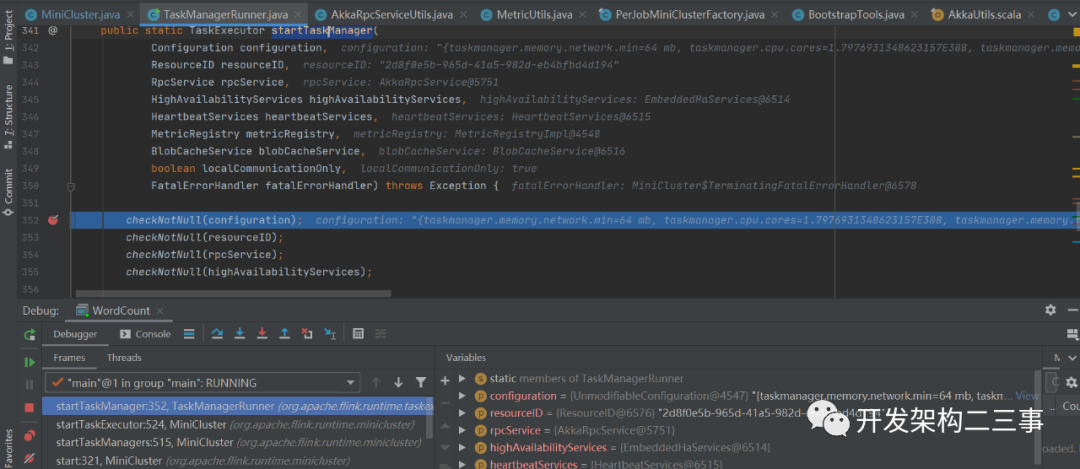
            final TaskExecutor taskExecutor = TaskManagerRunner.startTaskManager(
                configuration,
                new ResourceID(UUID.randomUUID().toString()),
                taskManagerRpcServiceFactory.createRpcService(),
                haServices,
                heartbeatServices,
                metricRegistry,
                blobCacheService,
                useLocalCommunication(),
                taskManagerTerminatingFatalErrorHandlerFactory.create(taskManagers.size()));

            taskExecutor.start();
            taskManagers.add(taskExecutor);
        }
    }
org.apache.flink.runtime.taskexecutor.TaskManagerRunner#startTaskManager:
org.apache.flink.runtime.taskexecutor.TaskManagerServices#fromConfiguration:
    /**
     * Creates and returns the task manager services.
     *
     * @param taskManagerServicesConfiguration task manager configuration
     * @param taskManagerMetricGroup metric group of the task manager
     * @param taskIOExecutor executor for async IO operations
     * @return task manager components
     * @throws Exception
     */
    public static TaskManagerServices fromConfiguration(
            TaskManagerServicesConfiguration taskManagerServicesConfiguration,
            MetricGroup taskManagerMetricGroup,
            Executor taskIOExecutor) throws Exception {

        // pre-start checks
        checkTempDirs(taskManagerServicesConfiguration.getTmpDirPaths());
        // 创建 dispatcher
        final TaskEventDispatcher taskEventDispatcher = new TaskEventDispatcher();

        // start the I/O manager, it will create some temp directories.
        final IOManager ioManager = new IOManagerAsync(taskManagerServicesConfiguration.getTmpDirPaths());

        final ShuffleEnvironment<?, ?> shuffleEnvironment = createShuffleEnvironment(
            taskManagerServicesConfiguration,
            taskEventDispatcher,
            taskManagerMetricGroup);
        final int listeningDataPort = shuffleEnvironment.start();
        // 创建并启动KvStateService
        final KvStateService kvStateService = KvStateService.fromConfiguration(taskManagerServicesConfiguration);
        kvStateService.start();

        final UnresolvedTaskManagerLocation unresolvedTaskManagerLocation = new UnresolvedTaskManagerLocation(
            taskManagerServicesConfiguration.getResourceID(),
            taskManagerServicesConfiguration.getExternalAddress(),
            // we expose the task manager location with the listening port
            // iff the external data port is not explicitly defined
            taskManagerServicesConfiguration.getExternalDataPort() > 0 ?
                taskManagerServicesConfiguration.getExternalDataPort() :
                listeningDataPort);
        // 广播变量管理
        final BroadcastVariableManager broadcastVariableManager = new BroadcastVariableManager();
        // slot table
        final TaskSlotTable<Task> taskSlotTable = createTaskSlotTable(
            taskManagerServicesConfiguration.getNumberOfSlots(),
            taskManagerServicesConfiguration.getTaskExecutorResourceSpec(),
            taskManagerServicesConfiguration.getTimerServiceShutdownTimeout(),
            taskManagerServicesConfiguration.getPageSize());
        // job manager table
        final JobManagerTable jobManagerTable = new JobManagerTable();
        // JobLeaderService
        final JobLeaderService jobLeaderService = new JobLeaderService(unresolvedTaskManagerLocation, taskManagerServicesConfiguration.getRetryingRegistrationConfiguration());

        final String[] stateRootDirectoryStrings = taskManagerServicesConfiguration.getLocalRecoveryStateRootDirectories();

        final File[] stateRootDirectoryFiles = new File[stateRootDirectoryStrings.length];

        for (int i = 0; i < stateRootDirectoryStrings.length; ++i) {
            stateRootDirectoryFiles[i] = new File(stateRootDirectoryStrings[i], LOCAL_STATE_SUB_DIRECTORY_ROOT);
        }
        // 本地状态管理器
        final TaskExecutorLocalStateStoresManager taskStateManager = new TaskExecutorLocalStateStoresManager(
            taskManagerServicesConfiguration.isLocalRecoveryEnabled(),
            stateRootDirectoryFiles,
            taskIOExecutor);
        // io执行器
        final ExecutorService ioExecutor = Executors.newSingleThreadExecutor(new ExecutorThreadFactory("taskexecutor-io"));
        // 几个taskManagerService的集合
        return new TaskManagerServices(
            unresolvedTaskManagerLocation,
            taskManagerServicesConfiguration.getManagedMemorySize().getBytes(),
            ioManager,
            shuffleEnvironment,
            kvStateService,
            broadcastVariableManager,
            taskSlotTable,
            jobManagerTable,
            jobLeaderService,
            taskStateManager,
            taskEventDispatcher,
            ioExecutor);
    }
这里会创建并启动一系列的taskManager内部的service,这其中也包括org.apache.flink.runtime.taskexecutor.JobLeaderService。
到了这里,taskManager的初始化部分以及启动部分都已经完成,我们再回过头来看org.apache.flink.runtime.minicluster.MiniCluster#submitJob方法:
public CompletableFuture<JobSubmissionResult> submitJob(JobGraph jobGraph) {
        final CompletableFuture<DispatcherGateway> dispatcherGatewayFuture = getDispatcherGatewayFuture();
        final CompletableFuture<InetSocketAddress> blobServerAddressFuture = createBlobServerAddress(dispatcherGatewayFuture);
        final CompletableFuture<Void> jarUploadFuture = uploadAndSetJobFiles(blobServerAddressFuture, jobGraph);
        final CompletableFuture<Acknowledge> acknowledgeCompletableFuture = jarUploadFuture
            .thenCombine(
                dispatcherGatewayFuture,
                (Void ack, DispatcherGateway dispatcherGateway) -> dispatcherGateway.submitJob(jobGraph, rpcTimeout))
            .thenCompose(Function.identity());
        return acknowledgeCompletableFuture.thenApply(
            (Acknowledge ignored) -> new JobSubmissionResult(jobGraph.getJobID()));
    }
org.apache.flink.runtime.dispatcher.Dispatcher#submitJob:
@Override
    public CompletableFuture<Acknowledge> submitJob(JobGraph jobGraph, Time timeout) {
        log.info("Received JobGraph submission {} ({}).", jobGraph.getJobID(), jobGraph.getName());

        try {
            if (isDuplicateJob(jobGraph.getJobID())) {
                return FutureUtils.completedExceptionally(
                    new DuplicateJobSubmissionException(jobGraph.getJobID()));
            } else if (isPartialResourceConfigured(jobGraph)) {
                return FutureUtils.completedExceptionally(
                    new JobSubmissionException(jobGraph.getJobID(), "Currently jobs is not supported if parts of the vertices have " +
                            "resources configured. The limitation will be removed in future versions."));
            } else {
                return internalSubmitJob(jobGraph);
            }
        } catch (FlinkException e) {
            return FutureUtils.completedExceptionally(e);
        }
    }
org.apache.flink.runtime.dispatcher.Dispatcher#internalSubmitJob:
private CompletableFuture<Acknowledge> internalSubmitJob(JobGraph jobGraph) {
        log.info("Submitting job {} ({}).", jobGraph.getJobID(), jobGraph.getName());

        final CompletableFuture<Acknowledge> persistAndRunFuture = waitForTerminatingJobManager(jobGraph.getJobID(), jobGraph, this::persistAndRunJob)
            .thenApply(ignored -> Acknowledge.get());

        return persistAndRunFuture.handleAsync((acknowledge, throwable) -> {
            if (throwable != null) {
                cleanUpJobData(jobGraph.getJobID(), true);
                -------------------------
进入org.apache.flink.runtime.dispatcher.Dispatcher#persistAndRunJob方法:
private CompletableFuture<Void> persistAndRunJob(JobGraph jobGraph) throws Exception {
        jobGraphWriter.putJobGraph(jobGraph);

        final CompletableFuture<Void> runJobFuture = runJob(jobGraph);

        return runJobFuture.whenComplete(BiConsumerWithException.unchecked((Object ignored, Throwable throwable) -> {
            if (throwable != null) {
                jobGraphWriter.removeJobGraph(jobGraph.getJobID());
            }
        }));
    }
org.apache.flink.runtime.dispatcher.Dispatcher#runJob:
    private CompletableFuture<Void> runJob(JobGraph jobGraph) {
        Preconditions.checkState(!jobManagerRunnerFutures.containsKey(jobGraph.getJobID()));

        final CompletableFuture<JobManagerRunner> jobManagerRunnerFuture = createJobManagerRunner(jobGraph);

        jobManagerRunnerFutures.put(jobGraph.getJobID(), jobManagerRunnerFuture);

        return jobManagerRunnerFuture
            .thenApply(FunctionUtils.uncheckedFunction(this::startJobManagerRunner))
            .thenApply(FunctionUtils.nullFn())
            .whenCompleteAsync(
                (ignored, throwable) -> {
                    if (throwable != null) {
                        jobManagerRunnerFutures.remove(jobGraph.getJobID());
                    }
                },
                getMainThreadExecutor());
    }
org.apache.flink.runtime.dispatcher.Dispatcher#createJobManagerRunner:
private CompletableFuture<JobManagerRunner> createJobManagerRunner(JobGraph jobGraph) {
        final RpcService rpcService = getRpcService();

        return CompletableFuture.supplyAsync(
            CheckedSupplier.unchecked(() ->
                jobManagerRunnerFactory.createJobManagerRunner(
                    jobGraph,
                    configuration,
                    rpcService,
                    highAvailabilityServices,
                    heartbeatServices,
                    jobManagerSharedServices,
                    new DefaultJobManagerJobMetricGroupFactory(jobManagerMetricGroup),
                    fatalErrorHandler)),
            rpcService.getExecutor());
    }
通过org.apache.flink.runtime.dispatcher.DefaultJobManagerRunnerFactory#createJobManagerRunner创建JobManagerRunnerImpl实例:
public JobManagerRunnerImpl(
            final JobGraph jobGraph,
            final JobMasterServiceFactory jobMasterFactory,
            final HighAvailabilityServices haServices,
            final LibraryCacheManager libraryCacheManager,
            final Executor executor,
            final FatalErrorHandler fatalErrorHandler) throws Exception {

        this.resultFuture = new CompletableFuture<>();
        this.terminationFuture = new CompletableFuture<>();
        this.leadershipOperation = CompletableFuture.completedFuture(null);

        // make sure we cleanly shut down out JobManager services if initialization fails
        try {
            this.jobGraph = checkNotNull(jobGraph);
            this.libraryCacheManager = checkNotNull(libraryCacheManager);
            this.executor = checkNotNull(executor);
            this.fatalErrorHandler = checkNotNull(fatalErrorHandler);

            checkArgument(jobGraph.getNumberOfVertices() > 0, "The given job is empty");

            // libraries and class loader first
            try {
                libraryCacheManager.registerJob(
                        jobGraph.getJobID(), jobGraph.getUserJarBlobKeys(), jobGraph.getClasspaths());
            } catch (IOException e) {
                throw new Exception("Cannot set up the user code libraries: " + e.getMessage(), e);
            }

            final ClassLoader userCodeLoader = libraryCacheManager.getClassLoader(jobGraph.getJobID());
            if (userCodeLoader == null) {
                throw new Exception("The user code class loader could not be initialized.");
            }

            // high availability services next
            this.runningJobsRegistry = haServices.getRunningJobsRegistry();
            this.leaderElectionService = haServices.getJobManagerLeaderElectionService(jobGraph.getJobID());

            this.leaderGatewayFuture = new CompletableFuture<>();
            // org.apache.flink.runtime.jobmaster.JobMasterService这个和taskManager中的jobMasterService是不同的
            // now start the JobManager
            this.jobMasterService = jobMasterFactory.createJobMasterService(jobGraph, this, userCodeLoader);
        }
        ----------------------
jobMasterFactory.createJobMasterService(jobGraph, this, userCodeLoader):
@Override
    public JobMaster createJobMasterService(
            JobGraph jobGraph,
            OnCompletionActions jobCompletionActions,
            ClassLoader userCodeClassloader) throws Exception {

        return new JobMaster(
            rpcService,
            jobMasterConfiguration,
            ResourceID.generate(),
            jobGraph,
            haServices,
            slotPoolFactory,
            schedulerFactory,
            jobManagerSharedServices,
            heartbeatServices,
            jobManagerJobMetricGroupFactory,
            jobCompletionActions,
            fatalErrorHandler,
            userCodeClassloader,
            schedulerNGFactory,
            shuffleMaster,
            lookup -> new JobMasterPartitionTrackerImpl(
                jobGraph.getJobID(),
                shuffleMaster,
                lookup
            ));
    }
这里创建了JobMaster。
org.apache.flink.runtime.dispatcher.Dispatcher#startJobManagerRunner:
    private JobManagerRunner startJobManagerRunner(JobManagerRunner jobManagerRunner) throws Exception {
        final JobID jobId = jobManagerRunner.getJobID();

        FutureUtils.assertNoException(
            jobManagerRunner.getResultFuture().handleAsync(
                (ArchivedExecutionGraph archivedExecutionGraph, Throwable throwable) -> {
                    // check if we are still the active JobManagerRunner by checking the identity
                    final JobManagerRunner currentJobManagerRunner = Optional.ofNullable(jobManagerRunnerFutures.get(jobId))
                        .map(future -> future.getNow(null))
                        .orElse(null);
                    //noinspection ObjectEquality
                    ------------------------
                }, getMainThreadExecutor()));

        jobManagerRunner.start();

        return jobManagerRunner;
    }
在这里启动jobMaster。
在Local client、taskManager、jobMaster中都会启动对应的一个actor service,然后相互之间会进行通信,如心跳和任务分配等。
