如果你还在担心以下问题:
没有学习资源; 没有学习路线; 没有学习平台;
那么上述的问题都不是问题,因为Kaggle官方已经提供了丰富的学习资料,具体Kaggle的Courses
页面。
如果你按照要求学习完成,还会获得Kaggle官方认证的证书,是不是非常赞!
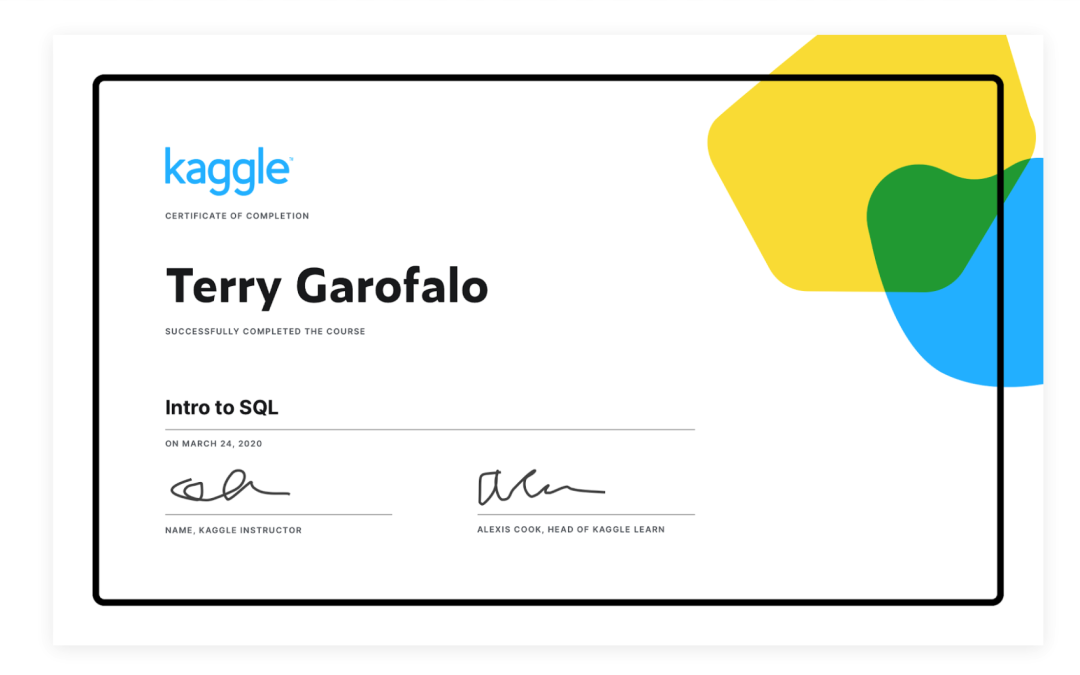
课程内容如下,非常推荐入门学习!
Python
Learn the most important language for data science.
课程链接:https://www.kaggle.com/learn/python
课程章节:
Hello, Python
: A quick introduction to Python syntax, variable assignment, and numbers.Functions and Getting Help
: Calling functions and defining our own, and using Python's builtin documentationBooleans and Conditionals
: Using booleans for branching logicLists
: Lists and the things you can do with them. Includes indexing, slicing and mutatingLoops and List Comprehensions
: For and while loops, and a much-loved Python feature: list comprehensionsStrings and Dictionaries
: Working with strings and dictionaries, two fundamental Python data typesWorking with External Libraries
: Imports, operator overloading, and survival tips for venturing into the world of external libraries
Intro to Machine Learning
Learn the core ideas in machine learning, and build your first models.
课程链接:https://www.kaggle.com/learn/intro-to-machine-learning
How Models Work
:The first step if you're new to machine learning.Basic Data Exploration
: Load and understand your data.First ML Model
:Building your first model. Hurray!Model Validation
: Measure the performance of your model ? so you can test and compare alternatives.Underfitting and Overfitting
: Fine-tune your model for better performance.Random Forests
: Using a more sophisticated machine learning algorithm.Machine Learning Competitions
: Enter the world of machine learning competitions to keep improving and see your progress.Intro to AutoML
: Learn how to use automated machine learning (AutoML) to accelerate your work.Getting Started With Titanic
: Create your own Kaggle Notebooks to organize your work in competitions.
Intermediate Machine Learning
Learn to handle missing values, non-numeric values, data leakage and more. Your models will be more accurate and useful.
课程链接:https://www.kaggle.com/learn/intermediate-machine-learning
Introduction
: Review what you need for this Micro-CourseMissing Values
: Missing values happen. Be prepared for this common challenge in real datasets.Categorical Variables
: There is a lot of non-numeric data out there. Here's how to use it for machine learning.Pipelines
: A critical skill for deploying (and even testing) complex models with pre-processing.Cross-Validation
: A better way to test your models.XGBoost
: The most accurate modeling technique for structured data.Data Leakage
: Find and fix this problem that ruins your model in subtle ways.
Data Visualization
Make great data visualizations. A great way to see the power of coding!
课程链接:https://www.kaggle.com/learn/data-visualization
Hello, Seaborn
: Your first introduction to coding for data visualization.Line Charts
: Visualize trends over time.Bar Charts and Heatmaps
: Use color or length to compare categories in a dataset.Scatter Plots
: Leverage the coordinate plane to explore relationships between variables.Distributions
: Create histograms and density plots.Choosing Plot Types and Custom Styles
: Customize your charts and make them look snazzy.Final Project
: Practice for real-world application.Creating Your Own Notebooks
: How to put your new skills to use for your next personal or work project.
Pandas
Solve short hands-on challenges to perfect your data manipulation skills.
课程链接:https://www.kaggle.com/learn/pandas
Creating, Reading and Writing
: You can't work with data if you can't read it. Get started here.Indexing, Selecting & Assigning
: Pro data scientists do this dozens of times a day. You can, too!Summary Functions and Maps
: Extract insights from your data.Grouping and Sorting
: Scale up your level of insight. The more complex the dataset, the more this matters.Data Types and Missing Values
: Deal with the most common progress-blocking problems.Renaming and Combining
: Data comes in from many sources. Help it all make sense together.
Intro to Deep Learning
Use TensorFlow and Keras to build and train neural networks for structured data.
课程链接:https://www.kaggle.com/learn/intro-to-deep-learning
A Single Neuron
: Learn about linear units, the building blocks of deep learning.Deep Neural Networks
: Add hidden layers to your network to uncover complex relationships.Stochastic Gradient Descent
: Use Keras and Tensorflow to train your first neural network.Overfitting and Underfitting
: Improve performance with extra capacity or early stopping.Dropout and Batch Normalization
: Add these special layers to prevent overfitting and stabilize training.Binary Classification
: Apply deep learning to another common task.Detecting the Higgs Boson With TPUs
: Get started with Tensor Processing Units (TPUs)!
Intro to SQL
Learn SQL for working with databases, using Google BigQuery to scale to massive datasets.
课程链接:https://www.kaggle.com/learn/intro-to-sql
Getting Started With SQL and BigQuery
: Learn the workflow for handling big datasets with BigQuery and SQL.Select, From & Where
: The foundational compontents for all SQL queries.Group By, Having & Count
: Get more interesting insights directly from your SQL queries.Order By
: Order your results to focus on the most important data for your use case.As & With
: Organize your query for better readability. This becomes especially important for complex queries.Joining Data
: Combine data sources. Critical for almost all real-world data problems.
Advanced SQL
Take your SQL skills to the next level.
课程链接:https://www.kaggle.com/learn/advanced-sql
JOINs and UNIONs
: Combine information from multiple tables. insert_drive_file.Analytic Functions
: Perform complex calculations on groups of rows.Nested and Repeated Data
: Learn to query complex datatypes in BigQuery.Writing Efficient Queries
: Write queries to run faster and use less data.
Data Cleaning
Master efficient workflows for cleaning real-world, messy data.
课程链接:https://www.kaggle.com/learn/data-cleaning
Handling Missing Values
: Drop missing values, or fill them in with an automated workflow.Scaling and Normalization
: Transform numeric variables to have helpful properties.Parsing Dates
: Help Python recognize dates as composed of day, month, and year.Character Encodings
: Avoid UnicoodeDecodeErrors when loading CSV files.Inconsistent Data Entry
: Efficiently fix typos in your data.
Geospatial Analysis
Create interactive maps, and discover patterns in geospatial data.
课程链接:https://www.kaggle.com/learn/geospatial-analysis
Your First Map
: Get started with plotting in GeoPandas. insert_drive_file.Coordinate Reference Systems
: It's pretty amazing that we can represent the Earth's surface in 2 dimensions!Interactive Maps
: Learn how to make interactive heatmaps, choropleth maps, and more!Manipulating Geospatial Data
: Find locations with just the name of a place. And, learn how to join data based on spatial relationships.Proximity Analysis
: Measure distance, and explore neighboring points on a map.
Machine Learning Explainability
Extract human-understandable insights from any machine learning model.
课程链接:https://www.kaggle.com/learn/machine-learning-explainability
Use Cases for Model Insights
: Why and when do you need insights?Permutation Importance
: What features does your model think are important?Partial Plots
: How does each feature affect your predictions? check.SHAP Values
: Understand individual predictions.Advanced Uses of SHAP Values
: Aggregate SHAP values for even more detailed model insights.
Microchallenges
Solve ultra-short challenges to build and test your skill.
课程链接:https://www.kaggle.com/learn/microchallenges
Blackjack Microchallenge
: Test your logic and programming skills by building a better blackjack player.Airline Price Optimization Microchallenge
: Can you improve how airlines set ticket prices?
Feature Engineering
Discover the most effective way to improve your models.
课程链接:https://www.kaggle.com/learn/feature-engineering
Baseline Model
: Building a baseline model as a starting point for feature engineering.Categorical Encodings
: There are many ways to encode categorical data for modeling. Some are pretty clever.Feature Generation
: The frequently useful case where you can combine data from multiple rows into useful features.Feature Selection
: You can make a lot of features. Here's how to get the best set of features for your model.
Natural Language Processing
Distinguish yourself by learning to work with text data.
课程链接:https://www.kaggle.com/learn/natural-language-processing
Intro to NLP
: Get started with NLP.Text Classification
: Combine machine learning with your newfound NLP skills.Word Vectors
: Explore an idea that ushered in a new generation of NLP techniques.
Intro to Game AI and Reinforcement Learning
Build your own video game bots, using classic algorithms and cutting-edge techniques.
课程链接:https://www.kaggle.com/learn/intro-to-game-ai-and-reinforcement-learning
Play the Game
: Write your first game-playing agent.One-Step Lookahead
: Make your agent smarter with a few simple changes.N-Step Lookahead
: Use the minimax algorithm to dramatically improve your agent.Deep Reinforcement Learning
: Explore advanced techniques for creating intelligent agents.Getting Started With Halite
: Put your new skills to the test with a more complex game.
Computer Vision
Create image classifiers with TensorFlow and Keras, and explore convolutional neural networks.
The Convolutional Classifier
: Create your first computer vision model with Keras.Convolution and ReLU
: Discover how convnets create features with convolutional layers.Maximum Pooling
: Learn more about feature extraction with maximum pooling.The Sliding Window
: Explore two important parameters: stride and padding.Custom Convnets
: Design your own convnet.Data Augmentation
: Boost performance by creating extra training data.Create Your First Submission
: Use Kaggle's free TPUs to make a submission to the Petals to the Metal competition!

若进群失败,可在后台回复【竞赛群】
即可得到最新的二维码!

若进群失败,可在后台回复【数据分析群】
即可得到最新的二维码!