virtio 是一种通用的半虚拟化的 I/O 通信协议,提供了一套前后端 I/O 通信的的框架协议和编程接口。根据该协议实现的设备通过前后端的配合,相比全模拟设备可以大幅减少陷入陷出以及内存拷贝的次数,使 guest 获得高效的 I/O 性能。作为目前虚拟化标准的通用协议规范,经历了 0.95、1.0、1.1 三个版本的演进。根据 0.95 版本实现的称为传统 virtio 设备,1.0 版本修改了一些 PCI 配置空间的访问方式和 virtioqueue 的优化和特定设备的约定,1.1 版本则增加了 packed virtqueue 的支持,详细可以参考官方发布的 virtio 协议规范。
之所以称 virtio 是一种半虚拟化的解决方案,是因为其首先需要在主机侧通过软件创建 virito 的后端设备,其次在 Guest 要有对应的设备前端驱动,前后端通过共享内存进行通信。virtio 规范定义了设备的控制和数据面接口,控制面接口包括设备状态、feature 的协商等,数据面则包括共享内存的数据布局定义以及前后端的通知方式。基于 virtio 协议,目前已衍生出了 virtio-blk、virtio-net、virtio-scsi、virtio-mem 等各种各样的半虚拟化设备。virtio 设备可以支持多种传输层协议,既可以挂载到 MMIO 总线,也可以作为 PCI 设备,另外还可以支持基于标准 I/O 通道机制的 S/390 设备。
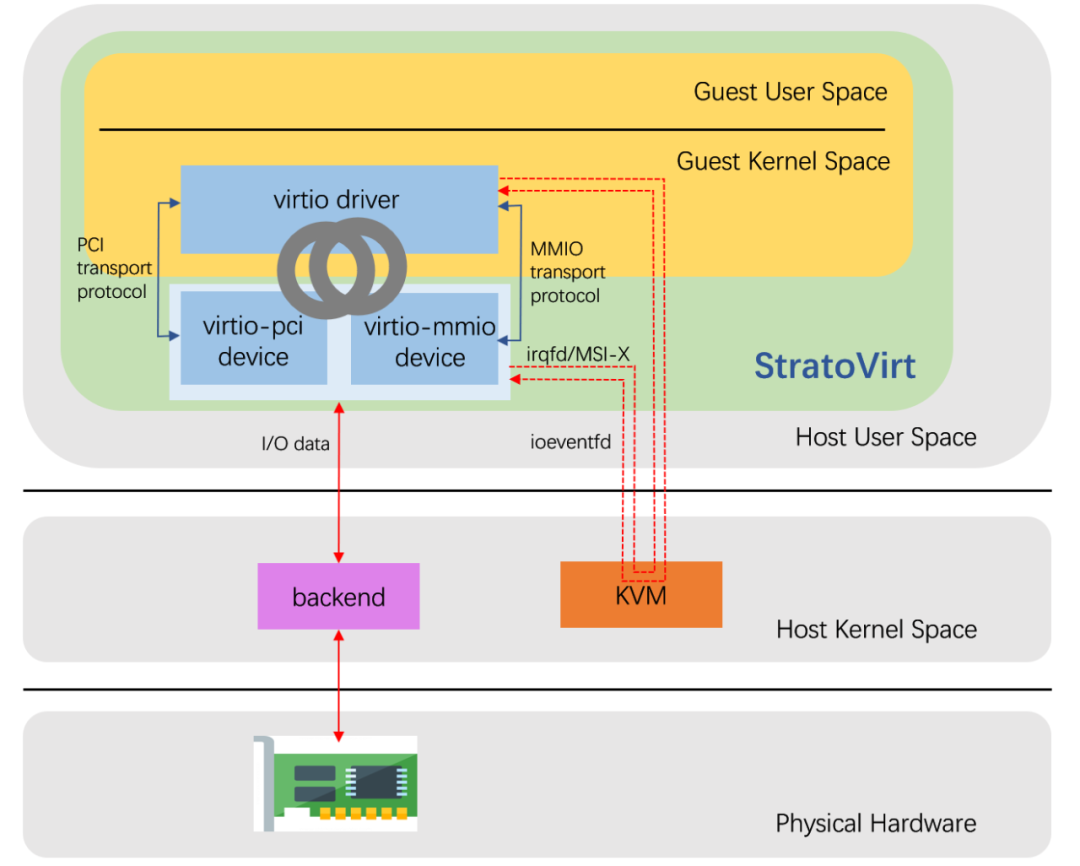
鉴于 virtio 设备具备较好的性能及通用性,StratoVirt 自然也支持,StratoVirt 中 virtio 设备的实现架构以及 I/O 通信流程如上图所示。下面就基于目前最新的代码,探究一下 StratoVirt 中 virtio 设备的代码实现框架。
VirtioDevice Trait
StratoVirt 的 virtio crate 提供了 virtio 设备的通用接口以及所有 virtio 设备的相关实现。其中,lib.rs 中定义了为所有 virtio 设备定义的 VirtioDevice Trait。每种 virtio 设备都需要实现自定义的 VirtioDevice 接口。
/// The trait for virtio device operations.pub trait VirtioDevice: Send { /// Realize low level device. fn realize(&mut self) -> Result<()>; /// Unrealize low level device fn unrealize(&mut self) -> Result<()> { bail!("Unrealize of the virtio device is not implemented"); } /// Get the virtio device type, refer to Virtio Spec. fn device_type(&self) -> u32; /// Get the count of virtio device queues. fn queue_num(&self) -> usize; /// Get the queue size of virtio device. fn queue_size(&self) -> u16; /// Get device features from host. fn get_device_features(&self, features_select: u32) -> u32; /// Set driver features by guest. fn set_driver_features(&mut self, page: u32, value: u32); /// Read data of config from guest. fn read_config(&self, offset: u64, data: &mut [u8]) -> Result<()>; /// Write data to config from guest. fn write_config(&mut self, offset: u64, data: &[u8]) -> Result<()>; /// Activate the virtio device, this function is called by vcpu thread when frontend /// virtio driver is ready and write `DRIVER_OK` to backend. /// /// # Arguments /// /// * `mem_space` - System mem. /// * `interrupt_evt` - The eventfd used to send interrupt to guest. /// * `interrupt_status` - The interrupt status present to guest. /// * `queues` - The virtio queues. /// * `queue_evts` - The notifier events from guest. fn activate( &mut self, mem_space: Arc<AddressSpace>, interrupt_cb: Arc<VirtioInterrupt>, queues: &[Arc<Mutex<Queue>>], queue_evts: Vec<EventFd>, ) -> Result<()>; /// Deactivate virtio device, this function remove event fd /// of device out of the event loop. fn deactivate(&mut self) -> Result<()> { bail!( "Reset this device is not supported, virtio dev type is {}", self.device_type() ); } /// Reset virtio device. fn reset(&mut self) -> Result<()> { Ok(()) } /// Update the low level config of MMIO device, /// for example: update the images file fd of virtio block device. /// /// # Arguments /// /// * `_file_path` - The related backend file path. fn update_config(&mut self, _dev_config: Option<Arc<dyn ConfigCheck>>) -> Result<()> { bail!("Unsupported to update configuration") }}
realize()/unrealize(): 这一组接口用于具现化/去具现化具体的 virtio 设备。具现化做的一些具体操作包括设置支持的 features、设备特有的属性(如网卡的 mac)、初始化连接 Host 后端设备等。 set_driver_features():将前端驱动支持的 features 与后端模拟设备支持的 features 进行协商后,设置最终实现的 features。 read_config()/write_config():virtio 协议规范为每种 virtio 设备定义了自定义的配置空间,这组接口就是用来读写这部分配置数据。 activate()/deactivate(): 激活/去激活设备,负责绑定/解绑后端、加入/移除 I/O 循环。 reset():虚拟机重启时某些设备需要重置。 update_config():支持轻量机型下的 virtio-mmio 设备动态绑定/解绑后端,实现 virtio-mmio 设备的模拟热插拔。
virtqueue
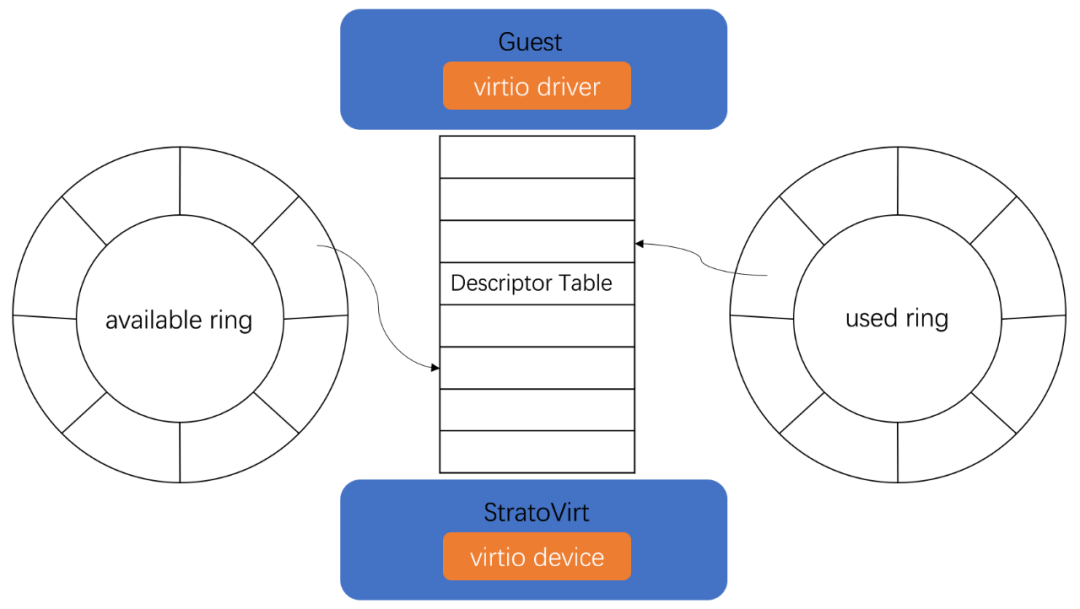
virtio 设备可以有一个或多个队列,每个队列有描述符表、available ring、used ring 三个部分。当前 StratoVirt 的 virtio 设备均遵循 1.0 规范,队列的内存布局仅支持 Split Vring 的方式。queue.rs 中定义了一系列针对队列操作及查询的接口。所有的 I/O 请求数据信息以描述符的形式存放在描述符表中,前端准备好数据后更新 available ring 告诉后端还有哪些 I/O 待发送,后端执行完 I/O 更新 used ring 通知前端。不同设备的 I/O 处理不尽相同,但是核心的 virtqueue 操作是一样的。
pub struct SplitVring { /// Region cache information. pub cache: Option<RegionCache>, /// Guest physical address of the descriptor table. /// The table is composed of descriptors(SplitVringDesc). pub desc_table: GuestAddress, /// Guest physical address of the available ring. /// The ring is composed of flags(u16), idx(u16), ring[size](u16) and used_event(u16). pub avail_ring: GuestAddress, /// Guest physical address of the used ring. /// The ring is composed of flags(u16), idx(u16), used_ring[size](UsedElem) and avail_event(u16). pub used_ring: GuestAddress, /// Host address cache. pub addr_cache: VirtioAddrCache, /// Indicate whether the queue configuration is finished. pub ready: bool, /// The maximal size in elements offered by the device. pub max_size: u16, /// The queue size set by frontend. pub size: u16, /// Interrupt vector index of the queue for msix pub vector: u16, /// The next index which can be popped in the available vring. next_avail: Wrapping<u16>, /// The next index which can be pushed in the used vring. next_used: Wrapping<u16>, /// The index of last descriptor used which has triggered interrupt. last_signal_used: Wrapping<u16>,}
virtio-mmio 设备
StratoVirt 目前提供两种机型:轻量机型和标准机型。轻量机型由于需要追求极致的启动速度以及内存底噪开销,因此只支持挂载数量有限的 virtio-mmio 设备。而标准机型面向传统的标准云化场景,对于 I/O 设备的性能要求较高,且需要支持热插拔满足资源弹性,因此标准机型支持将 virtio 设备以 PCI 设备挂载在模拟的 PCI 总线上。目前标准机型只支持配置 virtio-pci 设备,不支持 virtio-mmio 设备。
结构体 VirtioMmioDevice 定义了一个通用的 virtio-mmio 设备,其中的 device 即为实现了 VirtioDevice 这个 trait 的具体的 virtio 设备结构,可以是网卡、磁盘等。VirtioMmioState 结构体中存放了 virtio-mmio 设备的控制寄存器,并且为其实现了对应的读写接口 read_common_config()/write_common_config()。virtio-mmio 设备的配置空间布局如下图所示:

interrupt_evt 通过 irqfd 向虚拟机注入中断,host_notify_info 则为每个队列创建了一个 eventfd,虚拟机利用 ioeventfd 机制陷出到 StratoVirt 执行后端的 I/O 处理。
pub struct VirtioMmioDevice { // The entity of low level device. pub device: Arc<Mutex<dyn VirtioDevice>>, // EventFd used to send interrupt to VM interrupt_evt: EventFd, // Interrupt status. interrupt_status: Arc<AtomicU32>, // HostNotifyInfo used for guest notifier host_notify_info: HostNotifyInfo, // The state of virtio mmio device. state: VirtioMmioState, // System address space. mem_space: Arc<AddressSpace>, // Virtio queues. queues: Vec<Arc<Mutex<Queue>>>, // System Resource of device. res: SysRes,}
VirtioMmioDevice 实现了 realize 接口完成设备的具现化:
调用各设备实现的 VirtioDevice trait 的具现化接口。 virtio-mmio 设备挂载在了系统总线上,StratoVirt 为每个设备分配 512 字节的配置空间。除此之外,需要为其注册 irqfd 以便后续 I/O 完成后向虚拟机注入中断。这些信息都保存在 SysRes 数据结构中。 添加内核启动参数,通过内核启动参数将设备的内存区间及中断号信息直接告诉 Guest。
pub fn realize( mut self, sysbus: &mut SysBus, region_base: u64, region_size: u64, #[cfg(target_arch = "x86_64")] bs: &Arc<Mutex<BootSource>>,) -> Result<Arc<Mutex<Self>>> { self.device .lock() .unwrap() .realize() .chain_err(|| "Failed to realize virtio.")?; if region_base >= sysbus.mmio_region.1 { bail!("Mmio region space exhausted."); } self.set_sys_resource(sysbus, region_base, region_size)?; let dev = Arc::new(Mutex::new(self)); sysbus.attach_device(&dev, region_base, region_size)?; #[cfg(target_arch = "x86_64")] bs.lock().unwrap().kernel_cmdline.push(Param { param_type: "virtio_mmio.device".to_string(), value: format!( "{}@0x{:08x}:{}", region_size, region_base, dev.lock().unwrap().res.irq ), }); Ok(dev)}
前端驱动加载过程中会读写设备的配置空间,前后端完成 feature 的协商,一切 OK 后前端驱动将向配置空间写状态,后端设备将会调用 activate 方法激活设备。当触发激活时,前端已为这三个部分分配了内存空间,Guest 物理地址(GPA)已写入设备的配置空间,后端需要将 GPA 地址转化为 Host 虚拟地址(HVA)。随后,就可以根据队列配置创建队列,并将 I/O 的 eventfd 加入事件循环激活设备开始 I/O 通信。
virtio-pci 设备
如上所述,virtio 设备也可以作为一个 PCI 类设备挂载到 PCI 总线上。类似的,在 StratoVirt 中用结构体 VirtioPciDevice 来表示一个 virtio-pci 设备。既然是作为一个 PCI 设备,virtio-pci 就需要拥有符合 PCI 规范拥有 PCI 设备的配置空间,Guest 启动后通过 PCI 设备树枚举来发现设备,而不是像 virtio-mmio 设备一样直接通过内核启动参数告诉 Guest。
pub struct VirtioPciDevice { /// Name of this device name: String, /// The entity of virtio device device: Arc<Mutex<dyn VirtioDevice>>, /// Device id dev_id: Arc<AtomicU16>, /// Devfn devfn: u8, /// If this device is activated or not. device_activated: Arc<AtomicBool>, /// Memory AddressSpace sys_mem: Arc<AddressSpace>, /// Pci config space. config: PciConfig, /// Virtio common config refer to Virtio Spec. common_config: Arc<Mutex<VirtioPciCommonConfig>>, /// Primary Bus parent_bus: Weak<Mutex<PciBus>>, /// Eventfds used for notifying the guest. notify_eventfds: NotifyEventFds, /// The function for interrupt triggering interrupt_cb: Option<Arc<VirtioInterrupt>>, /// Virtio queues. The vector and Queue will be shared acrossing thread, so all with Arc<Mutex<..>> wrapper. queues: Arc<Mutex<Vec<Arc<Mutex<Queue>>>>>, /// Multi-Function flag. multi_func: bool,}
VirtioPciDevice 通过实现 PciDevOps trait 的 realize()方法完成设备的具现化:
初始化 PCI 配置寄存器。 将 virtio 协议规定的 common configuration、notifications、ISR status、Device-specific configuration 作为四个 PCI 设备的 capability, 对应数据的内存空间则映射到第 3 个 BAR 空间的不同部分。配置空间布局如下图所示:
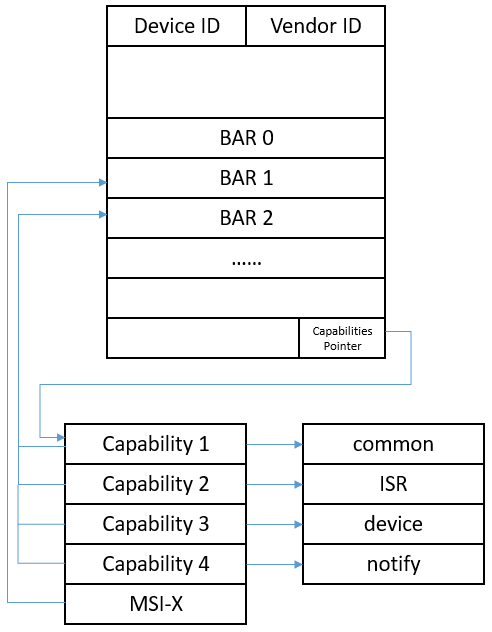
前端驱动对于各空间的访问的回调函数由 modern_mem_region_init()注册,当前端读写这部分内存区间时会陷出到 StratoVirt 执行注册的回调接口。每个队列在 notification cap 指向的空间中占据 4 个字节,StratoVirt 为每个队列的 4 个字节空间注册 ioeventfd。前端驱动准备好某个队列后,就会写对应队列的这 4 个字节的地址空间,后端借助 ioeventfd 机制收到通知后陷出进行 host 侧的 I/O 下发。 中断机制采用 MSI-X,向量表和 pending 位图则位于第 2 个 BAR 空间。
参考资料
[1]: http://docs.oasis-open.org/virtio/virtio/v1.0/virtio-v1.0.html
关注我们
StratoVirt 已经在 openEuler 社区开源。后续将开展一系列主题分享,如果您对 StratoVirt 的使用、实现感兴趣,欢迎您围观和加入。
项目地址
https://gitee.com/openeuler/stratovirt
您也可以订阅邮件列表
https://mailweb.openeuler.org/postorius/lists/virt.openeuler.org/
入群
如果您对虚拟化技术感兴趣,欢迎加入 Virt SIG 技术交流群,讨论 StratoVirt、KVM、QEMU 和 Libvirt 等虚拟化相关技术。您可以添加如下微信小助手,回复 StratoVirt 入群。