
学习 探索 分享数据库前沿知识和技术 共建数据库技术交流圈
上篇图文,我们分享了安全认证中认证机制、Kerberos安全认证的精彩内容,本篇将详细介绍安全管理源码解析——角色管理的相关内容。
9.3 角色管理
角色是拥有数据库对象和权限的实体,在不同的环境中角色可以认为是一个用户、一个组或者兼顾两者。角色管理包含了角色的创建、修改、删除、权限授予和回收操作。
9.3.1 角色创建
如果在openGauss上需要创建一个角色,可以使用SQL命令CREATE ROLE,其语法为:
CREATE ROLE role_name [ [ WITH ] option [ ... ] ] [ ENCRYPTED | UNENCRYPTED ] { PASSWORD | IDENTIFIED BY } { 'password' | DISABLE };
创建角色是通过函数CreateRole实现的,其函数接口为:
void CreateRole(CreateRoleStmt* stmt)
其中,CreateRoleStmt为创建角色时所需的数据结构,具体数据结构代码如下:
typedef struct CreateRoleStmt {NodeTag type;RoleStmtType stmt_type; /* 将要创建的角色类型 ROLE/USER/GROUP */char* role; /* 角色名 */List* options; /* 角色属性列表 */} CreateRoleStmt;
字段stmt_type是枚举类型,相关代码如下:
typedef enum RoleStmtType {ROLESTMT_ROLE, /* 代表创建角色 */ROLESTMT_USER, /* 代表创建用户 */ROLESTMT_GROUP, /* 代表创建组用户 */} RoleStmtType;
字段option用来存储角色的属性信息,具体的数据结构为:
typedef struct DefElem {NodeTag type;char* defnamespace; /* 节点对应的命名空间 */char* defname; /* 节点对应的角色属性名 */Node* arg; /* 表示值或类型名 */DefElemAction defaction; /* SET/ADD/DROP 等其他未指定的行为 */} DefElem;
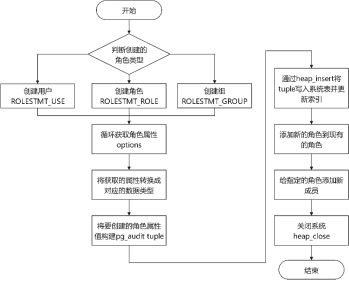
创建角色时先判断所要创建的角色类型。如果是创建用户,则设置其canlogin属性为true,因为用户默认具有登录权限。而创建角色和创建组时,若角色属性参数没有声明的话,则canlogin属性默认为false。相关代码如下:
/* 默认值可能因原始语句类型而异 */switch (stmt->stmt_type) {case ROLESTMT_ROLE:break;case ROLESTMT_USER:canlogin = true;break;case ROLESTMT_GROUP:break;default:break;}
检查完所要创建的角色类型以后,开始循环获取角色属性options中的内容,并将其转换成对应的角色属性值类型。相关代码如下:
/* 从node tree中获取option */foreach (option, stmt->options) {DefElem* defel = (DefElem*)lfirst(option);if (strcmp(defel->defname, "password") == 0 || strcmp(defel->defname, "encryptedPassword") == 0 ||strcmp(defel->defname, "unencryptedPassword") == 0) {if (dpassword != NULL) {clean_role_password(dpassword);ereport(ERROR, (errcode(ERRCODE_SYNTAX_ERROR), errmsg("conflicting or redundant options")));}dpassword = defel;if (strcmp(defel->defname, "encryptedPassword") == 0)encrypt_password = true;else if (strcmp(defel->defname, "unencryptedPassword") == 0) {clean_role_password(dpassword);ereport(ERROR,(errcode(ERRCODE_INSUFFICIENT_PRIVILEGE),errmsg("Permission denied to create role with option UNENCRYPTED.")));}} else if (strcmp(defel->defname, "sysid") == 0) {ereport(NOTICE, (errmsg("SYSID can no longer be specified")));} else if (strcmp(defel->defname, "inherit") == 0) {if (dinherit != NULL) {clean_role_password(dpassword);ereport(ERROR, (errcode(ERRCODE_SYNTAX_ERROR), errmsg("conflicting or redundant options")));}dinherit = defel;} else if (strcmp(defel->defname, "createrole") == 0) {if (dcreaterole != NULL) {clean_role_password(dpassword);ereport(ERROR, (errcode(ERRCODE_SYNTAX_ERROR), errmsg("conflicting or redundant options")));}dcreaterole = defel;} else if (strcmp(defel->defname, "createdb") == 0) {if (dcreatedb != NULL) {clean_role_password(dpassword);ereport(ERROR, (errcode(ERRCODE_SYNTAX_ERROR), errmsg("conflicting or redundant options")));}dcreatedb = defel;} else if (strcmp(defel->defname, "useft") == 0) {if (duseft != NULL) {clean_role_password(dpassword);ereport(ERROR, (errcode(ERRCODE_SYNTAX_ERROR), errmsg("conflicting or redundant options")));}duseft = defel;……
根据对应的参数信息转换需要的角色属性值类型,如提取issuper值和createrole值等。相关代码如下:
if (dissuper != NULL)issuper = intVal(dissuper->arg) != 0;if (dinherit != NULL)inherit = intVal(dinherit->arg) != 0;if (dcreaterole != NULL)createrole = intVal(dcreaterole->arg) != 0;if (dcreatedb != NULL)createdb = intVal(dcreatedb->arg) != 0;……
在完成了转换以后,将角色属性值以及角色的信息一起构建一个pg_authid的元组,再写回系统表并更新索引。作相关代码如下:
/* 检查pg_authid relation,确认该角色没有存在*/Relation pg_authid_rel = heap_open(AuthIdRelationId, RowExclusiveLock);TupleDesc pg_authid_dsc = RelationGetDescr(pg_authid_rel);if (OidIsValid(get_role_oid(stmt->role, true))) {str_reset(password);ereport(ERROR, (errcode(ERRCODE_DUPLICATE_OBJECT), errmsg("role \"%s\" already exists", stmt->role)));}……/* 创建一个插入的tuple */errno_t errorno = memset_s(new_record, sizeof(new_record), 0, sizeof(new_record));securec_check(errorno, "\0", "\0");errorno = memset_s(new_record_nulls, sizeof(new_record_nulls), false, sizeof(new_record_nulls));securec_check(errorno, "\0", "\0");new_record[Anum_pg_authid_rolname - 1] = DirectFunctionCall1(namein, CStringGetDatum(stmt->role));new_record[Anum_pg_authid_rolsuper - 1] = BoolGetDatum(issuper);new_record[Anum_pg_authid_rolinherit - 1] = BoolGetDatum(inherit);new_record[Anum_pg_authid_rolcreaterole - 1] = BoolGetDatum(createrole);new_record[Anum_pg_authid_rolcreatedb - 1] = BoolGetDatum(createdb);new_record[Anum_pg_authid_rolcatupdate - 1] = BoolGetDatum(issuper);new_record[Anum_pg_authid_rolcanlogin - 1] = BoolGetDatum(canlogin);new_record[Anum_pg_authid_rolreplication - 1] = BoolGetDatum(isreplication);new_record[Anum_pg_authid_rolauditadmin - 1] = BoolGetDatum(isauditadmin);new_record[Anum_pg_authid_rolsystemadmin - 1] = BoolGetDatum(issystemadmin);new_record[Anum_pg_authid_rolconnlimit - 1] = Int32GetDatum(connlimit);……HeapTuple tuple = heap_form_tuple(pg_authid_dsc, new_record, new_record_nulls);if (u_sess->proc_cxt.IsBinaryUpgrade && OidIsValid(u_sess->upg_cxt.binary_upgrade_next_pg_authid_oid)) {HeapTupleSetOid(tuple, u_sess->upg_cxt.binary_upgrade_next_pg_authid_oid);u_sess->upg_cxt.binary_upgrade_next_pg_authid_oid = InvalidOid;}roleid = simple_heap_insert(pg_authid_rel, tuple);if (IsUnderPostmaster) {if (OidIsValid(rpoid) && (rpoid != DEFAULT_POOL_OID))recordDependencyOnRespool(AuthIdRelationId, roleid, rpoid);u_sess->wlm_cxt->wlmcatalog_update_user = true;}……
完成更新以后,将新创建的角色加入指定存在的父角色中。相关代码如下:
/* 将新角色添加到指定的现有角色中 */foreach (item, addroleto) {char* oldrolename = strVal(lfirst(item));Oid oldroleid = get_role_oid(oldrolename, false);AddRoleMems(oldrolename, oldroleid, list_make1(makeString(stmt->role)), list_make1_oid(roleid), GetUserId(), false);}AddRoleMems(stmt->role, roleid, adminmembers, roleNamesToIds(adminmembers), GetUserId(), true);AddRoleMems(stmt->role, roleid, rolemembers, roleNamesToIds(rolemembers), GetUserId(), false);
至此就完成了整个角色创建的过程。
9.3.2 角色管理
1. 修改角色属性
修改一个数据库角色可以使用SQL命令ALTER ROLE。角色属性的修改是通过调用AlterRole函数来实现的,该函数只有一个类型为AlterRoleStmt结构的参数。相关代码如下:
typedef struct AlterRoleStmt {NodeTag type;char* role; /* 角色的名称 */List* options; /* 需要修改的属性列表 */int action; /* +1增加成员关系, -1删除成员关系 */RoleLockType lockstatus; /* 角色锁定状态 */} AlterRoleStmt;
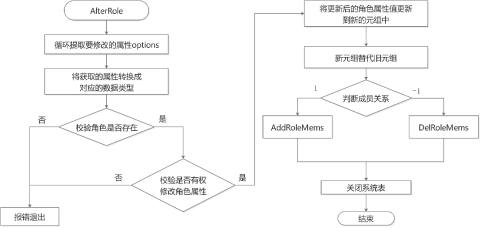
调用函数AlterRole修改用户角色属性时,首先循环判断options,依次提取要修改的角色属性;然后查看系统表pg_authid判断是否已存在该角色,如果不存在则提示报错;再进行相应的权限判断,检查执行者是否有权限去更改该角色的属性;最后构建一个新的元组,将要更改的属性更新到新元组中,存入系统表pg_authid。同时AlterRole函数也可以用来调整角色的成员关系,结构体中的action字段值设置为1和-1分别表示增加和删除成员关系,该选项将在授予和回收角色章节具体描述。AlterRole函数的具体实现代码如下:
void AlterRole(AlterRoleStmt* stmt){. . ./* 循环提取角色的属性options */foreach (option, stmt->options) {DefElem* defel = (DefElem*)lfirst(option);if (strcmp(defel->defname, "password") == 0 || strcmp(defel->defname, "encryptedPassword") == 0 ||strcmp(defel->defname, "unencryptedPassword") == 0) {if (dpassword != NULL) {clean_role_password(dpassword);ereport(ERROR, (errcode(ERRCODE_SYNTAX_ERROR), errmsg("conflicting or redundant options")));}dpassword = defel;if (strcmp(defel->defname, "encryptedPassword") == 0)encrypt_password = true;else if (strcmp(defel->defname, "unencryptedPassword") == 0) {clean_role_password(dpassword);ereport(ERROR,(errcode(ERRCODE_INVALID_ROLE_SPECIFICATION),errmsg("Permission denied to create role with option UNENCRYPTED.")));}} else if (strcmp(defel->defname, "createrole") == 0) {if (dcreaterole != NULL) {clean_role_password(dpassword);ereport(ERROR, (errcode(ERRCODE_SYNTAX_ERROR), errmsg("conflicting or redundant options")));}dcreaterole = defel;} else if (strcmp(defel->defname, "inherit") == 0) {if (dinherit != NULL) {clean_role_password(dpassword);ereport(ERROR, (errcode(ERRCODE_SYNTAX_ERROR), errmsg("conflicting or redundant options")));}dinherit = defel;}. . .else {clean_role_password(dpassword);ereport(ERROR,(errcode(ERRCODE_UNRECOGNIZED_NODE_TYPE), errmsg("option \"%s\" not recognized", defel->defname)));}}/* 将提取的属性赋值给对应的变量 */if (dpassword != NULL && dpassword->arg != NULL) {head = list_head((List*)dpassword->arg);if (head != NULL) {pwdargs = (A_Const*)linitial((List*)dpassword->arg);if (pwdargs != NULL) {password = strVal(&pwdargs->val);}if (lnext(head)) {pwdargs = (A_Const*)lsecond((List*)dpassword->arg);if (pwdargs != NULL) {replPasswd = strVal(&pwdargs->val);}}}}if (dinherit != NULL)inherit = intVal(dinherit->arg);if (dcreaterole != NULL)createrole = intVal(dcreaterole->arg);. . ./* 查看要修改的角色是否存在,不存在则提示报错 */Relation pg_authid_rel = heap_open(AuthIdRelationId, RowExclusiveLock);HeapTuple tuple = SearchSysCache1(AUTHNAME, PointerGetDatum(stmt->role));if (!HeapTupleIsValid(tuple)) {str_reset(password);str_reset(replPasswd);if (!have_createrole_privilege())ereport(ERROR, (errcode(ERRCODE_INSUFFICIENT_PRIVILEGE), errmsg("Permission denied.")));elseereport(ERROR, (errcode(ERRCODE_UNDEFINED_OBJECT), errmsg("role \"%s\" does not exist", stmt->role)));}roleid = HeapTupleGetOid(tuple);. . ./* 检查是否有权限更改相应角色的属性,权限不足则提示报错 */if (roleid == BOOTSTRAP_SUPERUSERID) {if (!(issuper < 0 && inherit < 0 && createrole < 0 && createdb < 0 && canlogin < 0 && isreplication < 0 &&isauditadmin < 0 && issystemadmin < 0 && isvcadmin < 0 && useft < 0 && dconnlimit == NULL &&rolemembers == NULL && validBegin == NULL && validUntil == NULL && drespool == NULL &&dparent == NULL && dnode_group == NULL && dspacelimit == NULL && dtmpspacelimit == NULL &&dspillspacelimit == NULL)) {str_reset(password);str_reset(replPasswd);ereport(ERROR,(errcode(ERRCODE_INSUFFICIENT_PRIVILEGE),errmsg("Permission denied to change privilege of the initial account.")));}}if (dpassword != NULL && roleid == BOOTSTRAP_SUPERUSERID && GetUserId() != BOOTSTRAP_SUPERUSERID) {str_reset(password);str_reset(replPasswd);ereport(ERROR,(errcode(ERRCODE_INSUFFICIENT_PRIVILEGE),errmsg("Permission denied to change password of the initial account.")));}. . .} else if (!have_createrole_privilege()) {if (!(inherit < 0 && createrole < 0 && createdb < 0 && canlogin < 0 && isreplication < 0 && isauditadmin < 0 &&issystemadmin < 0 && isvcadmin < 0 && useft < 0 && dconnlimit == NULL && rolemembers == NULL &&validBegin == NULL && validUntil == NULL && !*respool && !OidIsValid(parentid) && dnode_group == NULL &&!spacelimit && !tmpspacelimit && !spillspacelimit &&/* if not superuser or have createrole privilege, permission of lock and unlock is denied */stmt->lockstatus == DO_NOTHING &&/* if alter password, it will be handled below */roleid == GetUserId()) ||(roleid != GetUserId() && dpassword == NULL)) {str_reset(password);str_reset(replPasswd);ereport(ERROR, (errcode(ERRCODE_INSUFFICIENT_PRIVILEGE), errmsg("Permission denied.")));}}.../* 将要更改的角色属性值分别更新到新元组中,再将新元组替代旧元组存入系统表pg_authid中 */if (issuper >= 0) {new_record[Anum_pg_authid_rolsuper - 1] = BoolGetDatum(issuper > 0);new_record_repl[Anum_pg_authid_rolsuper - 1] = true;new_record[Anum_pg_authid_rolcatupdate - 1] = BoolGetDatum(issuper > 0);new_record_repl[Anum_pg_authid_rolcatupdate - 1] = true;}if (inherit >= 0) {new_record[Anum_pg_authid_rolinherit - 1] = BoolGetDatum(inherit > 0);new_record_repl[Anum_pg_authid_rolinherit - 1] = true;}. . .HeapTuple new_tuple = heap_modify_tuple(tuple, pg_authid_dsc, new_record, new_record_nulls, new_record_repl);simple_heap_update(pg_authid_rel, &tuple->t_self, new_tuple);CatalogUpdateIndexes(pg_authid_rel, new_tuple);. . ./* 判断成员关系,增加或删除成员 */if (stmt->action == 1)AddRoleMems(stmt->role, roleid, rolemembers, roleNamesToIds(rolemembers), GetUserId(), false);else if (stmt->action == -1) /* drop members FROM role */DelRoleMems(stmt->role, roleid, rolemembers, roleNamesToIds(rolemembers), false);. . .heap_close(pg_authid_rel, NoLock);}
2. 删除角色
如果要删除一个角色,可以使用SQL命令DROP ROLE。角色的删除是通过调用DropRole函数来实现的,该函数只有一个类型为DropRoleStmt结构的参数。相关代码如下:
typedef struct DropRoleStmt {NodeTagtype;List*roles; /* 要删除的角色列表 */boolmissing_ok; /* 判断角色是否存在 */boolis_user; /* 要删除的是角色还是用户 */boolinherit_from_parent; /* 是否继承自父角色*/DropBehavior behavior; /* 是否级联删除依赖对象 */} DropRoleStmt;
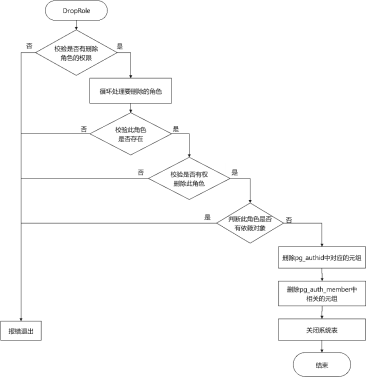
角色删除的执行流程为:首先判断当前操作者是否有权限执行该操作,若没有则报错退出;然后检查待删除的角色是否存在,若不存在,则根据missing_ok选择返回ERROR或NOTICE提示信息;再通过扫描系统表pg_authid和pg_auth_members,删除所有涉及待删除角色的元组执行;若behavior取值DROP_CASCADE,则级联删除该角色所拥有的所有数据库对象;最后删除该角色在系统表pg_auth_history和pg_user_status中对应的信息。具体的实现过程代码如下:
void DropRole(DropRoleStmt* stmt){. . ./* 检查执行者是否有权限删除角色 */if (!have_createrole_privilege())ereport(ERROR, (errcode(ERRCODE_INSUFFICIENT_PRIVILEGE), errmsg("Permission denied to drop role.")));/* 循环处理要删除的角色 */foreach (item, stmt->roles) {. . ./* 检查要删除的角色是否存在,若不存在则提示报错 */HeapTuple tuple = SearchSysCache1(AUTHNAME, PointerGetDatum(role));if (!HeapTupleIsValid(tuple)) {if (!stmt->missing_ok) {ereport(ERROR, (errcode(ERRCODE_UNDEFINED_OBJECT), errmsg("role \"%s\" does not exist", role)));} else {ereport(NOTICE, (errmsg("role \"%s\" does not exist, skipping", role)));}continue;}. . ./* 当前用户不允许删除 */if (roleid == GetUserId())ereport(ERROR, (errcode(ERRCODE_OBJECT_IN_USE), errmsg("current user cannot be dropped")));if (roleid == GetOuterUserId())ereport(ERROR, (errcode(ERRCODE_OBJECT_IN_USE), errmsg("current user cannot be dropped")));if (roleid == GetSessionUserId())ereport(ERROR, (errcode(ERRCODE_OBJECT_IN_USE), errmsg("session user cannot be dropped")));/* 校验执行者和被删除角色的权限,如系统管理员才有权限删除其他系统管理员 */if((((Form_pg_authid)GETSTRUCT(tuple))->rolsuper|| ((Form_pg_authid)GETSTRUCT(tuple))->rolsystemadmin) &&!isRelSuperuser())ereport(ERROR,(errcode(ERRCODE_INSUFFICIENT_PRIVILEGE), errmsg("Permission denied.")));if ((((Form_pg_authid)GETSTRUCT(tuple))->rolauditadmin) &&g_instance.attr.attr_security.enablePrivilegesSeparate && !isRelSuperuser())ereport(ERROR, (errcode(ERRCODE_INSUFFICIENT_PRIVILEGE), errmsg("Permission denied.")));. . ./* 针对CASCADE(级联)的情况,删除该角色拥有的对象 */if (stmt->behavior == DROP_CASCADE) {char* user = NULL;CancelQuery(role);user = (char*)palloc(sizeof(char) * strlen(role) + 1);errno_t errorno = strncpy_s(user, strlen(role) + 1, role, strlen(role));securec_check(errorno, "\0", "\0");drop_objectstmt.behavior = stmt->behavior;drop_objectstmt.type = T_DropOwnedStmt;drop_objectstmt.roles = list_make1(makeString(user));DropOwnedObjects(&drop_objectstmt);list_free_deep(drop_objectstmt.roles);}/* 检查是否有对象依赖于该角色,若还存在依赖,则提示报错 */if (checkSharedDependencies(AuthIdRelationId, roleid, &detail, &detail_log))ereport(ERROR,(errcode(ERRCODE_DEPENDENT_OBJECTS_STILL_EXIST),errmsg("role \"%s\" cannot be dropped because some objects depend on it", role),errdetail_internal("%s", detail),errdetail_log("%s", detail_log)));/* 从相关系统表中删除涉及待删除角色的元组 */simple_heap_delete(pg_authid_rel, &tuple->t_self);. . .while (HeapTupleIsValid(tmp_tuple = systable_getnext(sscan))) {simple_heap_delete(pg_auth_members_rel, &tmp_tuple->t_self);}systable_endscan(sscan);DropAuthHistory(roleid);DropUserStatus(roleid);DeleteSharedComments(roleid, AuthIdRelationId);DeleteSharedSecurityLabel(roleid, AuthIdRelationId);DropSetting(InvalidOid, roleid);. . .heap_close(pg_auth_members_rel, NoLock);heap_close(pg_authid_rel, NoLock);}
3. 授予和回收角色
如果要授予或回收角色的成员关系,可以使用SQL命令“GRANT/REVOKE”。如果声明了“WITH ADMIN OPTION”选项,那么被加入的成员角色还可以将其他角色加入到父角色中。角色的授予或回收通过调用GrantRole函数来实现,该函数只有一个类型为GrantRoleStmt结构的参数。相关代码如下:
typedef struct GrantRoleStmt {NodeTag type;List* granted_roles;/* 被授予或回收的角色集合 */List* grantee_roles;/* 从granted_roles中增加或删除的角色集合 */Bool is_grant;/* true代表授权,false代表回收 */Bool admin_opt;/* 是否带有with admin option选项 */char* grantor;/* 授权者 */Drop Behaviorbehavior;/* 是否级联回收角色 */} GrantRoleStmt;
授予角色时,grantee_roles中的角色将被添加到granted_roles,通过调用函数AddRoleMems实现;回收角色时,将grantee_roles中的角色从granted_roles中删除,通过调用函数DelRoleMems实现。
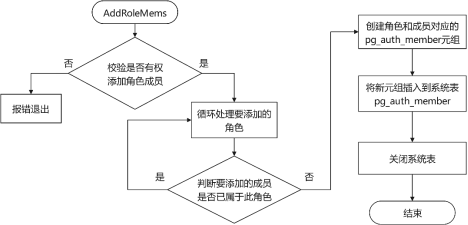
函数AddRoleMems的具体实现代码如下,其中:
(1) rolename和roleid分别表示要被加入成员的角色的名称和OID。
(2) memberNames和memberIds分别是要添加的角色名称和OID的列表。
(3) grantorId表示授权者的OID。
(4) admin_opt表示是否带有with admin option选项。
static void AddRoleMems(const char* rolename, Oid roleid, const List* memberNames, List* memberIds, Oid grantorId, bool admin_opt){. . ./* 校验执行者的权限 */if (superuser_arg(roleid)) {if (!isRelSuperuser())ereport(ERROR, (errcode(ERRCODE_INSUFFICIENT_PRIVILEGE), errmsg("Permission denied.")));. . .}. . .if (grantorId != GetUserId() && !superuser())ereport(ERROR, (errcode(ERRCODE_INSUFFICIENT_PRIVILEGE), errmsg("must be system admin to set grantor")));/* 循环处理要添加的角色 */pg_authmem_rel = heap_open(AuthMemRelationId, RowExclusiveLock);pg_authmem_dsc = RelationGetDescr(pg_authmem_rel);forboth(nameitem, memberNames, iditem, memberIds){/* 针对角色和成员信息创建pg_auth_members元组,再将新元组插入到系统表中 */. . .new_record[Anum_pg_auth_members_roleid - 1] = ObjectIdGetDatum(roleid);new_record[Anum_pg_auth_members_member -1] = ObjectIdGetDatum(memberid);new_record[Anum_pg_auth_members_grantor - 1] = ObjectIdGetDatum(grantorId);new_record[Anum_pg_auth_members_admin_option - 1] = BoolGetDatum(admin_opt);if (HeapTupleIsValid(authmem_tuple)) {new_record_repl[Anum_pg_auth_members_grantor - 1] = true;new_record_repl[Anum_pg_auth_members_admin_option - 1] = true;tuple = heap_modify_tuple(authmem_tuple, pg_authmem_dsc, new_record, new_record_nulls, new_record_repl);simple_heap_update(pg_authmem_rel, &tuple->t_self, tuple);CatalogUpdateIndexes(pg_authmem_rel, tuple);ReleaseSysCache(authmem_tuple);} else {tuple = heap_form_tuple(pg_authmem_dsc, new_record, new_record_nulls);(void)simple_heap_insert(pg_authmem_rel, tuple);CatalogUpdateIndexes(pg_authmem_rel, tuple);}}. . .heap_close(pg_authmem_rel, NoLock);}