



概要:
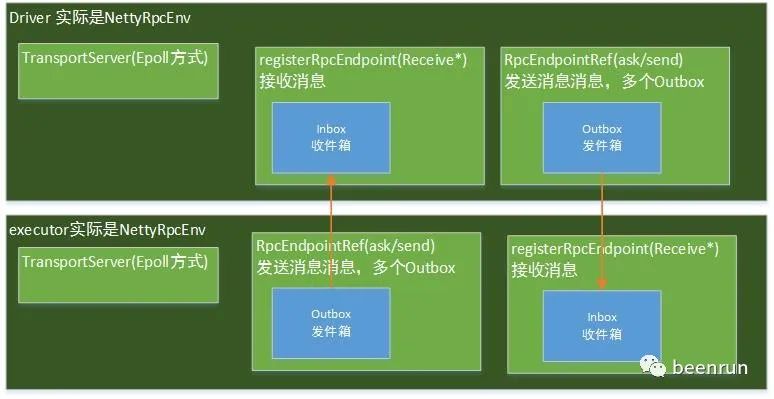
本文介绍的spark的driver和Executor之间的通信,底层使用Netty,框架通过是用工厂设计模式,实现了对Netty的解耦。Linux采用Epoll方式模拟AIO操作,实现消息通信。
1.spark的组件
类似实际咱们用的邮件系统
The life-cycle of an endpoint is:
constructor -> onStart -> receive* -> onStop

2.底层通信是netty
netty是AIO实现的
BIO:阻塞式IO,例如餐馆吃饭,发现前面排对有100人,到了后,只能在后面排对等着,直到自己。
NIO:非阻塞式IO,例如餐馆吃饭,发现前面排对有100人,到了后,领号,然后就离开了,干别的事情,过一会回来看看是否轮到自己,如果没有,就再次离开,重复多次,直到轮到自己。
AIO:异步非阻塞式IO,打电话订餐,大概要1小时后能做好,告诉老板做好后方在1号桌上,到后面我来取,老板做好后放入1号桌,然后我到1小时后来取餐。这样大家都不浪费时间。
Linux对AIO支持不好,Windows支持AIO
Linux采用Epoll方式模式AIO操作。
3.SparkContext类中找到env
创建执行环境
private[spark] def env: SparkEnv = _env// Create the Spark execution environment (cache, map output tracker, etc)_env = createSparkEnv(_conf, isLocal, listenerBus)SparkEnv.set(_env)
4.创建driver
// This function allows components created by SparkEnv to be mocked in unit tests:private[spark] def createSparkEnv(conf: SparkConf,isLocal: Boolean,listenerBus: LiveListenerBus): SparkEnv = {SparkEnv.createDriverEnv(conf, isLocal, listenerBus, SparkContext.numDriverCores(master, conf))}
5.Driver端创建SparkEnv
/*** Create a SparkEnv for the driver. */private[spark] def createDriverEnv(conf: SparkConf,isLocal: Boolean,listenerBus: LiveListenerBus,numCores: Int,mockOutputCommitCoordinator: Option[OutputCommitCoordinator] = None): SparkEnv = {assert(conf.contains(DRIVER_HOST_ADDRESS),s"${DRIVER_HOST_ADDRESS.key} is not set on the driver!")assert(conf.contains(DRIVER_PORT), s"${DRIVER_PORT.key} is not set on the driver!")val bindAddress = conf.get(DRIVER_BIND_ADDRESS)val advertiseAddress = conf.get(DRIVER_HOST_ADDRESS)val port = conf.get(DRIVER_PORT)val ioEncryptionKey = if (conf.get(IO_ENCRYPTION_ENABLED)) {Some(CryptoStreamUtils.createKey(conf))} else {None}create(conf,SparkContext.DRIVER_IDENTIFIER,bindAddress,advertiseAddress,Option(port),isLocal,numCores,ioEncryptionKey,listenerBus = listenerBus,mockOutputCommitCoordinator = mockOutputCommitCoordinator)}
6.创建rpcEnv对象
在 val rpcEnv = RpcEnv.create(systemName, bindAddress, advertiseAddress, port.getOrElse(-1), conf,
securityManager, numUsableCores, !isDriver)
中会获取rpvEnv对象
/*** Helper method to create a SparkEnv for a driver or an executor.*/private def create(conf: SparkConf,executorId: String,bindAddress: String,advertiseAddress: String,port: Option[Int],isLocal: Boolean,numUsableCores: Int,ioEncryptionKey: Option[Array[Byte]],listenerBus: LiveListenerBus = null,mockOutputCommitCoordinator: Option[OutputCommitCoordinator] = None): SparkEnv = {val isDriver = executorId == SparkContext.DRIVER_IDENTIFIERListener bus is only used on the driverif (isDriver) {assert(listenerBus != null, "Attempted to create driver SparkEnv with null listener bus!")}val authSecretFileConf = if (isDriver) AUTH_SECRET_FILE_DRIVER else AUTH_SECRET_FILE_EXECUTORval securityManager = new SecurityManager(conf, ioEncryptionKey, authSecretFileConf)if (isDriver) {securityManager.initializeAuth()}ioEncryptionKey.foreach { _ =>if (!securityManager.isEncryptionEnabled()) {logWarning("I/O encryption enabled without RPC encryption: keys will be visible on the " +"wire.")}}val systemName = if (isDriver) driverSystemName else executorSystemNameval rpcEnv = RpcEnv.create(systemName, bindAddress, advertiseAddress, port.getOrElse(-1), conf,securityManager, numUsableCores, !isDriver)/ Figure out which port RpcEnv actually bound to in case the original port is 0 or occupied.if (isDriver) {conf.set(DRIVER_PORT, rpcEnv.address.port)}val serializer = Utils.instantiateSerializerFromConf[Serializer](SERIALIZER, conf, isDriver)logDebug(s"Using serializer: ${serializer.getClass}")val serializerManager = new SerializerManager(serializer, conf, ioEncryptionKey)val closureSerializer = new JavaSerializer(conf)def registerOrLookupEndpoint(name: String, endpointCreator: => RpcEndpoint):RpcEndpointRef = {if (isDriver) {logInfo("Registering " + name)rpcEnv.setupEndpoint(name, endpointCreator)} else {RpcUtils.makeDriverRef(name, conf, rpcEnv)}}val broadcastManager = new BroadcastManager(isDriver, conf)val mapOutputTracker = if (isDriver) {new MapOutputTrackerMaster(conf, broadcastManager, isLocal)} else {new MapOutputTrackerWorker(conf)}// Have to assign trackerEndpoint after initialization as MapOutputTrackerEndpoint// requires the MapOutputTracker itself mapOutputTracker.trackerEndpoint = registerOrLookupEndpoint(MapOutputTracker.ENDPOINT_NAME,new MapOutputTrackerMasterEndpoint(rpcEnv, mapOutputTracker.asInstanceOf[MapOutputTrackerMaster], conf))// Let the user specify short names for shuffle managersval shortShuffleMgrNames = Map("sort" -> classOf[org.apache.spark.shuffle.sort.SortShuffleManager].getName,"tungsten-sort" -> classOf[org.apache.spark.shuffle.sort.SortShuffleManager].getName)val shuffleMgrName = conf.get(config.SHUFFLE_MANAGER)val shuffleMgrClass =shortShuffleMgrNames.getOrElse(shuffleMgrName.toLowerCase(Locale.ROOT), shuffleMgrName)val shuffleManager = Utils.instantiateSerializerOrShuffleManager[ShuffleManager](shuffleMgrClass, conf, isDriver)val memoryManager: MemoryManager = UnifiedMemoryManager(conf, numUsableCores)val blockManagerPort = if (isDriver) {conf.get(DRIVER_BLOCK_MANAGER_PORT)} else {conf.get(BLOCK_MANAGER_PORT)}val externalShuffleClient = if (conf.get(config.SHUFFLE_SERVICE_ENABLED)) {val transConf = SparkTransportConf.fromSparkConf(conf, "shuffle", numUsableCores)Some(new ExternalBlockStoreClient(transConf, securityManager,securityManager.isAuthenticationEnabled(), conf.get(config.SHUFFLE_REGISTRATION_TIMEOUT)))} else {None}// Mapping from block manager id to the block manager's information.val blockManagerInfo = new concurrent.TrieMap[BlockManagerId, BlockManagerInfo]()val blockManagerMaster = new BlockManagerMaster(registerOrLookupEndpoint(BlockManagerMaster.DRIVER_ENDPOINT_NAME,new BlockManagerMasterEndpoint(rpcEnv,isLocal,conf,listenerBus,if (conf.get(config.SHUFFLE_SERVICE_FETCH_RDD_ENABLED)) {externalShuffleClient} else {None}, blockManagerInfo,mapOutputTracker.asInstanceOf[MapOutputTrackerMaster], isDriver)),registerOrLookupEndpoint(BlockManagerMaster.DRIVER_HEARTBEAT_ENDPOINT_NAME,new BlockManagerMasterHeartbeatEndpoint(rpcEnv, isLocal, blockManagerInfo)),conf,isDriver)val blockTransferService =new NettyBlockTransferService(conf, securityManager, bindAddress, advertiseAddress,blockManagerPort, numUsableCores, blockManagerMaster.driverEndpoint)// NB: blockManager is not valid until initialize() is called later.val blockManager = new BlockManager(executorId,rpcEnv,blockManagerMaster,serializerManager,conf,memoryManager,mapOutputTracker,shuffleManager,blockTransferService,securityManager,externalShuffleClient)val metricsSystem = if (isDriver) {// Don't start metrics system right now for Driver.// We need to wait for the task scheduler to give us an app ID. // Then we can start the metrics system. MetricsSystem.createMetricsSystem(MetricsSystemInstances.DRIVER, conf)} else {// We need to set the executor ID before the MetricsSystem is created because sources and// sinks specified in the metrics configuration file will want to incorporate this executor's // ID into the metrics they report. conf.set(EXECUTOR_ID, executorId)val ms = MetricsSystem.createMetricsSystem(MetricsSystemInstances.EXECUTOR, conf)ms.start(conf.get(METRICS_STATIC_SOURCES_ENABLED))ms}val outputCommitCoordinator = mockOutputCommitCoordinator.getOrElse {new OutputCommitCoordinator(conf, isDriver)}val outputCommitCoordinatorRef = registerOrLookupEndpoint("OutputCommitCoordinator",new OutputCommitCoordinatorEndpoint(rpcEnv, outputCommitCoordinator))outputCommitCoordinator.coordinatorRef = Some(outputCommitCoordinatorRef)val envInstance = new SparkEnv(executorId,rpcEnv,serializer,closureSerializer,serializerManager,mapOutputTracker,shuffleManager,broadcastManager,blockManager,securityManager,metricsSystem,memoryManager,outputCommitCoordinator,conf)// Add a reference to tmp dir created by driver, we will delete this tmp dir when stop() is// called, and we only need to do it for driver. Because driver may run as a service, and if we // don't delete this tmp dir when sc is stopped, then will create too many tmp dirs. if (isDriver) {val sparkFilesDir = Utils.createTempDir(Utils.getLocalDir(conf), "userFiles").getAbsolutePathenvInstance.driverTmpDir = Some(sparkFilesDir)}envInstance}
7.创建rpcEnv对象
这里可以按到是使用NettyRpcEnvFactory来实现的,原来是用akk来实现,这里使用工厂方法,是为了将来有的通信方式改变起来方便
def create(name: String,bindAddress: String,advertiseAddress: String,port: Int,conf: SparkConf,securityManager: SecurityManager,numUsableCores: Int,clientMode: Boolean): RpcEnv = {val config = RpcEnvConfig(conf, name, bindAddress, advertiseAddress, port, securityManager,numUsableCores, clientMode)new NettyRpcEnvFactory().create(config)}
8.netty服务进行创建
Utils.startServiceOnPort方法调用创建了driver服务,
startNettyRpcEnv启动服务环境变量
def create(config: RpcEnvConfig): RpcEnv = {val sparkConf = config.conf// Use JavaSerializerInstance in multiple threads is safe. However, if we plan to support// KryoSerializer in future, we have to use ThreadLocal to store SerializerInstance val javaSerializerInstance =new JavaSerializer(sparkConf).newInstance().asInstanceOf[JavaSerializerInstance]val nettyEnv =new NettyRpcEnv(sparkConf, javaSerializerInstance, config.advertiseAddress,config.securityManager, config.numUsableCores)if (!config.clientMode) {val startNettyRpcEnv: Int => (NettyRpcEnv, Int) = { actualPort =>nettyEnv.startServer(config.bindAddress, actualPort)(nettyEnv, nettyEnv.address.port)}try {Utils.startServiceOnPort(config.port, startNettyRpcEnv, sparkConf, config.name)._1} catch {case NonFatal(e) =>nettyEnv.shutdown()throw e}}nettyEnv}
9.开始启动服务
def startServer(bindAddress: String, port: Int): Unit = {val bootstraps: java.util.List[TransportServerBootstrap] =if (securityManager.isAuthenticationEnabled()) {java.util.Arrays.asList(new AuthServerBootstrap(transportConf, securityManager))} else {java.util.Collections.emptyList()}server = transportContext.createServer(bindAddress, port, bootstraps)dispatcher.registerRpcEndpoint(RpcEndpointVerifier.NAME, new RpcEndpointVerifier(this, dispatcher))}
10.创建server对象
public TransportServer createServer(List<TransportServerBootstrap> bootstraps) {return this.createServer(0, bootstraps);}
11.进行初始化
public TransportServer(TransportContext context, String hostToBind, int portToBind, RpcHandler appRpcHandler, List<TransportServerBootstrap> bootstraps) {this.context = context;this.conf = context.getConf();this.appRpcHandler = appRpcHandler;if (this.conf.sharedByteBufAllocators()) {this.pooledAllocator = NettyUtils.getSharedPooledByteBufAllocator(this.conf.preferDirectBufsForSharedByteBufAllocators(), true);} else {this.pooledAllocator = NettyUtils.createPooledByteBufAllocator(this.conf.preferDirectBufs(), true, this.conf.serverThreads());}this.bootstraps = Lists.newArrayList((Iterable)Preconditions.checkNotNull(bootstraps));boolean shouldClose = true;try {this.init(hostToBind, portToBind);shouldClose = false;} finally {if (shouldClose) {JavaUtils.closeQuietly(this);}}}
12.进行初始化
workerGroup进行创建,这里能够看到后面调用的是
private void init(String hostToBind, int portToBind) {IOMode ioMode = IOMode.valueOf(this.conf.ioMode());EventLoopGroup bossGroup = NettyUtils.createEventLoop(ioMode, 1, this.conf.getModuleName() + "-boss");EventLoopGroup workerGroup = NettyUtils.createEventLoop(ioMode, this.conf.serverThreads(), this.conf.getModuleName() + "-server");this.bootstrap = ((ServerBootstrap)((ServerBootstrap)((ServerBootstrap)(new ServerBootstrap()).group(bossGroup, workerGroup).channel(NettyUtils.getServerChannelClass(ioMode))).option(ChannelOption.ALLOCATOR, this.pooledAllocator)).option(ChannelOption.SO_REUSEADDR, !SystemUtils.IS_OS_WINDOWS)).childOption(ChannelOption.ALLOCATOR, this.pooledAllocator);this.metrics = new NettyMemoryMetrics(this.pooledAllocator, this.conf.getModuleName() + "-server", this.conf);if (this.conf.backLog() > 0) {this.bootstrap.option(ChannelOption.SO_BACKLOG, this.conf.backLog());}if (this.conf.receiveBuf() > 0) {this.bootstrap.childOption(ChannelOption.SO_RCVBUF, this.conf.receiveBuf());}if (this.conf.sendBuf() > 0) {this.bootstrap.childOption(ChannelOption.SO_SNDBUF, this.conf.sendBuf());}if (this.conf.enableTcpKeepAlive()) {this.bootstrap.childOption(ChannelOption.SO_KEEPALIVE, true);}this.bootstrap.childHandler(new ChannelInitializer<SocketChannel>() {protected void initChannel(SocketChannel ch) {TransportServer.logger.debug("New connection accepted for remote address {}.", ch.remoteAddress());RpcHandler rpcHandler = TransportServer.this.appRpcHandler;TransportServerBootstrap bootstrap;for(Iterator var3 = TransportServer.this.bootstraps.iterator(); var3.hasNext(); rpcHandler = bootstrap.doBootstrap(ch, rpcHandler)) {bootstrap = (TransportServerBootstrap)var3.next();}TransportServer.this.context.initializePipeline(ch, rpcHandler);}});InetSocketAddress address = hostToBind == null ? new InetSocketAddress(portToBind) : new InetSocketAddress(hostToBind, portToBind);this.channelFuture = this.bootstrap.bind(address);this.channelFuture.syncUninterruptibly();this.port = ((InetSocketAddress)this.channelFuture.channel().localAddress()).getPort();logger.debug("Shuffle server started on port: {}", this.port);}
13.EPOLL方式进行通讯
public static EventLoopGroup createEventLoop(IOMode mode, int numThreads, String threadPrefix) {ThreadFactory threadFactory = createThreadFactory(threadPrefix);switch(mode) {case NIO:return new NioEventLoopGroup(numThreads, threadFactory);case EPOLL:return new EpollEventLoopGroup(numThreads, threadFactory);default:throw new IllegalArgumentException("Unknown io mode: " + mode);}}
