



Service Mesh 这个词,这确实是一个非常非常新的名词,这个词最早使用由开发Linkerd的Buoyant公司提出,并在内部使用。2016年9月29日第一次公开使用这个术语。2017年的时候随着Linkerd的传入,Service Mesh 进入国内技术社区的视野。最早翻译为“服务啮合层”,这个词比较拗口。用了几个月之后改成了服务网格。
Service Mesh又译作“服务网格”,作为服务间通信的基础设施层。Willian Morgan(Linkerd的CEO)如下定义Service Mesh。
A service mesh is a dedicated infrastructure layer for handling service-to-service communication. It’s responsible for the reliable delivery of requests through the complex topology of services that comprise a modern, cloud native application. In practice, the service mesh is typically implemented as an array of lightweight network proxies that are deployed alongside application code, without the application needing to be aware. (But there are variations to this idea, as we’ll see.)
Service Mesh 是一个基础设施层,用于处理服务间通信。云原生应用有着复杂的服务拓扑,Service Mesh 保证请求可以在这些拓扑中可靠地穿梭。在实际应用当中,Service Mesh 通常是由一系列轻量级的网络代理组成的,它们与应用程序部署在一起,但应用程序不需要知道它们的存在。
Service Mesh 是处于 TCP/IP 之上的一个抽象层,有如下几个特点:
应用程序间通讯的中间层;
轻量级网络代理;
应用程序无感知;
解耦应用程序的重试、超时、监控、追踪和服务发现;
Service Mesh 基本原理,可将它比作是微服务间的 TCP/IP,负责服务之间的网络调用、限流、熔断和监控。对于应用来说一般无须关心 TCP/IP 这一层的实现,使用 Service Mesh 也就无须关系服务之间的那些原来是通过应用程序或者其他框架实现的事情,比如 Spring Cloud、OSS,现在只要交给 Service Mesh 就可以了。
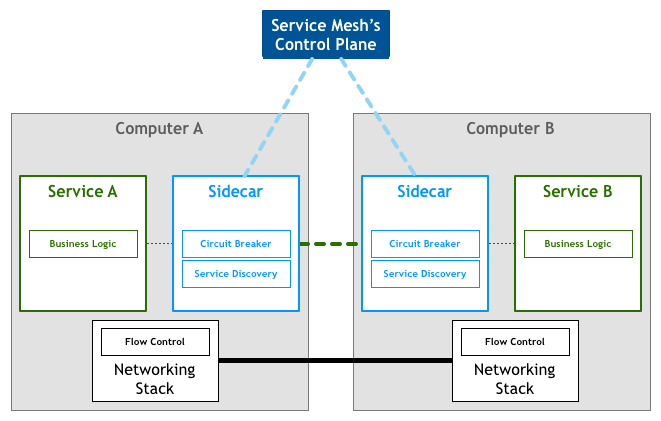
目前社区Service Mesh的开源解决方案有:Buoyant 公司推出的 Linkerd 和 Google、IBM 等厂商牵头的 Istio。Linkerd 更加成熟稳定些,Istio 功能更加丰富、设计上更为强大,社区相对也更加强大一些,所以普遍认为 Istio 的前景会更好。
