



作者:马顺华
从事运维管理工作多年,目前就职于某科技有限公司,熟悉运维自动化、OceanBase部署运维、MySQL 运维以及各种云平台技术和产品。并已获得OceanBase认证OBCA、OBCP证书。
第2天 | 学习openGauss客户端工具gsql的使用
学习目标
学习openGauss数据库客户端工具gsql的使用。
课程学习
gsql是openGauss提供在命令行下运行的数据库连接工具,可以通过此工具连接服务器并对其进行操作和维护,除了具备操作数据库的基本功能,gsql还提供了若干高级特性,便于用户使用。
1.使用gsql命令连接数据库
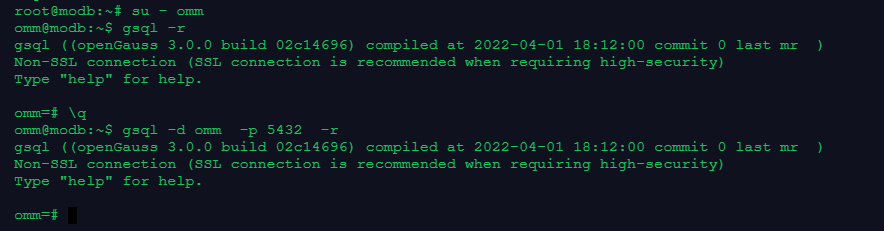
–使用omm用户连接到本机omm数据库的5432端口,命令中的-r选项提供了对gsql命令的历史版本支持。
切换用户su - omm
gsql -r
或
gsql -d omm -p 5432 -r
root@modb:~# su - omm
omm@modb:~$ gsql -r
gsql ((openGauss 3.0.0 build 02c14696) compiled at 2022-04-01 18:12:00 commit 0 last mr  )
Non-SSL connection (SSL connection is recommended when requiring high-security)
Type "help" for help.

omm=# \q
omm@modb:~$ gsql -d omm  -p 5432  -r
gsql ((openGauss 3.0.0 build 02c14696) compiled at 2022-04-01 18:12:00 commit 0 last mr  )
Non-SSL connection (SSL connection is recommended when requiring high-security)
Type "help" for help.

omm=#
2.在gsql中查看数据库的版本、pg基础版本和版权信息
select version();
show server_version;
\copyright
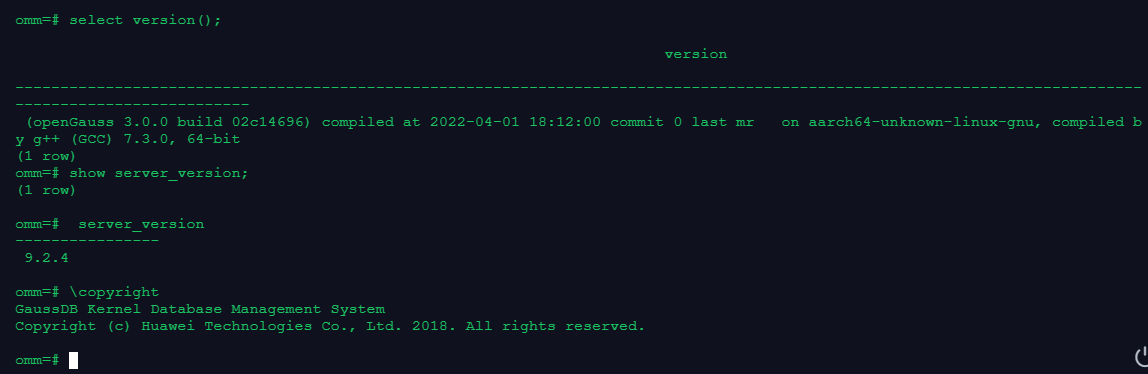
omm=# select version();

                                                                        version

-----------------------------------------------------------------------------------------------------------------------------
--------------------------
 (openGauss 3.0.0 build 02c14696) compiled at 2022-04-01 18:12:00 commit 0 last mr   on aarch64-unknown-linux-gnu, compiled b
y g++ (GCC) 7.3.0, 64-bit
(1 row)
omm=# show server_version;
(1 row)

omm=#  server_version
----------------
 9.2.4

omm=# \copyright
GaussDB Kernel Database Management System
Copyright (c) Huawei Technologies Co., Ltd. 2018. All rights reserved.

omm=#
3.常见元命令的使用
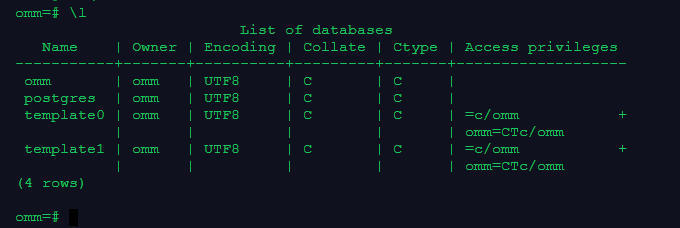
1). --\l命令,元命令\l的作用是显示openGauss数据库集簇中,目前有哪些数据库。
\l
omm=# \l
                         List of databases
   Name    | Owner | Encoding | Collate | Ctype | Access privileges
-----------+-------+----------+---------+-------+-------------------
 omm       | omm   | UTF8     | C       | C     |
 postgres  | omm   | UTF8     | C       | C     |
 template0 | omm   | UTF8     | C       | C     | =c/omm           +
           |       |          |         |       | omm=CTc/omm
 template1 | omm   | UTF8     | C       | C     | =c/omm           +
           |       |          |         |       | omm=CTc/omm
(4 rows)
2). --\conninfo命令,元命令\conninfo的作用是在gsql中,显示会话的连接信息。
\conninfo
omm=# \conninfo
You are connected to database "omm" as user "omm" via socket in "/tmp" at port "5432".

3).–\c[onnect] [DBNAME]命令,元命令\ c[onnect] [DBNAME]的作用是在gsql中,切换连接的数据库postgres。
\c postgres
omm=# \c postgres
Non-SSL connection (SSL connection is recommended when requiring high-security)
You are now connected to database "postgres" as user "omm".
openGauss=#

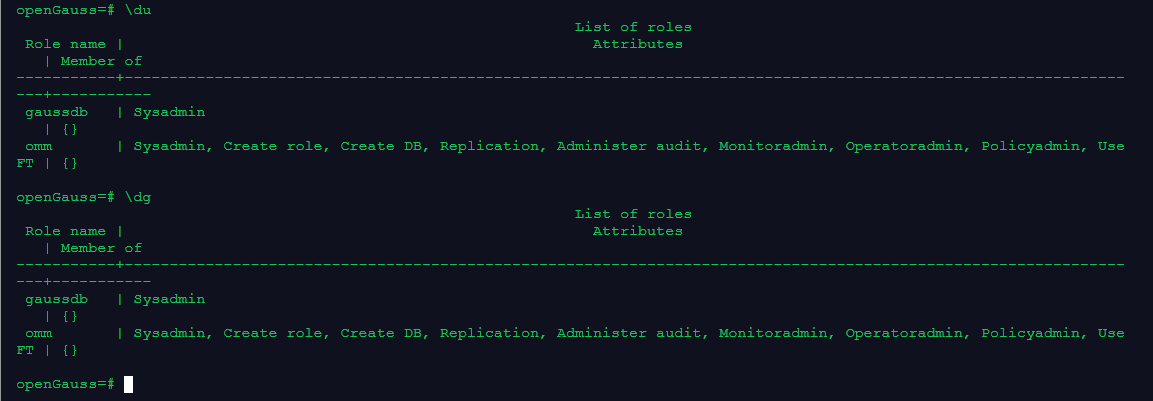
4). --\du命令和\dg命令,元命令\dg命令与元命令\du命令的作用类似,都是显示openGauss数据库集簇中,目前有哪些用户和角色。
\du
\dg
openGauss=# \du
                                                              List of roles
 Role name |                                                    Attributes
   | Member of
-----------+---------------------------------------------------------------------------------------------------------------
---+-----------
 gaussdb   | Sysadmin
   | {}
 omm       | Sysadmin, Create role, Create DB, Replication, Administer audit, Monitoradmin, Operatoradmin, Policyadmin, Use
FT | {}

openGauss=# \dg
                                                              List of roles
 Role name |                                                    Attributes
   | Member of
-----------+---------------------------------------------------------------------------------------------------------------
---+-----------
 gaussdb   | Sysadmin
   | {}
 omm       | Sysadmin, Create role, Create DB, Replication, Administer audit, Monitoradmin, Operatoradmin, Policyadmin, Use
FT | {}
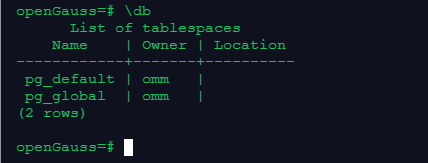
5). --\db命令,元命令\db的作用是显示openGauss数据库集簇中,目前有哪些表空间。
\db
openGauss=# \db
      List of tablespaces
    Name    | Owner | Location
------------+-------+----------
 pg_default | omm   |
 pg_global  | omm   |
(2 rows)

openGauss=#
6).–\dn命令,元命令\dn的作用是显示当前数据库有哪些数据库模式。
\du
openGauss=# \du
                                                              List of roles
 Role name |                                                    Attributes                                                    | Member of
-----------+------------------------------------------------------------------------------------------------------------------+-----------
 gaussdb   | Sysadmin                                                                                                         | {}
 omm       | Sysadmin, Create role, Create DB, Replication, Administer audit, Monitoradmin, Operatoradmin, Policyadmin, UseFT | {}

openGauss=#

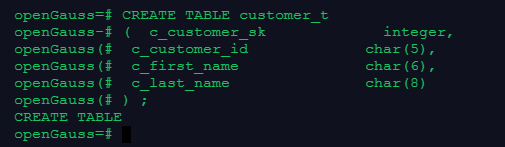
7).–创建表
CREATE TABLE customer_t
( c_customer_sk integer,
c_customer_id char(5),
c_first_name char(6),
c_last_name char(8)
) ;
openGauss=# CREATE TABLE customer_t
openGauss-# (  c_customer_sk             integer,
openGauss(#  c_customer_id             char(5),
openGauss(#  c_first_name              char(6),
openGauss(#  c_last_name               char(8)
openGauss(# ) ;
CREATE TABLE
openGauss=#
8).–插入数据
INSERT INTO customer_t (c_customer_sk, c_customer_id, c_first_name,c_last_name) VALUES (3769, 5, ‘Grace’,‘White’);
openGauss=# INSERT INTO customer_t (c_customer_sk, c_customer_id, c_first_name,c_last_name) VALUES (3769, 5, 'Grace','White');
INSERT 0 1
openGauss=#

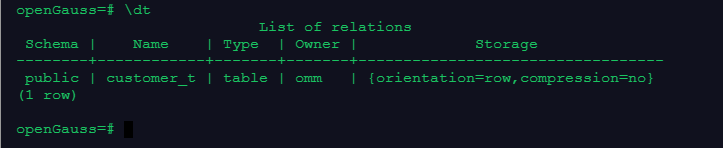
9).–\dt命令,命令\dt的作用是显示数据库中所有的表。
\dt
openGauss=# \dt
                           List of relations
 Schema |    Name    | Type  | Owner |             Storage
--------+------------+-------+-------+----------------------------------
 public | customer_t | table | omm   | {orientation=row,compression=no}
(1 row)

openGauss=#
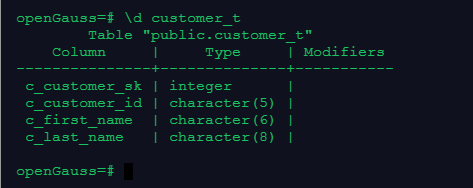
10).–\d TableName命令,元命令\d TableName的作用是查看某个表的信息。
\d customer_t
openGauss=# \d customer_t
        Table "public.customer_t"
    Column     |     Type     | Modifiers
---------------+--------------+-----------
 c_customer_sk | integer      |
 c_customer_id | character(5) |
 c_first_name  | character(6) |
 c_last_name   | character(8) |

openGauss=#
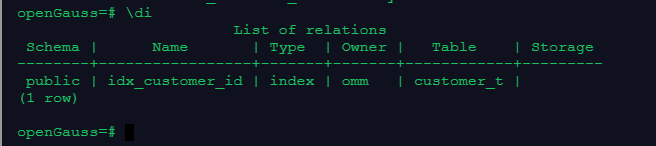
11).–\di IndexName命令,查看索引信息,元命令\di IndexName的作用是查看某个索引的信息。
create index idx_customer_id on customer_t(c_customer_id);
\di
openGauss=# \di
                        List of relations
 Schema |      Name       | Type  | Owner |   Table    | Storage
--------+-----------------+-------+-------+------------+---------
 public | idx_customer_id | index | omm   | customer_t |
(1 row)
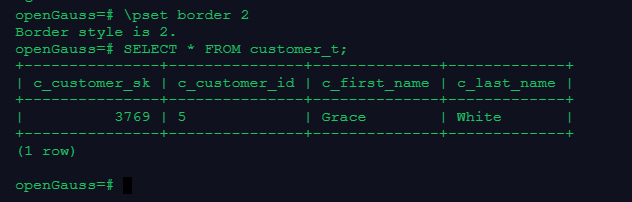
12).–可以用\pset命令以不同的方法显示表:
\pset border 2
SELECT * FROM customer_t;
openGauss=# \pset border 2
Border style is 2.
openGauss=# SELECT * FROM customer_t;
+---------------+---------------+--------------+-------------+
| c_customer_sk | c_customer_id | c_first_name | c_last_name |
+---------------+---------------+--------------+-------------+
|          3769 | 5             | Grace        | White       |
+---------------+---------------+--------------+-------------+
(1 row)

openGauss=#
13).–打开扩展表格式模式。
\x
openGauss=# \x
Expanded display is on.
openGauss=#
4.gsql中的事务:测试gsql中的默认事务自动提交功能
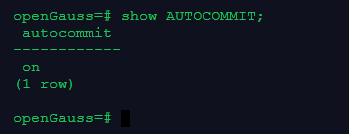
1).–查看gsql中事务是否默认为自动提交
show AUTOCOMMIT;
openGauss=# show AUTOCOMMIT;
 autocommit
------------
 on
(1 row)

openGauss=#
2).–测试gsql中事务默认为自动提交功能
create table customer_new as select * from customer_t;
\q
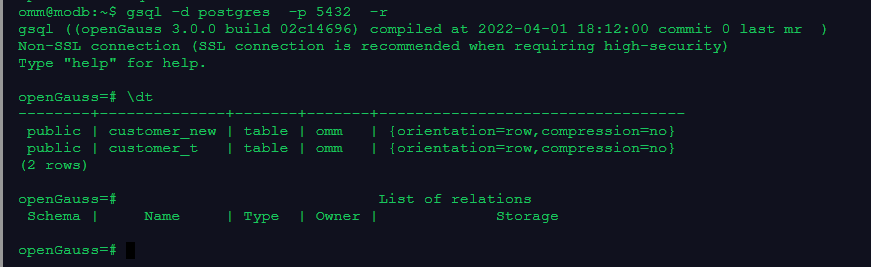
3).–重新登录后看到之前创建的表customer_new:
gsql -d postgres -p 5432 -r
\dt
omm@modb:~$ gsql -d postgres  -p 5432  -r
gsql ((openGauss 3.0.0 build 02c14696) compiled at 2022-04-01 18:12:00 commit 0 last mr  )
Non-SSL connection (SSL connection is recommended when requiring high-security)
Type "help" for help.

openGauss=# \dt
--------+--------------+-------+-------+----------------------------------
 public | customer_new | table | omm   | {orientation=row,compression=no}
 public | customer_t   | table | omm   | {orientation=row,compression=no}
(2 rows)

openGauss=#                             List of relations
 Schema |     Name     | Type  | Owner |             Storage

openGauss=#
5.gsql中的事务:测试gsql中的事务手动提交功能
1).–测试gsql手动提交
#Opengauss默认执行完一条语句后,立即提交。可以关闭自动提交功能:
#注意:此处设置ATUOCOMMIT必须用大写!
\set AUTOCOMMIT off
openGauss=# \set AUTOCOMMIT off

2). --插入一些数据
INSERT INTO customer_t (c_customer_sk, c_customer_id, c_first_name,c_last_name) VALUES
(6885, 1, ‘Joes’, ‘Hunter’),
(4321, 2, ‘Lily’,‘Carter’),
(9527, 3, ‘James’, ‘Cook’),
(9500, 4, ‘Lucy’, ‘Baker’);
openGauss=# \set AUTOCOMMIT off
openGauss=# INSERT INTO customer_t (c_customer_sk, c_customer_id, c_first_name,c_last_name) VALUES
openGauss-# (6885, 1, 'Joes', 'Hunter'),
openGauss-# (4321, 2, 'Lily','Carter'),
openGauss-# (9527, 3, 'James', 'Cook'),
openGauss-# (9500, 4, 'Lucy', 'Baker');
INSERT 0 4

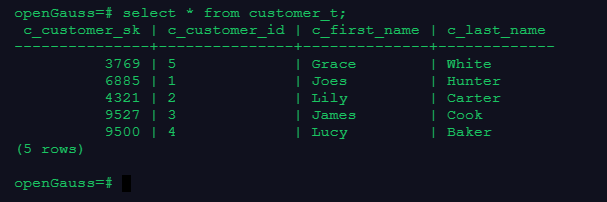
3). --查看表中数据
select * from customer_t;
openGauss=# select * from customer_t;
 c_customer_sk | c_customer_id | c_first_name | c_last_name
---------------+---------------+--------------+-------------
          3769 | 5             | Grace        | White
          6885 | 1             | Joes         | Hunter
          4321 | 2             | Lily         | Carter
          9527 | 3             | James        | Cook
          9500 | 4             | Lucy         | Baker
(5 rows)
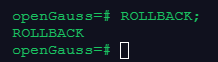
4).–执行回滚
ROLLBACK;
openGauss=# ROLLBACK;
ROLLBACK
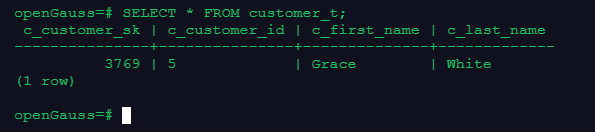
5). --检查是否回滚成功
SELECT * FROM customer_t;
openGauss=# SELECT * FROM customer_t;
 c_customer_sk | c_customer_id | c_first_name | c_last_name
---------------+---------------+--------------+-------------
          3769 | 5             | Grace        | White
(1 row)

openGauss=#
6.gsql相关的帮助
1). --连接数据库时,可以使用如下命令获取帮助信息。
gsql --help
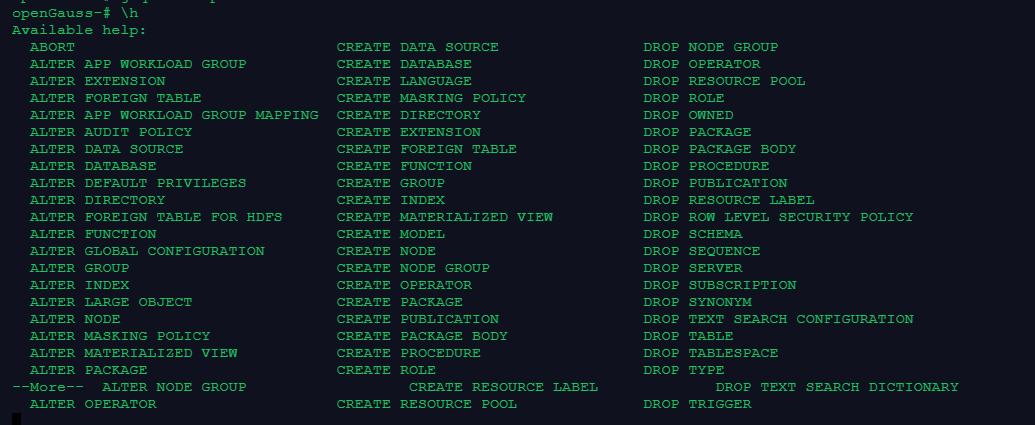
2). --\h获取和SQL语法有关的帮助信息
\h
openGauss-# \h
Available help:
  ABORT                             CREATE DATA SOURCE                DROP NODE GROUP
  ALTER APP WORKLOAD GROUP          CREATE DATABASE                   DROP OPERATOR
  ALTER EXTENSION                   CREATE LANGUAGE                   DROP RESOURCE POOL
  ALTER FOREIGN TABLE               CREATE MASKING POLICY             DROP ROLE
  ALTER APP WORKLOAD GROUP MAPPING  CREATE DIRECTORY                  DROP OWNED
  ALTER AUDIT POLICY                CREATE EXTENSION                  DROP PACKAGE
  ALTER DATA SOURCE                 CREATE FOREIGN TABLE              DROP PACKAGE BODY
  ALTER DATABASE                    CREATE FUNCTION                   DROP PROCEDURE
  ALTER DEFAULT PRIVILEGES          CREATE GROUP                      DROP PUBLICATION
  ALTER DIRECTORY                   CREATE INDEX                      DROP RESOURCE LABEL
  ALTER FOREIGN TABLE FOR HDFS      CREATE MATERIALIZED VIEW          DROP ROW LEVEL SECURITY POLICY
  ALTER FUNCTION                    CREATE MODEL                      DROP SCHEMA
  ALTER GLOBAL CONFIGURATION        CREATE NODE                       DROP SEQUENCE
  ALTER GROUP                       CREATE NODE GROUP                 DROP SERVER
  ALTER INDEX                       CREATE OPERATOR                   DROP SUBSCRIPTION
  ALTER LARGE OBJECT                CREATE PACKAGE                    DROP SYNONYM
  ALTER NODE                        CREATE PUBLICATION                DROP TEXT SEARCH CONFIGURATION
  ALTER MASKING POLICY              CREATE PACKAGE BODY               DROP TABLE
  ALTER MATERIALIZED VIEW           CREATE PROCEDURE                  DROP TABLESPACE
  ALTER PACKAGE                     CREATE ROLE                       DROP TYPE
--More--  ALTER NODE GROUP                  CREATE RESOURCE LABEL             DROP TEXT SEARCH DICTIONARY
  ALTER OPERATOR                    CREATE RESOURCE POOL              DROP TRIGGER
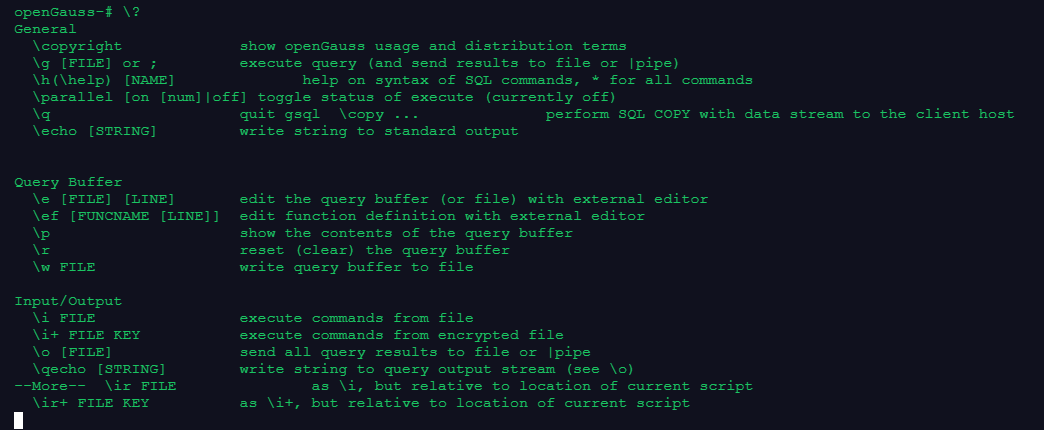
3). --? 获取和元命令有关的帮助信息
\?
openGauss-# \?
General
  \copyright             show openGauss usage and distribution terms
  \g [FILE] or ;         execute query (and send results to file or |pipe)
  \h(\help) [NAME]              help on syntax of SQL commands, * for all commands
  \parallel [on [num]|off] toggle status of execute (currently off)
  \q                     quit gsql  \copy ...              perform SQL COPY with data stream to the client host
  \echo [STRING]         write string to standard output


Query Buffer
  \e [FILE] [LINE]       edit the query buffer (or file) with external editor
  \ef [FUNCNAME [LINE]]  edit function definition with external editor
  \p                     show the contents of the query buffer
  \r                     reset (clear) the query buffer
  \w FILE                write query buffer to file

Input/Output
  \i FILE                execute commands from file
  \i+ FILE KEY           execute commands from encrypted file
  \o [FILE]              send all query results to file or |pipe
  \qecho [STRING]        write string to query output stream (see \o)
--More--  \ir FILE               as \i, but relative to location of current script
  \ir+ FILE KEY          as \i+, but relative to location of current script
课程总结
1.gsql命令连到数据库omm
2.查看数据库的版本、版权信息
3.常见元命令使用
4.使用两种方法,连到postgres数据库中
5.测试gsql中的默认事务自动提交功能
6.测试gsql中的事务手动提交功能
7.了解gsql相关帮助
