



gsql是openGauss提供在命令行下运行的数据库连接工具,可以通过此工具连接服务器并对其进行操作和维护,除了具备操作数据库的基本功能,gsql还提供了若干高级特性,便于用户使用。
1.使用gsql命令连接数据库
1.1)切换至omm用户下,gsql登录数据库
root@modb:~# su - omm
omm@modb:~$
1.2)使用omm用户连接到opengauss数据,命令中的-r选项提供了对gsql命令的历史版本支持。
利用客户端工具gsql登录opengauss数据库
[omm@node1 ~]$ gsql -d postgres -p 26000 -r
gsql ((openGauss 2.0.0 build 78689da9) compiled at 2021-03-31 21:04:03 commit 0 last mr  )
Non-SSL connection (SSL connection is recommended when requiring high-security)
Type "help" for help.

postgres=#
gsql:客户端工具
-d:db的选项缩写
postgres:数据库名
-p:port的选项缩写
26000:端口号
1.3)使用omm用户连接到本机omm数据库的5432端口,命令中的-r选项提供了对gsql命令的历史版本支持。
1.3.1)启动数据库容器
存储数据持久化,从容器外部连接容器数据库,opengauss默认监听启动在容器内的5432端口,如果想要从容器外部访问数据库,则需要在 docker run 的时候指定-p 参数。
【参数说明】:
a)数据持久化:
Docker 中 openGauss 的 所 有 数 据 文 件 : /var/lib/opengauss 目 录 , 存 储 在 宿 主 机 的/enmotech/opengauss 下。
宿主机的/enmotech/opengauss 如果不存在,会自动创建,但是必须是绝对路径。Docker 对其拥有读写权限。
b)网络端口:
8888:对外访问端口。
1.3.2)测试
关于使用docker,启动数据库容器,我们可以选择最新的版本enmotech/opengauss:latest 的镜像,也就是opengauss 3.0.0;也可以选择指定的版本enmotech/opengauss:2.0.1。
或者是opengauss 2.0.0的数据库,想要利用docker技术去持久化opengauss 2.0.1的数据库
docker run --name opengaussnet --privileged=true -d -e GS_PASSWORD=Passw0rd@1234 -v /enmotech/opengauss:/var/lib/opengauss -p 8888:5432 enmotech/opengauss:2.0.1或者是opengauss 2.0.0的数据库,想要利用docker技术去持久化opengauss 3.0.0的数据库
docker run --name opengaussnet --privileged=true -d -e GS_PASSWORD=Passw0rd@1234 -v /enmotech/opengauss:/var/lib/opengauss -p 8888:5432 enmotech/opengauss:latest利用docker技术登录opengauss数据库
启动容器
[root@node1 ~]# docker exec -it opengaussnet bash
root@ade4b851ac47:/#
切换omm用户
root@ade4b851ac47:/# su - omm
omm@ade4b851ac47:~$
登录数据库
omm@ade4b851ac47:~$ gsql -d postgres -p5432 -r
gsql ((openGauss 2.0.1 build d97c0e8a) compiled at 2021-06-02 19:37:17 commit 0 last mr  )
Non-SSL connection (SSL connection is recommended when requiring high-security)
Type "help" for help.

postgres=#
利用docker技术,研究opengauss数据库中的基本命令
2.在gsql中查看数据库的版本、pg基础版本和版权信息
select version();

show server_version;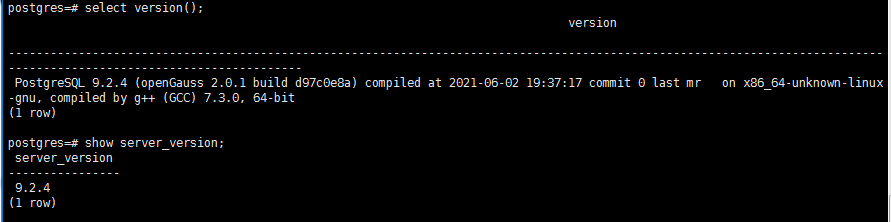
\copyright
3.常见元命令的使用
元命令\l的作用是显示openGauss数据库集簇中,目前有哪些数据库。
- \l
postgres=# \l
                          List of databases
   Name    | Owner | Encoding  | Collate | Ctype | Access privileges
-----------+-------+-----------+---------+-------+-------------------
 enmodb    | omm   | SQL_ASCII | C       | C     |
 mydb      | omm   | GBK       | C       | C     |
 postgres  | omm   | SQL_ASCII | C       | C     |
 template0 | omm   | SQL_ASCII | C       | C     | =c/omm           +
           |       |           |         |       | omm=CTc/omm
 template1 | omm   | SQL_ASCII | C       | C     | =c/omm           +
           |       |           |         |       | omm=CTc/omm
(5 rows)

postgres=#
元命令\conninfo的作用是在gsql中,显示会话的连接信息。
- \conninfo
postgres=# \conninfo
You are connected to database "postgres" as user "omm" via socket in "/opt/huawei/tmp" at port "26000".
postgres=#
元命令\ c[onnect] [DBNAME]的作用是在gsql中,切换连接的数据库postgres。
- 语法格式:\c[onnect] [DBNAME]
例如,\c postgres
postgres=#
postgres=# \c mydb
Non-SSL connection (SSL connection is recommended when requiring high-security)
You are now connected to database "mydb" as user "omm".mydb=#
mydb=# \l
                          List of databases
   Name    | Owner | Encoding  | Collate | Ctype | Access privileges
-----------+-------+-----------+---------+-------+-------------------
 enmodb    | omm   | SQL_ASCII | C       | C     |
 mydb      | omm   | GBK       | C       | C     |
 postgres  | omm   | SQL_ASCII | C       | C     |
 template0 | omm   | SQL_ASCII | C       | C     | =c/omm           +
           |       |           |         |       | omm=CTc/omm
 template1 | omm   | SQL_ASCII | C       | C     | =c/omm           +
           |       |           |         |       | omm=CTc/omm
(5 rows)

mydb=# 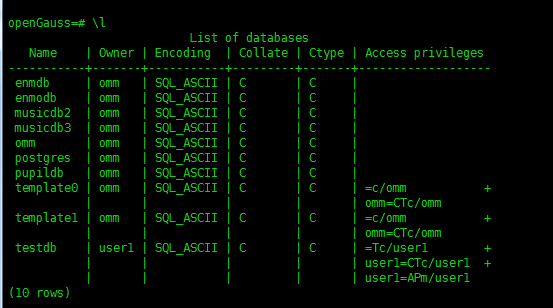
元命令\dg命令与元命令\du命令的作用类似,都是显示openGauss数据库集簇中,目前有哪些用户和角色。
- \du
postgres=# \du
                                                              List of roles
 Role name |                                                    Attributes
 | Member of
-----------+-----------------------------------------------------------------------------------------------------------------
-+-----------
 gaussdb   | Sysadmin
 | {}
 omm       | Sysadmin, Create role, Create DB, Replication, Administer audit, Monitoradmin, Operatoradmin, Policyadmin, UseFT
 | {}

postgres=#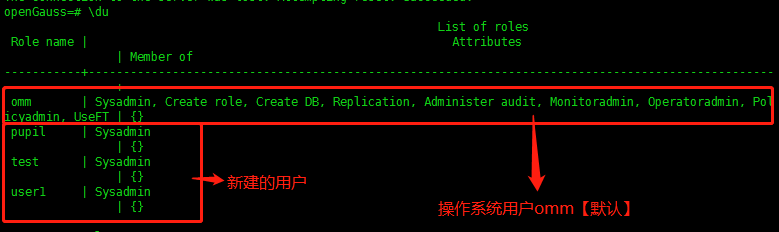
- \dg
postgres=# \dg
                                                              List of roles
 Role name |                                                    Attributes
 | Member of
-----------+-----------------------------------------------------------------------------------------------------------------
-+-----------
 gaussdb   | Sysadmin
 | {}
 omm       | Sysadmin, Create role, Create DB, Replication, Administer audit, Monitoradmin, Operatoradmin, Policyadmin, UseFT
 | {}

postgres=#
元命令\db的作用是显示openGauss数据库集簇中,目前有哪些表空间。
- \db
enmodb=# \db
            List of tablespaces
    Name    | Owner |       Location
------------+-------+-----------------------
 enmodb_ts  | omm   | tablespace/enmodb_ts1
 pg_default | omm   |
 pg_global  | omm   |
(3 rows)

enmodb=#
元命令\dn的作用是显示当前数据库有哪些数据库模式。
- \dn
enmodb=# \dn
   List of schemas
    Name     | Owner
-------------+-------
 cstore      | omm
 dbe_perf    | omm
 pkg_service | omm
 public      | omm
 snapshot    | omm
(5 rows)

enmodb=#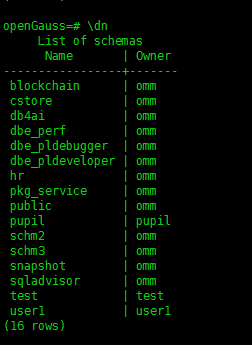
--创建表
CREATE TABLE customer_t
( c_customer_sk integer,
c_customer_id char(5),
c_first_name char(6),
c_last_name char(8)
) ;
--插入数据
INSERT INTO customer_t (c_customer_sk, c_customer_id, c_first_name,c_last_name) VALUES (3769, 5, 'Grace','White');
INSERT INTO customer_t (c_customer_sk, c_customer_id, c_first_name,c_last_name) VALUES (3770, 6, 'Grace','Black');
INSERT INTO customer_t (c_customer_sk, c_customer_id, c_first_name,c_last_name) VALUES (3771, 7, 'Grace','Orange');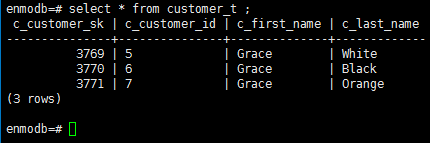
命令\dt的作用是显示数据库中所有的表。
- \dt
enmodb=# \dt
                           List of relations
 Schema |    Name    | Type  | Owner |             Storage
--------+------------+-------+-------+----------------------------------
 public | advisor    | table | omm   | {orientation=row,compression=no}
 public | classroom  | table | omm   | {orientation=row,compression=no}
 public | course     | table | omm   | {orientation=row,compression=no}
 public | customer_t | table | omm   | {orientation=row,compression=no}
 public | department | table | omm   | {orientation=row,compression=no}
 public | instructor | table | omm   | {orientation=row,compression=no}
 public | prereq     | table | omm   | {orientation=row,compression=no}
 public | section    | table | omm   | {orientation=row,compression=no}
 public | student    | table | omm   | {orientation=row,compression=no}
 public | takes      | table | omm   | {orientation=row,compression=no}
 public | teaches    | table | omm   | {orientation=row,compression=no}
 public | time_slot  | table | omm   | {orientation=row,compression=no}
(12 rows)

enmodb=#
元命令\d TableName的作用是查看某个表的信息。
- 语法格式:\d TableName命令,
比如,\d customer_t
enmodb=# \d customer_t
        Table "public.customer_t"
    Column     |     Type     | Modifiers
---------------+--------------+-----------
 c_customer_sk | integer      |
 c_customer_id | character(5) |
 c_first_name  | character(6) |
 c_last_name   | character(8) |

enmodb=#
查看索引信息,元命令\di IndexName的作用是查看某个索引的信息。
- 语法格式:\di IndexName命令
比如,create index idx_customer_id on customer_t(c_customer_id);
\di
enmodb=# create index idx_customer_id on customer_t(c_customer_id);
CREATE INDEX
enmodb=# \di
                        List of relations
 Schema |      Name       | Type  | Owner |   Table    | Storage
--------+-----------------+-------+-------+------------+---------
 public | advisor_pkey    | index | omm   | advisor    |
 public | classroom_pkey  | index | omm   | classroom  |
 public | course_pkey     | index | omm   | course     |
 public | department_pkey | index | omm   | department |
 public | idx_customer_id | index | omm   | customer_t |
 public | instructor_pkey | index | omm   | instructor |
 public | prereq_pkey     | index | omm   | prereq     |
 public | section_pkey    | index | omm   | section    |
 public | student_pkey    | index | omm   | student    |
 public | takes_pkey      | index | omm   | takes      |
 public | teaches_pkey    | index | omm   | teaches    |
 public | time_slot_pkey  | index | omm   | time_slot  |
(12 rows)

enmodb=# \di idx_customer_id
                        List of relations
 Schema |      Name       | Type  | Owner |   Table    | Storage
--------+-----------------+-------+-------+------------+---------
 public | idx_customer_id | index | omm   | customer_t |
(1 row)

enmodb=#
可以用\pset命令以不同的方法显示表:
- \pset border 2
enmodb=# \pset border 2
Border style is 2.
enmodb=# select * from customer_t;
+---------------+---------------+--------------+-------------+
| c_customer_sk | c_customer_id | c_first_name | c_last_name |
+---------------+---------------+--------------+-------------+
|          3769 | 5             | Grace        | White       |
|          3770 | 6             | Grace        | Black       |
|          3771 | 7             | Grace        | Orange      |
+---------------+---------------+--------------+-------------+
(3 rows)

enmodb=#
打开扩展表格式模式。
- \x
enmodb=# \x
Expanded display is on.
enmodb=# select * from customer_t;
+-[ RECORD 1 ]--+----------+
| c_customer_sk | 3769     |
| c_customer_id | 5        |
| c_first_name  | Grace    |
| c_last_name   | White    |
+-[ RECORD 2 ]--+----------+
| c_customer_sk | 3770     |
| c_customer_id | 6        |
| c_first_name  | Grace    |
| c_last_name   | Black    |
+-[ RECORD 3 ]--+----------+
| c_customer_sk | 3771     |
| c_customer_id | 7        |
| c_first_name  | Grace    |
| c_last_name   | Orange   |
+---------------+----------+

enmodb=#
4.gsql中的事务:测试gsql中的默认事务自动提交功能
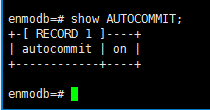
- 查看gsql中事务是否默认为自动提交
enmodb=# show AUTOCOMMIT;
- 测试gsql中事务默认为自动提交功能
enmodb=# create table customer_new as select * from customer_t;
enmodb=# select * from customer_new;
+-[ RECORD 1 ]--+----------+
| c_customer_sk | 3769     |
| c_customer_id | 5        |
| c_first_name  | Grace    |
| c_last_name   | White    |
+-[ RECORD 2 ]--+----------+
| c_customer_sk | 3770     |
| c_customer_id | 6        |
| c_first_name  | Grace    |
| c_last_name   | Black    |
+-[ RECORD 3 ]--+----------+
| c_customer_sk | 3771     |
| c_customer_id | 7        |
| c_first_name  | Grace    |
| c_last_name   | Orange   |
+---------------+----------+

enmodb=#
如何关闭\x的拓展模式?
说明:\q退出当前数据库,再进入数据库,就不会出现\x的拓展模式。
退出当前数据库:\q
- 重新登录后看到之前创建的表customer_new:
postgres=# postgres=# \c enmodb
Non-SSL connection (SSL connection is recommended when requiring high-security)
You are now connected to database "enmodb" as user "omm".
enmodb=# \dt
                            List of relations
 Schema |     Name     | Type  | Owner |             Storage
--------+--------------+-------+-------+----------------------------------
 public | advisor      | table | omm   | {orientation=row,compression=no}
 public | classroom    | table | omm   | {orientation=row,compression=no}
 public | course       | table | omm   | {orientation=row,compression=no}
 public | customer_new | table | omm   | {orientation=row,compression=no}
 public | customer_t   | table | omm   | {orientation=row,compression=no}
 public | department   | table | omm   | {orientation=row,compression=no}
 public | instructor   | table | omm   | {orientation=row,compression=no}
 public | prereq       | table | omm   | {orientation=row,compression=no}
 public | section      | table | omm   | {orientation=row,compression=no}
 public | student      | table | omm   | {orientation=row,compression=no}
 public | takes        | table | omm   | {orientation=row,compression=no}
 public | teaches      | table | omm   | {orientation=row,compression=no}
 public | time_slot    | table | omm   | {orientation=row,compression=no}
(13 rows)

enmodb=# select * from customer_new;
 c_customer_sk | c_customer_id | c_first_name | c_last_name
---------------+---------------+--------------+-------------
          3769 | 5             | Grace        | White
          3770 | 6             | Grace        | Black
          3771 | 7             | Grace        | Orange
(3 rows)

enmodb=#
5.gsql中的事务:测试gsql中的事务手动提交功能
- 测试gsql手动提交
1)opengauss默认执行完一条语句后,立即提交。可以关闭自动提交功能:
2)注意:此处设置ATUOCOMMIT必须用大写!
postgres=# \set AUTOCOMMIT off- 插入一些数据
INSERT INTO customer_t (c_customer_sk, c_customer_id, c_first_name,c_last_name) VALUES
(6885, 1, 'Joes', 'Hunter'),
(4321, 2, 'Lily','Carter'),
(9527, 3, 'James', 'Cook'),
(9500, 4, 'Lucy', 'Baker');
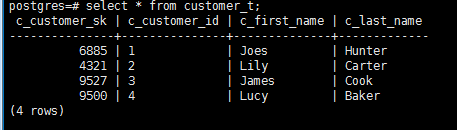
- 查看表中数据
postgres=# select * from customer_t;
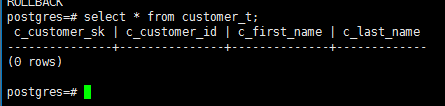
- 执行回滚
postgres=# rollback;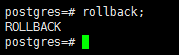
- 检查是否回滚成功
postgres=# select * from customer_t;
6.gsql相关的帮助
- 连接数据库时,可以使用如下命令获取帮助信息。
[omm@node1 ~]$ gsql --help
gsql is the openGauss interactive terminal.

Usage:
  gsql [OPTION]... [DBNAME [USERNAME]]

General options:
  -c, --command=COMMAND    run only single command (SQL or internal) and exit
  -d, --dbname=DBNAME      database name to connect to (default: "omm")
  -f, --file=FILENAME      execute commands from file, then exit
  -l, --list               list available databases, then exit
  -v, --set=, --variable=NAME=VALUE
                           set gsql variable NAME to VALUE
  -V, --version            output version information, then exit
  -X, --no-gsqlrc          do not read startup file (~/.gsqlrc)
  -1 ("one"), --single-transaction
                           execute command file as a single transaction
  -?, --help               show this help, then exit

Input and output options:
  -a, --echo-all           echo all input from script
  -e, --echo-queries       echo commands sent to server
  -E, --echo-hidden        display queries that internal commands generate
  -k, --with-key=KEY       the key for decrypting the encrypted file
  -L, --log-file=FILENAME  send session log to file
  -m, --maintenance        can connect to cluster during 2-pc transaction recovery
  -n, --no-libedit        disable enhanced command line editing (libedit)
  -o, --output=FILENAME    send query results to file (or |pipe)
  -q, --quiet              run quietly (no messages, only query output)
  -C, --enable-client-encryption              enable client encryption feature
  -s, --single-step        single-step mode (confirm each query)
  -S, --single-line        single-line mode (end of line terminates SQL command)

Output format options:
  -A, --no-align           unaligned table output mode
  -F, --field-separator=STRING
                           set field separator (default: "|")
  -H, --html               HTML table output mode
  -P, --pset=VAR[=ARG]     set printing option VAR to ARG (see \pset command)
  -R, --record-separator=STRING
                           set record separator (default: newline)
  -r        		   if this parameter is set,use libedit
  -t, --tuples-only        print rows only
  -T, --table-attr=TEXT    set HTML table tag attributes (e.g., width, border)
  -x, --expanded           turn on expanded table output
  -z, --field-separator-zero
                           set field separator to zero byte
  -0, --record-separator-zero
                           set record separator to zero byte

Connection options:
  -h, --host=HOSTNAME      database server host or socket directory (default: "/opt/huawei/tmp")
  -p, --port=PORT          database server port (default: "5432")
  -U, --username=USERNAME  database user name (default: "omm")
  -W, --password=PASSWORD  the password of specified database user

For more information, type "\?" (for internal commands) or "\help" (for SQL
commands) from within gsql, or consult the gsql section in the openGauss documentation.

[omm@node1 ~]$ - 获取和SQL语法有关的帮助信息
postgres-# \h
Available help:
  ABORT                             CREATE BARRIER                    DROP MATERIALIZED VIEW
  ALTER APP WORKLOAD GROUP          CREATE CLIENT MASTER KEY          DROP NODE
  ALTER APP WORKLOAD GROUP MAPPING  CREATE COLUMN ENCRYPTION KEY      DROP NODE GROUP
  ALTER AUDIT POLICY                CREATE DATA SOURCE                DROP OWNED
  ALTER DATA SOURCE                 CREATE DATABASE                   DROP PROCEDURE
  ALTER DATABASE                    CREATE DIRECTORY                  DROP RESOURCE LABEL
  ALTER DEFAULT PRIVILEGES          CREATE EXTENSION                  DROP RESOURCE POOL
  ALTER DIRECTORY                   CREATE FOREIGN TABLE              DROP ROLE
  ALTER EXTENSION                   CREATE FUNCTION                   DROP ROW LEVEL SECURITY POLICY
  ALTER FOREIGN TABLE               CREATE GROUP                      DROP SCHEMA
  ALTER FOREIGN TABLE FOR HDFS      CREATE INDEX                      DROP SEQUENCE
  ALTER FUNCTION                    CREATE MASKING POLICY             DROP SERVER
  ALTER GROUP                       CREATE MATERIALIZED VIEW          DROP SYNONYM
  ALTER INDEX                       CREATE NODE                       DROP TABLE
  ALTER LARGE OBJECT                CREATE NODE GROUP                 DROP TABLESPACE
  ALTER MASKING POLICY              CREATE PROCEDURE                  DROP TEXT SEARCH CONFIGURATION
  ALTER NODE                        CREATE RESOURCE LABEL             DROP TEXT SEARCH DICTIONARY
  ALTER NODE GROUP                  CREATE RESOURCE POOL              DROP TRIGGER
  ALTER RESOURCE LABEL              CREATE ROLE                       DROP TYPE
  ALTER RESOURCE POOL               CREATE ROW LEVEL SECURITY POLICY  DROP USER
  ALTER ROLE                        CREATE SCHEMA                     DROP VIEW
  ALTER ROW LEVEL SECURITY POLICY   CREATE SEQUENCE                   DROP WEAK PASSWORD DICTIONARY
  ALTER SCHEMA                      CREATE SERVER                     DROP WORKLOAD GROUP
  ALTER SEQUENCE                    CREATE SYNONYM                    END
  ALTER SERVER                      CREATE TABLE                      EXECUTE
  ALTER SESSION                     CREATE TABLE AS                   EXECUTE DIRECT
  ALTER SYNONYM                     CREATE TABLE PARTITION            EXPLAIN
  ALTER SYSTEM KILL SESSION         CREATE TABLESPACE                 FETCH
  ALTER SYSTEM SET                  CREATE TEXT SEARCH CONFIGURATION  GRANT
  ALTER TABLE                       CREATE TEXT SEARCH DICTIONARY     INSERT
  ALTER TABLE PARTITION             CREATE TRIGGER                    LOCK
  ALTER TABLESPACE                  CREATE TYPE                       MERGE
  ALTER TEXT SEARCH CONFIGURATION   CREATE USER                       MOVE
  ALTER TEXT SEARCH DICTIONARY      CREATE VIEW                       PREPARE
  ALTER TRIGGER                     CREATE WEAK PASSWORD DICTIONARY   PREPARE TRANSACTION
  ALTER TYPE                        CREATE WORKLOAD GROUP             REASSIGN OWNED
  ALTER USER                        CURSOR                            REFRESH MATERIALIZED VIEW
  ALTER VIEW                        DEALLOCATE                        REINDEX
  ALTER WORKLOAD GROUP              DECLARE                           RESET
  ANALYSE                           DELETE                            REVOKE
  ANALYZE                           DO                                ROLLBACK
  ANONYMOUS BLOCK                   DROP APP WORKLOAD GROUP           ROLLBACK PREPARED
  BEGIN                             DROP APP WORKLOAD GROUP MAPPING   SELECT
  CALL                              DROP AUDIT POLICY                 SELECT INTO
  CHECKPOINT                        DROP CLIENT MASTER KEY            SET
  CLEAN CONNECTION                  DROP COLUMN ENCRYPTION KEY        SET CONSTRAINTS
  CLOSE                             DROP DATA SOURCE                  SET ROLE
  CLUSTER                           DROP DATABASE                     SET SESSION AUTHORIZATION
  COMMENT                           DROP DIRECTORY                    SET TRANSACTION
  COMMIT                            DROP EXTENSION                    SHOW
  COMMIT PREPARED                   DROP FOREIGN TABLE                START TRANSACTION
  COPY                              DROP FUNCTION                     TRUNCATE
  CREATE APP WORKLOAD GROUP         DROP GROUP                        UPDATE
  CREATE APP WORKLOAD GROUP MAPPING DROP INDEX                        VACUUM
  CREATE AUDIT POLICY               DROP MASKING POLICY               VALUES
postgres-#
获取和元命令有关的帮助信息
enmodb=# \?
General
  \copyright             show openGauss usage and distribution terms
  \g [FILE] or ;         execute query (and send results to file or |pipe)
  \h(\help) [NAME]              help on syntax of SQL commands, * for all commands
  \parallel [on [num]|off] toggle status of execute (currently off)
  \q                     quit gsql

Query Buffer
  \e [FILE] [LINE]       edit the query buffer (or file) with external editor
  \ef [FUNCNAME [LINE]]  edit function definition with external editor
  \p                     show the contents of the query buffer
  \r                     reset (clear) the query buffer
  \w FILE                write query buffer to file

Input/Output
  \copy ...              perform SQL COPY with data stream to the client host
  \echo [STRING]         write string to standard output
  \i FILE                execute commands from file
  \i+ FILE KEY           execute commands from encrypted file
  \ir FILE               as \i, but relative to location of current script
  \ir+ FILE KEY          as \i+, but relative to location of current script
  \o [FILE]              send all query results to file or |pipe
  \qecho [STRING]        write string to query output stream (see \o)

Informational
  (options: S = show system objects, + = additional detail)
  \d[S+]                 list tables, views, and sequences
  \d[S+]  NAME           describe table, view, sequence, or index
  \da[S]  [PATTERN]      list aggregates
  \db[+]  [PATTERN]      list tablespaces
  \dc[S+] [PATTERN]      list conversions
  \dC[+]  [PATTERN]      list casts
  \dd[S]  [PATTERN]      show object descriptions not displayed elsewhere
  \ddp    [PATTERN]      list default privileges
  \dD[S+] [PATTERN]      list domains
  \ded[+] [PATTERN]      list data sources
  \det[+] [PATTERN]      list foreign tables
  \des[+] [PATTERN]      list foreign servers
  \deu[+] [PATTERN]      list user mappings
  \dew[+] [PATTERN]      list foreign-data wrappers
  \df[antw][S+] [PATRN]  list [only agg/normal/trigger/window] functions
  \dF[+]  [PATTERN]      list text search configurations
  \dFd[+] [PATTERN]      list text search dictionaries
  \dFp[+] [PATTERN]      list text search parsers
  \dFt[+] [PATTERN]      list text search templates
  \dg[+]  [PATTERN]      list roles
  \di[S+] [PATTERN]      list indexes
  \dl                    list large objects, same as \lo_list
  \dL[S+] [PATTERN]      list procedural languages
  \dn[S+] [PATTERN]      list schemas
  \do[S]  [PATTERN]      list operators
  \dO[S+] [PATTERN]      list collations
  \dp     [PATTERN]      list table, view, and sequence access privileges
  \drds [PATRN1 [PATRN2]] list per-database role settings
  \ds[S+] [PATTERN]      list sequences
  \dt[S+] [PATTERN]      list tables
  \dT[S+] [PATTERN]      list data types
  \du[+]  [PATTERN]      list roles
  \dv[S+] [PATTERN]      list views
  \dE[S+] [PATTERN]      list foreign tables
  \dx[+]  [PATTERN]      list extensions
  \l[+]                  list all databases
  \sf[+] FUNCNAME        show a function's definition
  \z      [PATTERN]      same as \dp

Formatting
  \a                     toggle between unaligned and aligned output mode
  \C [STRING]            set table title, or unset if none
  \f [STRING]            show or set field separator for unaligned query output
  \H                     toggle HTML output mode (currently off)
  \pset NAME [VALUE]     set table output option
                         (NAME := {format|border|expanded|fieldsep|fieldsep_zero|footer|null|
                         numericlocale|recordsep|recordsep_zero|tuples_only|title|tableattr|pager})
  \t [on|off]            show only rows (currently off)
  \T [STRING]            set HTML <table> tag attributes, or unset if none
  \x [on|off|auto]       toggle expanded output (currently off)

Connection
  \c[onnect] [DBNAME|- USER|- HOST|- PORT|-]
                         connect to new database (currently "enmodb")
  \encoding [ENCODING]   show or set client encoding
  \conninfo              display information about current connection

Operating System
  \cd [DIR]              change the current working directory
  \setenv NAME [VALUE]   set or unset environment variable
  \timing [on|off]       toggle timing of commands (currently off)
  \! [COMMAND]           execute command in shell or start interactive shell

Variables
  \prompt [TEXT] NAME    prompt user to set internal variable
  \set [NAME [VALUE]]    set internal variable, or list all if no parameters
  \unset NAME            unset (delete) internal variable

Large Objects
  \lo_export LOBOID FILE
  \lo_import FILE [COMMENT]
  \lo_list
  \lo_unlink LOBOID      large object operations
enmodb=# 