



一、学习目标
学习openGauss体系结构,使用一个用户访问多个数据库。
二、课程学习
数据库用户user1可以访问不同的数据库(musicdb1、musicdb2、musicdb3)。
实验中user1用户在数据库musicdb1中创建了表t11、在数据库musicdb2创建了表t21、在数据库musicdb3中创建了表t31,验证了这个结论。
三、课程作业
首先连接数据库:
root@modb:~# su - omm
omm@modb:~$ gsql -r
gsql ((openGauss 3.0.0 build 02c14696) compiled at 2022-04-01 18:12:00 commit 0 last mr  )
Non-SSL connection (SSL connection is recommended when requiring high-security)
Type "help" for help.
1.创建数据库musicdb10,创建用户user10,赋予sysadmin权限
--创建数据库musicdb10
omm=# CREATE TABLESPACE music_tbs RELATIVE LOCATION 'tablespace/test_ts1';
CREATE TABLESPACE
omm=# CREATE DATABASE musicdb10  WITH TABLESPACE = music_tbs;
CREATE DATABASE
--执行下面的SQL语句,创建用户user1:
omm=# CREATE USER user10 IDENTIFIED BY 'kunpeng@1234';
NOTICE:  The encrypted password contains MD5 ciphertext, which is not secure.
CREATE ROLE
--授予user1数据库系统的SYSADMIN权限:
omm=# ALTER USER user10 SYSADMIN;
ALTER ROLE
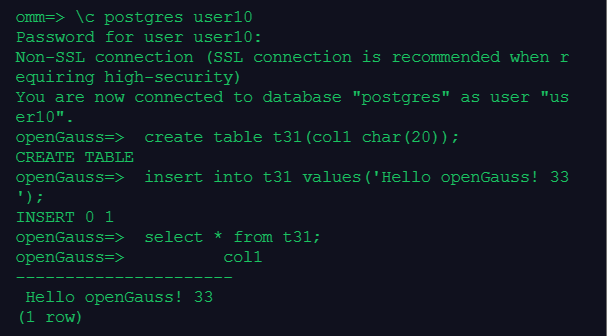
2.用户user10访问数据库postgres,创建一个表并插入数据
–用户user1登录到数据库postgres,创建表t31,并插入、查看数据
omm=> \c postgres user10
Password for user user10:
Non-SSL connection (SSL connection is recommended when requiring high-security)
You are now connected to database "postgres" as user "user10".
openGauss=>  create table t31(col1 char(20));
CREATE TABLE
openGauss=>  insert into t31 values('Hello openGauss! 33');
INSERT 0 1
openGauss=>  select * from t31;
openGauss=>          col1
----------------------
 Hello openGauss! 33
(1 row)
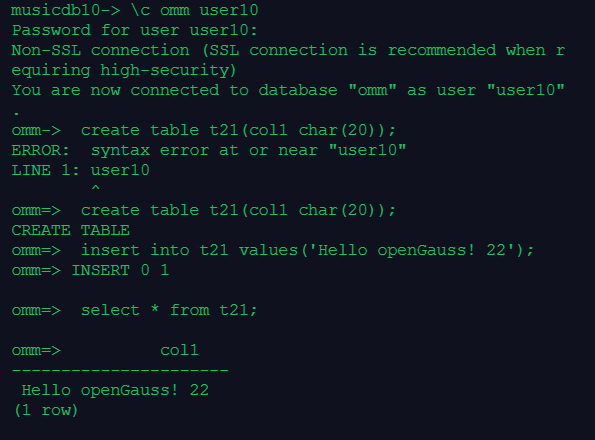
3.用户user10访问数据库omm,创建一个表并插入数据
--用户user10登录到数据库omm,创建表t21,并插入、查看数据
,创建表t21,并插入、查看数据
musicdb10-> \c omm user10
Password for user user10:
Non-SSL connection (SSL connection is recommended when requiring high-security)
You are now connected to database "omm" as user "user10".
omm=>  create table t21(col1 char(20));
CREATE TABLE
omm=>  insert into t21 values('Hello openGauss! 22');
omm=> INSERT 0 1
omm=>  select * from t21;
omm=>          col1
----------------------
 Hello openGauss! 22
(1 row)
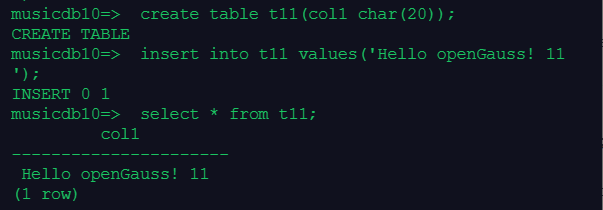
4.用户user10访问数据库musicdb10,创建一个表并插入数据
--用户user10登录到数据库musicdb10,创建表t11,并插入、查看数据
omm-# \c musicdb10 user10
Password for user user10:
Non-SSL connection (SSL connection is recommended when requiring high-security)
You are now connected to database "musicdb10" as user "user10".
musicdb10=>  create table t11(col1 char(20));
CREATE TABLE
musicdb10=>  insert into t11 values('Hello openGauss! 11');
INSERT 0 1
musicdb10=>  select * from t11;
         col1
----------------------
 Hello openGauss! 11
(1 row)
四、心得体会
通过今天的学习,使用一个用户访问了三个数据库,并分别创建了一个表并做插入数据及查询操作,用户在每个数据库里都可以查询到其在这个库里创建的表。通过以上学习,证明了openGauss一个用户访问多个数据库。
「喜欢这篇文章,您的关注和赞赏是给作者最好的鼓励」
关注作者
【版权声明】本文为墨天轮用户原创内容,转载时必须标注文章的来源(墨天轮),文章链接,文章作者等基本信息,否则作者和墨天轮有权追究责任。如果您发现墨天轮中有涉嫌抄袭或者侵权的内容,欢迎发送邮件至:contact@modb.pro进行举报,并提供相关证据,一经查实,墨天轮将立刻删除相关内容。
