



gsql是openGauss提供在命令行下运行的数据库连接工具,可以通过此工具连接服务器并对其进行操作和维护,除了具备操作数据库的基本功能,gsql还提供了若干高级特性,便于用户使用。
1.gsql命令连到数据库omm
实训环境使用默认的端口配置,直接gsql可以连接到环境

自己的环境使用了26000端口:
[omm@fdb62pd2 ~]$ gsql -d postgres -p 26000 -r
gsql ((openGauss 3.1.0 build 4e931f9a) compiled at 2022-09-29 14:19:24 commit 0 last mr )
Non-SSL connection (SSL connection is recommended when requiring high-security)
Type "help" for help.
openGauss=#
2.查看数据库的版本、版权信息
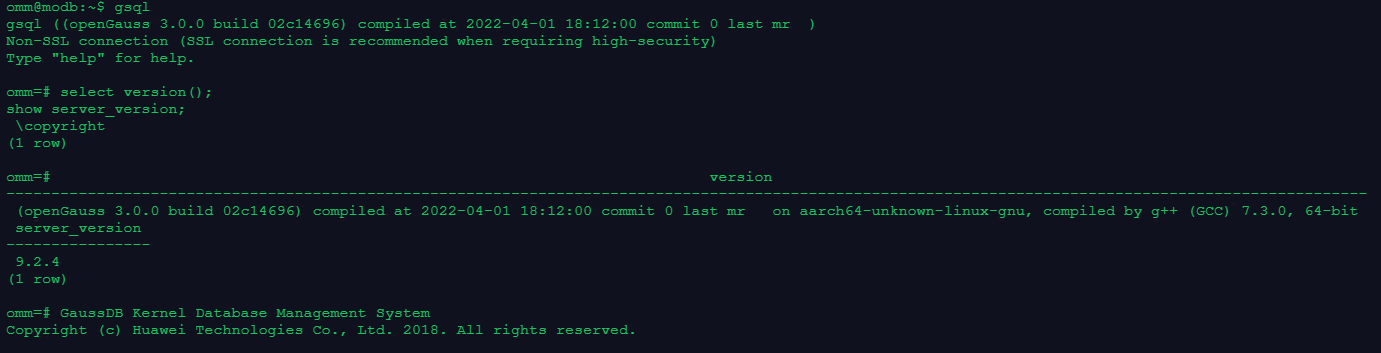
openGauss=# select version();
version
------------------------------------
(openGauss 3.1.0 build 4e931f9a) compiled at 2022-09-29 14:19:24 commit 0 last mr on x86_64-unknown-linux-gnu, compiled by g++ (GCC) 7.3.0, 64-bit
(1 row)
openGauss-# \copyright
GaussDB Kernel Database Management System
Copyright (c) Huawei Technologies Co., Ltd. 2018. All rights reserved.
3.常见元命令使用
--\l命令,元命令\l的作用是显示openGauss数据库集簇中,目前有哪些数据库。
openGauss-# \l
List of databases
Name | Owner | Encoding | Collate | Ctype | Access privileges
-----------+-------+-----------+---------+-------+-------------------
postgres | omm | SQL_ASCII | C | C |
template0 | omm | SQL_ASCII | C | C | =c/omm +
| | | | | omm=CTc/omm
template1 | omm | SQL_ASCII | C | C | =c/omm +
| | | | | omm=CTc/omm
(3 rows)
--\conninfo命令,元命令\conninfo的作用是在gsql中,显示会话的连接信息。
openGauss-# \conninfo
You are connected to database "postgres" as user "omm" via socket in "/apps2/opengauss/tmp" at port "26000".
openGauss-#
--\c[onnect] [DBNAME]命令,元命令\ c[onnect] [DBNAME]的作用是在gsql中,切换连接的数据库postgres。
openGauss-# \c postgres
Non-SSL connection (SSL connection is recommended when requiring high-security)
You are now connected to database "postgres" as user "omm".
openGauss-#
--\du命令和\dg命令,元命令\dg命令与元命令\du命令的作用类似,都是显示openGauss数据库集簇中,目前有哪些用户和角色。
openGauss-# \du
List of roles
Role name | Attributes | Member of
-----------+------------------------------------------------------------------------------------------------------------------+-----------
omm | Sysadmin, Create role, Create DB, Replication, Administer audit, Monitoradmin, Operatoradmin, Policyadmin, UseFT | {}
openGauss-#
openGauss-# \dg
List of roles
Role name | Attributes | Member of
-----------+------------------------------------------------------------------------------------------------------------------+-----------
omm | Sysadmin, Create role, Create DB, Replication, Administer audit, Monitoradmin, Operatoradmin, Policyadmin, UseFT | {}
--\db命令,元命令\db的作用是显示openGauss数据库集簇中,目前有哪些表空间。
openGauss-# \db
List of tablespaces
Name | Owner | Location
------------+-------+----------
pg_default | omm |
pg_global | omm |
(2 rows)
--\dn命令,元命令\dn的作用是显示当前数据库有哪些数据库模式。
openGauss-# \dn
List of schemas
Name | Owner
-----------------+-------
blockchain | omm
cstore | omm
db4ai | omm
dbe_perf | omm
dbe_pldebugger | omm
dbe_pldeveloper | omm
dbe_sql_util | omm
pkg_service | omm
public | omm
snapshot | omm
sqladvisor | omm
(11 rows)
--创建表
CREATE TABLE customer_t
( c_customer_sk integer,
c_customer_id char(5),
c_first_name char(6),
c_last_name char(8)
) ;
--插入数据
INSERT INTO customer_t (c_customer_sk, c_customer_id, c_first_name,c_last_name) VALUES (3769, 5, 'Grace','White');
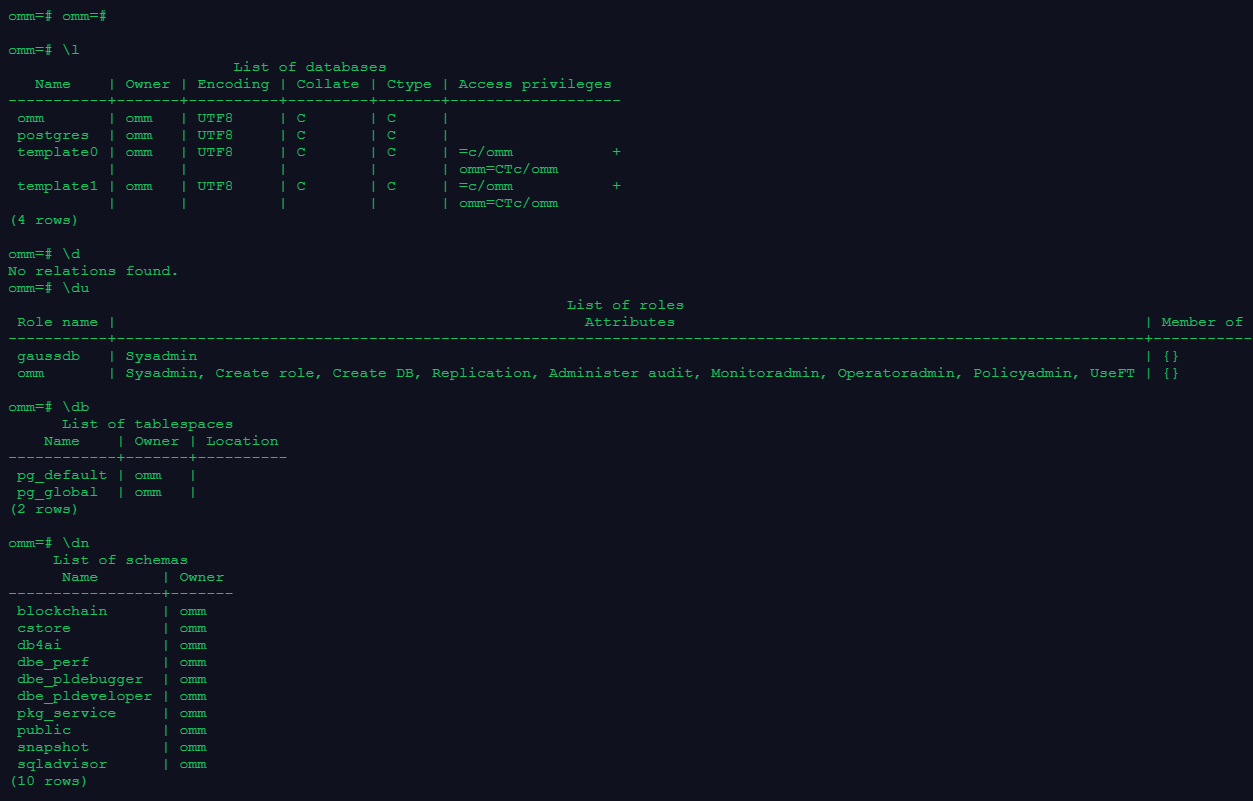
--\dt命令,命令\dt的作用是显示数据库中所有的表。
\dt
--\d TableName命令,元命令\d TableName的作用是查看某个表的信息。
\d customer_t
openGauss=# CREATE TABLE customer_t
openGauss-# ( c_customer_sk integer,
openGauss(# c_customer_id char(5),
openGauss(# c_first_name char(6),
openGauss(# c_last_name char(8)
openGauss(# ) ;
CREATE TABLE
openGauss=#
openGauss=# \dt
List of relations
Schema | Name | Type | Owner | Storage
--------+------------+-------+-------+----------------------------------
public | customer_t | table | omm | {orientation=row,compression=no}
(1 row)
openGauss=# INSERT INTO customer_t (c_customer_sk, c_customer_id, c_first_name,c_last_name) VALUES (3769, 5, 'Grace','White');
INSERT 0 1
openGauss=#
openGauss=# \d
List of relations
Schema | Name | Type | Owner | Storage
--------+------------+-------+-------+----------------------------------
public | customer_t | table | omm | {orientation=row,compression=no}
(1 row)
openGauss=# CREATE TABLE customer_t
openGauss-# ( c_customer_sk integer,
openGauss(# c_customer_id char(5),
openGauss(# c_first_name char(6),
openGauss(# c_last_name char(8)
openGauss(# ) ;
CREATE TABLE
openGauss=#
openGauss=# \dt
List of relations
Schema | Name | Type | Owner | Storage
--------+------------+-------+-------+----------------------------------
public | customer_t | table | omm | {orientation=row,compression=no}
(1 row)
openGauss=# INSERT INTO customer_t (c_customer_sk, c_customer_id, c_first_name,c_last_name) VALUES (3769, 5, 'Grace','White');
INSERT 0 1
openGauss=#
openGauss=# \d
List of relations
Schema | Name | Type | Owner | Storage
--------+------------+-------+-------+----------------------------------
public | customer_t | table | omm | {orientation=row,compression=no}
(1 row)
查看索引
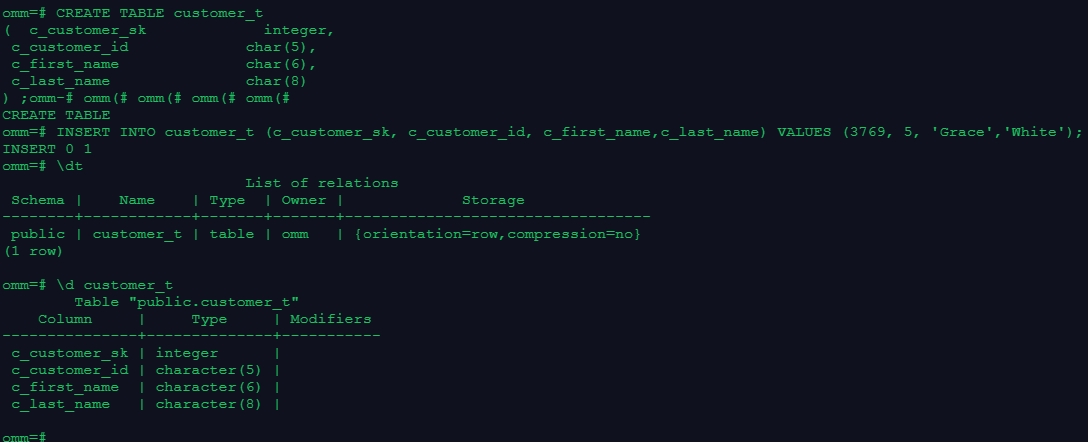
--\di IndexName命令,查看索引信息,元命令\di IndexName的作用是查看某个索引的信息。
create index idx_customer_id on customer_t(c_customer_id);
openGauss=# create index idx_customer_id on customer_t(c_customer_id);
CREATE INDEX
openGauss-# \di
List of relations
Schema | Name | Type | Owner | Table | Storage
--------+-----------------+-------+-------+------------+---------
public | idx_customer_id | index | omm | customer_t |
(1 row)
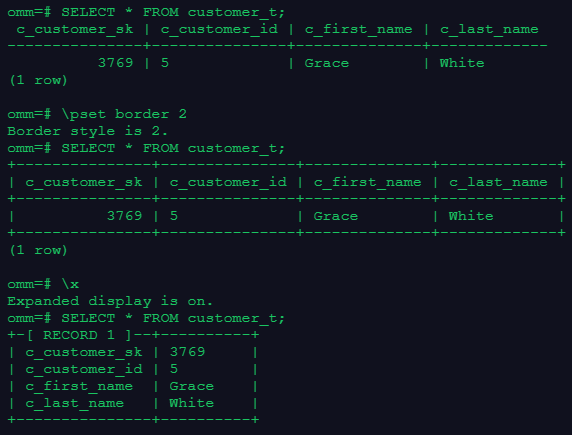
--可以用\pset命令以不同的方法显示表:
\pset border 2
SELECT * FROM customer_t;
openGauss=# SELECT * FROM customer_t;
c_customer_sk | c_customer_id | c_first_name | c_last_name
---------------+---------------+--------------+-------------
3769 | 5 | Grace | White
(1 row)
openGauss=# \pset border 2
Border style is 2.
openGauss=#
openGauss=# SELECT * FROM customer_t;
+---------------+---------------+--------------+-------------+
| c_customer_sk | c_customer_id | c_first_name | c_last_name |
+---------------+---------------+--------------+-------------+
| 3769 | 5 | Grace | White |
+---------------+---------------+--------------+-------------+
(1 row)
--打开扩展表格式模式。
\x
openGauss=# \x
Expanded display is on.
openGauss=#
openGauss=# SELECT * FROM customer_t;
+-[ RECORD 1 ]--+----------+
| c_customer_sk | 3769 |
| c_customer_id | 5 |
| c_first_name | Grace |
| c_last_name | White |
+---------------+----------+
查看表
查看索引
调整显示模式
4.使用两种方法,连到postgres数据库中
方式1:
[omm@fdb62pd2 ~]$ gsql -d postgres -p 26000
gsql ((openGauss 3.1.0 build 4e931f9a) compiled at 2022-09-29 14:19:24 commit 0 last mr )
Non-SSL connection (SSL connection is recommended when requiring high-security)
Type "help" for help.
openGauss=#
openGauss=# \q
--使用omm用户连接到本机omm数据库的5432端口,命令中的-r选项提供了对gsql命令的历史版本支持。
方式2:[omm@fdb62pd2 ~]$ gsql -d postgres -p 26000 -r
gsql ((openGauss 3.1.0 build 4e931f9a) compiled at 2022-09-29 14:19:24 commit 0 last mr )
Non-SSL connection (SSL connection is recommended when requiring high-security)
Type "help" for help.
openGauss=#
5.测试gsql中的默认事务自动提交功能
--查看gsql中事务是否默认为自动提交
show AUTOCOMMIT;
--测试gsql中事务默认为自动提交功能
create table customer_new as select * from customer_t;
\q
--重新登录后看到之前创建的表customer_new:
gsql -d postgres -p 5432 -r
\dt
openGauss=# show AUTOCOMMIT;
autocommit
------------
on
(1 row)
openGauss=# create table customer_new as select * from customer_t;
INSERT 0 1
openGauss=# \d
List of relations
Schema | Name | Type | Owner | Storage
--------+--------------+-------+-------+----------------------------------
public | customer_new | table | omm | {orientation=row,compression=no}
public | customer_t | table | omm | {orientation=row,compression=no}
(2 rows)
[omm@fdb62pd2 ~]$ gsql -d postgres -p 26000 -r
gsql ((openGauss 3.1.0 build 4e931f9a) compiled at 2022-09-29 14:19:24 commit 0 last mr )
Non-SSL connection (SSL connection is recommended when requiring high-security)
Type "help" for help.
openGauss=# \dt
List of relations
Schema | Name | Type | Owner | Storage
--------+--------------+-------+-------+----------------------------------
public | customer_new | table | omm | {orientation=row,compression=no}
public | customer_t | table | omm | {orientation=row,compression=no}
(2 rows)
表数据还在
6.测试gsql中的事务手动提交功能
–测试gsql手动提交
#Opengauss默认执行完一条语句后,立即提交。可以关闭自动提交功能:
\set AUTOCOMMIT off
--插入一些数据
INSERT INTO customer_t (c_customer_sk, c_customer_id, c_first_name,c_last_name) VALUES
(6885, 1, 'Joes', 'Hunter'),
(4321, 2, 'Lily','Carter'),
(9527, 3, 'James', 'Cook'),
(9500, 4, 'Lucy', 'Baker');
--查看表中数据
select * from customer_t;
--执行回滚
ROLLBACK;
--检查是否回滚成功
SELECT * FROM customer_t;
[omm@fdb62pd2 ~]$ gsql -d postgres -p 26000 -r
gsql ((openGauss 3.1.0 build 4e931f9a) compiled at 2022-09-29 14:19:24 commit 0 last mr )
Non-SSL connection (SSL connection is recommended when requiring high-security)
Type "help" for help.
openGauss=# show AUTOCOMMIT;
autocommit
------------
on
(1 row)
openGauss=# \set AUTOCOMMIT off
openGauss=# select *from customer_t;
c_customer_sk | c_customer_id | c_first_name | c_last_name
---------------+---------------+--------------+-------------
3769 | 5 | Grace | White
(1 row)
openGauss=# INSERT INTO customer_t (c_customer_sk, c_customer_id, c_first_name,c_last_name) VALUES
openGauss-# (6885, 1, 'Joes', 'Hunter'),
openGauss-# (4321, 2, 'Lily','Carter'),
openGauss-# (9527, 3, 'James', 'Cook'),
openGauss-# (9500, 4, 'Lucy', 'Baker');
INSERT 0 4
openGauss=# select *from customer_t;
c_customer_sk | c_customer_id | c_first_name | c_last_name
---------------+---------------+--------------+-------------
3769 | 5 | Grace | White
6885 | 1 | Joes | Hunter
4321 | 2 | Lily | Carter
9527 | 3 | James | Cook
9500 | 4 | Lucy | Baker
(5 rows)
openGauss=# ROLLBACK;
ROLLBACK
openGauss=# select *from customer_t;
c_customer_sk | c_customer_id | c_first_name | c_last_name
---------------+---------------+--------------+-------------
3769 | 5 | Grace | White
(1 row)
7.了解gsql相关帮助
[omm@fdb62pd2 ~]$ gsql --help
gsql is the openGauss interactive terminal.
Usage:
gsql [OPTION]... [DBNAME [USERNAME]]
General options:
-c, --command=COMMAND run only single command (SQL or internal) and exit
-d, --dbname=DBNAME database name to connect to (default: "omm")
-f, --file=FILENAME execute commands from file, then exit
-l, --list list available databases, then exit
-v, --set=, --variable=NAME=VALUE
set gsql variable NAME to VALUE
-V, --version output version information, then exit
-X, --no-gsqlrc do not read startup file (~/.gsqlrc)
-1 ("one"), --single-transaction
execute command file as a single transaction
-?, --help show this help, then exit
[omm@fdb62pd2 ~]$ gsql -\?
gsql is the openGauss interactive terminal.
Usage:
gsql [OPTION]... [DBNAME [USERNAME]]
gsql还内置了很多功能特性,具体可以参照官网https://docs.opengauss.org/zh/docs/3.1.0/docs/Toolreference/gsql.html
