



作者:马顺华
从事运维管理工作多年,目前就职于某科技有限公司,熟悉运维自动化、OceanBase部署运维、MySQL 运维以及各种云平台技术和产品。并已获得OceanBase认证OBCA、OBCP证书。
第 8 天 | openGauss中一个数据库可以存储在多个表空间中
学习目标
学习表空间与数据库对象的关系。
在musicdb数据库中创建的所有的表,没有指定表空间的名字,因此都创建在数据库默认的表空间music_tbs中,当我们在musicdb数据库中创建表warehouse_t1的时候,明确指定在表空间ds_location1中创建时,这个表会存储在这个指定的表空间。即一个数据库中的对象,可以位于不同的表空间.
课程学习
openGauss中一个数据库可以存储在多个表空间中
1.连接数据库,准备测试环境
#第一次进入等待15秒
#数据库启动中…
1)–连接数据库,进入数据库omm
su - omm
gsql -r
root@modb:~# su - omm
omm@modb:~$ gsql -r
gsql ((openGauss 3.0.0 build 02c14696) compiled at 2022-04-01 18:12:00 commit 0 last mr  )
Non-SSL connection (SSL connection is recommended when requiring high-security)
Type "help" for help.

omm=#

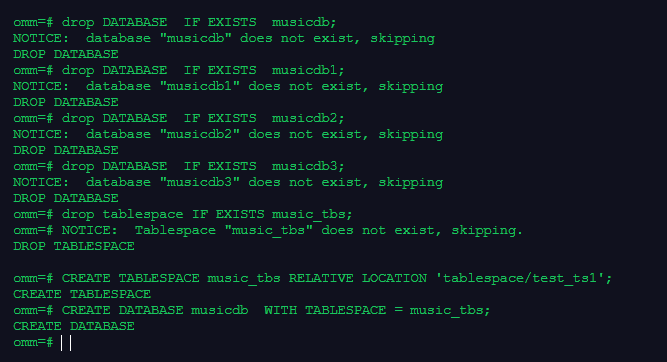
2)–进入数据库omm,创建表空间、测试数据库
drop DATABASE IF EXISTS musicdb;
drop DATABASE IF EXISTS musicdb1;
drop DATABASE IF EXISTS musicdb2;
drop DATABASE IF EXISTS musicdb3;
drop tablespace IF EXISTS music_tbs;
CREATE TABLESPACE music_tbs RELATIVE LOCATION ‘tablespace/test_ts1’;
CREATE DATABASE musicdb WITH TABLESPACE = music_tbs;
omm=# drop DATABASE  IF EXISTS  musicdb;
NOTICE:  database "musicdb" does not exist, skipping
DROP DATABASE
omm=# drop DATABASE  IF EXISTS  musicdb1;
NOTICE:  database "musicdb1" does not exist, skipping
DROP DATABASE
omm=# drop DATABASE  IF EXISTS  musicdb2;
NOTICE:  database "musicdb2" does not exist, skipping
DROP DATABASE
omm=# drop DATABASE  IF EXISTS  musicdb3;
NOTICE:  database "musicdb3" does not exist, skipping
DROP DATABASE
omm=# drop tablespace IF EXISTS music_tbs;
omm=# NOTICE:  Tablespace "music_tbs" does not exist, skipping.
DROP TABLESPACE

omm=# CREATE TABLESPACE music_tbs RELATIVE LOCATION 'tablespace/test_ts1';
CREATE TABLESPACE
omm=# CREATE DATABASE musicdb  WITH TABLESPACE = music_tbs;
CREATE DATABASE
omm=#
3)–执行下面的SQL语句,创建用户user1:
CREATE USER user1 IDENTIFIED BY ‘kunpeng@1234’;
omm=# CREATE USER user1 IDENTIFIED BY 'kunpeng@1234';
NOTICE:  The encrypted password contains MD5 ciphertext, which is not secure.
CREATE ROLE
omm=#

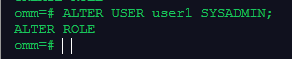
4)–授予user1数据库系统的SYSADMIN权限:
ALTER USER user1 SYSADMIN;
omm=# ALTER USER user1 SYSADMIN;
ALTER ROLE
omm=#
2.创建表空间、查看表空间
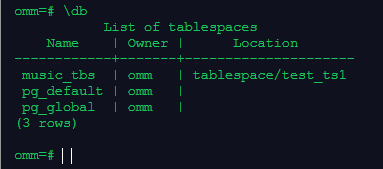
1)–执行下面的命令,查看当前表空间:
\db
omm=# \db
           List of tablespaces
    Name    | Owner |      Location
------------+-------+---------------------
 music_tbs  | omm   | tablespace/test_ts1
 pg_default | omm   |
 pg_global  | omm   |
(3 rows)

omm=#
2)–创建一个新的名为ds_location1的表空间:
CREATE TABLESPACE ds_location1 RELATIVE LOCATION ‘tablespace/tablespace_1’;
omm=# CREATE TABLESPACE ds_location1 RELATIVE LOCATION 'tablespace/tablespace_1';
CREATE TABLESPACE
omm=#
omm=#

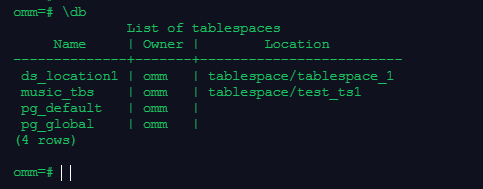
3)–执行下面的命令,查看实例当前有哪些表空间:
\db
omm=# \db
              List of tablespaces
     Name     | Owner |        Location
--------------+-------+-------------------------
 ds_location1 | omm   | tablespace/tablespace_1
 music_tbs    | omm   | tablespace/test_ts1
 pg_default   | omm   |
 pg_global    | omm   |
(4 rows)

omm=#
3.使用user1用户,访问musicdb数据库 ,在表空间ds_location1上创建表warehouse_t1:
\c musicdb user1
omm=# \c musicdb user1
Password for user user1:
musicdb=> Non-SSL connection (SSL connection is recommended when requiring high-security)
You are now connected to database "musicdb" as user "user1".

musicdb=>

create table warehouse_t1 (col1 char(10)) tablespace ds_location1;
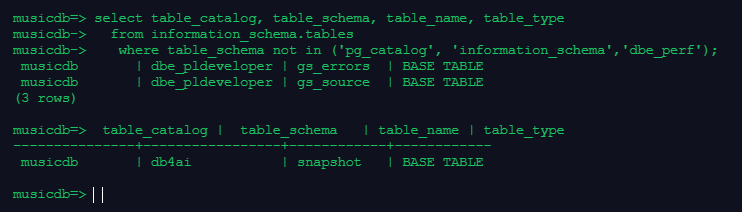
4.查看musicdb数据库目前有哪些表:
select table_catalog, table_schema, table_name, table_type
from information_schema.tables
where table_schema not in (‘pg_catalog’, ‘information_schema’,‘dbe_perf’);
musicdb=> select table_catalog, table_schema, table_name, table_type
musicdb->   from information_schema.tables
musicdb->    where table_schema not in ('pg_catalog', 'information_schema','dbe_perf');
 musicdb       | dbe_pldeveloper | gs_errors  | BASE TABLE
 musicdb       | dbe_pldeveloper | gs_source  | BASE TABLE
(3 rows)

musicdb=>  table_catalog |  table_schema   | table_name | table_type
---------------+-----------------+------------+------------
 musicdb       | db4ai           | snapshot   | BASE TABLE

musicdb=>
查询表在那个表空间
系统表在默认表空间,非系统表在指定的表空间中(否则在默认表空间)
1)–建表warehouse_t1指定表空间ds_location1,查看表warehouse_t1所在的表空间:
select * from pg_tables where tablename = ‘warehouse_t1’;
musicdb=> select * from pg_tables where tablename = 'warehouse_t1';
 schemaname | tablename | tableowner | tablespace | hasindexes | hasrules | hastriggers | tablecreator | created | last_ddl_time
------------+-----------+------------+------------+------------+----------+-------------+--------------+---------+---------------
(0 rows)

musicdb=>

2)–创建表warehouse_t12未指定表空间,则在默认表空间(不显示默认表空间名)
create table warehouse_t12 (col1 char(10));
select * from pg_tables where tablename = ‘warehouse_t12’;
musicdb=> create table warehouse_t12 (col1 char(10));
musicdb=> CREATE TABLE
select * from pg_tables where tablename = 'warehouse_t12';
 schemaname |   tablename   | tableowner | tablespace | hasindexes | hasrules | hastriggers | tablecreator |            created            |
   last_ddl_time
------------+---------------+------------+------------+------------+----------+-------------+--------------+-------------------------------+------
-------------------------
 public     | warehouse_t12 | user1      |            | f          | f        | f           | user1        | 2022-12-01 10:25:24.413938+08 | 2022-
12-01 10:25:24.413938+08
(1 row)

musicdb=>

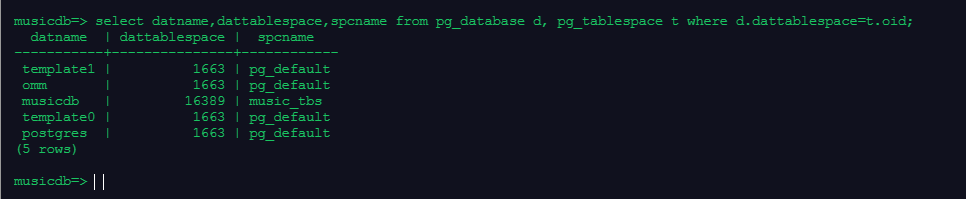
6.查看openGuass数据库的默认表空间
select datname,dattablespace,spcname from pg_database d, pg_tablespace t where d.dattablespace=t.oid;
musicdb=> select datname,dattablespace,spcname from pg_database d, pg_tablespace t where d.dattablespace=t.oid;
  datname  | dattablespace |  spcname
-----------+---------------+------------
 template1 |          1663 | pg_default
 omm       |          1663 | pg_default
 musicdb   |         16389 | music_tbs
 template0 |          1663 | pg_default
 postgres  |          1663 | pg_default
(5 rows)

musicdb=>
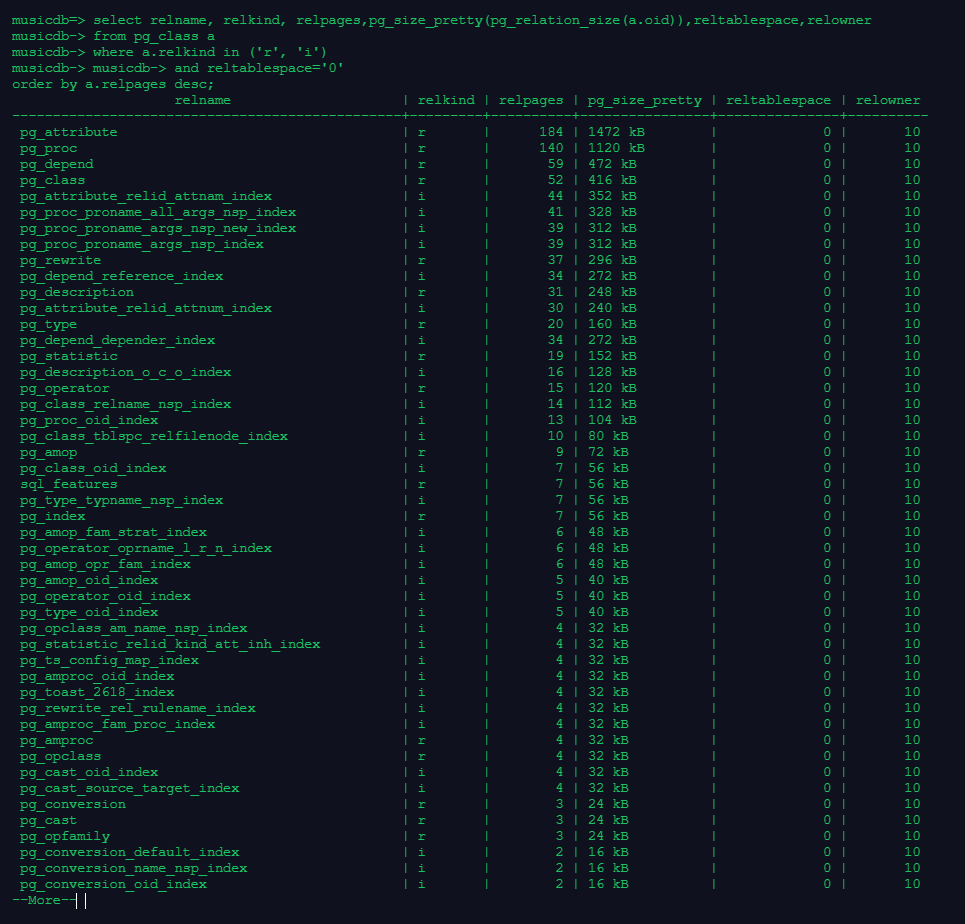
7.查询数据库的默认表空间上的对象
select relname, relkind, relpages,pg_size_pretty(pg_relation_size(a.oid)),reltablespace,relowner
from pg_class a
where a.relkind in (‘r’, ‘i’)
and reltablespace=‘0’
order by a.relpages desc;
musicdb=> select relname, relkind, relpages,pg_size_pretty(pg_relation_size(a.oid)),reltablespace,relowner
musicdb-> from pg_class a
musicdb-> where a.relkind in ('r', 'i')
musicdb-> musicdb-> and reltablespace='0'
order by a.relpages desc;
                    relname                     | relkind | relpages | pg_size_pretty | reltablespace | relowner
------------------------------------------------+---------+----------+----------------+---------------+----------
 pg_attribute                                   | r       |      184 | 1472 kB        |             0 |       10
 pg_proc                                        | r       |      140 | 1120 kB        |             0 |       10
 pg_depend                                      | r       |       59 | 472 kB         |             0 |       10
 pg_class                                       | r       |       52 | 416 kB         |             0 |       10
 pg_attribute_relid_attnam_index                | i       |       44 | 352 kB         |             0 |       10
 pg_proc_proname_all_args_nsp_index             | i       |       41 | 328 kB         |             0 |       10
 pg_proc_proname_args_nsp_new_index             | i       |       39 | 312 kB         |             0 |       10
 pg_proc_proname_args_nsp_index                 | i       |       39 | 312 kB         |             0 |       10
 pg_rewrite                                     | r       |       37 | 296 kB         |             0 |       10
 pg_depend_reference_index                      | i       |       34 | 272 kB         |             0 |       10
 pg_description                                 | r       |       31 | 248 kB         |             0 |       10
 pg_attribute_relid_attnum_index                | i       |       30 | 240 kB         |             0 |       10
 pg_type                                        | r       |       20 | 160 kB         |             0 |       10
 pg_depend_depender_index                       | i       |       34 | 272 kB         |             0 |       10
 pg_statistic                                   | r       |       19 | 152 kB         |             0 |       10
 pg_description_o_c_o_index                     | i       |       16 | 128 kB         |             0 |       10
 pg_operator                                    | r       |       15 | 120 kB         |             0 |       10
 pg_class_relname_nsp_index                     | i       |       14 | 112 kB         |             0 |       10
 pg_proc_oid_index                              | i       |       13 | 104 kB         |             0 |       10
 pg_class_tblspc_relfilenode_index              | i       |       10 | 80 kB          |             0 |       10
 pg_amop                                        | r       |        9 | 72 kB          |             0 |       10
 pg_class_oid_index                             | i       |        7 | 56 kB          |             0 |       10
 sql_features                                   | r       |        7 | 56 kB          |             0 |       10
 pg_type_typname_nsp_index                      | i       |        7 | 56 kB          |             0 |       10
 pg_index                                       | r       |        7 | 56 kB          |             0 |       10
 pg_amop_fam_strat_index                        | i       |        6 | 48 kB          |             0 |       10
 pg_operator_oprname_l_r_n_index                | i       |        6 | 48 kB          |             0 |       10
 pg_amop_opr_fam_index                          | i       |        6 | 48 kB          |             0 |       10
 pg_amop_oid_index                              | i       |        5 | 40 kB          |             0 |       10
 pg_operator_oid_index                          | i       |        5 | 40 kB          |             0 |       10
 pg_type_oid_index                              | i       |        5 | 40 kB          |             0 |       10
 pg_opclass_am_name_nsp_index                   | i       |        4 | 32 kB          |             0 |       10
 pg_statistic_relid_kind_att_inh_index          | i       |        4 | 32 kB          |             0 |       10
 pg_ts_config_map_index                         | i       |        4 | 32 kB          |             0 |       10
 pg_amproc_oid_index                            | i       |        4 | 32 kB          |             0 |       10
 pg_toast_2618_index                            | i       |        4 | 32 kB          |             0 |       10
 pg_rewrite_rel_rulename_index                  | i       |        4 | 32 kB          |             0 |       10
 pg_amproc_fam_proc_index                       | i       |        4 | 32 kB          |             0 |       10
 pg_amproc                                      | r       |        4 | 32 kB          |             0 |       10
 pg_opclass                                     | r       |        4 | 32 kB          |             0 |       10
 pg_cast_oid_index                              | i       |        4 | 32 kB          |             0 |       10
 pg_cast_source_target_index                    | i       |        4 | 32 kB          |             0 |       10
 pg_conversion                                  | r       |        3 | 24 kB          |             0 |       10
 pg_cast                                        | r       |        3 | 24 kB          |             0 |       10
 pg_opfamily                                    | r       |        3 | 24 kB          |             0 |       10
 pg_conversion_default_index                    | i       |        2 | 16 kB          |             0 |       10
 pg_conversion_name_nsp_index                   | i       |        2 | 16 kB          |             0 |       10
 pg_conversion_oid_index                        | i       |        2 | 16 kB          |             0 |       10
--More--
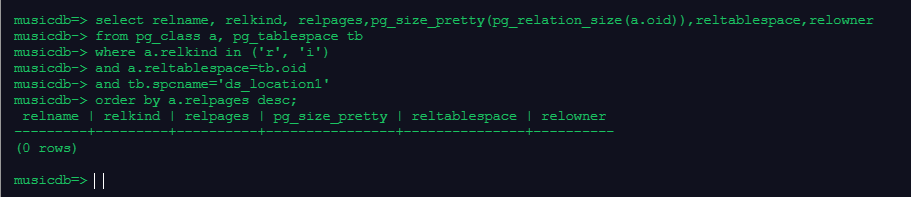
8.查询表空间ds_location1上的对像
\c musicdb user1
musicdb=> \c musicdb user1
Password for user user1:
Non-SSL connection (SSL connection is recommended when requiring high-security)
You are now connected to database "musicdb" as user "user1".
musicdb=>

select relname, relkind, relpages,pg_size_pretty(pg_relation_size(a.oid)),reltablespace,relowner
from pg_class a, pg_tablespace tb
where a.relkind in (‘r’, ‘i’)
and a.reltablespace=tb.oid
and tb.spcname=‘ds_location1’
order by a.relpages desc;
musicdb=> select relname, relkind, relpages,pg_size_pretty(pg_relation_size(a.oid)),reltablespace,relowner
musicdb-> from pg_class a, pg_tablespace tb
musicdb-> where a.relkind in ('r', 'i')
musicdb-> and a.reltablespace=tb.oid
musicdb-> and tb.spcname='ds_location1'
musicdb-> order by a.relpages desc;
 relname | relkind | relpages | pg_size_pretty | reltablespace | relowner
---------+---------+----------+----------------+---------------+----------
(0 rows)

musicdb=>
课程总结
1.创建表空间newtbs1、 ds_location1,查看表空间
2.创建一个数据库newdb1,默认表空间为newtbs1
3.创建用户user5,并授予SYSADMIN权限,访问数据库newdb1,在表空间ds_location1上,创建一个表newt1(表结构自定义)
4.查看表所在的表空间
5.查看表空间newtbs1、 ds_location1上的对象
