作者:马顺华
从事运维管理工作多年,目前就职于某科技有限公司,熟悉运维自动化、OceanBase部署运维、MySQL 运维以及各种云平台技术和产品。并已获得OceanBase认证OBCA、OBCP证书。
第12天 | openGauss逻辑结构:模式管理
学习目标
模式管理包括为数据库创建模式、删除模式、查看和设置模式的搜索路径、查看模式中的信息。
课程学习
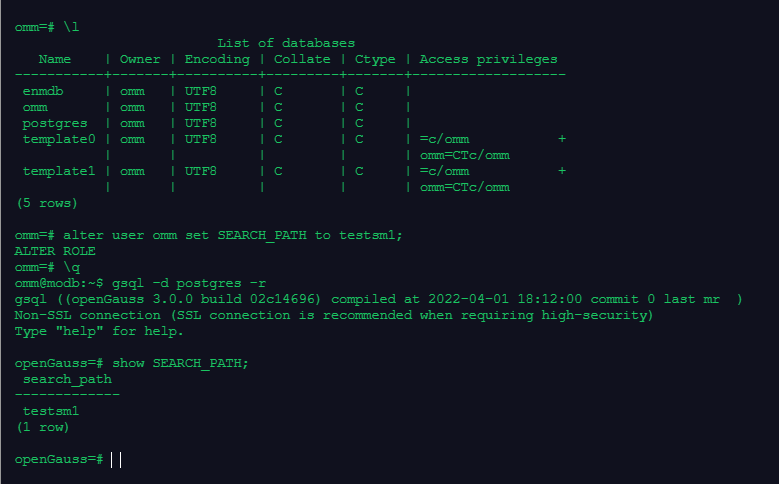
openGauss的模式是对数据库做一个逻辑分割。所有的数据库对象都建立在模式下面。openGauss的模式和用户是弱绑定的,所谓的弱绑定是指虽然创建用户的同时会自动创建一个同名模式,但用户也可以单独创建模式,并且为用户指定其他的模式。
在一个数据库中,可以有多个模式。模式可以把一组对象组织在一起。这样组织机构有多少个应用,我们可以将数据库对象组织成几个模式;组织机构有几个部门,也可以为该部门创建单独的模式。默认情况下,用户将访问数据库的public模式。
1.实验准备:
#第一次进入等待15秒
#数据库启动中…
–连接数据库
su - omm
gsql -r
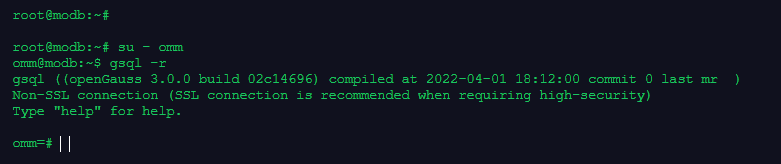
root@modb:~# su - omm
omm@modb:~$ gsql -r
gsql ((openGauss 3.0.0 build 02c14696) compiled at 2022-04-01 18:12:00 commit 0 last mr  )
Non-SSL connection (SSL connection is recommended when requiring high-security)
Type "help" for help.

omm=#
–执行如下的命令和SQL语句,创建表空间enmtbs和数据库enmdb:
CREATE TABLESPACE enmtbs RELATIVE LOCATION ‘tablespace/enmtbs1’;
CREATE DATABASE enmdb WITH TABLESPACE = enmtbs;
omm=# CREATE TABLESPACE enmtbs RELATIVE LOCATION 'tablespace/enmtbs1';
CREATE TABLESPACE
omm=# CREATE DATABASE enmdb WITH TABLESPACE = enmtbs;
CREATE DATABASE
omm=#

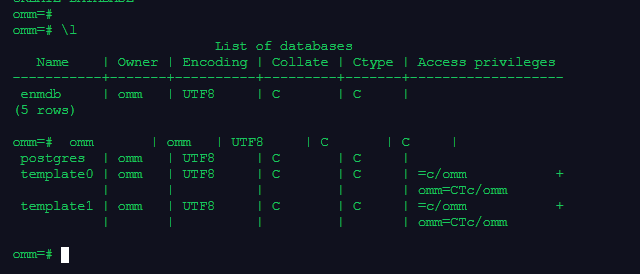
–执行下面的gsql元命令\l,查看openGauss数据库集群上有哪些数据库:
\l
omm=# \l
                         List of databases
   Name    | Owner | Encoding | Collate | Ctype | Access privileges
-----------+-------+----------+---------+-------+-------------------
 enmdb     | omm   | UTF8     | C       | C     |
(5 rows)

omm=#  omm       | omm   | UTF8     | C       | C     |
 postgres  | omm   | UTF8     | C       | C     |
 template0 | omm   | UTF8     | C       | C     | =c/omm           +
           |       |          |         |       | omm=CTc/omm
 template1 | omm   | UTF8     | C       | C     | =c/omm           +
           |       |          |         |       | omm=CTc/omm

omm=#
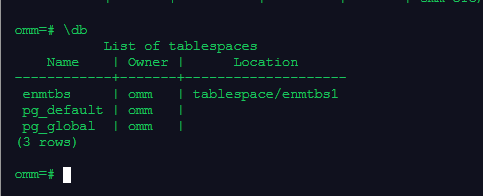
–执行下面的gsql元命令\db,查看openGauss数据库集群上有哪些表空间:
\db
omm=# \db
           List of tablespaces
    Name    | Owner |      Location
------------+-------+--------------------
 enmtbs     | omm   | tablespace/enmtbs1
 pg_default | omm   |
 pg_global  | omm   |
(3 rows)

omm=#
2.执行下面的gsql元命令,查看openGauss数据库上有哪些用户和模式
–执行下面的gsql元命令\du,查看openGauss数据库上有哪些用户:
\du
–执行下面的gsql元命令\dn,查看openGauss数据库上有哪些模式
\dn
3.执行下面的SQL语句,创建一个数据库用户user1,其密码为kunpeng@1234,并授予数据库用户user1 SYSADMIN权限:
–创建数据库用户user1的同时,会在系统的omm数据库中创建一个与这个用户名同名的模式user1。
CREATE USER user1 IDENTIFIED BY ‘kunpeng@1234’;
ALTER USER user1 SYSADMIN;
omm=# CREATE USER user1 IDENTIFIED BY 'kunpeng@1234';
NOTICE:  The encrypted password contains MD5 ciphertext, which is not secure.
CREATE ROLE
omm=# ALTER USER user1  SYSADMIN;
ALTER ROLE
omm=#

–再次执行下面的gsql元命令\du,查看openGauss数据库上有哪些用户:
\du
omm=# \du
 omm       | Sysadmin, Create role, Create DB, Replication, Administer audit, Monitoradmin, Operatoradmin, Policyadmin, UseFT | {}
 user1     | Sysadmin                                                                                                         | {}

omm=#                                                               List of roles
 Role name |                                                    Attributes                                                    | Member of
-----------+------------------------------------------------------------------------------------------------------------------+-----------
 gaussdb   | Sysadmin                                                                                                         | {}

omm=#

–再次执行下面的gsql元命令\dn,查看openGauss数据库上有哪些模式
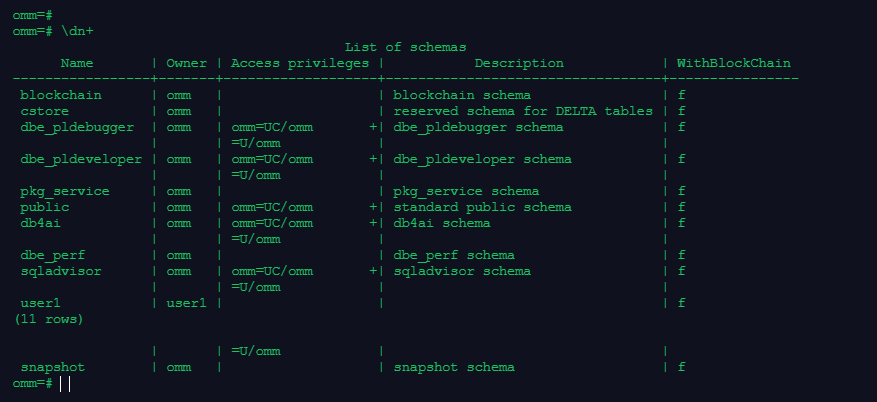
\dn+
omm=# \dn+
                                         List of schemas
      Name       | Owner | Access privileges |           Description            | WithBlockChain
-----------------+-------+-------------------+----------------------------------+----------------
 blockchain      | omm   |                   | blockchain schema                | f
 cstore          | omm   |                   | reserved schema for DELTA tables | f
 dbe_pldebugger  | omm   | omm=UC/omm       +| dbe_pldebugger schema            | f
                 |       | =U/omm            |                                  |
 dbe_pldeveloper | omm   | omm=UC/omm       +| dbe_pldeveloper schema           | f
                 |       | =U/omm            |                                  |
 pkg_service     | omm   |                   | pkg_service schema               | f
 public          | omm   | omm=UC/omm       +| standard public schema           | f
 db4ai           | omm   | omm=UC/omm       +| db4ai schema                     | f
                 |       | =U/omm            |                                  |
 dbe_perf        | omm   |                   | dbe_perf schema                  | f
 sqladvisor      | omm   | omm=UC/omm       +| sqladvisor schema                | f
                 |       | =U/omm            |                                  |
 user1           | user1 |                   |                                  | f
(11 rows)

                 |       | =U/omm            |                                  |
 snapshot        | omm   |                   | snapshot schema                  | f
omm=#
–或
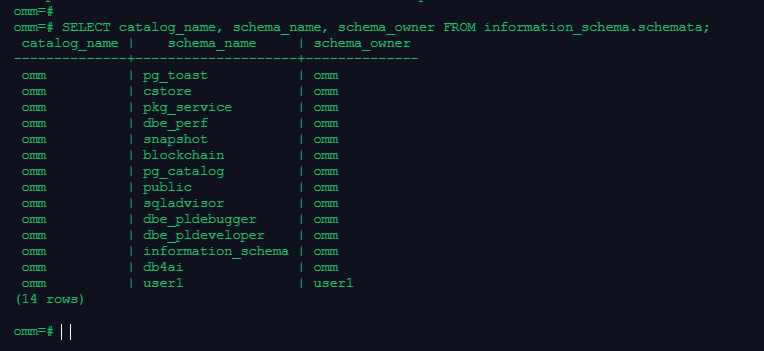
SELECT catalog_name, schema_name, schema_owner FROM information_schema.schemata;
omm=# SELECT catalog_name, schema_name, schema_owner FROM information_schema.schemata;
 catalog_name |    schema_name     | schema_owner
--------------+--------------------+--------------
 omm          | pg_toast           | omm
 omm          | cstore             | omm
 omm          | pkg_service        | omm
 omm          | dbe_perf           | omm
 omm          | snapshot           | omm
 omm          | blockchain         | omm
 omm          | pg_catalog         | omm
 omm          | public             | omm
 omm          | sqladvisor         | omm
 omm          | dbe_pldebugger     | omm
 omm          | dbe_pldeveloper    | omm
 omm          | information_schema | omm
 omm          | db4ai              | omm
 omm          | user1              | user1
(14 rows)

omm=#
4.PUBLIC模式:
openGauss在创建一个新的数据库时,会自动创建一个public模式。当用户登录到该数据库时,如果没有特殊的指定,都是操作在public模式中的数据库对象。
默认情况下,用户新创建的表,位于public模式中
–执行下面的SQL语句,创建一个测试表test:
create table test(col1 char(10));
omm=# create table test(col1 char(10));
CREATE TABLE
omm=#

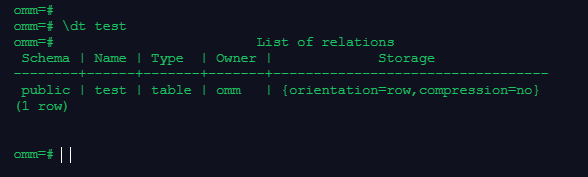
–执行下面的gsql元命令\dt,查看 test表的Schema:
\dt test
omm=# \dt test
omm=#                         List of relations
 Schema | Name | Type  | Owner |             Storage
--------+------+-------+-------+----------------------------------
 public | test | table | omm   | {orientation=row,compression=no}
(1 row)

omm=#
5.为数据库创建模式
一个用户可以创建多个模式
–创建一个模式schm1,属主是用户user1,并再次查看当前连接的数据库下有哪些模式:
create schema schm1 AUTHORIZATION user1;
omm=#
omm=# create schema schm1 AUTHORIZATION user1;
CREATE SCHEMA
omm=#

–继续在数据库enmdb中,创建模式schm2,模式schm3,属主是用户omm:
create schema schm2;
create schema schm3;
\dn
omm=# create schema schm2;
CREATE SCHEMA
omm=# create schema schm3;
CREATE SCHEMA
omm=# \dn
     List of schemas
      Name       | Owner
-----------------+-------
 blockchain      | omm
 cstore          | omm
 db4ai           | omm
 dbe_perf        | omm
 dbe_pldebugger  | omm
 dbe_pldeveloper | omm
 pkg_service     | omm
 public          | omm
 schm1           | user1
 schm2           | omm
 schm3           | omm
 snapshot        | omm
 sqladvisor      | omm
 user1           | user1
(14 rows)

omm=#
6.查看和设置模式的搜索路径
–会话级设置模式搜索顺序
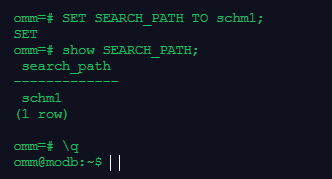
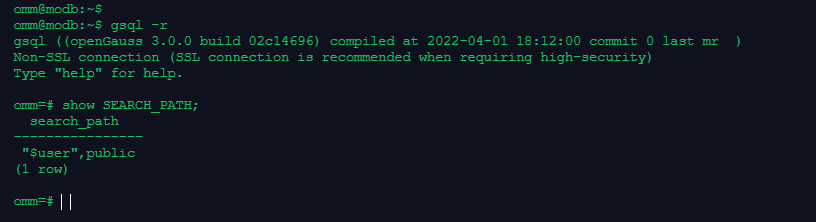
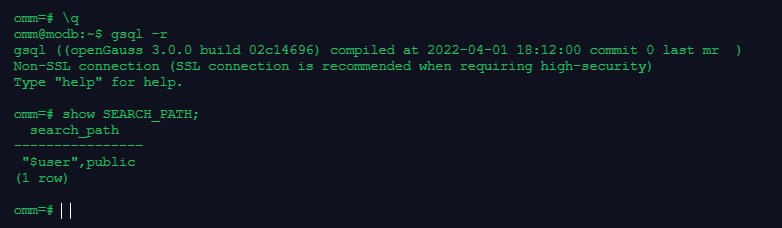
在gsql客户端会话中,执行命令SET SEARCH_PATH TO schm1可以修改模式搜索路径,但只在gsql客户端会话的持续过程中起作用,一旦退出gsql客户端会话,这个设置就丢失了。重新登录gsql会话将模式搜索路径恢复为默认值"$user",public。
SET SEARCH_PATH TO schm1;
show SEARCH_PATH;
\q
omm=# SET SEARCH_PATH TO schm1;
SET
omm=# show SEARCH_PATH;
 search_path
-------------
 schm1
(1 row)

omm=# \q
omm@modb:~$
gsql -r
show SEARCH_PATH;
omm@modb:~$
omm@modb:~$ gsql -r
gsql ((openGauss 3.0.0 build 02c14696) compiled at 2022-04-01 18:12:00 commit 0 last mr  )
Non-SSL connection (SSL connection is recommended when requiring high-security)
Type "help" for help.

omm=# show SEARCH_PATH;
  search_path
----------------
 "$user",public
(1 row)

omm=#
–数据库级设置模式搜索顺序
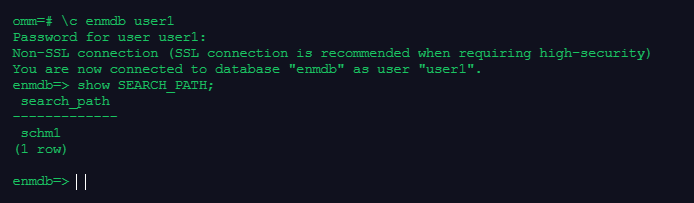
修改数据库级别的搜索顺序后,数据库用户user1再次登录到数据库enmdb,其模式搜索路径已经变更为数据库默认的模式搜索路径schm1。
ALTER DATABASE enmdb SET SEARCH_PATH TO schm1;
\q
omm=# ALTER DATABASE enmdb SET SEARCH_PATH TO schm1;
ALTER DATABASE
omm=# \q
omm@modb:~$

gsql -r
\c enmdb user1
show SEARCH_PATH;
omm@modb:~$ gsql -r
gsql ((openGauss 3.0.0 build 02c14696) compiled at 2022-04-01 18:12:00 commit 0 last mr  )
Non-SSL connection (SSL connection is recommended when requiring high-security)
Type "help" for help.

omm=# \c enmdb user1
Password for user user1:
Non-SSL connection (SSL connection is recommended when requiring high-security)
You are now connected to database "enmdb" as user "user1".
enmdb=> show SEARCH_PATH;
 search_path
-------------
 schm1
(1 row)

enmdb=>
–用户级设置模式搜索顺序
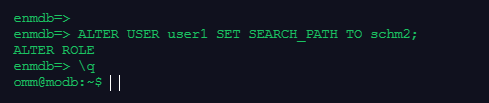
–设置数据库的用户user1的模式搜索顺序为模式schm2:
ALTER USER user1 SET SEARCH_PATH TO schm2;
\q
enmdb=> ALTER USER user1 SET SEARCH_PATH TO schm2;
ALTER ROLE
enmdb=> \q
omm@modb:~$
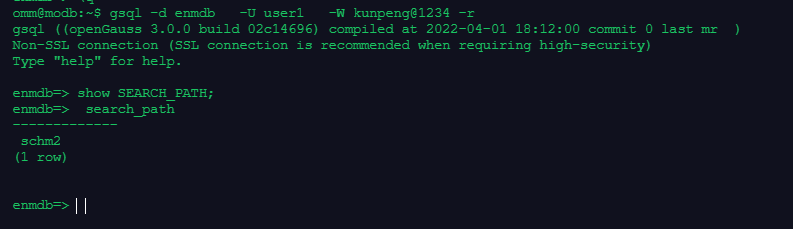
gsql -d enmdb -U user1 -W kunpeng@1234 -r
show SEARCH_PATH;
omm@modb:~$ gsql -d enmdb   -U user1   -W kunpeng@1234 -r
gsql ((openGauss 3.0.0 build 02c14696) compiled at 2022-04-01 18:12:00 commit 0 last mr  )
Non-SSL connection (SSL connection is recommended when requiring high-security)
Type "help" for help.

enmdb=> show SEARCH_PATH;
enmdb=>  search_path
-------------
 schm2
(1 row)

enmdb=>
7.搜索顺序的优先级
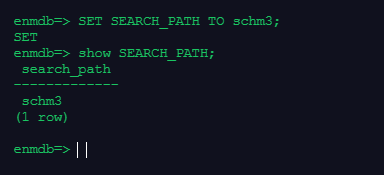
–会话级模式搜索顺序的优先级最高,用户级模式搜索顺序的优先级第2,数据库级模式搜索顺序的优先级最低。
#在会话级修改模式搜索顺序为模式schm3:
SET SEARCH_PATH TO schm3;
show SEARCH_PATH;
enmdb=> SET SEARCH_PATH TO schm3;
SET
enmdb=> show SEARCH_PATH;
 search_path
-------------
 schm3
(1 row)

enmdb=>
8.查看模式有哪些表
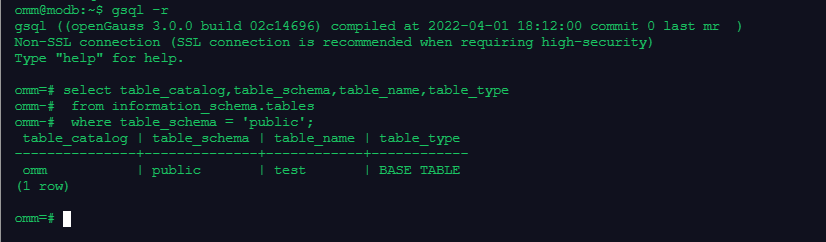
–查看当前连接的数据库中,public模式下有哪些表:
gsql -r
select table_catalog,table_schema,table_name,table_type
from information_schema.tables
where table_schema = ‘public’;
omm@modb:~$ gsql -r
gsql ((openGauss 3.0.0 build 02c14696) compiled at 2022-04-01 18:12:00 commit 0 last mr  )
Non-SSL connection (SSL connection is recommended when requiring high-security)
Type "help" for help.

omm=# select table_catalog,table_schema,table_name,table_type
omm-#  from information_schema.tables
omm-#  where table_schema = 'public';
 table_catalog | table_schema | table_name | table_type
---------------+--------------+------------+------------
 omm           | public       | test       | BASE TABLE
(1 row)

omm=#
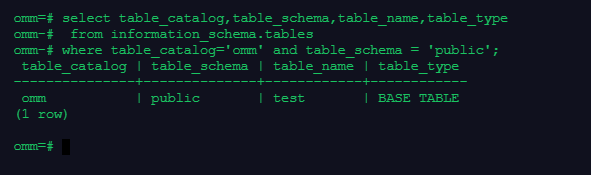
–查看指定数据库中,public模式下有哪些表:
select table_catalog,table_schema,table_name,table_type
from information_schema.tables
where table_catalog=‘omm’ and table_schema = ‘public’;
omm=# select table_catalog,table_schema,table_name,table_type
omm-#  from information_schema.tables
omm-# where table_catalog='omm' and table_schema = 'public';
 table_catalog | table_schema | table_name | table_type
---------------+--------------+------------+------------
 omm           | public       | test       | BASE TABLE
(1 row)

omm=#
课程作业
1.创建一个名为testsm、testsm1的模式
2.创建一个用户john, 并将testsm的owner修改为
john,且修改owner前后分别使用\dn+查看模式信息
3.重命名testsm为testsm2
4.在模式testsm1中建表t1、插入记录和查询记录
5.在会话级设置模式搜索顺序
6.在数据库级设置模式搜索顺序
7.在用户级设置模式搜索顺序
1.创建一个名为testsm、testsm1的模式
root@modb:~#
root@modb:~# su - omm
omm@modb:~$ gsql -r
gsql ((openGauss 3.0.0 build 02c14696) compiled at 2022-04-01 18:12:00 commit 0 last mr  )
Non-SSL connection (SSL connection is recommended when requiring high-security)
Type "help" for help.

omm=#

omm=# create schema testsm ;
CREATE SCHEMA
omm=# create schema testsm1 ;
CREATE SCHEMA
omm=#
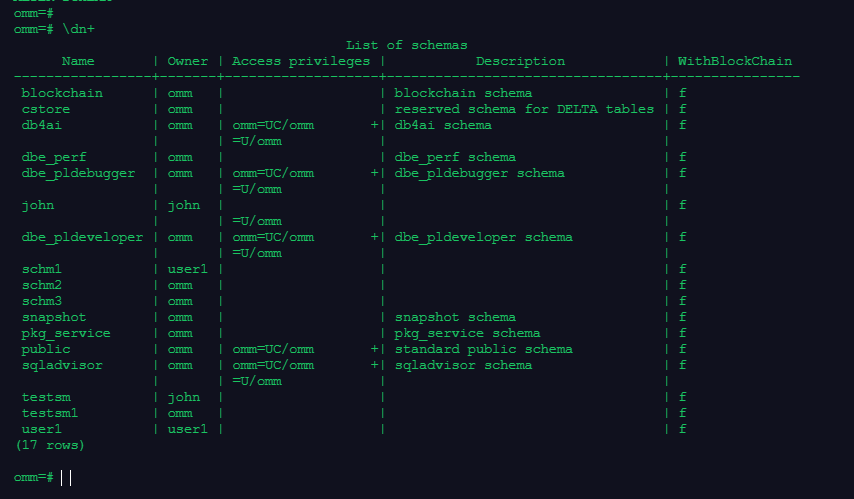
2.创建一个用户john, 并将testsm的owner修改为
john,且修改owner前后分别使用\dn+查看模式信息
omm=# create user john identified by 'kunpeng@1234';
NOTICE:  The encrypted password contains MD5 ciphertext, which is not secure.
CREATE ROLE
omm=#

omm=# alter user john sysadmin ;
ALTER ROLE

omm=# \dn+
                                         List of schemas
      Name       | Owner | Access privileges |           Description            | WithBlockChain
-----------------+-------+-------------------+----------------------------------+----------------
 blockchain      | omm   |                   | blockchain schema                | f
 cstore          | omm   |                   | reserved schema for DELTA tables | f
 db4ai           | omm   | omm=UC/omm       +| db4ai schema                     | f
                 |       | =U/omm            |                                  |
 dbe_perf        | omm   |                   | dbe_perf schema                  | f
 dbe_pldebugger  | omm   | omm=UC/omm       +| dbe_pldebugger schema            | f
                 |       | =U/omm            |                                  |
 dbe_pldeveloper | omm   | omm=UC/omm       +| dbe_pldeveloper schema           | f
                 |       | =U/omm            |                                  |
 john            | john  |                   |                                  | f
 pkg_service     | omm   |                   | pkg_service schema               | f
 public          | omm   | omm=UC/omm       +| standard public schema           | f
 schm2           | omm   |                   |                                  | f
 schm3           | omm   |                   |                                  | f
 snapshot        | omm   |                   | snapshot schema                  | f
 sqladvisor      | omm   | omm=UC/omm       +| sqladvisor schema                | f
                 |       | =U/omm            |                                  |
                 |       | =U/omm            |                                  |
 schm1           | user1 |                   |                                  | f
 testsm          | omm   |                   |                                  | f
 testsm1         | omm   |                   |                                  | f
 user1           | user1 |                   |                                  | f
(17 rows)

omm=#
omm=#
omm=# alter schema testsm owner to john ;
ALTER SCHEMA
omm=#

omm=# \dn+
                                         List of schemas
      Name       | Owner | Access privileges |           Description            | WithBlockChain
-----------------+-------+-------------------+----------------------------------+----------------
 blockchain      | omm   |                   | blockchain schema                | f
 cstore          | omm   |                   | reserved schema for DELTA tables | f
 db4ai           | omm   | omm=UC/omm       +| db4ai schema                     | f
                 |       | =U/omm            |                                  |
 dbe_perf        | omm   |                   | dbe_perf schema                  | f
 dbe_pldebugger  | omm   | omm=UC/omm       +| dbe_pldebugger schema            | f
                 |       | =U/omm            |                                  |
 john            | john  |                   |                                  | f
                 |       | =U/omm            |                                  |
 dbe_pldeveloper | omm   | omm=UC/omm       +| dbe_pldeveloper schema           | f
                 |       | =U/omm            |                                  |
 schm1           | user1 |                   |                                  | f
 schm2           | omm   |                   |                                  | f
 schm3           | omm   |                   |                                  | f
 snapshot        | omm   |                   | snapshot schema                  | f
 pkg_service     | omm   |                   | pkg_service schema               | f
 public          | omm   | omm=UC/omm       +| standard public schema           | f
 sqladvisor      | omm   | omm=UC/omm       +| sqladvisor schema                | f
                 |       | =U/omm            |                                  |
 testsm          | john  |                   |                                  | f
 testsm1         | omm   |                   |                                  | f
 user1           | user1 |                   |                                  | f
(17 rows)

omm=#
3.重命名testsm为testsm2
omm=# alter schema testsm rename to testsm2;
ALTER SCHEMA
omm=#

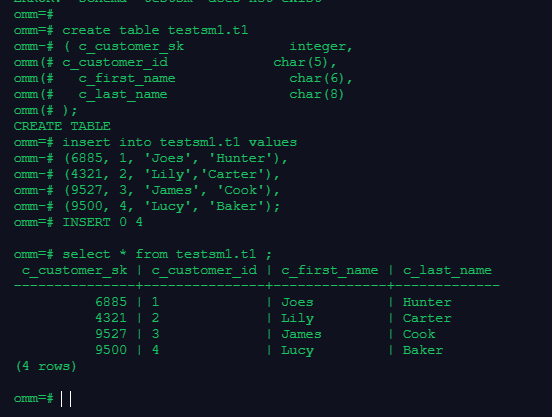
4.在模式testsm1中建表t1、插入记录和查询记录
omm=#
omm=# create table testsm1.t1
omm-# ( c_customer_sk             integer,
omm(# c_customer_id             char(5),
omm(#   c_first_name              char(6),
omm(#   c_last_name               char(8)
omm(# );
CREATE TABLE
omm=# insert into testsm1.t1 values
omm-# (6885, 1, 'Joes', 'Hunter'),
omm-# (4321, 2, 'Lily','Carter'),
omm-# (9527, 3, 'James', 'Cook'),
omm-# (9500, 4, 'Lucy', 'Baker');
omm=# INSERT 0 4

omm=# select * from testsm1.t1 ;
 c_customer_sk | c_customer_id | c_first_name | c_last_name
---------------+---------------+--------------+-------------
          6885 | 1             | Joes         | Hunter
          4321 | 2             | Lily         | Carter
          9527 | 3             | James        | Cook
          9500 | 4             | Lucy         | Baker
(4 rows)

omm=#
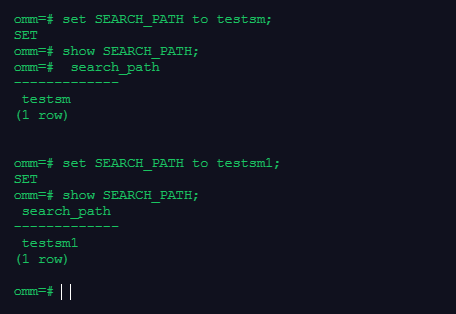
5.在会话级设置模式搜索顺序
omm=# set SEARCH_PATH to testsm;
SET
omm=# show SEARCH_PATH;
omm=#  search_path
-------------
 testsm
(1 row)


omm=# set SEARCH_PATH to testsm1;
SET
omm=# show SEARCH_PATH;
 search_path
-------------
 testsm1
(1 row)

omm=#
omm=# \q
omm@modb:~$ gsql -r
gsql ((openGauss 3.0.0 build 02c14696) compiled at 2022-04-01 18:12:00 commit 0 last mr  )
Non-SSL connection (SSL connection is recommended when requiring high-security)
Type "help" for help.

omm=# show SEARCH_PATH;
  search_path
----------------
 "$user",public
(1 row)

omm=#
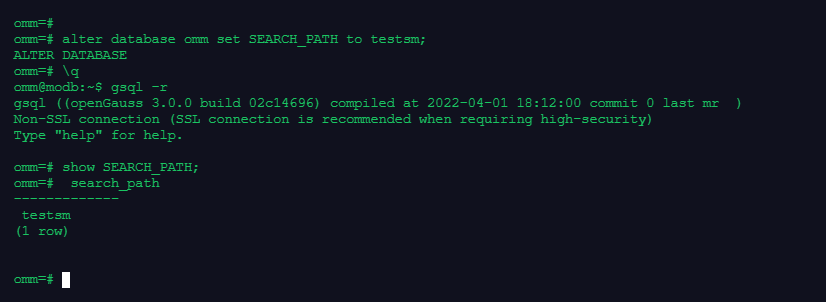
6.在数据库级设置模式搜索顺序
omm=#
omm=# alter database omm set SEARCH_PATH to testsm;
ALTER DATABASE
omm=# \q
omm@modb:~$ gsql -r
gsql ((openGauss 3.0.0 build 02c14696) compiled at 2022-04-01 18:12:00 commit 0 last mr  )
Non-SSL connection (SSL connection is recommended when requiring high-security)
Type "help" for help.

omm=# show SEARCH_PATH;
omm=#  search_path
-------------
 testsm
(1 row)

omm=#
7.在用户级设置模式搜索顺序
omm=# \l
                         List of databases
   Name    | Owner | Encoding | Collate | Ctype | Access privileges
-----------+-------+----------+---------+-------+-------------------
 enmdb     | omm   | UTF8     | C       | C     |
 omm       | omm   | UTF8     | C       | C     |
 postgres  | omm   | UTF8     | C       | C     |
 template0 | omm   | UTF8     | C       | C     | =c/omm           +
           |       |          |         |       | omm=CTc/omm
 template1 | omm   | UTF8     | C       | C     | =c/omm           +
           |       |          |         |       | omm=CTc/omm
(5 rows)

omm=# alter user omm set SEARCH_PATH to testsm1;
ALTER ROLE
omm=# \q
omm@modb:~$ gsql -d postgres -r
gsql ((openGauss 3.0.0 build 02c14696) compiled at 2022-04-01 18:12:00 commit 0 last mr  )
Non-SSL connection (SSL connection is recommended when requiring high-security)
Type "help" for help.

openGauss=# show SEARCH_PATH;
 search_path
-------------
 testsm1
(1 row)

openGauss=#