



一、学习目标
掌握openGauss DBMS索引的管理:创建索引、删除索引、查询索引的信息、修改索引的信息。
二、课程学习
索引是一个指向表中数据的指针。一个数据库中的索引与一本书的索引目录是非常相似的。
索引可以用来提高数据库查询性能,但是不恰当的使用将导致数据库性能下降。
三、课后作业
首先还是连接数据库:
root@modb:~# su - omm
omm@modb:~$ gsql -r
gsql ((openGauss 3.0.0 build 02c14696) compiled at 2022-04-01 18:12:00 commit 0 last mr  )
Non-SSL connection (SSL connection is recommended when requiring high-security)
Type "help" for help.
1.创建表,在表中创建索引
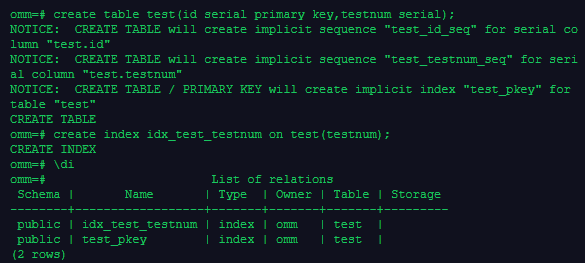
omm=# create table test(id serial primary key,testnum serial);
NOTICE:  CREATE TABLE will create implicit sequence "test_id_seq" for serial column "test.id"
NOTICE:  CREATE TABLE will create implicit sequence "test_testnum_seq" for serial column "test.testnum"
NOTICE:  CREATE TABLE / PRIMARY KEY will create implicit index "test_pkey" for table "test"
CREATE TABLE
omm=# create index idx_test_testnum on test(testnum);
CREATE INDEX
--查看索引
omm=# \di
omm=#                       List of relations
 Schema |       Name       | Type  | Owner | Table | Storage
--------+------------------+-------+-------+-------+---------
 public | idx_test_testnum | index | omm   | test  |
 public | test_pkey        | index | omm   | test  |
(2 rows)
2.通过hint使用索引
测试准备,创建表customer,并插入数据
CREATE TABLE customer
(
ca_address_sk integer NOT NULL ,
ca_address_id character(16),
ca_street_number character(10) ,
ca_street_name character varying(60) ,
ca_street_type character(15) ,
ca_suite_number character(10) ,
ca_city character varying(60) ,
ca_county character varying(30) ,
ca_state character(2) ,
ca_zip character(10) ,
ca_country character varying(20) ,
ca_gmt_offset numeric(5,2) ,
ca_location_type character(20)
);
insert into customer values
(1, 'AAAAAAAABAAAAAAA', '18', 'Jackson', 'Parkway', 'Suite 280', 'Fairfield', 'Maricopa County', 'AZ', '86192' ,'United States', -7.00, 'condo'),
(2, 'AAAAAAAACAAAAAAA', '362', 'Washington 6th', 'RD', 'Suite 80', 'Fairview', 'Taos County', 'NM', '85709', 'United States', -7.00, 'condo'),
(3, 'AAAAAAAADAAAAAAA', '585', 'Dogwood Washington', 'Circle', 'Suite Q', 'Pleasant Valley', 'York County', 'PA', '12477', 'United States', -5.00, 'single family');
创建索引
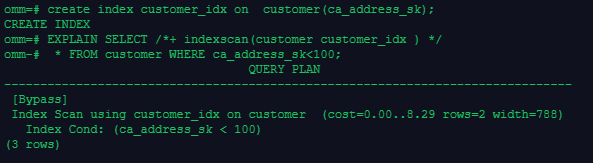
create index customer_idx on  customer(ca_address_sk);
通过hint强制使用索引,查看执行计划
omm=# EXPLAIN SELECT /*+ indexscan(customer customer_idx ) */
omm-#  * FROM customer WHERE ca_address_sk<100;
                                  QUERY PLAN
-------------------------------------------------------------------------------
 [Bypass]
 Index Scan using customer_idx on customer  (cost=0.00..8.29 rows=2 width=788)
   Index Cond: (ca_address_sk < 100)
(3 rows)
3.rename索引
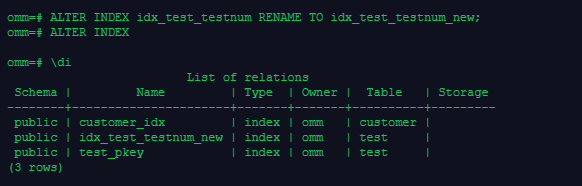
omm=# ALTER INDEX idx_test_testnum RENAME TO idx_test_testnum_new;
omm=# ALTER INDEX
omm=# \di
                         List of relations
 Schema |         Name         | Type  | Owner |  Table   | Storage
--------+----------------------+-------+-------+----------+---------
 public | customer_idx         | index | omm   | customer |
 public | idx_test_testnum_new | index | omm   | test     |
 public | test_pkey            | index | omm   | test     |
(3 rows)
4.重建索引
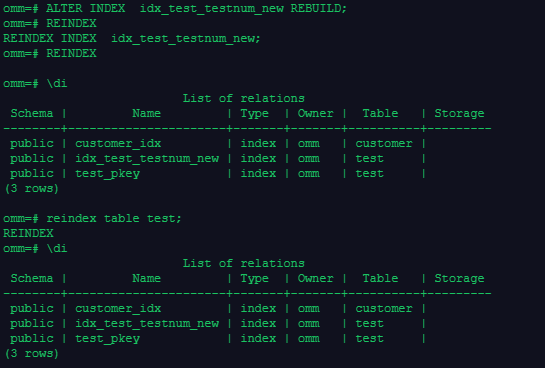
重建一个单独索引
omm=# ALTER INDEX  idx_test_testnum_new REBUILD;
omm=# REINDEX
REINDEX INDEX  idx_test_testnum_new;
omm=# REINDEX
--重建所有索引
reindex table test;
5.移动索引到其他表空间
创建表空间myindex_ts:
 CREATE TABLESPACE myindex_ts RELATIVE LOCATION 'tablespace/myindex_ts1';
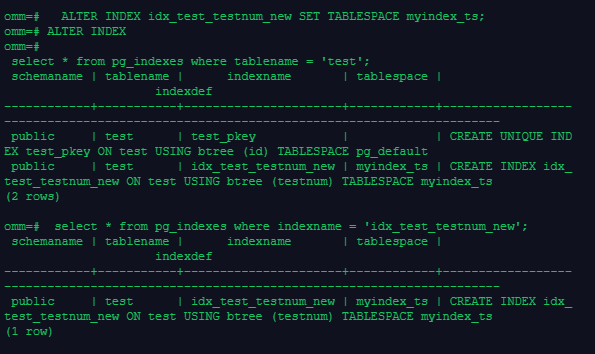
将索引idx_test_testnum_new移动到表空间myindex_ts:
  ALTER INDEX idx_test_testnum_new SET TABLESPACE myindex_ts;
查看索引所在的表空间
omm=#
 select * from pg_indexes where tablename = 'test';
 schemaname | tablename |      indexname       | tablespace |
                     indexdef
------------+-----------+----------------------+------------
 public     | test      | test_pkey            |            | CREATE UNIQUE IND
EX test_pkey ON test USING btree (id) TABLESPACE pg_default
 public     | test      | idx_test_testnum_new | myindex_ts | CREATE INDEX idx_
test_testnum_new ON test USING btree (testnum) TABLESPACE myindex_ts
(2 rows)

omm=#  select * from pg_indexes where indexname = 'idx_test_testnum_new';
 schemaname | tablename |      indexname       | tablespace |
                     indexdef
------------+-----------+----------------------+------------
 public     | test      | idx_test_testnum_new | myindex_ts | CREATE INDEX idx_
test_test
6.删除索引
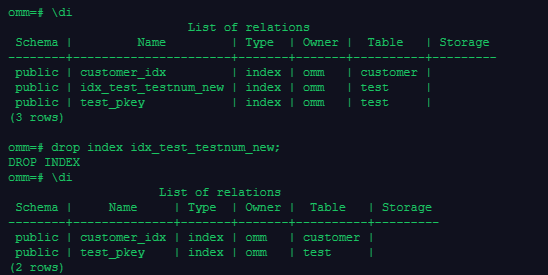
omm=# \di
                         List of relations
 Schema |         Name         | Type  | Owner |  Table   | Storage
--------+----------------------+-------+-------+----------+---------
 public | customer_idx         | index | omm   | customer |
 public | idx_test_testnum_new | index | omm   | test     |
 public | test_pkey            | index | omm   | test     |
(3 rows)

omm=# drop index idx_test_testnum_new;
DROP INDEX
omm=# \di
                     List of relations
 Schema |     Name     | Type  | Owner |  Table   | Storage
--------+--------------+-------+-------+----------+---------
 public | customer_idx | index | omm   | customer |
 public | test_pkey    | index | omm   | test     |
(2 rows)
四、心得体会
通过今天学习openGauss DBMS索引的管理:创建索引、删除索引、查询索引的信息、修改索引的信息,通过今天的实验进一步理解了所有的创建、修改、查询、删除等操作。
「喜欢这篇文章,您的关注和赞赏是给作者最好的鼓励」
关注作者
【版权声明】本文为墨天轮用户原创内容,转载时必须标注文章的来源(墨天轮),文章链接,文章作者等基本信息,否则作者和墨天轮有权追究责任。如果您发现墨天轮中有涉嫌抄袭或者侵权的内容,欢迎发送邮件至:contact@modb.pro进行举报,并提供相关证据,一经查实,墨天轮将立刻删除相关内容。
