传统的机器学习训练模型需要大量的标签数据,而且每一个模型是为了解决特定任务设计的,所以当面对全新领域问题就显得无能为力,因此采用迁移学习来解决不同领域之间知识迁移问题,能达到“举一反三”的作用,使学习性能显著提高。
VGG-16结构
VGG-16共包括13个卷积层、3个全连接层、5个池化层,卷积层与全连接层具有权重系数,而池化层不涉及权重,因此这就是VGG-16的来源,如图6.36所示。
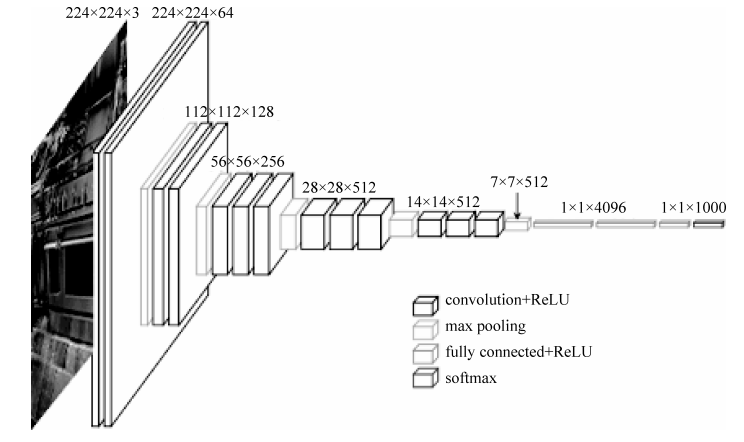
■ 图6.36VGG-16模型结构图
我们保留VGG-16的卷积层,修改全连接层,将其迁移到与图片分类不同的领域,实现动物体长的识别。
迁移学习过程
首先,获取想要进行训练的数据集,本实验采用1000个分类中的猫和老虎的数据。然后,自定义设置猫和老虎的体长参数,如图6.37所示。
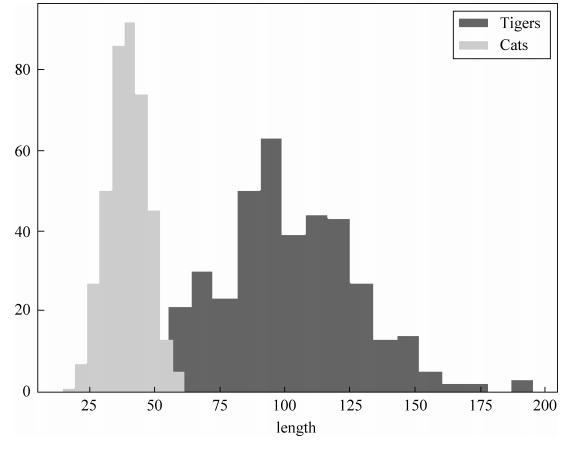
■ 图6.37猫和虎的体长数据分布
利用VGG-16训练好的model parameters,然后保留Convolution和pooling层,修改fullyconnected层,使其变为可以被训练的两层结构,最终输出数字代表猫和老虎的体长。
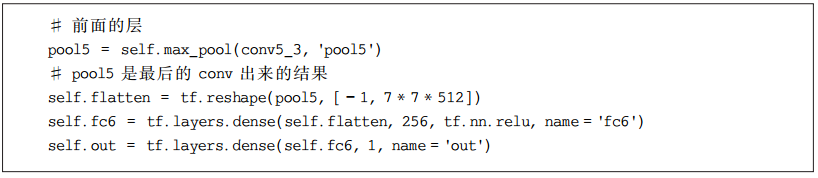
self.flatten之前的layers都是不能被训练的. 而 tf.layers.dense() 建立的layers是可以被训练的. 训练成功之后, 再定义一个Saver来保存由 tf.layers.dense()建立的parameters。

训练好后的VGG-16的Convolution相当于一个feature extractor,提取或压缩图片的特征,这些特征用作训练regressor,即softmax。

至此,迁移学习已经完成,进行测试。
迁移学习结果
通过传入两张分别为猫和虎的图片,应用迁移学习给出各自体长结果,如图6.38所示。
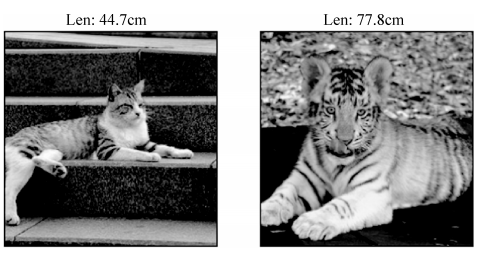
■ 图6.38迁移学习模型输出结果
实践示例程序参见附录E。
附录E VGG-16迁移学习
import os
import numpy as np
import tensorflow as tf
import skimage.io
import skimage.transform
import matplotlib.pyplot as plt

def load_img(path):
    img = skimage.io.imread(path)
    img = img  255.0
    # print "Original Image Shape: ", img.shape
    # we crop image from center
    short_edge = min(img.shape[:2])
    yy = int((img.shape[0] - short_edge)  2)
    xx = int((img.shape[1] - short_edge)  2)
    crop_img = img[yy: yy + short_edge, xx: xx + short_edge]
    # resize to 224, 224
    resized_img = skimage.transform.resize(crop_img, (224, 224))[None, :, :, :] # shape [1, 224, 224, 3]
    return resized_img

def load_data():
    imgs = {'tiger': [], 'kittycat': []}
    for k in imgs.keys():
        dir = './for_transfer_learning/data/' + k
        for file in os.listdir(dir):
            if not file.lower().endswith('.jpg'):
                continue
            try:
                resized_img = load_img(os.path.join(dir, file))
            except OSError:
                continue
            imgs[k].append(resized_img) # [1, height, width, depth] * n
            if len(imgs[k]) == 400: # only use 400 imgs to reduce my memory load
                break
    # fake length data for tiger and cat
    tigers_y = np.maximum(20, np.random.randn(len(imgs['tiger']), 1) * 30 + 100)
    cat_y = np.maximum(10, np.random.randn(len(imgs['kittycat']), 1) * 8 + 40)
    return imgs['tiger'], imgs['kittycat'], tigers_y, cat_y


class Vgg16:
    vgg_mean = [103.939, 116.779, 123.68]

    def __init__(self, vgg16_npy_path=None, restore_from=None):
        # pre-trained parameters
        try:
            self.data_dict = np.load(vgg16_npy_path,allow_pickle=True, encoding='latin1').item()
        except FileNotFoundError:
            print('请下载')
        self.tfx = tf.placeholder(tf.float32, [None, 224, 224, 3])
        self.tfy = tf.placeholder(tf.float32, [None, 1])

        # Convert RGB to BGR
        red, green, blue = tf.split(axis=3, num_or_size_splits=3, value=self.tfx * 255.0)
        bgr = tf.concat(axis=3, values=[
            blue - self.vgg_mean[0],
            green - self.vgg_mean[1],
            red - self.vgg_mean[2],
        ])

        # pre-trained VGG layers are fixed in fine-tune
        conv1_1 = self.conv_layer(bgr, "conv1_1")
        conv1_2 = self.conv_layer(conv1_1, "conv1_2")
        pool1 = self.max_pool(conv1_2, 'pool1')

        conv2_1 = self.conv_layer(pool1, "conv2_1")
        conv2_2 = self.conv_layer(conv2_1, "conv2_2")
        pool2 = self.max_pool(conv2_2, 'pool2')

        conv3_1 = self.conv_layer(pool2, "conv3_1")
        conv3_2 = self.conv_layer(conv3_1, "conv3_2")
        conv3_3 = self.conv_layer(conv3_2, "conv3_3")
        pool3 = self.max_pool(conv3_3, 'pool3')

        conv4_1 = self.conv_layer(pool3, "conv4_1")
        conv4_2 = self.conv_layer(conv4_1, "conv4_2")
        conv4_3 = self.conv_layer(conv4_2, "conv4_3")
        pool4 = self.max_pool(conv4_3, 'pool4')

        conv5_1 = self.conv_layer(pool4, "conv5_1")
        conv5_2 = self.conv_layer(conv5_1, "conv5_2")
        conv5_3 = self.conv_layer(conv5_2, "conv5_3")
        pool5 = self.max_pool(conv5_3, 'pool5')

        # detach original VGG fc layers and
        # reconstruct your own fc layers serve for your own purpose
        self.flatten = tf.reshape(pool5, [-1, 7 * 7 * 512])
        self.fc6 = tf.layers.dense(self.flatten, 256, tf.nn.relu, name='fc6')
        self.out = tf.layers.dense(self.fc6, 1, name='out')

        self.sess = tf.Session()
        if restore_from:
            saver = tf.train.Saver()
            saver.restore(self.sess, restore_from)
        else:  # training graph
            self.loss = tf.losses.mean_squared_error(labels=self.tfy, predictions=self.out)
            self.train_op = tf.train.RMSPropOptimizer(0.001).minimize(self.loss)
            self.sess.run(tf.global_variables_initializer())

    def max_pool(self, bottom, name):
        return tf.nn.max_pool(bottom, ksize=[1, 2, 2, 1], strides=[1, 2, 2, 1], padding='SAME', name=name)

    def conv_layer(self, bottom, name):
        with tf.variable_scope(name): # CNN's filter is constant, NOT Variable that can be trained
            conv = tf.nn.conv2d(bottom, self.data_dict[name][0], [1, 1, 1, 1], padding='SAME')
            lout = tf.nn.relu(tf.nn.bias_add(conv, self.data_dict[name][1]))
            return lout

    def train(self, x, y):
        loss, _ = self.sess.run([self.loss, self.train_op], {self.tfx: x, self.tfy: y})
        return loss

    def predict(self, paths):
        fig, axs = plt.subplots(1, 2)
        for i, path in enumerate(paths):
            x = load_img(path)
            length = self.sess.run(self.out, {self.tfx: x})
            axs[i].imshow(x[0])
            axs[i].set_title('Len: %.1f cm' % length)
            axs[i].set_xticks(());
            axs[i].set_yticks(())
        plt.show()

    def save(self, path='./for_transfer_learning/model/transfer_learn'):
        saver = tf.train.Saver()
        saver.save(self.sess, path, write_meta_graph=False)

def train():
    tigers_x, cats_x, tigers_y, cats_y = load_data()

    # plot fake length distribution
    plt.hist(tigers_y, bins=20, label='Tigers')
    plt.hist(cats_y, bins=10, label='Cats')
    plt.legend()
    plt.xlabel('length')
    plt.show()

    xs = np.concatenate(tigers_x + cats_x, axis=0)
    ys = np.concatenate((tigers_y, cats_y), axis=0)

    vgg = Vgg16(vgg16_npy_path='./for_transfer_learning/vgg16.npy')
    print('Net built')
    for i in range(100):
        b_idx = np.random.randint(0, len(xs), 6)
        train_loss = vgg.train(xs[b_idx], ys[b_idx])
        print(i, 'train loss: ', train_loss)

    vgg.save('./for_transfer_learning/model/transfer_learn') # save learned fc layers

def eval():
    vgg = Vgg16(vgg16_npy_path='./for_transfer_learning/vgg16.npy',
                restore_from='./for_transfer_learning/model/transfer_learn')
    vgg.predict(
        ['./for_transfer_learning/data/kittycat/23066047.d6694f.jpg', './for_transfer_learning/data/tiger/37425296_58a9896259.jpg'])

if __name__ == '__main__':
    # download()
     #train()
    eval()
实例讲解
人工智能

精彩回顾
参考书籍

《人工智能》
ISBN:9787302572541
尚文倩 编著
定价:59.8元

扫码微店优惠购书
内容简介
本书系统介绍了人工智能的基本原理、基本技术、基本方法和应用领域等内容,比较全面地反映了60多年来人工智能领域的进展,并根据人工智能的发展动向对一些传统内容做了取舍。全书共9章。第1章介绍人工智能的基本概念、发展历史、应用领域等。其后8章的内容分为两大部分:第一部分(第2~5章)主要讲述传统人工智能的基本概念、原理、方法和技术,涵盖知识表示、搜索策略、确定性推理和不确定推理的相关技术与方法;第二部分(第6~9章)主要讲述现代人工智能的新技术和方法,涵盖机器学习、数据挖掘、大数据、深度学习的**技术与方法。本书提供了8个实践项目案例,并且每章后面附有习题,以供读者练习。本书主要作为计算机专业和其他相关学科相关课程教材,也可供有关科技人员参考。
精彩推荐
微信小程序游戏开发│猜数字小游戏(附源码+视频) Flink编程基础│Scala编程初级实践 Flink编程基础│FlinkCEP编程实践 Flink编程基础│DataStream API编程实践 Flink编程基础│DataSet API编程实践 数据分析实战│客户价值分析 数据分析实战│价格预测挑战 数据分析实战│时间序列预测 数据分析实战│KaggleTitanic生存预测