



join语句横向连接表格,这次讲使用
union语句竖向连接表格。竖向连接表格就是把有相同列的数据竖向连接在一起,在sqlite中有两种竖向连接表格的语句,第一种是直接使用
union语句连接两个查询语句,第二种是使用
union all语句连接两个查询语句,这两个语句的区别是第一种不会连接重复的行,第二种会连接重复的行。
union语句连接表格的语句形式如下:
select ... from table_name where condition
union [all]
select ... from table_name where condition
""" union竖向连接表格

union      连接不重复的行
union all  连接重复的行

the statistics of this file:
lines(count)    understand_level(h/m/l)    classes(count)    functions(count)    fields(count)
000000000051    ----------------------l    00000000000000    0000000000000001    ~~~~~~~~~~~~~
"""

import time
import sqlite3

__author__ = '与C同行'


def print_pretty_outcome(cursor):
    print('-' * 80)
    all_outcome = cursor.fetchall()
    for column_desc in cursor.description:
        print(f'{column_desc[0]:<20}', end='')
    print()
    for item in all_outcome:
        for cell in item:
            try:
                print(f'{cell:<20}', end='')
            except TypeError:
                cell = 'None'
                print(f'{cell:<20}', end='')
        print()
    print('-' * 80)
    print()


if __name__ == '__main__':
    print(f'当前时间:{time.ctime()}')
    conn = sqlite3.connect('learn.db')
    c = conn.cursor()

    print()
    print('union连接多个表格,不重复相同行')
    c.execute('select name from report_tb union select name from salary_tb')
    print_pretty_outcome(c)

    print('union all连接多个表格,重复相同行')
    c.execute('select name from report_tb'
              ' union all select name from salary_tb')
    print_pretty_outcome(c)

    c.close()
    conn.close()
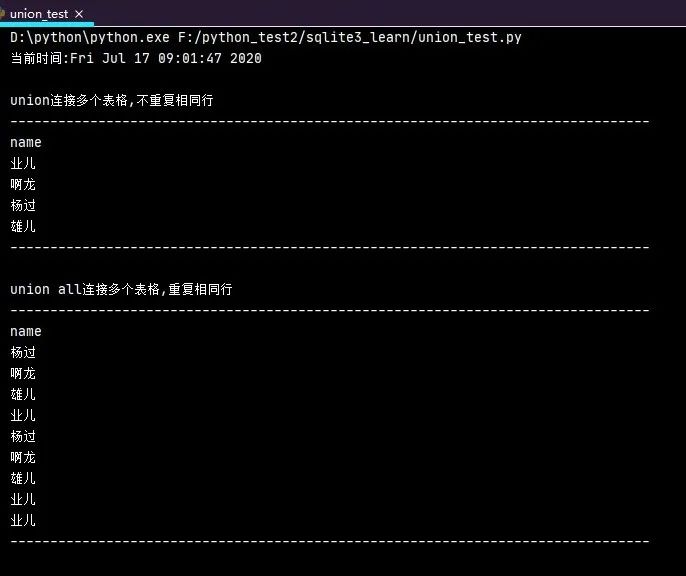
从上面的结果中可以清晰地看到使用uinon
和union all
的区别。

文章转载自与C同行,如果涉嫌侵权,请发送邮件至:contact@modb.pro进行举报,并提供相关证据,一经查实,墨天轮将立刻删除相关内容。
