作者
digoal
日期
2019-08-26
标签
PostgreSQL , postgis , 并行
背景
原文
https://info.crunchydata.com/blog/waiting-for-postgis-3-parallelism-in-postgis
PostgreSQL 12开始,自定义C函数支持了
1、代价估算接口,
```
CREATE [ OR REPLACE ] FUNCTION
name ( [ [ argmode ] [ argname ] argtype [ { DEFAULT | = } default_expr ] [, ...] ] )
[ RETURNS rettype
| RETURNS TABLE ( column_name column_type [, ...] ) ]
{ LANGUAGE lang_name
| TRANSFORM { FOR TYPE type_name } [, ... ]
| WINDOW
| IMMUTABLE | STABLE | VOLATILE | [ NOT ] LEAKPROOF
| CALLED ON NULL INPUT | RETURNS NULL ON NULL INPUT | STRICT
| [ EXTERNAL ] SECURITY INVOKER | [ EXTERNAL ] SECURITY DEFINER
| PARALLEL { UNSAFE | RESTRICTED | SAFE }
| COST execution_cost
| ROWS result_rows
| SUPPORT support_function
| SET configuration_parameter { TO value | = value | FROM CURRENT }
| AS 'definition'
| AS 'obj_file', 'link_symbol'
} ...
support函数必须为C写的。
| COST execution_cost
| ROWS result_rows
| SUPPORT support_function
SUPPORT support_function
The name (optionally schema-qualified) of a planner
support function to use for this function.
See Section 37.11 for details. You must be
superuser to use this option.
```
2、query rewrite(放大查询范围以便使用索引,即使用lossy索引),转换某些查询条件为支持索引查询的条件。
PostGIS 是PostgreSQL的专业时空插件,支持大量的时空计算函数和操作符。由于时空计算通常比较耗费CPU资源(而非IO资源),所以并行计算可以有效的提升空间查询效率。
在PG 12以前,PostGIS的函数要支持并行计算,通常需要强制指定并行度。因为函数的代价是静态的,不太好设置多少?
PG 12开始,通过SUPPORT support_function 接口,PostGIS可以指定GIS函数的评估函数,通过评估函数,可以向优化器返回被评估函数的
SupportRequestSimplify, SupportRequestSelectivity, SupportRequestCost, SupportRequestRows, SupportRequestIndexCondition等结构信息。包括选择性,代价,行数,索引条件等。有了这些信息,优化器可以做出更正确的决定。
被评估函数 -》 评估函数
my_int_eq,被评估函数
test_support_func,评估函数
```
CREATE FUNCTION my_int_eq(int, int) RETURNS bool
LANGUAGE internal STRICT IMMUTABLE PARALLEL SAFE
AS $$int4eq$$;
-- By default, planner does not think that's selective
EXPLAIN (COSTS OFF)
SELECT * FROM tenk1 a JOIN tenk1 b ON a.unique1 = b.unique1
WHERE my_int_eq(a.unique2, 42);
QUERY PLAN
Hash Join
Hash Cond: (b.unique1 = a.unique1)
-> Seq Scan on tenk1 b
-> Hash
-> Seq Scan on tenk1 a
Filter: my_int_eq(unique2, 42)
(6 rows)
```
```
-- With support function that knows it's int4eq, we get a different plan
ALTER FUNCTION my_int_eq(int, int) SUPPORT test_support_func;
EXPLAIN (COSTS OFF)
SELECT * FROM tenk1 a JOIN tenk1 b ON a.unique1 = b.unique1
WHERE my_int_eq(a.unique2, 42);
QUERY PLAN
Nested Loop
-> Seq Scan on tenk1 a
Filter: my_int_eq(unique2, 42)
-> Index Scan using tenk1_unique1 on tenk1 b
Index Cond: (unique1 = a.unique1)
(5 rows)
```
评估函数定义如下,篡改选择性等信息。
```
PG_FUNCTION_INFO_V1(test_support_func);
Datum
test_support_func(PG_FUNCTION_ARGS)
{
Node rawreq = (Node ) PG_GETARG_POINTER(0);
Node *ret = NULL;
    if (IsA(rawreq, SupportRequestSelectivity))
    {
            /*
             * Assume that the target is int4eq; that's safe as long as we don't
             * attach this to any other boolean-returning function.
             */
            SupportRequestSelectivity *req = (SupportRequestSelectivity *) rawreq;
            Selectivity s1;

            if (req->is_join)
                    s1 = join_selectivity(req->root, Int4EqualOperator,
                                                              req->args,
                                                              req->inputcollid,
                                                              req->jointype,
                                                              req->sjinfo);
            else
                    s1 = restriction_selectivity(req->root, Int4EqualOperator,
                                                                             req->args,
                                                                             req->inputcollid,
                                                                             req->varRelid);

            req->selectivity = s1;
            ret = (Node *) req;
    }
    if (IsA(rawreq, SupportRequestCost))
    {
            /* Provide some generic estimate */
            SupportRequestCost *req = (SupportRequestCost *) rawreq;

            req->startup = 0;
            req->per_tuple = 2 * cpu_operator_cost;
            ret = (Node *) req;
    }

    if (IsA(rawreq, SupportRequestRows))
    {
            /*
             * Assume that the target is generate_series_int4; that's safe as long
             * as we don't attach this to any other set-returning function.
             */
            SupportRequestRows *req = (SupportRequestRows *) rawreq;

            if (req->node && IsA(req->node, FuncExpr))      /* be paranoid */
            {
                    List       *args = ((FuncExpr *) req->node)->args;
                    Node       *arg1 = linitial(args);
                    Node       *arg2 = lsecond(args);

                    if (IsA(arg1, Const) &&
                            !((Const *) arg1)->constisnull &&
                            IsA(arg2, Const) &&
                            !((Const *) arg2)->constisnull)
                    {
                            int32           val1 = DatumGetInt32(((Const *) arg1)->constvalue);
                            int32           val2 = DatumGetInt32(((Const *) arg2)->constvalue);

                            req->rows = val2 - val1 + 1;
                            ret = (Node *) req;
                    }
            }
    }

    PG_RETURN_POINTER(ret);
}
```
PostGIS 利用 PG 12 评估函数接口,篡改postgis用户函数代价评估,从而让优化器更加智能的选择是否并行计算。
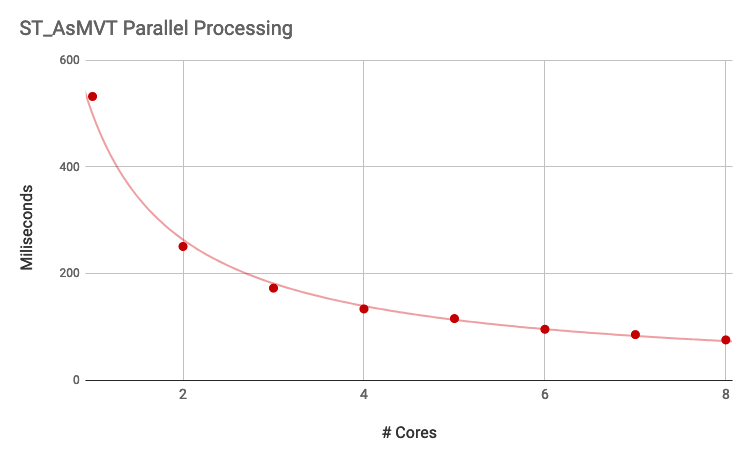
One of the functions that benefits from parallelism is the popular ST_AsMVT() aggregate function. When there are enough input rows, the aggregate will fan out and parallelize, which is great since ST_AsMVT() calls usually wrap a call to the expensive geometry processing function, ST_AsMVTGeom().
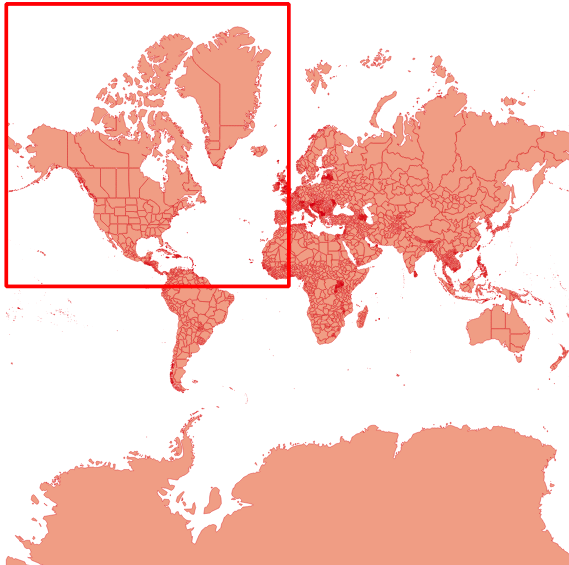
Using the Natural Earth Admin 1 layer of states and provinces as an input, I ran a small performance test, building a vector tile for zoom level one.
WITH rows AS MATERIALIZED (
  SELECT
  gid,
  ST_AsMVTGeom(ST_TileEnvelope(1, 0, 0)::box2d) AS geom
 FROM admin1
 WHERE ST_Intersects(geom, ST_Transform(ST_TileEnvelope(1, 0, 0), 4326))
)
SELECT length(ST_AsMVT(rows.*))
FROM rows
WHERE rows.geom IS NOT NULL;
并行度与响应RT比例
小结
PG 12提供了评估函数后,给优化器提供了一种输入,让自定义函数的代价评估更加的可定制化,而不是简单的row, cost静态设置。PostGIS利用这个接口,对
例如:
``` -- Availability: 1.4.0 CREATE OR REPLACE FUNCTION ST_LineCrossingDirection(geom1 geometry, geom2 geometry) RETURNS integer AS 'MODULE_PATHNAME', 'ST_LineCrossingDirection' SUPPORT postgis_index_supportfn LANGUAGE 'c' IMMUTABLE STRICT _PARALLEL _COST_HIGH;
-- Availability: 1.3.4 CREATE OR REPLACE FUNCTION ST_DWithin(geom1 geometry, geom2 geometry,float8) RETURNS boolean AS 'MODULE_PATHNAME', 'LWGEOM_dwithin' SUPPORT postgis_index_supportfn LANGUAGE 'c' IMMUTABLE STRICT _PARALLEL _COST_HIGH;
-- Availability: 1.2.2 CREATE OR REPLACE FUNCTION ST_Touches(geom1 geometry, geom2 geometry) RETURNS boolean AS 'MODULE_PATHNAME','touches' SUPPORT postgis_index_supportfn LANGUAGE 'c' IMMUTABLE STRICT _PARALLEL _COST_HIGH;
-- Availability: 1.2.2 CREATE OR REPLACE FUNCTION ST_Intersects(geom1 geometry, geom2 geometry) RETURNS boolean AS 'MODULE_PATHNAME','ST_Intersects' SUPPORT postgis_index_supportfn LANGUAGE 'c' IMMUTABLE STRICT _PARALLEL _COST_HIGH;
-- Availability: 1.2.2 CREATE OR REPLACE FUNCTION ST_Crosses(geom1 geometry, geom2 geometry) RETURNS boolean AS 'MODULE_PATHNAME','crosses' SUPPORT postgis_index_supportfn LANGUAGE 'c' IMMUTABLE STRICT _PARALLEL _COST_HIGH; ```
``` / * For functions that we want enhanced with spatial * index lookups, add this support function to the * SQL function defintion, for example: * CREATE OR REPLACE FUNCTION ST_Intersects(g1 geometry, g2 geometry) * RETURNS boolean * AS 'MODULE_PATHNAME','ST_Intersects' * SUPPORT postgis_index_supportfn * LANGUAGE 'c' IMMUTABLE STRICT PARALLEL SAFE * COST 100; * The function must also have an entry above in the * IndexableFunctions array so that we know what * index search strategy we want to apply. / PG_FUNCTION_INFO_V1(postgis_index_supportfn); Datum postgis_index_supportfn(PG_FUNCTION_ARGS) { Node rawreq = (Node ) PG_GETARG_POINTER(0); Node *ret = NULL;
    if (IsA(rawreq, SupportRequestSelectivity))
    {
            SupportRequestSelectivity *req = (SupportRequestSelectivity *) rawreq;

            if (req->is_join)
            {
                    req->selectivity = gserialized_joinsel_internal(req->root, req->args, req->jointype, 2);
            }
            else
            {
                    req->selectivity = gserialized_sel_internal(req->root, req->args, req->varRelid, 2);
            }
            elog(DEBUG2, "%s: got selectivity %g", __func__, req->selectivity);
            PG_RETURN_POINTER(req);
    }

    /*
    * This support function is strictly for adding spatial index
    * support.
    */
    if (IsA(rawreq, SupportRequestIndexCondition))
    {
            SupportRequestIndexCondition *req = (SupportRequestIndexCondition *) rawreq;

            if (is_funcclause(req->node))   /* ST_Something() */
            {
                    FuncExpr *clause = (FuncExpr *) req->node;
                    Oid funcid = clause->funcid;
                    IndexableFunction idxfn = {NULL, 0, 0, 0};
                    Oid opfamilyoid = req->opfamily; /* OPERATOR FAMILY of the index */

                    if (needsSpatialIndex(funcid, &idxfn))
                    {
                            int nargs = list_length(clause->args);
                            Node *leftarg, *rightarg;
                            Oid leftdatatype, rightdatatype, oproid;
                            bool swapped = false;

                            /*
                            * Only add an operator condition for GIST, SPGIST, BRIN indexes.
                            * Effectively this means only these opclasses will get automatic
                            * indexing when used with one of the indexable functions
                            * gist_geometry_ops_2d, gist_geometry_ops_nd,
                            * spgist_geometry_ops_2d, spgist_geometry_ops_nd
                            */
                            Oid opfamilyam = opFamilyAmOid(opfamilyoid);
                            if (opfamilyam != GIST_AM_OID &&
                                opfamilyam != SPGIST_AM_OID &&
                                opfamilyam != BRIN_AM_OID)
                            {
                                    PG_RETURN_POINTER((Node *)NULL);
                            }

                            /*
                            * We can only do something with index matches on the first
                            * or second argument.
                            */
                            if (req->indexarg > 1)
                                    PG_RETURN_POINTER((Node *)NULL);

                            /*
                            * Make sure we have enough arguments.
                            */
                            if (nargs < 2 || nargs < idxfn.expand_arg)
                                    elog(ERROR, "%s: associated with function with %d arguments", __func__, nargs);

                            /*
                            * Extract "leftarg" as the arg matching
                            * the index and "rightarg" as the other, even if
                            * they were in the opposite order in the call.
                            * NOTE: The functions we deal with here treat
                            * their first two arguments symmetrically
                            * enough that we needn't distinguish between
                            * the two cases beyond this. Could be more
                            * complications in the future.
                            */
                            if (req->indexarg == 0)
                            {
                                    leftarg = linitial(clause->args);
                                    rightarg = lsecond(clause->args);
                            }
                            else
                            {
                                    rightarg = linitial(clause->args);
                                    leftarg = lsecond(clause->args);
                                    swapped = true;
                            }
                            /*
                            * Need the argument types (which should always be geometry/geography) as
                            * this support function is only ever bound to functions
                            * using those types.
                            */
                            leftdatatype = exprType(leftarg);
                            rightdatatype = exprType(rightarg);

                            /*
                            * Given the index operator family and the arguments and the
                            * desired strategy number we can now lookup the operator
                            * we want (usually && or &&&).
                            */
                            oproid = get_opfamily_member(opfamilyoid, leftdatatype, rightdatatype, idxfn.strategy_number);
                            if (!OidIsValid(oproid))
                                    elog(ERROR, "no spatial operator found for opfamily %u strategy %d", opfamilyoid, idxfn.strategy_number);

                            /*
                            * For the ST_DWithin variants we need to build a more complex return.
                            * We want to expand the non-indexed side of the call by the
                            * radius and then apply the operator.
                            * st_dwithin(g1, g2, radius) yields this, if g1 is the indexarg:
                            * g1 && st_expand(g2, radius)
                            */
                            if (idxfn.expand_arg)
                            {
                                    Expr *expr;
                                    Node *radiusarg = (Node *) list_nth(clause->args, idxfn.expand_arg-1);
                                    Oid expandfn_oid = expandFunctionOid(rightdatatype, clause->funcid);

                                    FuncExpr *expandexpr = makeFuncExpr(expandfn_oid, rightdatatype,
                                        list_make2(rightarg, radiusarg),
                                            InvalidOid, InvalidOid, COERCE_EXPLICIT_CALL);

                                    /*
                                    * The comparison expression has to be a pseudo constant,
                                    * (not volatile or dependent on the target index table)
                                    */
                                    if (!is_pseudo_constant_for_index((Node*)expandexpr, req->index))
                                            PG_RETURN_POINTER((Node*)NULL);

                                    /* OK, we can make an index expression */
                                    expr = make_opclause(oproid, BOOLOID, false,
                                                  (Expr *) leftarg, (Expr *) expandexpr,
                                                  InvalidOid, InvalidOid);

                                    ret = (Node *)(list_make1(expr));
                            }
                            /*
                            * For the ST_Intersects variants we just need to return
                            * an index OpExpr with the original arguments on each
                            * side.
                            * st_intersects(g1, g2) yields: g1 && g2
                            */
                            else
                            {
                                    Expr *expr;
                                    /*
                                    * The comparison expression has to be a pseudoconstant
                                    * (not volatile or dependent on the target index's table)
                                    */
                                    if (!is_pseudo_constant_for_index(rightarg, req->index))
                                            PG_RETURN_POINTER((Node*)NULL);

                                    /*
                                    * Arguments were swapped to put the index value on the
                                    * left, so we need the commutated operator for
                                    * the OpExpr
                                    */
                                    if (swapped)
                                    {
                                            oproid = get_commutator(oproid);
                                            if (!OidIsValid(oproid))
                                                    PG_RETURN_POINTER((Node *)NULL);
                                    }

                                    expr = make_opclause(oproid, BOOLOID, false,
                                                    (Expr *) leftarg, (Expr *) rightarg,
                                                    InvalidOid, InvalidOid);

                                    ret = (Node *)(list_make1(expr));
                            }

                            /*
                            * Set the lossy field on the SupportRequestIndexCondition parameter
                            * to indicate that the index alone is not sufficient to evaluate
                            * the condition. The function must also still be applied.
                            */
                            req->lossy = true;

                            PG_RETURN_POINTER(ret);
                    }
                    else
                    {
                            elog(WARNING, "support function '%s' called from unsupported spatial function", __func__);
                    }
            }
    }

    PG_RETURN_POINTER(ret);
}
endif / POSTGIS_PGSQL_VERSION >= 120 /
```
参考
《PostgreSQL 12 preview - 优化器接口 - 自定义函数成本估算优化接口》
https://info.crunchydata.com/blog/waiting-for-postgis-3-parallelism-in-postgis
https://github.com/postgres/postgres/blob/fe9b7b2fe5973309c0a5f7d9240dde91aeeb94aa/src/include/nodes/supportnodes.h
http://blog.cleverelephant.ca/2019/06/parallel-postgis-4b.html
PostgreSQL 许愿链接
您的愿望将传达给PG kernel hacker、数据库厂商等, 帮助提高数据库产品质量和功能, 说不定下一个PG版本就有您提出的功能点. 针对非常好的提议,奖励限量版PG文化衫、纪念品、贴纸、PG热门书籍等,奖品丰富,快来许愿。开不开森.
9.9元购买3个月阿里云RDS PostgreSQL实例
PostgreSQL 解决方案集合
德哥 / digoal's github - 公益是一辈子的事.