作者
digoal
日期
2017-06-20
标签
PostgreSQL , PostGIS , 复合索引 , btree_gist , 共享单车
背景
随着移动互联网的普及,空间数据已经成为大多数企业数据的标配,例如出行、快递、等。
通常数据的查询会带位置距离搜索,同时还会伴随其他属性的过滤,其他属性的过滤:例如时间范围,区域ID的过滤,物流公司ID的过滤。
空间索引和BTREE索引在PostgreSQL中属于两种索引(PostgreSQL支持btree,hash,gin,gist,sp-gist,brin,rum,bloom,zoomdb等多种索引方法)。
怎么使得查询效率达到最优呢?
gist空间复合索引
例子
数据库中存储了3个关键字段,一个表示共享单车的公司(mobike, ofo, ...),一个表示共享单车是否在使用中,还有一个字段表示共享单车当前的位置。
构建测试表,三个字段,两个INT类型,一个POINT类型,用户可能需要根据point查询近邻数据,同时过滤掉c1,c2的某一些值。
测试表以及测试数据如下
```
postgres=# create table cb(
c1 int, -- 0表示未使用,1表示已使用
c2 int, -- 共享单车属于哪家运营公司
c3 point -- 共享单车当前位置
);
CREATE TABLE
postgres=# insert into cb select random()1, random()1000 , point(10000random(), 10000random()) from generate_series(1,10000000);
INSERT 0 10000000
postgres=# select * from cb limit 10;
c1 | c2 | c3
----+-----+-------------------------------------
0 | 981 | (8099.59028847516,9043.13919134438)
1 | 256 | (9331.68333489448,2223.74511882663)
1 | 510 | (2517.2486435622,8716.1894608289)
0 | 398 | (2658.8175073266,2361.14453990012)
0 | 989 | (8130.69586176425,1361.2649217248)
0 | 344 | (2282.57383685559,9480.9684343636)
1 | 944 | (8550.47187302262,2814.43384941667)
0 | 418 | (3858.46449527889,5060.3136094287)
0 | 196 | (4103.45280077308,1458.2177111879)
0 | 344 | (3681.96283001453,1260.5628464371)
(10 rows)
```
搜索某个点附近1000距离内,属于某个公司的,没有使用的共享单车。
查询语句如下
select * from cb where c1=0 and c2=100 and c3 <@ circle '((23,3175),1000)' order by c3 <-> point(23,3175) limit 1000;
创建空间复合索引
```
postgres=# set maintenance_work_mem='32GB';
SET
postgres=# create extension btree_gist;
CREATE EXTENSION
postgres=# create index idx1 on cb using gist(c1,c2,c3);
CREATE INDEX
```
性能如下
```
postgres=# explain (analyze,verbose,timing,costs,buffers) select * from cb where c1=0 and c2=100 and c3 <@ circle '((23,3175),1000)' order by c3 <-> point(23,3175) limit 1000;
QUERY PLAN
Limit (cost=0.42..9.55 rows=5 width=32) (actual time=0.125..0.355 rows=93 loops=1)
Output: c1, c2, c3, ((c3 <-> '(23,3175)'::point))
Buffers: shared hit=106
-> Index Only Scan using idx1 on public.cb (cost=0.42..9.55 rows=5 width=32) (actual time=0.124..0.344 rows=93 loops=1)
Output: c1, c2, c3, (c3 <-> '(23,3175)'::point)
Index Cond: ((cb.c1 = 0) AND (cb.c2 = 100) AND (cb.c3 <@ '<(23,3175),1000>'::circle))
Order By: (cb.c3 <-> '(23,3175)'::point)
Heap Fetches: 93
Buffers: shared hit=106
Planning time: 0.110 ms
Execution time: 0.387 ms
(11 rows)
```
PostGIS例子
对于一个这样的PostGIS相关的QUERY,优化如下
```
explain (analyze,verbose,timing,costs,buffers)
select xxx1,xxx2,xxx3,st_asbinary(geo) as geo,
ST_Transform (ST_GeomFromText ('POINT(121.403833486783 31.1425794813889)', 4326), 26986) <-> ST_Transform (geo, 26986) as distance2Center
from tbl
where xxx1='1' and xxx2='xxx'
and ST_Transform (geo, 26986) && ST_Buffer(ST_Transform(ST_GeomFromText('POINT(121.403833486783 31.1425794813889)', 4326), 26986), 300)
order by ST_Transform (ST_GeomFromText ('POINT(121.403833486783 31.1425794813889)', 4326), 26986) <-> ST_Transform (geo, 26986) asc
对于这个查询,使用这个索引是最好的
create index idx1 on tbl using gist(xxx1, xxx2, ST_Transform (geo, 26986));
```
极限优化
《HTAP数据库 PostgreSQL 场景与性能测试之 47 - (OLTP) 空间应用 - 高并发空间位置更新、多属性KNN搜索并测(含空间索引)末端配送、新零售类项目》
create or replace function ff1(geometry, float8, int) returns setof record as $$
declare
  v_rec record;
  v_limit int := $3;
begin
  set local enable_seqscan=off;   -- 强制索引, 扫描行数够就退出.
  for v_rec in
    select *,
    ST_Distance ( $1, loc_box ) as dist
    from cloudpoint_test_agg
    -- where xxx1='1' and xxx2='xxx'
    order by loc_box <-> $1           -- 按距离顺序由近到远返回
  loop
    if v_limit <=0 then               -- 判断返回的记录数是否达到LIMIT的记录数
      raise notice '已经取足limit设置的 % 条数据, 但是距离 % 以内的点可能还有.', $3, $2;
      return;
    end if;
    if v_rec.dist > $2 then       -- 判断距离是否大于请求的距离
      raise notice '距离 % 以内的点已输出完毕', $2;
      return;
    else
      return next v_rec;
    end if;
    v_limit := v_limit - array_length(v_rec.loc_agg, 1);  -- 扣减grid内的point个数
  end loop;
end;
$$ language plpgsql strict volatile;
如果不使用空间复合索引,性能会差很多
如下,同样的数据:
```
postgres=# create table cc (like cb);
CREATE TABLE
postgres=# insert into cc select * from cb;
INSERT 0 10000000
仅仅创建c3的空间索引
postgres=# create index idx2 on cc using gist(c3);
CREATE INDEX
```
查询性能如下
```
postgres=# explain (analyze,verbose,timing,costs,buffers) select * from cc where c1=0 and c2=100 and c3 <@ circle '((23,3175),1000)' order by c3 <-> point(23,3175) limit 1000;
QUERY PLAN
Limit (cost=12552.41..12552.42 rows=5 width=32) (actual time=153.300..153.317 rows=93 loops=1)
Output: c1, c2, c3, ((c3 <-> '(23,3175)'::point))
Buffers: shared hit=60543
-> Sort (cost=12552.41..12552.42 rows=5 width=32) (actual time=153.298..153.306 rows=93 loops=1)
Output: c1, c2, c3, ((c3 <-> '(23,3175)'::point))
Sort Key: ((cc.c3 <-> '(23,3175)'::point))
Sort Method: quicksort Memory: 32kB
Buffers: shared hit=60543
-> Bitmap Heap Scan on public.cc (cost=236.92..12552.35 rows=5 width=32) (actual time=52.341..153.244 rows=93 loops=1)
Output: c1, c2, c3, (c3 <-> '(23,3175)'::point)
Recheck Cond: (cc.c3 <@ '<(23,3175),1000>'::circle)
Filter: ((cc.c1 = 0) AND (cc.c2 = 100))
Rows Removed by Filter: 160633
Heap Blocks: exact=58622
Buffers: shared hit=60543
-> Bitmap Index Scan on idx2 (cost=0.00..236.92 rows=10000 width=0) (actual time=39.223..39.223 rows=160726 loops=1)
Index Cond: (cc.c3 <@ '<(23,3175),1000>'::circle)
Buffers: shared hit=1921
Planning time: 0.116 ms
Execution time: 153.373 ms
(20 rows)
postgres=# set enable_seqscan=off;
SET
postgres=# explain (analyze,verbose,timing,costs,buffers) select * from cc where c1=0 and c2=100 and c3 <@ circle '((23,3175),1000)' order by c3 <-> point(23,3175) limit 1000;
QUERY PLAN
Limit (cost=0.42..14296.43 rows=5 width=32) (actual time=0.998..210.033 rows=93 loops=1)
Output: c1, c2, c3, ((c3 <-> '(23,3175)'::point))
Buffers: shared hit=162645
-> Index Scan using idx2 on public.cc (cost=0.42..14296.43 rows=5 width=32) (actual time=0.996..210.008 rows=93 loops=1)
Output: c1, c2, c3, (c3 <-> '(23,3175)'::point)
Index Cond: (cc.c3 <@ '<(23,3175),1000>'::circle)
Order By: (cc.c3 <-> '(23,3175)'::point)
Filter: ((cc.c1 = 0) AND (cc.c2 = 100))
Rows Removed by Filter: 160633
Buffers: shared hit=162645
Planning time: 0.109 ms
Execution time: 210.079 ms
(12 rows)
```
性能差的原因是rows remove by filter,因为仅仅通过空间扫描的过滤,大量的行是不满足条件的,所以导致了大量的无用功。
btree复合索引(geohash+其他过滤条件)
如果你使用的是geohash,而不是geometry类型,当你的地理位置并非边界地址时,相邻的数据的geohash的某些prefix可能是相同的,因此geohash可以使用btree索引。
```
create table test (
c1 int, -- 共享单车是否已被租用
c2 int, -- 共享单车运营公司
c3 text -- 共享单车位置(geohash)
);
create index idx on test using btree(c1,c2,c3);
```
再次优化,cluster,减少索引扫描的离散度。
cluster test using idx;
范围扫描复合优化
还是前面的例子,当驱动列的过滤条件不是等于,而是范围时,效果为什么不好呢?
因为需要扫描整个范围以及下级分支,而索引的块是离散块,所以扫描效率并不高。
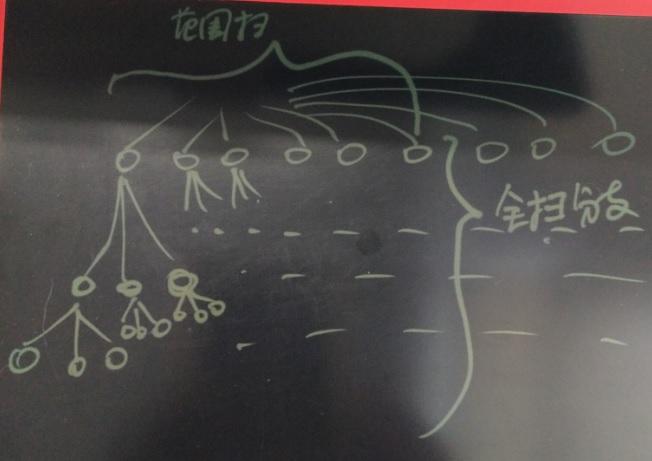
例子
```
create table test(c1 int, c2 int, c3 timestamp, c4 point);
create index idx on test using gist(c3,c2,c4);
select * from test where c3 between '2017-01-01' and '2017-01-02' and c2=1 order by c4;
这样的查询效率并不高。
```
而前面的例子对应的是驱动列的点扫描,所以效率很好。
对于有范围扫描的场景,应该如何应对呢?
1、使用分区表,例如使用C3字段作为分区列,按时间进行分区。建立索引时将C3列摘除。
```
create table test_20170101 (like test, check c3 between '2017-01-01' and '2017-01-02');
create index idx on test_20170101 using gist (c2, c4);
select * from test_20170101 where c2=1 order by c4;
```
或者使用内核优化,让内核支持分区索引。
内核优化
分区索引,按时间进行分区,建立分区索引。
在扫描时,自动检索对应的索引分区。达到 分区表+独立索引 同样的效果。
GIS领域朋友的建议
收到来自PostgreSQL社区GIS领域朋友的建议,为了防止给学习GIS的同学带来误导(为了测试方便,文中大量使用了内置的几何point类型,并非GIS类型。),请参考如下建议。
感谢。
``` select DropGeometryColumn ('cb','geom'); drop table if exists cb;
create table cb(
objectid int not null, --共享单车编号
c1 int, -- 0表示未使用,其它表示已使用
c2 int, -- 共享单车属于哪家运营公司
constraint pk_cb_objectid primary key (objectid)
);
--GIS必须明确指出地图单位是什么
--民用GPS小数6位精度(6位大约为10米级精度,8位已经是亚米级精度)已经很高了,再多没有意义
--c3 point -- 共享单车当前位置, point在文章里只能算是自定义类型(实际上是PostgreSQL内置的几何点类型),这会给参考您文章的学习GIS的同学造成困扰
--where c1=0 and c2=100 and c3 <@ circle '((23,3175),1000)' order by c3 <-> point(23,3175) limit 1000;
--搜索某个点附近1000距离内,属于某个公司的,没有使用的共享单车。
--这样的查询条件在测试没问题,但是别人看了会造成困扰,因为没有地图单位,这个1000距离不知道是什么东西
--新版本的postgis文档中已经没有ST_GeomFromText ('POINT(121.403833486783 31.1425794813889)', 4326)这样的函数了,虽然还支持,未来可能会删除
--请使用ST_SetSRID(ST_GeomFromText ('POINT(121.403833486783 31.1425794813889)'),4326)或ST_GeomFromText ('SRID=4326;POINT(121.403833486783 31.1425794813889)')
--发现好几篇您写的关于gis的文章都有类似的问题,希望关于gis方面的文章严格按postgis标准
--创建空间字段,根据空间参考不同,地图单位可能为米、度或其它,统称地图单位
select AddGeometryColumn ('cb','geom',4326,'POINT',2); -- 共享单车当前位置,GPS采用4326 ,类型为点,二维坐标
--创建空间索引 create index gidx_cb_geom on cb using gist(geom); create index gidx_cb_geomgraphy on cb using gist((geom::geography));
--坐标范围限制在中国[73.406586, 3.408477, 135.085831, 53.880950]
do $$
declare vStart bigint;
declare vEnd bigint;
declare MAXVALE bigint;
declare INTERVAL bigint;
begin
MAXVALE := 20000000;
INTERVAL := 1000; vStart := 1 ;vEnd := INTERVAL;
loop
-- 20家公司比较符合市场现状,更能反应实际情况
insert into cb
select id,(random()1)::integer, (random()(20-1)+1)::integer,
ST_SetSRID(ST_Point(
round((random()(135.085831-73.406586)+73.406586)::numeric,6),
round((random()(53.880950-3.408477)+3.408477)::numeric,6)
),4326)
from generate_series(vStart,vEnd) as id;
raise notice '%', vEnd;
vStart := vEnd + 1; vEnd := vEnd + INTERVAL;
if( vEnd > MAXVALE ) then
return;
end if;
end loop;
end$$;
--ix,iy为gps经度和纬度(单位为度)
--idistance为搜索距离(单位为米)
drop function if exists spatialQuery(ix float,iy float,idistance float); create or replace function spatialQuery(ix float,iy float,idistance float) returns table(oobjectid integer,oc1 integer,oc2 integer,odistance float,ogeom geometry) as $$ declare vrecord record; vcurrentpoint geometry; vspheroid spheroid; begin vspheroid := 'SPHEROID["WGS84",6378137,298.257223563]' ; --WGS84椭球体参数定义 vcurrentpoint := ST_SetSRID(ST_Point(ix,iy),4326); -- --查找圆心为vcurrentpoint,半径idistance米范围内未使用的共享单车,并按距离排序,只返回1千行 return query ( with cte as( select * from cb where ST_DWithin(geom::geography ,vcurrentpoint::geography,idistance,true) ) select objectid,c1,c2,ST_DistanceSpheroid(geom,vcurrentpoint,vspheroid),geom from cte where c1=0 order by ST_DistanceSpheroid(geom,vcurrentpoint,vspheroid) limit 1000 ); end; $$ language plpgsql;
select * from spatialQuery(102,24,5000);
--查询计划
explain (analyze,verbose,costs,buffers,timing) with cte as( select * from cb where ST_DWithin(geom::geography ,ST_SetSRID(ST_Point(102,24),4326)::geography,5000,true) ) select objectid,c1,c2,ST_DistanceSpheroid(geom,ST_SetSRID(ST_Point(102,24),4326),'SPHEROID["WGS84",6378137,298.257223563]'),geom from cte where c1=0 order by ST_DistanceSpheroid(geom,ST_SetSRID(ST_Point(102,24),4326),'SPHEROID["WGS84",6378137,298.257223563]') limit 1000; ```
小结
1、如果要构建复合索引,那么为了达到最好的效果,所有的驱动列使用等值查询是最好的,使用范围查询会导致大范围的搜索。
2、如果需要使用复合索引进行排序,那么要么按所有字段排序,要么按驱动列等值条件+suffix列排序。
3、为了减少索引扫描的离散度,建议使用cluster对数据按索引进行重排。
PostgreSQL 许愿链接
您的愿望将传达给PG kernel hacker、数据库厂商等, 帮助提高数据库产品质量和功能, 说不定下一个PG版本就有您提出的功能点. 针对非常好的提议,奖励限量版PG文化衫、纪念品、贴纸、PG热门书籍等,奖品丰富,快来许愿。开不开森.
9.9元购买3个月阿里云RDS PostgreSQL实例
PostgreSQL 解决方案集合
德哥 / digoal's github - 公益是一辈子的事.