



阿里巴巴论文_Can LLM Already Serve as A Database InterfaceA BIg Bench for Large-Scale Database GroundedText-to-SQLs.pdf
免费下载

Can LLM Already Serve as A Database Interface?
A BIg Bench for Large-Scale Database Grounded
Text-to-SQLs
Jinyang Li
1,♣ ‡
, Binyuan Hui
2,♣
, Ge Qu
1,♣
, Binhua Li
2
, Jiaxi Yang
2
, Bowen Li
3
, Bailin Wang
4
,
Bowen Qin
2
, Rongyu Cao
2
, Ruiying Geng
2
, Nan Huo
1
, Xuanhe Zhou
3
, Chenhao Ma
5
,
Guoliang Li
3
, Kevin C.C. Chang
6 †
, Fei Huang
2
, Reynold Cheng
1 †
, Yongbin Li
2 †
1
The University of Hong Kong
2
DAMO Academy, Alibaba Group
3
Tsinghua University
4
Massachusetts Institute of Technology
5
The Chinese University of Hong Kong (Shenzhen)
6
University of Illinois at Urbana-Champaign
jl0725@connect.hku.hk, ckcheng@cs.hku.hk
binyuan.hby@alibaba-inc.com
Abstract
Text-to-SQL parsing, which aims at converting natural language instructions into
executable SQLs, has gained increasing attention in recent years. In particular,
Codex and ChatGPT have shown impressive results in this task. However, most of
the prevalent benchmarks, i.e., Spider, and WikiSQL, focus on database schema
with few rows of database contents leaving the gap between academic study and
real-world applications. To mitigate this gap, we present BIRD, a BIg benchmark
for laRge-scale Database grounded in text-to-SQL tasks, containing 12,751 pairs
of text-to-SQL data and 95 databases with a total size of 33.4 GB, spanning
37 professional domains. Our emphasis on database values highlights the new
challenges of dirty database contents, external knowledge between NL questions
and database contents, and SQL efficiency, particularly in the context of massive
databases. To solve these problems, text-to-SQL models must feature database
value comprehension in addition to semantic parsing. The experimental results
demonstrate the significance of database values in generating accurate text-to-SQLs
for big databases. Furthermore, even the most popular and effective text-to-SQL
models, i.e. ChatGPT, only achieve 40.08% in execution accuracy, which is still far
from the human result of 92.96%, proving that challenges still stand. Besides, we
also provide an efficiency analysis to offer insights into generating text-to-efficient-
SQLs that are beneficial to industries. We believe that BIRD will contribute to
advancing real-world applications of text-to-SQL research. The leaderboard and
source code are available: https://bird-bench.github.io/.
1 Introduction
Text-to-SQL parsing [
57
,
52
,
53
,
2
,
54
,
37
], which focuses on transforming natural language into SQL
queries, has attracted significant research interests from both academia and industry. This attention
stems from its potential to empower non-expert data analysts in automatically extracting desired
information from ubiquitous relational databases using natural language. Recent advances in neural
♣ Equal contribution.
‡
Work done during an intern at Alibaba DAMO Academy.
†
Corresponding authors.
arXiv:2305.03111v2 [cs.CL] 30 May 2023
External Knowledge Reasoning
Large and Realistic Database Values
SQL Execution Efficiency
What is the winning rate of Boston Celtics in 2000?
SELECT COUNT(won) / ((COUNT(won) + COUNT(lose))
FROM teams WHERE team_name = ‘Boston Celtics’
AND year = 2000;
External Knowledge:
winning rate = # won / (# won + # lose)
What is the average salary of the worst performing managers?
SELECT AVG(CAST(REPLACE(SUBSTR(T1.salary, 4), ',', '') AS REAL)) FROM
last_name
Milgrom
… …
em_id
0000
… …
Employees
US$57,500.00
first_name
salary
2222
6543
Adams
Wood
Milgrom
Sandy
Emily
… …
US$19,500.00
US$69,000.00
… …
Reasoned Database:
employee AS T1 JOIN position AS T2 ON T1.positionID = T2.positionID
WHERE T1.performance = 'Poor' AND T2.positiontitle = 'Manager'
Among the coaches who have served more than 2 NBA teams, during
which coach‘s period of coaching, a team has the least numbers of
games lost in the post-season games?
SELECT coachID FROM coaches WHERE lgID='NBA’ AND post_wins !=0
SQL
1
: normal semantic parser
AND post_losses !=0 AND coachID IN
(SELECT coachID FROM coaches WHERE lgID='NBA’ GROUP BY coachID
HAVING COUNT(tmID)>=2) ORDER BY post_losses ASC LIMIT 1 ;
Run time: 22.4s
What is the average salary of the worst performing managers?
SELECT AVG (CAST(REPLACE(SUBSTR(T1.salary, 4), ',', '') AS REAL)) FROM
last_name
Milgrom
… …
em_id
0000
… …
Employees
US$57,500.00
first_name
salary
2222
6543
Adams
Wood
Santa
Sandy
Emily
… …
US$19,500.00
US$69,000.00
… …
Reasoned Database:
employee AS T1 JOIN position AS T2 ON T1.positionID = T2.positionID
WHERE T1.performance = 'Poor' AND T2.positiontitle = 'Manager'
SQL
2
: efficient semantic parser
SELECT coachID FROM coaches WHERE lgID=‘NBA’ AND post_wins !=0
AND post_losses !=0 AND EXISTS (SELECT 1 FROM coaches AS coaches1
WHERE (coaches1.lgID=‘NBA’) AND (coaches.coachID=coaches1.coachID)
GROUP BY coaches1.coachID HAVING count(coaches1.tmID) >= 2
ORDER BY NULL ) ORDER BY coaches.post_losses ASC LIMIT 1
Run time: 4.0s
How many accounts are eligible for loans in New Yo rk City?
The condition of loans is that
the type of the account should
be “OWNER”.
SELECT COUNT(*) FROM account WHERE account.type
= ‘OWNER’ AND city = ‘NY’;
External Knowledge:
(a).
(b).
(c).
How many accounts are eligible for loans in New Yo rk City?
The condition of loans is that
the type of the account should
be “OWNER”.
SELECT COUNT(*) FROM account WHERE account.type
= ‘OWNER’ AND disp_id = ‘NY’;
External Knowl edge:
List account id who chooses weekly issue issuance statement?
‘POPLATEK TYDNE’ stands
for weekly issuance.
SELECT account_id FROM account WHERE account.frequency
= ‘POPLATEK TYDNE‘;
External Knowl edge:
How many accounts are eligible for loans in New Yo rk City?
The condition of loans is that
the type of the account should
be “OWNER”.
SELECT COUNT(*) FROM account WHERE account.type
= ‘OWNER’ AND disp_id = ‘NY’;
External Knowledge:
List account id who chooses weekly issue issuance statement?
‘POPLATEK TYDNE’ stands
for weekly issuance.
SELECT account_id FROM account WHERE account.frequency
= ‘POPLATEK TYDNE‘;
External Knowledge:
What is the average salary of the worst performing managers?
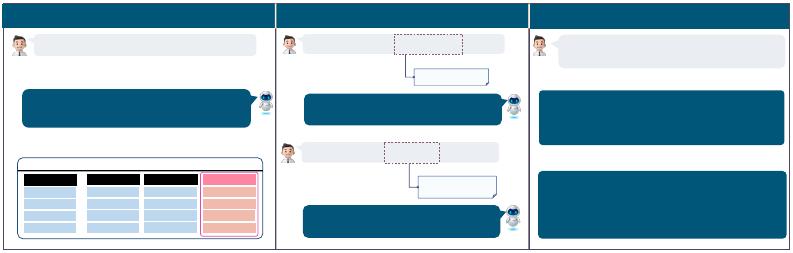
Figure 1: Examples of challenges in our BIRD benchmark. 1) databases contain values of noisy data
types [
14
,
24
,
19
,
32
]. In the left example, the average salary could be fetched by processing the
data type from string (
TEXT
in SQLite) to float (
REAL
in SQLite) after deleting the special tokens,
"US$"
and
","
. 2) external knowledge and reasoning are required. In the middle example, models
must handle that only
"OWNER"
accounts are eligible for loans. 3) query execution efficiency needs
to be considered. In the right example, the adoption of more efficient SQL queries leads to significant
gains in speed, which is of great value in industries.
models, including those based on large language models (LLMs), have led to impressive performance
on existing benchmarks such as Spider [
55
] and WikiSQL [
60
]. For instance, the execution accuracy
of the top-performing model in Spider leaderboard has increased from 53.5% [
61
] to 85.3% [
35
] over
the past three years. The latest SOTA parser [
35
] in Spider benefits from the powerful understanding
and coding capabilities of the large language model (LLM), and such excellent performance leads us
to ask a question: Can LLM already serve as a database interface ?
The answer is no, as shown in Figure.1, we discovered that current state-of-the-art models still struggle
to generalize to more realistic situations characterized by large database sizes and noisy content.
Besides, the mysteries hidden behind the huge database values require external knowledge and
reasoning to reveal. Furthermore, existing benchmarks do not account for SQL execution efficiency,
which holds significant practical importance in real-life applications, notably in the case of large
databases. Motivated by these observations, we aim to develop a new text-to-SQL benchmark that
better represents real-life scenarios and narrows the gap between experimental and practical settings.
In this work, we propose BIRD, a BIg Bench for LaRge-Scale Database Grounded in Text-to-SQLs
for real-world applications. BIRD contains complex 12,751 examples of querying information over
95 big databases with a total size of 33.4 GB spanning 37 professional domains. For training, we
collected 80 open-source relational databases from real analysis platforms (Kaggle, Relation.vit);
for evaluation, we curated 15 additional relational databases. Given these databases, we rely on
crowdsourcing to collect natural language instructions and the corresponding SQLs. First, our
database experts create a description file explaining all column names, abbreviated values, value
types, and external knowledge for each database to help annotators better understand the database
contents. Then we hire and train native speakers to ask questions facing these databases on one
side; on the other side, a SQL annotation team consisting of data engineers and database students
is recruited to generate SQLs to answer questions. To accommodate efficiency, we propose a new
metric Valid Efficiency Score (VES) to evaluate the efficiency of generated SQLs in addition to the
standard execution accuracy. To the best of our knowledge, BIRD is the first text-to-SQL benchmark
to incorporate efficiency, promoting more efficient query methods within the context of massive and
noisy database contents.
We evaluate the performance of state-of-the-art text-to-SQL parsers using two popular methodologies:
fine-tuning with T5 [
38
], and in-context learning with large language models (LLMs) such as Codex
[
6
] (
code-davinci-002
) and ChatGPT [
33
] (
gpt-3.5-turbo
). Our experimental results
reveal that the current models struggle to generalize well. Specifically, the Spider SOTA model,
which depends solely on the database schema, achieves execution accuracies of only 25.88% and
28.95% on the development and test sets, respectively. In comparison, the performance still lags far
behind human performance, which we also provide in this benchmark. We encourage further research
to address the more realistic settings presented in this benchmark.
2
of 20
免费下载
【版权声明】本文为墨天轮用户原创内容,转载时必须标注文档的来源(墨天轮),文档链接,文档作者等基本信息,否则作者和墨天轮有权追究责任。如果您发现墨天轮中有涉嫌抄袭或者侵权的内容,欢迎发送邮件至:contact@modb.pro进行举报,并提供相关证据,一经查实,墨天轮将立刻删除相关内容。
下载排行榜

评论