



exadata-x10m-datasheet-en.pdf
5墨值下载
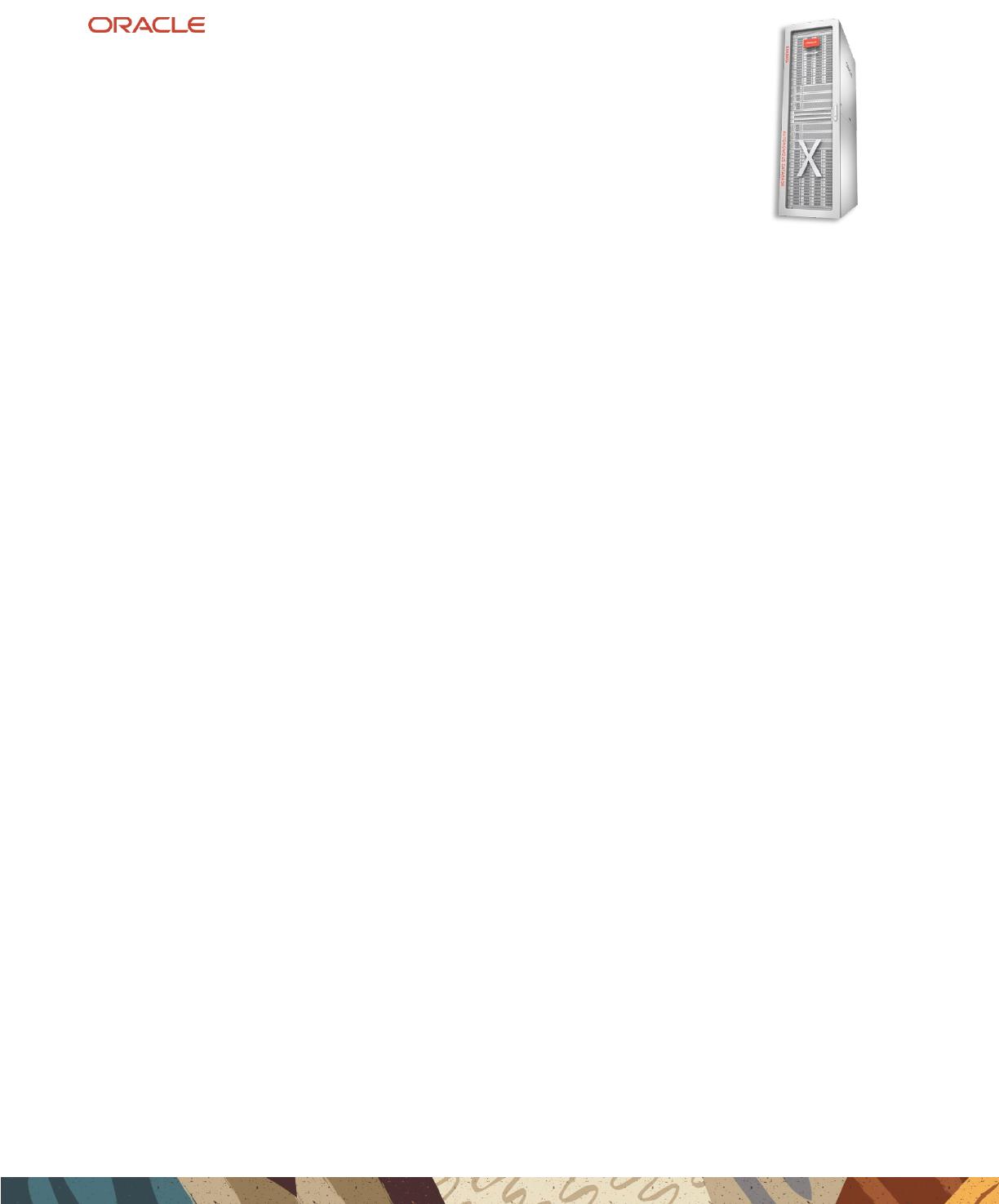
1 Oracle Exadata Database Machine X10M / Version 1.0
Copyright © 2023, Oracle and/or its affiliates / Public
Oracle Exadata
Database Machine
X10M
The Oracle Exadata Database Machine (Exadata) is engineered to deliver
dramatically better performance, cost-effectiveness, and availability for Oracle
databases. Exadata features a modern cloud-enabled architecture with scale-out
high-performance database servers, scale-out intelligent storage servers with
state-of-the-art PCIe flash, unique storage caching using RDMA accessible
memory, and cloud-scale RDMA over Converged Ethernet (RoCE) internal fabric
that connects all servers and storage. Unique algorithms and protocols in Exadata
implement database intelligence in storage, compute, and networking to deliver
higher performance and capacity at lower costs than other database platforms.
Exadata is ideal for all types of modern database workloads, including Online
Transaction Processing (OLTP), Data Warehousing (DW), In-Memory Analytics,
Internet of Things (IoT), financial services, gaming, and compliance data
management, as well as efficient consolidation of mixed database workloads.
Simple and fast to implement, the Exadata Database Machine X10M powers and
protects your most important databases. Exadata can be purchased and deployed
on-premises as the ideal foundation for a private database cloud or acquired using
a subscription model and deployed in the Oracle Public Cloud or Cloud@Customer
with all infrastructure management performed by Oracle. The Oracle Autonomous
Database is available exclusively on Exadata, either in the Oracle Public Cloud or
Cloud@Customer.
Engineered For Fast and Reliable Deployment
The Exadata Database Machine is the most cost-efficient and highest-
performance platform for running Oracle Databases. Exadata is easy to deploy
even for the most mission-critical systems, as the database servers, storage
servers, and network are pre-configured, pre-tuned, and pre-tested by Oracle
experts. Extensive end-to-end testing and validation ensure all components,
including database software, operating system, hypervisor, drivers, and firmware,
work seamlessly together and that there are no performance bottlenecks or single
points of failure.
Oracle Exadata Database
Machine X10M
Key Features
Up to 2,880 CPU cores per
rack for database
processing
Up to 33 TB memory per
rack for database
processing
Up to 1,088 CPU cores per
rack dedicated to SQL
processing in storage
Up to 21.25 TB of Exadata
RDMA Memory per rack
100 Gb/sec RoCE Network
Complete redundancy for
high availability
From 2 to 15 database
servers per rack
From 3 to 17 storage
servers per rack
Up to 462.4 TB of
performance-optimized
flash capacity (raw) per rack
Up to 2 PB of capacity-
optimized flash capacity
(raw) per rack
Up to 4.2 PB of disk capacity
(raw) per rack

2 Oracle Exadata Database Machine X10M / Version 1.0
Copyright © 2023, Oracle and/or its affiliates / Public
All Exadata Database Machines are identically configured; therefore, customers
benefit from the experience of thousands of other customers’ Exadata Database
Machine deployments. Customer machines are also identical to the machines
Oracle Support uses for problem identification and resolution, the machines Oracle
Development develop and test the Oracle Database, and the machines that run
Oracle’s own public cloud services. Exadata is the most thoroughly tested and
tuned platform for running Oracle Database.
Any Oracle Database on any supported platform can be seamlessly migrated
to the Exadata Database Machine with no changes to the application using that
database. Likewise, any Oracle Database can also be easily migrated off Exadata,
eliminating “lock-in” concerns.
Extreme System Scalability and Growth with Elastic
Configurations
The Exadata Database Machine uses a scale-out architecture for both database
and storage servers. As workloads grow, database, storage, and networking
resources can be added to an Exadata Database Machine to scale without
bottlenecks. The architecture scales from small to extremely large
configurations to accommodate workloads of any size. In Exadata X10M, a
high-bandwidth, low-latency active-active 100 Gb/sec RDMA over Converged
Ethernet (RoCE) Network Fabric connects all the components inside an Exadata
Database Machine. Specialized database networking protocols deliver much lower
latency and higher bandwidth than is possible with generic communication
protocols for faster response time for OLTP operations and higher throughput
for analytic workloads. External data center connectivity to the Exadata Database
Machine is via standard 10 Gb/sec, 25 Gb/sec, or 100 Gb/sec Ethernet.
Exadata Database Machine is the most versatile database platform with
extreme scalability inherent at every layer in its architecture. The Exadata
X10M Database Machines powerful database servers are equipped with two 96-
core x86 processors and 512 GB of DDR5 memory (expandable up to 3 TB).
The scalability within each database server enables superior database and VM
consolidation with higher OLTP transaction throughput and significantly more
parallelized analytic workloads to coexist and consume fewer data center
resources.
Exadata also uses scale-out, intelligent storage servers for database I/O
processing, which are available in three configurations – High Capacity (HC),
Extreme Flash (EF), or Extended Storage (XT):
HC Storage Servers have four 6.8 TB performance-optimized Flash
Accelerator F680 NVMe PCIe Flash cards for Exadata Smart Flash Cache and
twelve 22 TB 7,200 RPM SAS disks for a total of 264 TB of raw storage.
EF Storage Servers have an all-flash configuration. Each has four 6.8 TB
performance-optimized Flash Accelerator F680 NVMe PCIe Flash drives for
Exadata Smart Flash Cache and four 30.72 TB capacity-optimized NVMe PCIe
Flash drives totaling 122.88 TB of raw storage.
Key Benefits
Pre-configured, pre-tested
system optimized for all
database applications
Uncompressed I/O
bandwidth of up to 1
TB/sec per rack from SQL
Ability to perform up to
25.2M 8K database read I/O
operations, or 10.9M 8K
Flash write I/O operations
per second in a single rack
Easily add database or
storage servers to meet the
needs of any size
application
Extreme Scalability by
connecting multiple Exadata
Database Machine X10M
racks or Exadata X10M
Storage Expansion Racks.
Up to 14 racks can be
connected by simply adding
RoCE cables and internal
switches. Larger
configurations can be built
with external RoCE switches
of 27
5墨值下载
【版权声明】本文为墨天轮用户原创内容,转载时必须标注文档的来源(墨天轮),文档链接,文档作者等基本信息,否则作者和墨天轮有权追究责任。如果您发现墨天轮中有涉嫌抄袭或者侵权的内容,欢迎发送邮件至:contact@modb.pro进行举报,并提供相关证据,一经查实,墨天轮将立刻删除相关内容。
下载排行榜

文档被以下合辑收录
评论