



《LLM As DBA》论文_清华大学_Xuanhe Zhou.pdf
免费下载
LLM As DBA
Xuanhe Zhou
Tsinghua University
Beijing, China
zhouxuan19@mails.tsinghua.edu.cn
Guoliang Li
Tsinghua University
Beijing, China
liguoliang@tsinghua.edu.cn
Zhiyuan Liu
Tsinghua University
Beijing, China
liuzy@tsinghua.edu.cn
ABSTRACT
Database administrators (DBAs) play a crucial role in managing,
maintaining and optimizing a database system to ensure data avail-
ability, performance, and reliability. However, it is hard and tedious
for DBAs to manage a large number of database instances (e.g., mil-
lions of instances on the cloud databases). Recently large language
models (LLMs) have shown great potential to understand valuable
documents and accordingly generate reasonable answers. Thus, we
propose D-Bot, a LLM-based database administrator that can con-
tinuously acquire database maintenance experience from textual
sources, and provide reasonable, well-founded, in-time diagnosis
and optimization advice for target databases. This paper presents a
revolutionary LLM-centric framework for database maintenance,
including
(𝑖)
database maintenance knowledge detection from doc-
uments and tools,
(𝑖𝑖)
tree of thought reasoning for root cause
analysis, and
(𝑖𝑖𝑖)
collaborative diagnosis among multiple LLMs.
Our preliminary experimental results that D-Bot can eciently
and eectively diagnose the root causes and our code is available
at github.com/TsinghuaDatabaseGroup/DB-GPT.
1 INTRODUCTION
Limitations of DBAs. Currently, most companies still rely on
DBAs for database maintenance (DM, e.g., tuning, conguring,
diagnosing, optimizing) to ensure high performance, availability
and reliability of the databases. However, there is a signicant gap
between DBAs and DM tasks. First, it takes a long time to train a DBA.
There are numerous relevant documents (e.g., administrator guides),
which can span over 10,000 pages for just one database product
and consumes DBAs several years to partially grasp the skills by
applying in real practice. Second, it is hard to obtain enough DBAs
to manage a large number of database instances, e.g. millions of
instance on cloud databases. Third, a DBA may not provide in-time
response in emergent cases (especially for correlated issues across
multiple database modules) and cause great nancial losses.
Limitations of Database Tools. Many database products are
equipped with semi-automatic maintenance tools to relieve the
pressure of human DBAs [
5
,
6
,
10
–
12
]. However, they have sev-
eral limitations. First, they are built by empirical rules [
4
,
24
] or
small-scale ML models (e.g., classiers [
13
]), which have poor text
processing capability and cannot utilize available documents to
answer basic questions. Second, they cannot exibly generalize
to scenario changes. For empirical methods, it is tedious to man-
ually update rules by newest versions of documents. And learned
methods require costly model retraining and are not suitable for
online maintenance. Third, they cannot reason the root cause of an
anomaly like DBAs, such as looking up more system views based
xxxx
Query
Rewriter
Query
Planner
Query
Executor
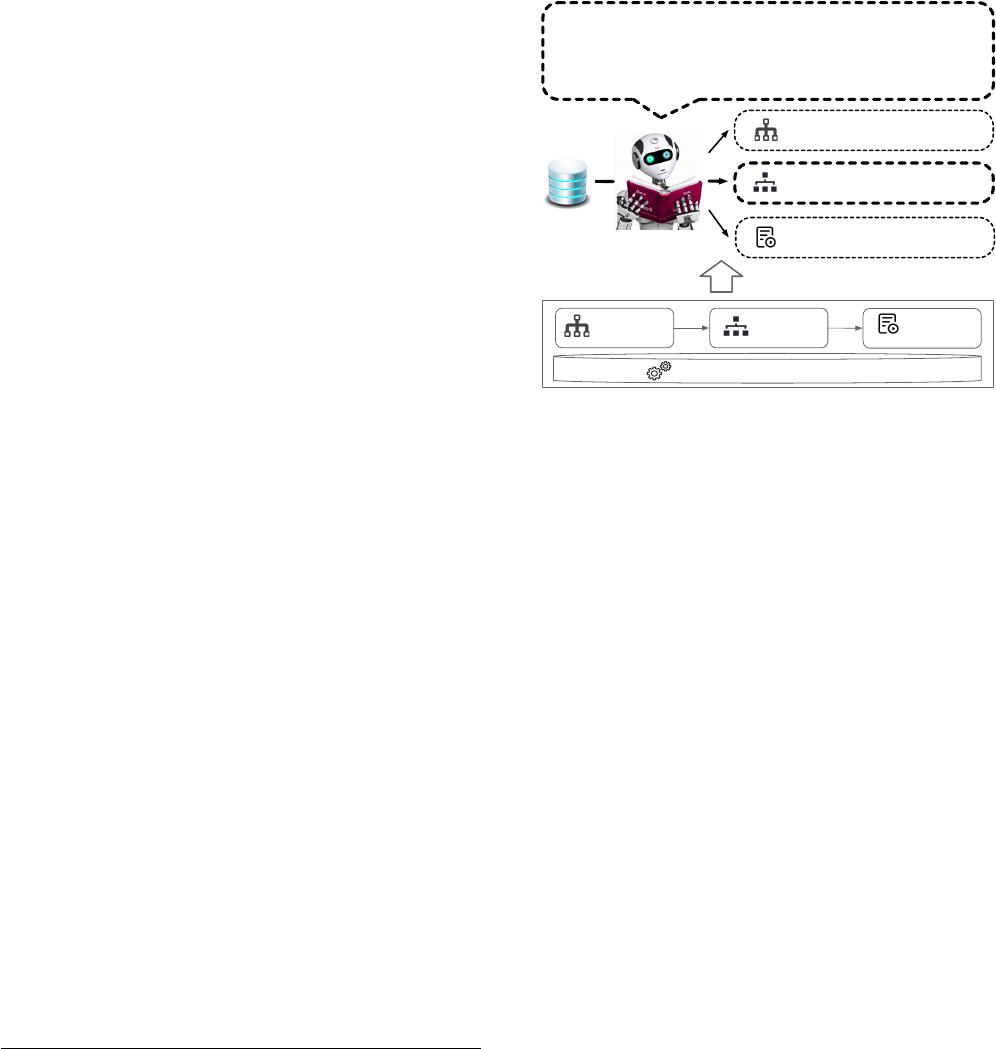
D-Bot
Rewrite logical query …
Add lacking indexes …
Documents
Optimize query plan …
System Configuration
Thought: High memory usage seems to be caused by
poor join performance and much inactive memory
Reasoning: Poor joins can be solved by plan optimization
Action: optimize_query_plan
Figure 1: LLM As DBA
on the initial analysis results. This capability is vital to detect useful
information in complex cases.
Our Vision: A Human-Beyond Database Adminstrator. To this
end, we aim to build a human-beyond “DBA” that can tirelessly learn
from documents (see Figure 1), which, given a set of documents,
automatically (1) learns experience from documents, (2) obtains
status metrics by interacting with the database, (3) reasons about
possible root causes with the abnormal metrics, and (4) accordingly
gives optimization advice by calling proper tools.
Challenges. Recent advances in Large Language Models (LLMs)
have demonstrated superiority in understanding natural language,
generating basic codes, and using external tools. However, leverag-
ing LLM to design a “human-beyond DBA” is still challenging.
(1) Experience learning from documents. Just like human learners
taking notes in classes, although LLMs have undergone training on
vast corpus, important knowledge points (e.g., diagnosis experience)
cannot be easily utilized without careful attention. However, most
texts are of long documents (with varying input lengths and section
correlations) and dierent formats of the extracted experience can
greatly aect the utilization capability of the LLM.
(2) Reasoning by interacting with database. With the extracted
experience, we need to inspire LLM to reason about the given
anomalies. Dierent from basic prompt design in machine learning,
database diagnosis is an interactive procedure with the database
(e.g., looking up system views or metrics). However, LLM responses
are often untrustworthy (“hallucination” problem), and it is critical
to design strategies that guide LLM to utilize proper interfaces of
the database and derive reasonable analysis.
(3) Mechanism for communication across multiple LLMs. Similar
to human beings, one LLM alone may be stuck in sub-optimal
arXiv:2308.05481v2 [cs.DB] 11 Aug 2023
solutions, and it is vital to derive a framework where multiple
LLMs collaborate to tackle complex database problems. By pooling
their collective intelligence, these LLMs can provide comprehensive
and smart solutions that a single LLM or even skilled human DBA
would struggle to think out.
Idea of LLM as DBA. Based on above observations, we introduce
D-Bot, an LLM based database administrator. First, D-Bot trans-
forms documents into experiential knowledge by dividing them into
manageable chunks and summarizing them for further extraction
of maintenance insights with LLM. Second, it iteratively generates
and assesses dierent formats of task descriptions to assist LLM in
understanding the maintenance tasks better. Third, D-Bot utilizes
external tools by employing matching algorithms to select appro-
priate tools and providing LLM with instructions on how to use the
APIs of selected tools. Once equipped with the experience, tools,
and input prompt, LLM can detect anomalies, analyze root causes,
and provide suggestions, following a tree of thought strategy to re-
vert to previous steps if a failure occurs. Moreover, D-Bot promotes
collaborative diagnosis by allowing multiple LLMs to communicate
based on predened environmental settings, inspiring more robust
solutions via debate-like communications.
Contributions. We make the following contributions.
(1) We design a LLM-centric database maintenance framework, and
explore potential to overcome limitations of traditional strategies.
(2) We propose an eective data collection mechanism by
(𝑖)
de-
tecting experiential knowledge from documents and
(𝑖𝑖)
leveraging
external tools with matching algorithms.
(3) We propose a root cause analysis method that utilizes LLM and
tree search algorithm for accurate diagnosis.
(4) We propose an innovative concept of collaborative diagnosis
among LLMs, thereby oering more comprehensive and robust
solutions to complex database problems.
(5) Our preliminary experimental results that D-Bot can eciently
and eectively diagnose the root causes.
2 PRELIMINARIES
Database Anomalies. In databases, there are ve common prob-
lems that can negatively aect the normal execution status. (1)
Running Slow. The database exhibits longer response time than
expectancy, leading to bad execution performance. (2) Full Disk
Capacity. The database’s disk space is exhausted, preventing it from
storing new data. (3) Execution Errors. The database experiences
errors, potentially due to improper error handling in the application
(e.g., leaking sensitive data or system details) or issues within data-
base (e.g., improper data types). (4) Hanging. The database becomes
unresponsive, which is usually caused by long-running queries,
deadlocks, or resource contention. (5) Crashing. The database un-
expectedly shuts down, causing data inaccessible. For a mature
database product, each anomaly type is explained in the do cumenta-
tion and suitable to be learned by LLMs.
Observation Tools for Anomaly Detection. “Observability of
the database” is vital to detect above anomalies, including logs, met-
rics, and traces. (1) Logs are records of database events. For example,
PostgresSQL supports slow query logs (with error messages that
can help debug and solve execution issues), but these logs may
record a large scale of data and are generally not enabled in on-
line stage. (2) Metrics capture the aggregated database and system
statistics. For example, views like pg_stat_statements record the
templates and statistics of slow queries; tools like Prometheus [
20
]
provide numerous monitoring metrics, making it possible to cap-
ture the real time system status. (3) Traces provide visibility into
how requests behave during executing in the database. Dierent
from logs that help to identify the database problem, traces help to
locate the specic abnormal workload or application.
Optimization Tools for Anomaly Solving. Users mainly con-
cern how to restore to the normal status after an anomaly occurs.
Here we showcase some optimization tools. (1) For slow queries,
since most open-source databases are weak in logical transfor-
mation, there are external engines (e.g., Calcite with
∼
120 query
rewrite rules) and tuning guides (e.g., Oracle with over 34 trans-
formation suggestions) that help to optimize slow queries. (2) For
knob tuning, many failures (e.g., max_connections in Postgres)
or bad performance (e.g., memory management knobs) are cor-
related with database knobs (e.g., for a slow workload, incresae
innodb_buer_pool_size in MySQL by 5% if the memory usage
is lower than 60%). Similarly, there are index tuning rules that
generate potentially useful indexes (e.g., taking columns within
the same predicate as a composite index). Besides, we can utilize
more advanced methods, such as selecting among heuristic meth-
ods [
3
,
21
,
22
] and learned methods [
7
–
9
,
15
,
23
,
25
,
26
] for problems
like index lacking, which is not within the scope of this paper.
We aim to design D-Bot, an LLM-based DBA, for automatically
diagnosing the database anomalies and use LLM to directly (or call
appropriate tools to indirectly) provide the root causes.
3 THE VISON OF D-BOT
Existing LLMs are criticized for problems like “Brain in a Vat” [
14
].
Thus, it is essential to establish close connections between LLMs
and the target database, allowing us to guide LLMs in eectively
maintaining the database’s health and functionality. Hence, we
propose D-Bot, which is composed of two stages.
First, in preparation stage, D-Bot generates experience (from
documents) and prompt template (from diagnosis samples), which
are vital to guide online maintenance.
•
Documents
→
Experience. Given a large volume of diverse,
long, unstructured database documents (e.g., database man-
ual, white paper, blogs), we rst split each document into
chunks that can be processed by the LLM. To aggregate
correlated chunks together (e.g., chunk
𝑣
𝑖
that explains the
meaning of “bloat-table” and chunk
𝑣
𝑗
that utilizes “bloat-
table” in root cause analysis), we generate a summary for
each chunk based on both its content and its subsections.
Finally, we utilize LLM to extract maintenance experience
from chunks with similar summaries (Section 4).
•
Prompt Template Generation. To help LLM better under-
stand the DM tasks, we iteratively generate and score dif-
ferent formats of task descriptions using DM samples (i.e.,
given the anomaly and solutions, ask LLM to describe the
task), and adopt task description that both scores high perfor-
mance and is sensible to human DBAs (in cases of learning
bias) for LLM diagnosis (Section 5).
2
of 11
免费下载
【版权声明】本文为墨天轮用户原创内容,转载时必须标注文档的来源(墨天轮),文档链接,文档作者等基本信息,否则作者和墨天轮有权追究责任。如果您发现墨天轮中有涉嫌抄袭或者侵权的内容,欢迎发送邮件至:contact@modb.pro进行举报,并提供相关证据,一经查实,墨天轮将立刻删除相关内容。
下载排行榜

评论