



VLDB2022_HET:Scaling out Huge Embedding Model Training via Cache-enabled Distributed Framework_腾讯云数据库.pdf
免费下载

HET: Scaling out Huge Embedding Model Training via
Cache-enabled Distributed Framework
Xupeng Miao
∗1
, Hailin Zhang
∗1
, Yining Shi
1
, Xiaonan Nie
1
, Zhi Yang
1
, Yangyu Tao
2
, Bin Cui
1,3
1
Department of Computer Science & Key Lab of High Condence Software Technologies (MOE), Peking University
3
Institute of Computational Social Science, Peking University (Qingdao),
2
Tencent Inc.
3
Center for Data Science, Peking University & National Engineering Laboratory for Big Data Analysis and Applications
{xupeng.miao, z.hl, shiyining, xiaonan.nie, yangzhi, bin.cui}@pku.edu.cn,
2
brucetao@tencent.com
ABSTRACT
Embedding models have been an eective learning paradigm for
high-dimensional data. However, one open issue of embedding
models is that their representations (latent factors) often result in
large parameter space. We observe that existing distributed train-
ing frameworks face a scalability issue of embedding models since
updating and retrieving the shared embedding parameters from
servers usually dominates the training cycle. In this paper, we pro-
pose HET, a new system framework that signicantly improves the
scalability of huge embedding model training. We embrace skewed
popularity distributions of embeddings as a performance oppor-
tunity and leverage it to address the communication bottleneck
with an embedding cache. To ensure consistency across the caches,
we incorporate a new consistency model into HET design, which
provides ne-grained consistency guarantees on a per-embedding
basis. Compared to previous work that only allows staleness for
read operations, HET also utilizes staleness for write operations.
Evaluations on six representative tasks show that HET achieves
up to 88% embedding communication reductions and up to 20
.
68
×
performance speedup over the state-of-the-art baselines.
PVLDB Reference Format:
Xupeng Miao, Hailin Zhang, Yining Shi, Xiaonan Nie, Zhi Yang, Yangyu
Tao, Bin Cui. HET: Scaling out Huge Embedding Model Training via
Cache-enabled Distributed Framework . PVLDB, 15(2): 312 - 320, 2022.
doi:10.14778/3489496.3489511
PVLDB Artifact Availability:
The source code of this research paper has been made publicly available at
https://github.com/PKU-DAIR/Hetu/.
1 INTRODUCTION
To train a model on high-dimensional data, such as words in a cor-
pus of text [
9
,
38
,
42
] or the user-item interaction data [
16
,
45
,
54
],
it is common to use an embedding model, which projects a sparse
high-dimensional feature space, into a continuous low-dimensional
embedding space. For example, in a language model, a training ex-
ample might be a sparse vector with non-zero entries corresponding
to the IDs of words in a vocabulary, and the distributed represen-
tation for each word will be a lower-dimensional vector. “Wide
∗
Equal contribution.
This work is licensed under the Creative Commons BY-NC-ND 4.0 International
License. Visit https://creativecommons.org/licenses/by-nc-nd/4.0/ to view a copy of
this license. For any use beyond those covered by this license, obtain permission by
emailing info@vldb.org. Copyright is held by the owner/author(s). Publication rights
licensed to the VLDB Endowment.
Proceedings of the VLDB Endowment, Vol. 15, No. 2 ISSN 2150-8097.
doi:10.14778/3489496.3489511
and deep learning” [
10
] creates distributed representations from
cross-product transformations on categorical features. Embedding
model is common at modern web companies (e.g., Facebook [
39
],
Google [
12
] and Tencent [
49
]), which have been recognized as
an eective learning paradigm to extract useful information for
downstream tasks such as recommendation.
As each feature needs to be represented by a set of embeddings
(i.e., latent vectors), many embedding models are at a giant scale and
are too large to copy to a worker on every use, or even to store in
RAM on a single host. For instance, the parameters of a real-world
document embedding model in Google [
7
,
13
] occupies several
terabytes, and the industrial click-through rate prediction model in
Baidu [
53
] has 10
11
input sparse features and also requires 10 Tb
parameters. For this reason, it is challenging to scale embedding
models up to large-scale use cases, in which millions or even billions
of parameters need to be learned.
Modern distributed ML systems (e.g., TensorFlow [
7
]) typically
adopt the parameter server [
28
] framework to scale out models.
The server usually maintains the globally shared parameters by
aggregating updates from the workers and updating the global
parameters. Workers communicate only with the server nodes,
updating and retrieving the shared parameters. Existing ML systems
usually support data parallelism where a worker usually contains a
replica of the ML model and is assigned an equal-sized partition of
the entire training data. Bulk Synchronous Parallel (BSP) [
15
] or
Asynchronous Parallel (ASP) [
32
] are usually adopted for updating
the model parameters during distributed training.
However, this setup faces a scalability issue for large embed-
ding models [
46
,
53
]. We observe that the greatest ineciency
comes from updating and retrieving the shared feature embedding
parameters through a limited bandwidth link. For example, using
TensorFlow with ASP, up to 86% of training time is spent on em-
bedding fetching and updating, which dominates the training cycle.
The major reason is that an embedding model often uses deep neu-
ral networks with low computational complexity, comparing with
the giant embedding data. Accordingly, the computation takes a
much shorter time than the reads and writes of remote embedding
data. Moreover, with the increasing gap between emerging pow-
erful accelerators and the slow growth of network bandwidth, the
embedding communication bottleneck would become even more
severe. To our knowledge, there is little prior work addressing the
scalability issue of embedding models in a distributed environment.
In this paper, we propose
HET
, a novel distributed system frame-
work to scale
H
uge
E
mbedding model
T
raining. Our key idea is
to exploit an ecient
embedding-cache-enabled
architecture,
1
arXiv:2112.07221v1 [cs.LG] 14 Dec 2021
Sparse
Feature
Dense Feature
Embedding Lookup
Prediction
Dense Part
Sparse Part
𝑒
!
𝑊
𝑥
!
𝑆 ×𝐷
Figure 1: Illustrate of embedding model architecture
which is mainly inspired by the critical characteristics for embed-
ding models: popularity skewness and staleness tolerant. Specically,
the popularity distribution of embeddings is often highly skewed,
typically following power-law distributions [
50
], implying a perfor-
mance opportunity: a small cache of hot embedding at each worker
can eectively save the network bandwidth while scaling training
throughput with the number of workers.
Replicating shared embedding data in multiple caches raises the
problem of consistency in the presence of writes. Fortunately, em-
bedding models are iterative convergent algorithms where some
staleness errors during training are acceptable and will not pre-
vent convergence. In other words, embedding models are robust
to a bounded amount of inconsistency (e.g., reading out-of-date
shared state). By relaxing the consistency guarantees properly, we
can exploit the opportunity of caches to gain signicant system
improvements. However, conventional relaxed consistency models
such as Stale Synchronous Parallel (SSP) [
21
] are not aware of the
presence of skew access and require that every single worker should
be able to hold an entire set of parameters. Moreover, they mainly
target straggler problems rather than communication overhead. For
example, SSP maintains an up-to-date global model through sent
out write updates to servers each clock. Considering the large scale
and communication cost of embedding models, the above issues
become a critical limitation for scaling out the training.
To address the above issues, we incorporate a new consistency
model into HET. Our consistency model diers from the traditional
ones in two aspects. First, we enable the
ne-grained
caching and
consistency that provides guarantees on a per-embedding basis.
Specically, for each cached embedding, we leverage an embedding-
specic Lamport clock to manage its ne-grained consistency ac-
tions (e.g., validation, synchronization) and provide the concept
of “per-embedding-clock-bounded” consistency — a worker can
see all updates of an embedding older than certain embedding-
specic clocks. We provide a ne-grained consistency model and
theoretically prove its convergence guarantees. Second, compared
to previous works that only allow staleness for read operations, we
further utilizes staleness for writes, allowing
stale-writes
based
on the timestamp deviation between the global and local clocks of
each embedding. This means that writing to an embedding residing
in the cache does not update the underlying global model until the
embedding is invalided or evicted from the cache. This feature is
critical in reducing communication overheads.
We summarize our contributions as follows: First, we reveal the
performance bottleneck and the opportunity for scaling huge em-
bedding models, and introduce a novel
system abstraction
with
embedding cache. Second, we employ a new cache
consistency
model
that provides (1) clock-bounded consistency at the ne-
grained of each embedding, and (2) allows staleness for both caches
read and write operations for minimizing communication overhead.
Finally, we build
HET system
, a new framework that implements
the proposed system abstraction and the consistency model, and
supports 10
12
parameters scale embedding model training, achiev-
ing 6
.
37
−
20
.
68
×
speedup and up to 88% embedding communication
reduction over the state-of-the-art baseline systems.
2 PRELIMINARY
2.1 Distributed Training
Distributed machine learning.
The target of machine learn-
ing is to nd a model
x ∈ R
𝑑
(
𝑑
is the total number of parameters
in the model) that minimizes the empirical risk:
min
x
h
𝐹 (x) :=
1
|𝜉 |
𝑖
𝑓 (x; 𝜉
𝑖
)
i
, (1)
where
𝑓 (·)
is the loss function,
𝜉
is the training dataset and
𝜉
𝑖
rep-
resents the
𝑖
-th data sample. Distributed ML systems have been
extensively studied in recent years to scale up ML for big data and
large models. Parameter Server (PS) is a trendy data parallelism ar-
chitecture for many existing systems (e.g., TensorFlow [
7
], PS2 [
51
]).
Another choice is All-Reduce and several recent systems (e.g., Py-
Torch [
29
], Horovod [
43
]) show superior performance over PS with
the help of NCCL [4], especially for dense models.
Parallel training paradigms.
Most of data parallelism studies
manage to keep consistent model performance as the standalone
mini-batch SGD. BSP assumes that all
𝑁
workers are fully synchro-
nized and performing the following update rule:
x(𝑡 + 1) = x (𝑡) −𝜂
h
1
𝑁
𝑁
𝑖=1
𝐺
𝑖
(x (𝑡); 𝜉
𝑖
)
i
, (2)
where
𝜂
is the learning rate,
𝜉
𝑖
are randomly sampled from the
training set, and
𝐺
𝑖
(·)
denotes the gradient from the
𝑖
-th worker.
However, the frequent synchronization and straggler problem bring
signicant communication costs. ASP avoids such overheads by
allowing the workers to proceed without waiting for each other.
But the model degradation happens because of the stale gradients.
To balance the trade-o between training eciency and model
performance, SSP and several variants [
23
] have been proposed. It
has been proved that they could share the same convergence rate
with BSP when the staleness is upper bounded [
31
]. Unfortunately,
SSP requires to store the replication of the entire model inside every
single worker, which is impractical for giant models.
2.2 Embedding Models
Many types of embedding models (e.g., Wide & Deep [
10
], Deep
& Cross [
44
], DeepFM [
17
], xDeepFM [
30
] and Deep Interest Net-
work [
54
]) have been developed for high-dimension data, and have
achieved widespread success in recommender systems–a critical
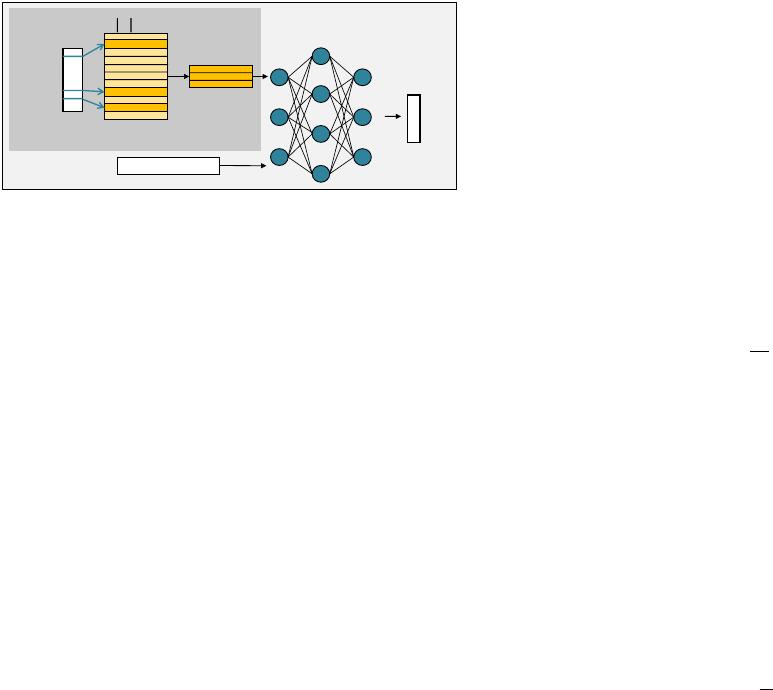
service for internet companies. Figure 1 illustrates a common em-
bedding model architecture. In order to handle categorical data,
embedding tables map categorical features to dense representations
in an abstract space. In particular, each embedding lookup may be
interpreted as using a one-hot vector
𝑒
𝑖
(with the
𝑖
-th position being
1 while others are 0, where index
𝑖
corresponds to
𝑖
-th category)
of 9
免费下载
【版权声明】本文为墨天轮用户原创内容,转载时必须标注文档的来源(墨天轮),文档链接,文档作者等基本信息,否则作者和墨天轮有权追究责任。如果您发现墨天轮中有涉嫌抄袭或者侵权的内容,欢迎发送邮件至:contact@modb.pro进行举报,并提供相关证据,一经查实,墨天轮将立刻删除相关内容。
下载排行榜

评论