



NeuFace Realistic 3D Neural Face Rendering from Multi-view Images.pdf
100墨值下载
NeuFace: Realistic 3D Neural Face Rendering from Multi-view Images
Mingwu Zheng
1,2
, Haiyu Zhang
1,2
, Hongyu Yang
3
, Di Huang
1,2,4
*
1
State Key Laboratory of Software Development Environment, Beihang University, Beijing, China
2
School of Computer Science and Engineering, Beihang University, Beijing, China
3
Institute of Artificial Intelligence, Beihang University, Beijing, China
4
Hangzhou Innovation Institute, Beihang University, Hangzhou, China
{zhengmingwu, zhyzhy, hongyuyang, dhuang}@buaa.edu.cn
Abstract
Realistic face rendering from multi-view images is bene-
ficial to various computer vision and graphics applications.
Due to the complex spatially-varying reflectance proper-
ties and geometry characteristics of faces, however, it re-
mains challenging to recover 3D facial representations both
faithfully and efficiently in the current studies. This paper
presents a novel 3D face rendering model, namely Neu-
Face, to learn accurate and physically-meaningful under-
lying 3D representations by neural rendering techniques.
It naturally incorporates the neural BRDFs into physically
based rendering, capturing sophisticated facial geometry
and appearance clues in a collaborative manner. Specifi-
cally, we introduce an approximated BRDF integration and
a simple yet new low-rank prior, which effectively lower the
ambiguities and boost the performance of the facial BRDFs.
Extensive experiments demonstrate the superiority of Neu-
Face in human face rendering, along with a decent gener-
alization ability to common objects. Code is released at
NeuFace.
1. Introduction
Rendering realistic human faces with controllable view-
points and lighting is now becoming ever increasingly im-
portant with its applications ranging from game production,
movie industry, to immersive experiences in the Metaverse.
Various factors, including the sophisticated geometrical dif-
ferences among individuals, the person-specific appearance
idiosyncrasies, along with the spatially-varying reflectance
properties of skins, collectively make faithful face rendering
a rather difficult problem.
According to photogrammetry, the pioneering studies on
this issue generally leverage complex active lighting setups,
e.g., LightStage [9], to build 3D face models from multiple
*
Corresponding author.
Rendered
Diffuse
Specular
Geometry
Relighting
Unprocessed Facial Multiview Images
…
Figure 1. Demonstration of the face rendering results and recov-
ered underlying 3D representations.
photos of an individual, where accurate shape attributes and
high-quality diffuse and specular reflectance properties are
commonly acknowledged as the premises of its success. An
elaborately designed workflow is required, typically involv-
ing a series of stages such as camera calibration, dynamic
data acquisition, multi-view stereo, material estimation, and
texture parameterization [44]. While a compelling and con-
vincing 3D face model can be finally obtained, this output
highly depends on the expertise of the engineers and artists
with significant manual efforts, as the multi-step process in-
evitably brings diverse optimization goals.
Recently, 3D neural rendering, which offers an end-to-
end alternative, has demonstrated promising performance in
recovering scene properties from real-world imageries, such
as view-dependent radiance [27, 29, 37, 39, 49] and geome-
try [34, 50, 51, 56, 57]. It is mainly credited to the disentan-
glement of the learnable 3D representations and the differ-
entiable image formation process, free of the tedious pho-
togrammetry pipeline. However, like classical function fit-
ting, inverse rendering is fundamentally under-constrained,
which may incur badly-conditioned fits of the underly-
ing 3D representations, especially for intricate cases, e.g.,
non-Lambertian surfaces with view-dependent highlights.
With the trend in the combination of computer graphics
arXiv:2303.14092v2 [cs.CV] 27 Mar 2023
and learning techniques, several attempts take advantage
of physically motivated inductive biases and present Phys-
ically Based Rendering (PBR) [15, 32, 49, 58], where Bidi-
rectional Reflectance Distribution Functions (BRDFs) are
widely adopted. By explicitly mimicking the interaction
of the environment light with the scene, they facilitate net-
work optimization and deliver substantial gains. Unfortu-
nately, the exploited physical priors are either heuristic or
analytic [8, 21, 46], limited to a small set of real-world ma-
terials, e.g., metal, incapable of describing human faces.
For realistic face rendering, the most fundamental issue
lies in accurately modeling the optical properties of multi-
layered facial skin [22]. In particular, the unevenly dis-
tributed fine-scale oily layers and epidermis reflect the inci-
dent lights irregularly, leading to complex view-dependent
and spatially-varying highlights. This characteristic and the
low-textured nature of facial surfaces strongly amplify the
shape-appearance ambiguity. Moreover, subsurface scatter-
ing between the underlying dermis and other skin layers fur-
ther complicates this problem.
In this paper, we follow the PBR paradigm for its poten-
tial in learning 3D representations and make the first step
towards realistic 3D neural face rendering, mainly target-
ing complex skin reflection modeling. Our method, namely
NeuFace, is able to recover faithful facial reflectance and
geometry from only multi-view images. Concretely, we es-
tablish a PBR framework to learn neural BRDFs to describe
facial skin, which simulates physically-correct light trans-
port with a much higher representation capability. By using
a differentiable Signed Distance Function (SDF) based rep-
resentation, i.e. ImFace [63], as the shape prior, the facial
appearance and geometry field can be synchronously opti-
mized in inverse rendering.
Compared to the analytic BRDFs, the neural ones allow
richer representations for sophisticated material like facial
skin. In spite of this superiority, such representations pose
challenges to computational cost and data demand during
training. To tackle these difficulties, the techniques in real-
time rendering [1] are adapted to separate the hemisphere
integral of neural BRDFs, where the material and light in-
tegrals are individually learned instead, bypassing the mas-
sive Monte-Carlo sampling phase [35] required by numer-
ical solutions. Furthermore, a low-rank prior is introduced
into the spatially-varying facial BRDFs, which greatly re-
stricts the solution space thereby diminishing the need for
large-scale training observations. These model designs in-
deed enable NeuFace to accurately and stably describe how
the light interacts with the facial surface as in the real 3D
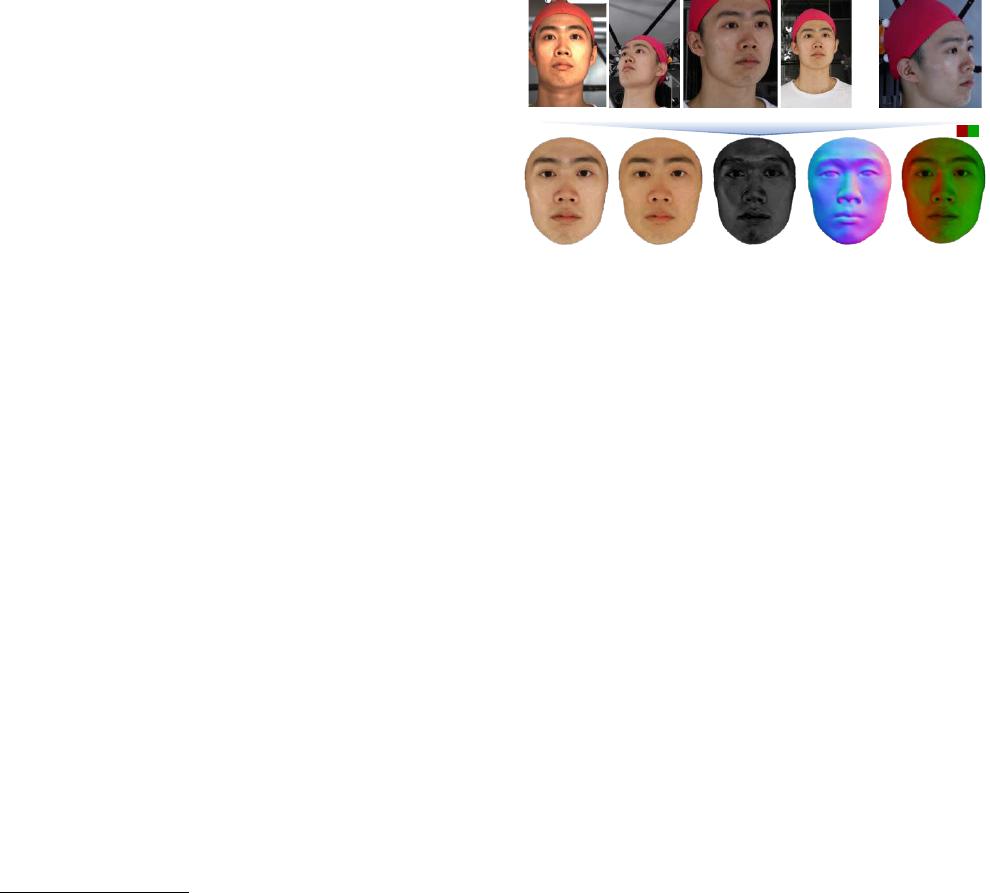
space. Fig. 1 displays an example.
The main contributions of this study include: 1) A novel
framework with naturally-bonded PBR as well as neural
BRDF representations, which collaboratively captures fa-
cial geometry and appearance properties in complicated fa-
cial skin. 2) A new and simple low-rank prior, which sig-
nificantly facilitates the learning of neural BRDFs and im-
proves the appearance recovering performance. 3) Impres-
sive face rendering results from only multi-view images,
applicable to various applications such as relighting, along
with a decent generalization ability to common objects.
2. Related Work
We restrict the discussion specifically to static facial ge-
ometry and appearance capturing and 3D neural rendering.
Please refer to [10, 22, 45] for more in-depth discussion.
Face Capturing. Its goal is to render a realistic 3D face
under arbitrary lighting condition. Existing methods gener-
ally take advantage of photogrammetry techniques to esti-
mate facial geometries and appearances, requiring massive
manual efforts. In this case, they typically decompose the
problem where facial geometry is pre-captured by an intri-
cate multi-view stereo process [3, 4]. However, facial ap-
pearances with reflectances are still hard to acquire due to
complex interactions between light and skin. The initial at-
tempts [9, 17, 53] tackle the challenge by densely capturing
the per-pixel facial reflectance at the cost of extensive data
acquisition and specialized equipment. Subsequently, gra-
dient [12,20, 26] or polarized illumination [12, 13, 26, 40] is
explored to reduce the memory cost, where most efforts are
paid to the well-conditioned fitting of BRDFs. In contrast to
the studies above, our solution is truly end-to-end and only
observes facial skin under a single, unknown illumination
condition, without cumbersome capturing settings.
3D Neural Rendering. The recent advance in this field,
like NeRF [30], have already revolutionized the paradigm
of multi-view reconstruction. With learnable volumetric
representations (e.g., neural field [30, 57], grid [11], and
hybrid [31]) and analytic differentiable forward mapping,
scene properties can be directly inferred from only 2D
imageries. While reporting impressive results on novel
view synthesis [27, 29, 37, 39, 49] or geometry reconstruc-
tion [34, 50, 51, 56, 57], studies still suffer from 2D-3D am-
biguities, leading to that realistic appearances and accurate
geometries can hardly be established simultaneously [59].
Such an issue is more prominent for facial skin due to the
rather complicated reflection properties. Ref-NeRF [49]
makes a step forward to the goal of both accurate surface
normals and glossy appearances, which is achieved by repa-
rameterizing the radiance in classical NeRF with reflec-
tion direction. It validates the significance of physical laws
in disambiguity. [15, 23, 32, 43, 58] go further with PBR
pipelines, delivering improved quality and supporting re-
lighting simultaneously. Nevertheless, simplified material
models are utilized or assumed, which are incapable of han-
dling complex materials like skin. [25, 61, 62] train a neu-
ral material model from measurement data. But acquiring
such data is impractical for live biotissue. By contrast, our
of 20
100墨值下载
【版权声明】本文为墨天轮用户原创内容,转载时必须标注文档的来源(墨天轮),文档链接,文档作者等基本信息,否则作者和墨天轮有权追究责任。如果您发现墨天轮中有涉嫌抄袭或者侵权的内容,欢迎发送邮件至:contact@modb.pro进行举报,并提供相关证据,一经查实,墨天轮将立刻删除相关内容。
下载排行榜

评论