



PAMS Quantized Super-Resolution via.pdf
100墨值下载

PAMS: Quantized Super-Resolution via
Parameterized Max Scale
Huixia Li
1†
, Chenqian Yan
1†
, Shaohui Lin
2
, Xiawu Zheng
1
,
Baochang Zhang
3
, Fan Yang
4
, Rongrong Ji
15!
1
Media Analytics and Compu ti n g Lab, Department of Artificial Intelligence,
School of Informatics, Xiam en University, China.
2
National U n iversity of Singapore, Singa pore.
3
Beihang Un i versity, China.
4
Huawei Technologies Co., Ltd.
5
Peng Cheng Laboratory.
{hxlee,zhengxiawu}@stu.xmu.edu.cn, {im.cqyan,shaohuilin007}@gmail.com,
bczhang@buaa.edu.cn, yangfan74@huawei.com, rrji@xmu.edu.cn
Abstract. Deep convolutional neural networks (DCNNs) have shown
dominant performance in the task of super-resolution (SR). However,
their heavy memory cost and computation overhead s ig n i fi ca ntly rest ri ct
their practical deployments on resource-limited devices, which mainly
arise from the floating-point storage a n d operations between weights a n d
activations. Although previous endeavors mainly resort to fixed-point
operations, quantizing both weights and activations with fixed coding
lengths may cause signific a nt performance drop, especially on low bits.
Specifically, most state -o f- th e -a rt SR models wit h ou t batch normaliz a -
tion have a large dynamic quantization range, which also serves as an-
other cause of performance drop. To address these two issues, we propose
a new quantization scheme termed PArameterized Max Scale (PAMS),
which applies the trainable truncated parameter to explore the upper
bound of the quantization rang e adaptively. Fin a ll y, a structured knowl-
edge transfer (SKT) loss is introdu c ed to fine-t u n e the quantized network.
Extensive experiments demonstrate that the proposed PAMS scheme can
well compress and accelerate the existing SR models such as EDSR and
RDN. Notably, 8-bit PAMS-EDSR improves PSNR on Set5 benchmark
from 32.095dB to 32.124dB with 2.42× compres sio n ratio, which achieves
a new state-of-the-art.
Keywords: Super Resolution · Network Quantization
1 Introduction
Single image super-resolution (SISR) aims to recover a high-resolution (HR) im-
age from the corresponding low-resolution (LR) one, which has been a research
†
Equal contribution.
!
Corresponding author.
2 Huixia Li et al.
Q
Q
Q
Q
!
!
quant
clamp
conv
conv
conv
conv
PAMSBlock
conv
conv
relu
ResBlock
convconv
relu
ResBlock
QQ
Q
Q
! !
conv
PAMSBlock
U
conv
upsampler
relu
relu
conv
conv
LR
LR
SR
SR
HR
Low-level
Feature Extractor
High-level
Feature Extractor
Reconstruction
U
ℒ
#$%
Structured
Knowledge
ℒ
&'(
Pixel-wise
Feature
Feature
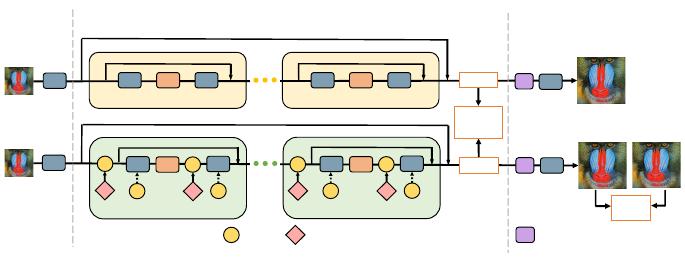
Fig. 1. The framework of our approach. The super-reso lu t io n opera ti o n is split into
three modules, i.e., low-level feature extractor, high-level fea t u re extractor and recon-
struction. We deploy PAMS with different α on each activation layer in the high-level
feature extractor. quant den o t es the quantization operation and clamp represents the
clamp function of quantization. Dash lines denote t h e weights are quantized with the
maximum. Here, we illustrate EDSR as backbone.
hot spot in computer vision for decades. Coming with the advances of dee p learn-
ing, deep convolutional neural networks (DCNNs) [ 7, 18, 23] have dominated SR
in recent years. These networks commonly use an extraction module to extract
a series of featur e maps from the LR image, cascaded with the u p- samp l in g
module, which stepwisely increases the resolution to reconstruct the HR image.
As one of the pioneering works for deep learning based SR, Dong et al. [7]
introduce three convolution layers to achieve high vis ual perception. After that,
Kim et al. [18] design a deep network VDSR by stacking 20 convolutional layers.
Subsequent works mainly resort to increasin g the network depth to improve SR
performance. For instance, Lim et al. [23] propose the enhanced deep resi d ual
networks (e.g. EDSR and MDSR) and remove batch normalization (BN) [16] to
reduce the memory consumption, which however still requires at least 64 convo-
lution layers (more than 160 layers for MDSR). A channel atte ntion mechanism
equipped into the RCAN model [38] requires more than 400 layers with about
30B FLOPs and 13M parameters. Such si gni fi cant computation and memory
overheads restrict their applications in scenarios where only limited memory
and computation resources are avai l abl e . Consequently, compressing deep SR
networks has attracted increasing attention recently [29].
Beyond SR, neural network compression and acceleration have been widely
studied in the literature. Representative works include parameter pruning [11–13,
27, 26, 22], low-rank approximation [6, 24, 25], compact networks [33, 28], knowl-
edge distillat ion (KD) [14, 32], neural architecture search (NAS) [43, 40] and
quantization [5, 17]. Considering the uniq ue structures such as EDSR [23] and
RDN [39] in SR, it is by nature t o leverage quantization schemes to acceler-
ate and compress SR networks, i.e., by converting full-precision weights [17],
activations [2], and gradients [41] to low bits.
of 16
100墨值下载
【版权声明】本文为墨天轮用户原创内容,转载时必须标注文档的来源(墨天轮),文档链接,文档作者等基本信息,否则作者和墨天轮有权追究责任。如果您发现墨天轮中有涉嫌抄袭或者侵权的内容,欢迎发送邮件至:contact@modb.pro进行举报,并提供相关证据,一经查实,墨天轮将立刻删除相关内容。
下载排行榜

评论