



Graph Transformer GANs for Graph-Constrained House Generation.pdf
100墨值下载

Graph Transformer GANs for Graph-Constrained House Generation
Hao Tang
1
Zhenyu Zhang
2
Humphrey Shi
3
Bo Li
2
Ling Shao
4
Nicu Sebe
5
Radu Timofte
1,6
Luc Van Gool
1,7
1
CVL, ETH Zurich
2
Tencent Youtu Lab
3
U of Oregon & UIUC & Picsart AI Research
4
UCAS-Terminus AI Lab, UCAS
5
University of Trento
6
University of Wurzburg
7
KU Leuven
Abstract
We present a novel graph Transformer generative adver-
sarial network (GTGAN) to learn effective graph node re-
lations in an end-to-end fashion for the challenging graph-
constrained house generation task. The proposed graph-
Transformer-based generator includes a novel graph Trans-
former encoder that combines graph convolutions and self-
attentions in a Transformer to model both local and global
interactions across connected and non-connected graph
nodes. Specifically, the proposed connected node atten-
tion (CNA) and non-connected node attention (NNA) aim
to capture the global relations across connected nodes and
non-connected nodes in the input graph, respectively. The
proposed graph modeling block (GMB) aims to exploit local
vertex interactions based on a house layout topology. More-
over, we propose a new node classification-based discrim-
inator to preserve the high-level semantic and discrimina-
tive node features for different house components. Finally,
we propose a novel graph-based cycle-consistency loss that
aims at maintaining the relative spatial relationships be-
tween ground truth and predicted graphs. Experiments on
two challenging graph-constrained house generation tasks
(i.e., house layout and roof generation) with two public
datasets demonstrate the effectiveness of GTGAN in terms
of objective quantitative scores and subjective visual real-
ism. New state-of-the-art results are established by large
margins on both tasks.
1. Introduction
This paper focuses on converting an input graph to a re-
alistic house footprint, as depicted in Figure 1. Existing
house generation methods such as [2, 15, 18, 26, 30, 43, 45],
typically rely on building convolutional layers. However,
convolutional architectures lack an understanding of long-
range dependencies in the input graph since inherent in-
ductive biases exist. Several Transformer architectures
[3, 6, 11, 16, 17, 22, 41, 42, 44, 52, 53] based on the self-
attention mechanism have recently been proposed to encode
long-range or global relations, thus learn highly expressive
feature representations. On the other hand, graph convolu-
tion networks are good at exploiting local and neighborhood
vertex correlations based on a graph topology. Therefore,
it stands to reason to combine graph convolution networks
and Transformers to model local as well as global interac-
tions for solving graph-constrained house generation.
In addition, the proposed discriminator aims to distin-
guish real and fake house layouts, which ensures that our
generated house layouts or roofs look realistic. At the same
time, the discriminator classifies the generated rooms to
their corresponding real labels, preserving the discrimina-
tive and semantic features (e.g., size and position) for differ-
ent house components. To maintain the graph-level layout,
we also propose a novel graph-based cycle-consistency loss
to preserve the relative spatial relationships between ground
To this end, we propose a novel graph Transformer gen-
erative adversarial network (GTGAN), which consists of
two main novel components, i.e., a graph Transformer-
based generator and a node classification-based discrimi-
nator (see Figure 1). The proposed generator aims to gen-
erate a realistic house from the input graph, which consists
of three components, i.e., a convolutional message passing
neural network (Conv-MPN), a graph Transformer encoder
(GTE), and a generation head. Specifically, Conv-MPN first
receives graph nodes as inputs and aims to extract discrim-
inative node features. Next, the embedded nodes are fed to
GTE, in which the long-range and global relation reasoning
is performed by the connected node attention (CNA) and
non-connected node attention (NNA) modules. Then, the
output from both attention modules is fed to the proposed
graph modeling block (GMB) to capture local and neigh-
borhood relationships based on a house layout topology. Fi-
nally, the output of GTE is fed to the generative head to pro-
duce the corresponding house layout or roof. To the best of
our knowledge, we are the first to use a graph Transformer
to model local and global relations across graph nodes for
solving graph-constrained house generation.
truth and predicted graphs.
Overall, our contributions are summarized as follows:
arXiv:2303.08225v1 [cs.CV] 14 Mar 2023
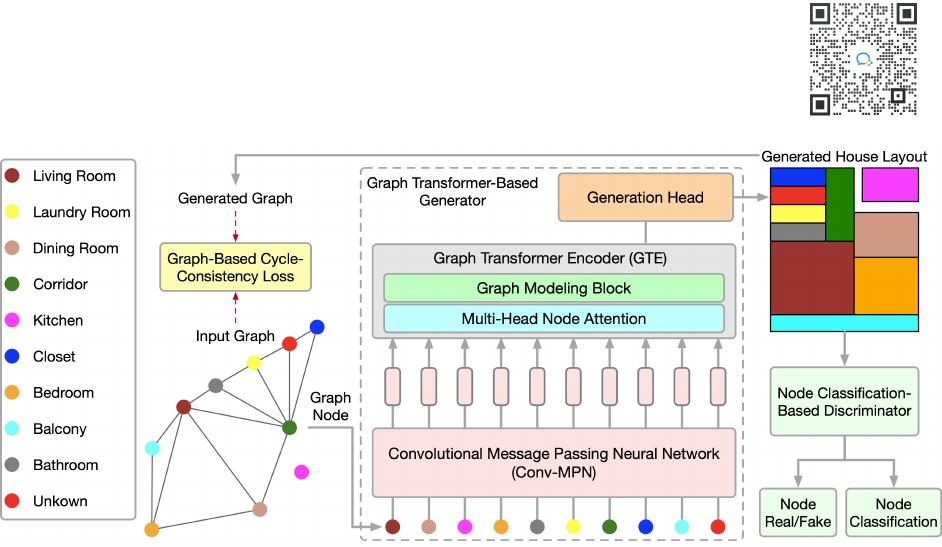
Figure 1. Overview of the proposed GTGAN on house layout generation. It consists of a novel graph Transformer-based generator G and
a novel node classification-based discriminator D. The generator takes graph nodes as input and aims to capture local and global relations
across connected and non-connected nodes using the proposed graph modeling block and multi-head node attention, respectively. Note that
we do not use position embeddings since our goal is to predict positional node information in the generated house layout. The discriminator
D aims to distinguish real and generated layouts and simultaneously classify the generated house layouts to their corresponding room
types. The graph-based cycle-consistency loss aligns the relative spatial relationships between ground truth and predicted nodes. The
whole framework is trained in an end-to-end fashion so that all components benefit from each other.
• We propose a novel Transformer-based network (i.e., GT-
GAN) for the challenging graph-constrained house gener-
ation task. To the best of our knowledge, GTGAN is the
first Transformer-based framework, enabling more effec-
tive relation reasoning for composing house layouts and
validating adjacency constraints.
• We propose a novel graph Transformer generator that
combines both graph convolutional networks and Trans-
formers to explicitly model global and local correlations
across both connected and non-connected nodes simul-
taneously. We also propose a new node classification-
based discriminator to preserve high-level semantic and
discriminative features for different types of rooms.
• We propose a novel graph-based cycle-consistency loss to
guide the learning process toward accurate relative spatial
distance of graph nodes.
• Qualitative and quantitative experiments on two challeng-
ing graph-constrained house generation tasks (i.e., house
layout generation and house roof generation) with two
datasets demonstrate that GTGAN can generate better
house structures than state-of-the-art methods, such as
HouseGAN [26] and RoofGAN [30].
2. Related Work
Generative Adversarial Networks [12] have been widely
used for image generation [19,32,35,36]. The vanilla GAN
consists of a generator and a discriminator. The generator
aims to synthesize photorealistic images from a noise vec-
tor, while the discriminator aims to distinguish between real
and generated samples. To create user-specific images, the
conditional GAN (CGAN) [25] was proposed. A CGAN
combines a vanilla GAN and external information, such as
class labels [7], text descriptions [39, 40, 51], object key-
points [31], human skeletons [33], semantic maps [29, 37,
38], edge maps [34], or attention maps [24]. This paper
mainly focuses on the challenging graph-constrained gen-
eration task, which aims to transfer an input graph to a real-
istic house.
Graph-Constrained Layout Generation has been a focus
of research recently [10, 15, 23, 43]. For example, Wang et
al. [43] presented a layout generation framework that plans
an indoor scene as a relation graph and iteratively inserts a
3D model at each node. Hu et al. [15] converted a layout
graph along with a building boundary into a floorplan that
fulfills both the layout and boundary constraints. Ashual et
al. [2] and Johnson et al. [18] tried to generate image layouts
and synthesize realistic images from input scene graphs via
GCNs. Nauata et al. [26] proposed a graph-constrained gen-
erative adversarial network, whose generator and discrimi-
nator are built upon a relational architecture. Our innovation
is a novel graph Transformer GAN, where the input con-
straint is encoded into the graph structure of the proposed
graph Transformer-based generator and node classification-
based discriminator. Experimental results show the effec-
tiveness of GTGAN over all the leading methods.
Transformers in Computer Vision. The Transformer was
first proposed in [41] for machine translation and has es-
tablished state-of-the-art results in many natural language
of 10
100墨值下载
【版权声明】本文为墨天轮用户原创内容,转载时必须标注文档的来源(墨天轮),文档链接,文档作者等基本信息,否则作者和墨天轮有权追究责任。如果您发现墨天轮中有涉嫌抄袭或者侵权的内容,欢迎发送邮件至:contact@modb.pro进行举报,并提供相关证据,一经查实,墨天轮将立刻删除相关内容。
下载排行榜

评论