



CAP-VSTNet.pdf
50墨值下载
CAP-VSTNet: Content Affinity Preserved Versatile Style Transfer
Linfeng Wen
1
Chengying Gao
1 *
Changqing Zou
2,3
1
Sun Yat-Sen University
2
State Key Lab of CAD&CG, Zhejiang University
3
Zhejiang Lab
wenlf5@mail2.sysu.edu.cn mcsgcy@mail.sysu.edu.cn aaronzou1125@gmail.com
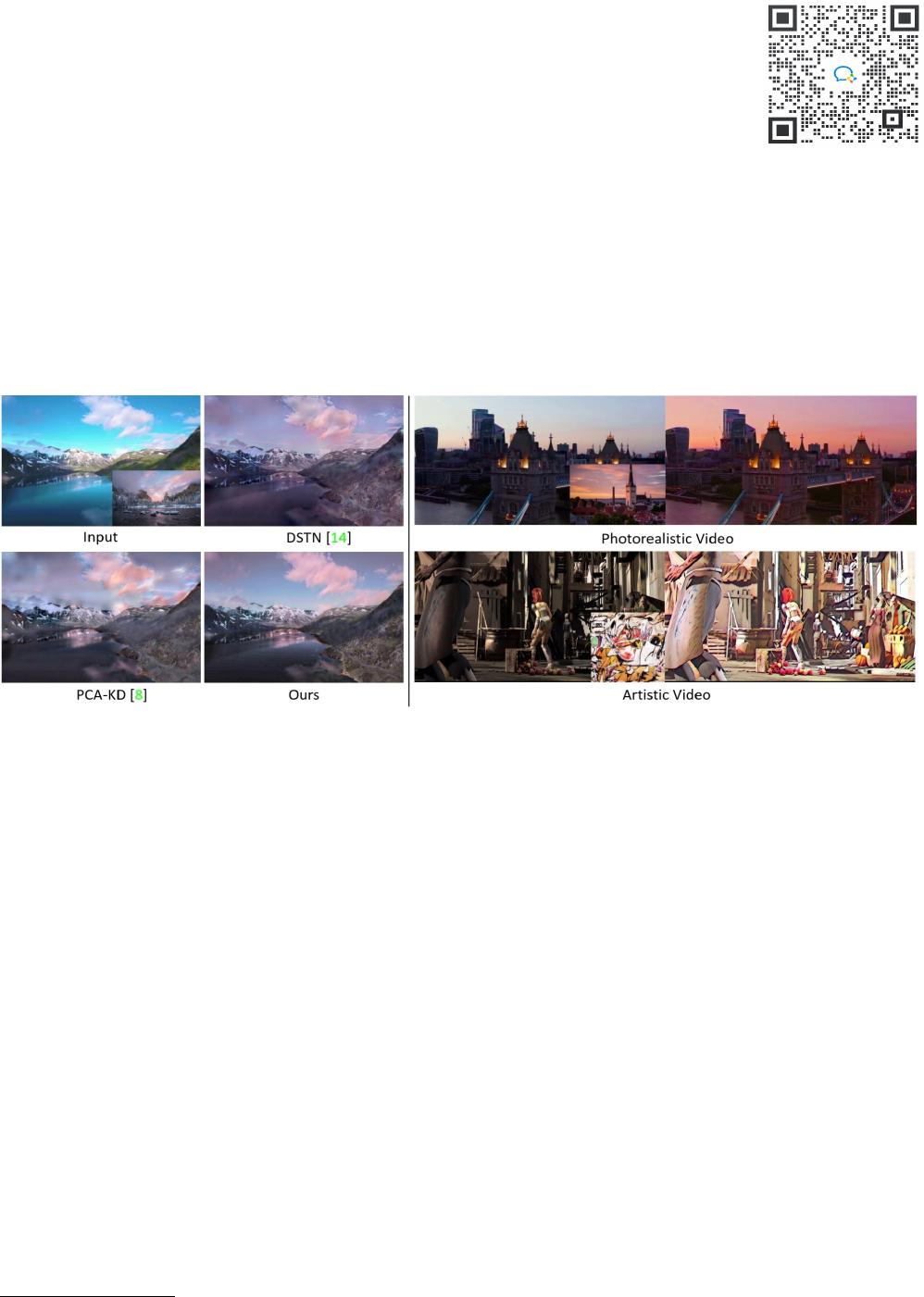
Figure 1. Our model produces more consistent stylization results with content affinity preserved for photorealistic image style transfer
(left), and photorealistic video and artistic video style transfer (right). Animations can be found in the supplementary material.
Abstract
Content affinity loss including feature and pixel affinity
is a main problem which leads to artifacts in photorealis-
tic and video style transfer. This paper proposes a new
framework named CAP-VSTNet, which consists of a new re-
versible residual network and an unbiased linear transform
module, for versatile style transfer. This reversible resid-
ual network can not only preserve content affinity but not
introduce redundant information as traditional reversible
networks, and hence facilitate better stylization. Empow-
ered by Matting Laplacian training loss which can address
the pixel affinity loss problem led by the linear transform,
the proposed framework is applicable and effective on ver-
satile style transfer. Extensive experiments show that CAP-
VSTNet can produce better qualitative and quantitative re-
sults in comparison with the state-of-the-art methods.
1. Introduction
Photorealistic style transfer aims to reproduce content
image with the style from a reference image in a photore-
*Corresponding Author
alistic way. To be photorealism, the stylized image should
preserve clear content detail and consistent stylization of
the same semantic regions. Content affinity preservation,
including feature and pixel affinity preservation [23,25,28],
is the key to achieve both clear content detail and consistent
stylization in the transfer.
The framework of a deep learning based photorealis-
tic style transfer generally uses such an architecture: an
encoder module extracting content and style features, fol-
lowed by a transformation module to adjust features statis-
tics, and finally a decoder module to invert stylized feature
back to stylized image. Existing photorealistic methods typ-
ically employ pre-trained VGG [30] as encoder. Since the
encoder is specifically designed to capture object-level in-
formation for the classification task, it inevitably results in
content affinity loss. To reduce the artifacts, existing meth-
ods either use skip connection modules [2, 14, 40] or build
a shallower network [8, 23, 39]. However, these strategies,
limited by the image recovery bias, cannot achieve a perfect
content affinity preservation on unseen images.
In this work, rather than use the traditional encoder-
transformation-decoder architecture, we resort to a re-
versible framework [1] based solution called CAP-VSTNet,
which consists of a specifically designed reversible residual
arXiv:2303.17867v1 [cs.CV] 31 Mar 2023
network followed by an unbiased linear transform module
based on Cholesky decomposition [19] that performs style
transfer in the feature space. The reversible network takes
the advantages of the bijective transformation and can avoid
content affinity information loss during forward and back-
ward inference. However, directly using the reversible net-
work cannot work well on our problem. This is because re-
dundant information will accumulate greatly when the net-
work channel increases. It will further lead to content affin-
ity loss and noticeable artifacts as the transform module is
sensitive to the redundant information. Inspired by knowl-
edge distillation methods [8, 35], we improve the reversible
network and employ a channel refinement module to avoid
the redundant information accumulation. We achieve this
by spreading the channel information into a patch of the
spatial dimension. In addition, we also introduce cycle con-
sistency loss in CAP-VSTNet to make the reversible net-
work robust to small perturbations caused by numerical er-
ror.
Although the unbiased linear transform based on
Cholesky decomposition [19] can preserve feature affinity,
it cannot guarantee pixel affinity. Inspired by [25, 28], we
introduce Matting Laplacian [22] loss to train the network
and preserve pixel affinity. Matting Laplacian [22] may
result in blurry images when it is used with another net-
work like one with an encoder-decoder architecture. But it
does not have this issue in CAP-VSTNet, since the bijective
transformation of reversible network theoretically requires
all information to be preserved.
CAP-VSTNet can be flexibly applied to versatile style
transfer, including photorealistic and artistic image/video
style transfer. We conduct extensive experiments to eval-
uate its performance. The results show it can produce better
qualitative and quantitative results in comparison with the
state-of-the-art image style transfer methods. We show that
with minor loss function modifications, CAP-VSTNet can
perform stable video style transfer and outperforms existing
methods.
2. Related Work
2.1. Style Transfer
Gatys et al. [11] expose the powerful representation abil-
ity of deep neural networks and propose neural style transfer
by matching the correlations of deep features. Feed-forward
frameworks [17, 33, 38] are proposed to address the issue
of computational cost. To achieve universal style transfer,
transformation modules are proposed to adjust statistics of
deep features, such as the mean and variance [15] and the
inter-channel correlation [24].
Photorealistic style transfer requires that stylized image
should be undistorted and consistently stylized. DPST [28]
optimizes stylized image with regularization term computed
on Matting Laplacian [22] to suppress distortion. Pho-
toWCT [25] proposes post-processing algorithm by using
Matting Laplacian as affinity matrix to reduce artifacts.
However, both of these methods may blur the stylized im-
ages instead of preserving the pixel affinity. The follow-
ing works [2,8,40] mainly focus on preserving clear details
and speeding up processing by designing skip connection
module or shallower network. Content affinity preservation
including feature and pixel affinity preservation remains an
unsolved challenge.
Recently, versatile style transfer has received a lot of
attention. Many approaches focus on exploring a gen-
eral framework capable of performing artistic, photoreal-
istic and video style transfer. Li et al. [23] propose a lin-
ear style transfer network and a spatial propagation net-
work [27] for artistic and photorealistic style transfer, re-
spectively. DSTN [14] introduces a unified architecture
with domain-aware indicator to adaptively balance between
artistic and photorealistic stylization. Chiu et al. [7] pro-
pose an optimization-based method to achieve fast artistic
or photorealistic style transfer by simply adjusting the num-
ber of iterations. Chen et al. [6] extend contrastive learn-
ing to artistic image and video style transfer by considering
internal-external statistics. Wu et al. [39] apply contrastive
learning by incorporating neighbor-regulating scheme to
preserve the coherence of the content source for artistic and
photorealistic video style transfer. While achieving versa-
tile style transfer, VGG-based networks suffer from incon-
sistent stylization due to content affinity loss. We show that
preserving content affinity can improve image consistent
stylization and video temporal consistency.
2.2. Reversible Network
Dinh et al. [9] first propose an estimator that learns a bi-
jective transform between data and latent space, which can
be seen as a perfect auto-encoder pair as it naturally satis-
fies reconstruction term of auto-encoder [4, 34]. Follow-up
work by Dinh et al. [10] introduces new transformation that
breaks the unit determinant of Jacobian to address volume-
preserving mapping. Glow [20] proposes a simple type
of generative flow building on the works by Dinh [9, 10].
Since each layer’s activation of reversible network can be
exactly reconstructed from the next layer’s, RevNet [12]
and Reformer [21] present reversible residual layers to ad-
dress memory consumption during deep network training.
i-RevNet [16] builds an invertible type of RevNet with in-
vertible down-sampling module. i-ResNet [3] inverts resid-
ual mapping by using Banach fixed point theorem to address
the restriction of reversible network architecture.
Recently, An et al. [1] apply flow-based model [20] to
address the content leak problem for artistic style transfer.
However, content affinity may not be preserved due to trans-
formation module and redundant information, which leads
of 19
50墨值下载
【版权声明】本文为墨天轮用户原创内容,转载时必须标注文档的来源(墨天轮),文档链接,文档作者等基本信息,否则作者和墨天轮有权追究责任。如果您发现墨天轮中有涉嫌抄袭或者侵权的内容,欢迎发送邮件至:contact@modb.pro进行举报,并提供相关证据,一经查实,墨天轮将立刻删除相关内容。
下载排行榜

评论