



04 Chat.pdf
25墨值下载

2020 IEEE TRANSACTIONS ON INTELLIGENT VEHICLES, VOL. 8, NO. 3, MARCH 2023
Letters
Chat With ChatGPT on Intelligent Vehicles: An IEEE
TIV Perspective
Haiping Du , Senior Member, IEEE,SiyuTeng , Hong Chen , Fellow, IEEE,JiaqiMa ,XiaoWang ,
Chao Gou
,BaiLi , Siji Ma , Qinghai Miao , Xiaoxiang Na , Peijun Ye , Hui Zhang , Guiyang Luo ,
and Fei-Yue Wang
, Fellow, IEEE
Abstract—This letter reports on a TIV DHW (decentralized
and hybrid workshop) that explores the prospective influence
of ChatGPT on research and development in intelligent vehi-
cles. To assess the update capabilities of ChatGPT, we conducted
tests involving both basic and technically relevant questions. Our
Manuscript received 1 March 2023; accepted 1 March 2023. Date of pub-
lication 6 March 2023; date of current version 27 April 2023. This work
was supported in part by National Key R&D Program of China under Grant
2022YFB2502900. (Corresponding author: Fei-Yue Wang.)
Haiping Du is with the School of Electrical, Computer and Telecommu-
nications Engineering, University of Wollongong, Wollongong, NSW 2522,
Australia (e-mail: hdu@uow.edu.au).
Siyu Teng is with the Department of Computer Science, Faculty of Science,
Hong Kong Baptist University, Hong Kong 999077, SAR, China, and also with
the BNU-HKBU United International College, Zhuhai 519087, China (e-mail:
siyuteng22@gmail.com).
Hong Chen is with the College of Electronic and Information Engineer-
ing, Tongji University, Shanghai 201804, China (e-mail: chenhong2019@
tongji.edu.cn).
Jiaqi Ma is with the Samueli School of Engineering, University of California,
Los Angeles, CA 90095 USA (e-mail: jiaqima@ucla.edu).
Xiao Wang is with the School of Artificial Intelligence, Anhui University,
Hefei 230601, China (e-mail: xiao.wang@ahu.edu.cn).
Chao Gou is with the School of Intelligent Systems Engineering, Sun Yat-Sen
University, Guangzhou 510275, China (e-mail: gouchao@mail.sysu.edu.cn).
Bai Li is with the College of Mechanical and Vehicle Engineering, Hunan
University, Changsha 410082, China (e-mail: libai@zju.edu.cn).
Siji Ma is with the Faculty of Innovation Engineering, Macau Uni-
versity of Science and Technology, Macau 999078, China (e-mail: masi-
jiguge123@gmail.com).
Qinghai Miao is with the School of Artificial Intelligence, Univer-
sity of Chinese Academy of Sciences, Beijing 100049, China (e-mail:
miaoqh@ucas.ac.cn).
Xiaoxiang Na is with the Department of Engineering, University of Cam-
bridge, Cambridge CB2 1PZ, U.K. (e-mail: xnhn2@cam.ac.uk).
Peijun Ye is with the State Key Laboratory for Management and Control of
Complex Systems, Chinese Academy of Sciences, Beijing 100190, China, and
also with the State Key Laboratory of Multimodal Artificial Intelligence Sys-
tems, Institute of Automation, Chinese Academy of Sciences, Beijing 100190,
China (e-mail: peijun_ye@hotmail.com).
Hui Zhang is with the School of Computer and Information Tech-
nology, Beijing Jiaotong University, B eijing 100044, China (e-mail:
huizhang1@bjtu.edu.cn).
Guiyang Luo is with the School of Computer Science and Technology, Beijing
University of Posts and Telecommunications, Beijing 100876, China (e-mail:
luoguiyang@bupt.edu.cn).
Fei-Yue Wang is with the School of Artificial Intelligence, Univer-
sity of Chinese Academy of Sciences, Beijing 100190, China ( e-mail:
feiyue.wang@ia.ac.cn).
Color versions of one or more figures in this article are available at
https://doi.org/10.1109/TIV.2023.3253281.
Digital Object Identifier 10.1109/TIV.2023.3253281
preliminary testing revealed that ChatGPT’s information can be
updated and corrected at one time, but it may take some time
for the changes t o be reflected in ChatGPT’s responses, so it may
not always possess the latest knowledge regarding specific topics.
We further discuss the prospective influence of ChatGPT on the
field of intelligent vehicles, particularly possible applications of
ChatGPT in areas like autonomous driving, human-vehicle interac-
tion, and intelligent transportation systems, highlighting challenges
and opportunities associated with these applications. Additionally,
we address technical questions, such as the feasibility of training
intelligent vehicles using the same methods as ChatGPT and the
reflection of the intelligence of intelligent vehicles in the context of
human-machine shared control. I n conclusion, this letter presents a
preliminary exploration of the potential of ChatGPT for intelligent
vehicle research, from an IEEE TIV perspective, acknowledging
the limitations and uncertainties of this emerging technology.
Index Terms—Neural language programming, intelligent
vehicles, human-vehicle interaction, intelligent transportation
systems.
I. INTRODUCTION
R
ECENT advances in artificial intelligence (AI) have led to
significant progress. One particular development is natural
language processing, which has enabled the creation of chatbots
that can simulate human-like conversations. One such language
model is ChatGPT [1], which gains widespread attention
because of its powerful ability to converse with humans.
Given the potential relevance of ChatGPT to intelligent vehicle
research [2], a TIV DHW was held to explore the prospective
influence of ChatGPT on this field [3]. The DHW was attended
by Associate Editors and the Editor-in-Chief of IEEE TIV
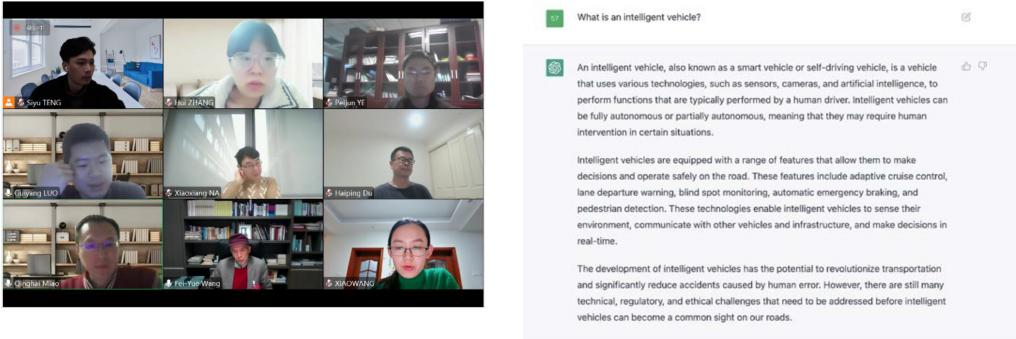
online as shown in Fig. 1 as well as some Associate Editors
offline, who reported their perspectives on the topic and engaged
in discussions and debates [4], [5], [6], [7], [8], [9], [10], [11],
[12], [13], [14], [15], [16].
The main objectives of the TIV DHW were:
r
Test the update capabilities of ChatGPT through basic
questions about intelligent vehicles, the IEEE TIV, and the
Editor-in-Chief of IEEE TIV.
r
Discuss possible applications of ChatGPT in areas such
as autonomous driving, human-vehicle interaction, and
intelligent transportation systems, and highlight some of
2379-8858 © 2023 IEEE. Personal use is permitted, but republication/redistribution requires IEEE permission.
See https://www.ieee.org/publications/rights/index.html for more information.
Authorized licensed use limited to: Shenzhen Institute of Advanced Technology CAS. Downloaded on October 11,2023 at 14:13:45 UTC from IEEE Xplore. Restrictions apply.
IEEE TRANSACTIONS ON INTELLIGENT VEHICLES, VOL. 8, NO. 3, MARCH 2023 2021
Fig. 1. TIV DHW on chat with ChatGPT.
the challenges and opportunities associated with these
applications.
r
Raise technical questions related to the use of ChatGPT
in intelligent vehicle research, such as the training of
intelligent vehicles and the reflection of intelligence in the
context of human-machine shared control [17].
Overall, the DHW provided a preliminary exploration of
the potential of ChatGPT in the context of intelligent vehicle
research, while acknowledging the limitations and uncertainties
of this emerging technology. The following sections of this letter
will provide more details on the testing of ChatGPT ’s update
capabilities, the potential applications of ChatGPT in intelligent
vehicles, and the opportunities and challenges associated with
these applications.
II. T
ESTING UPDATE CAPABILITIES OF CHATGPT
A. Questions
To assess the update capabilities of ChatGPT in the con-
text of intelligent vehicles, we designed a series of basic and
technical questions. The basic questions covered topics such
as the definition of intelligent vehicles, the IEEE TIV, and its
Editor-in-Chief. Additionally, we included questions on how to
prescreen artificial manuscripts and make the journal a flagship
in the community. The technical questions focused on using
ChatGPT to train autonomous vehicles, the potential for pow-
erful driving models, and how to reflect the intelligence of
intelligent vehicles in the context of human-machine shared
control. Overall, these questions highlight the potential impact of
ChatGPT on intelligent vehicle research, while also identifying
key technical challenges that must be addressed in order to fully
realize its potential. The basic questions include:
1) What is an intelligent vehicle?
2) Do you know IEEE TIV?
3) Do You know who is the EiC of IEEE TIV?
4) How should IEEE TIV quickly prescreen artificial
manuscripts written by ChatGPT?
5) What efforts should be made to make IEEE TIV a world-
wide flagship journal in the community of intelligent
vehicles?
6) Do you know IEEE?
7) Do you know anything about IEEE TIV?
Fig. 2. Answers to question 1.
8) Do You know who is the EiC of IEEE TIV?
The technical questions include:
9) Can we use the method of training ChatGPT to train an
intelligent vehicle with autonomous driving ability?
10) Is it possible to train a powerful driving model using
RLHF as ChatGPT does?
11) In the context of human-machine shared control, how to
reflect the intelligence of intelligent vehicles from the
perspective of foundation models?
12) What impact will ChatGPT bring to the field of intelligent
vehicles?
13) How to develop an intelligent vehicle that can overcome
most of the existing drawbacks?
B. Results of Preliminary Testing
The preliminary testing of ChatGPT showed that while the
model may have outdated or incomplete information at the time
of the initial query, it can be corrected and updated with new
information as it becomes available at one time. However, it
may take some time for the changes to be reflected in ChatGPT’s
responses, as the updated model may need to be deployed and in-
tegrated into the system. The model was able to provide relevant
and accurate responses to most of the questions, indicating its
potential as a useful tool for researchers in the field of intelligent
vehicles.
However, there were instances where ChatGPT provided in-
complete or incorrect information, particularly when it comes to
the most recent developments and updates in the field. This is not
unexpected given t he dynamic nature of the field and the frequent
changes in, for instance, editorial positions and affiliations.
ChatGPT also stated that “as an AI language model, I do not have
access to real-time information or current events” and indicated
that its knowledge cutoff date is September 2021 (at the time
this paper is published). The testing process also revealed some
technical limitations and uncertainties of ChatGPT, particularly
in the context of complex and specialized topics related to
intelligent vehicles. Some examples are given as follows. For
example, some answers are quite accurate and reasonable as
showninFigs.2–4. But some answers are not updated, for
example the answer shown in Fig. 5. Also some information
Authorized licensed use limited to: Shenzhen Institute of Advanced Technology CAS. Downloaded on October 11,2023 at 14:13:45 UTC from IEEE Xplore. Restrictions apply.
of 7
25墨值下载
【版权声明】本文为墨天轮用户原创内容,转载时必须标注文档的来源(墨天轮),文档链接,文档作者等基本信息,否则作者和墨天轮有权追究责任。如果您发现墨天轮中有涉嫌抄袭或者侵权的内容,欢迎发送邮件至:contact@modb.pro进行举报,并提供相关证据,一经查实,墨天轮将立刻删除相关内容。
下载排行榜

评论