


1


LightPainter.pdf
50墨值下载
LightPainter: Interactive Portrait Relighting with Freehand Scribble
Yiqun Mei
1
He Zhang
2
Xuaner Zhang
2
Jianming Zhang
2
Zhixin Shu
2
Yilin Wang
2
Zijun Wei
2
Shi Yan
2
HyunJoon Jung
2
Vishal M. Patel
1
1
Johns Hopkins University
2
Adobe Inc.
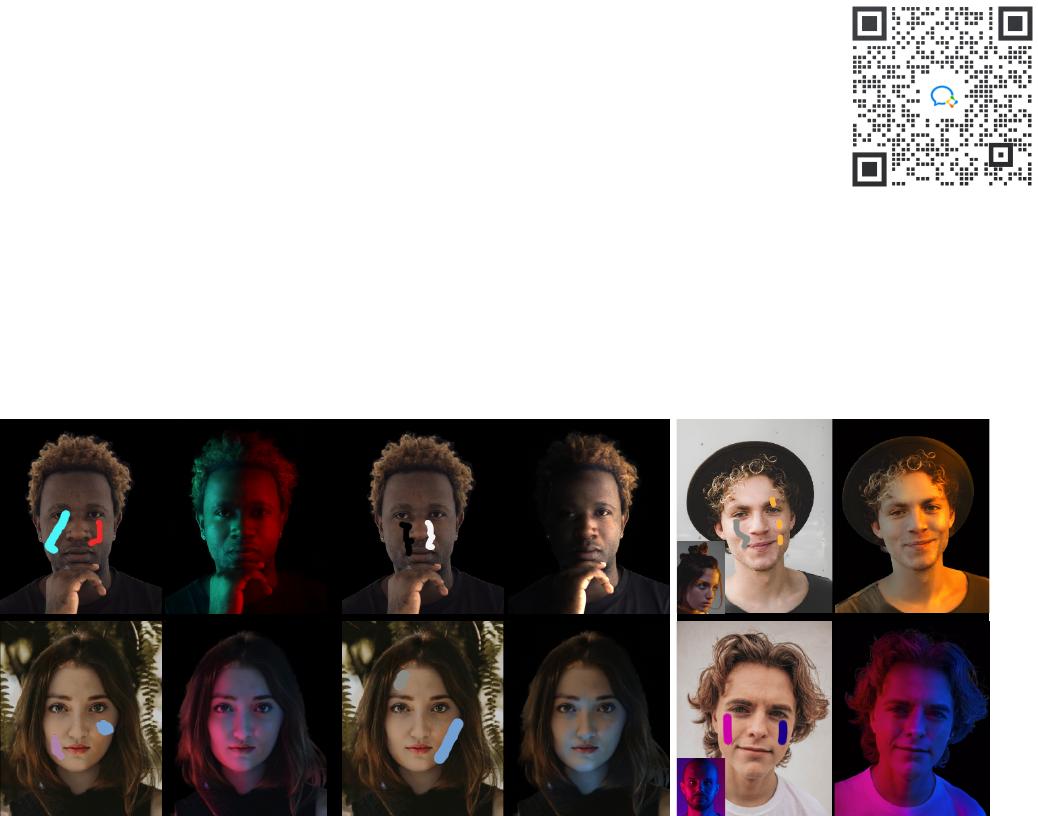
Figure 1. LightPainter is an interactive lighting editing system that takes in an input image with freehand scribbles drawn on top and
renders the correspondingly relit portrait. It enables creative portrait lighting editing (left) and allows users to reproduce a target lighting
effect with ease (right).
Abstract
Recent portrait relighting methods have achieved realis-
tic results of portrait lighting effects given a desired light-
ing representation such as an environment map. However,
these methods are not intuitive for user interaction and
lack precise lighting control. We introduce LightPainter, a
scribble-based relighting system that allows users to inter-
actively manipulate portrait lighting effect with ease. This
is achieved by two conditional neural networks, a delighting
module that recovers geometry and albedo optionally con-
ditioned on skin tone, and a scribble-based module for re-
lighting. To train the relighting module, we propose a novel
scribble simulation procedure to mimic real user scribbles,
which allows our pipeline to be trained without any human
annotations. We demonstrate high-quality and flexible por-
trait lighting editing capability with both quantitative and
qualitative experiments. User study comparisons with com-
mercial lighting editing tools also demonstrate consistent
user preference for our method.
1. Introduction
Lighting is a fundamental aspect of portrait photograph,
as lights shape the reality, and give the work depth, color-
fulness and excitement. Professional photographers [17,38]
spend hours designing lighting such that shadow and high-
light are distributed accurately on the subject to achieve the
desired photographic look. Getting the exact lighting setups
requires years of training, expensive equipment, environ-
ment setup, timing, and costly teamwork. Recently, portrait
relighting techniques [20, 22, 33, 43, 45, 48, 53, 61, 63] al-
low users to apply a different lighting condition to a portrait
photo. These methods require a given lighting condition:
some use an exemplar image [42, 43], which lacks precise
lighting control and requires exhaustive image search to find
the specific style; some use a high dynamic range (HDR)
environment maps [33, 45, 48, 53] that is difficult and unin-
tuitive to interpret or edit.
Hand-drawn sketches and scribbles have been shown to
be good for user interaction and thus are widely used in vari-
ous image editing applications [6, 9, 10, 30,32,57]. Inspired
1
arXiv:2303.12950v1 [cs.CV] 22 Mar 2023

by this, we propose LightPainter, a scribble-based inter-
active portrait relighting system. As shown in Figure 1,
LightPainter is an intuitive and flexible lighting editing sys-
tem that only requires casual scribbles drawn on the input.
Unlike widely-used lighting representations such as envi-
ronment maps and spherical harmonics, it is non-trivial to
interpret free-hand scribbles as lighting effects for a number
of challenges.
The first challenge is simulating scribbles to mimic real
free-hand input as it is impractical to collect a large num-
ber of human inputs. In addition, unlike other sketch-based
editing tasks [6,9,10,30,32,57] where sketches can be com-
puted from edges or orientation maps, there is no conven-
tional way to connect scribbles with lighting effects. To
address such challenge, we propose a scribble simulation
algorithm that can generate a diverse set of synthetic scrib-
bles that mimic real human inputs. For an interactive re-
lighting task, scribbles should be flexible and expressive:
easy to draw and accurately reflecting the lighting effect,
such as changes in local shading and color. Compared to a
shading map, scribbles are often “incomplete”: users tend
to sparsely place the scribbles on a few key areas on the
face. Therefore, we propose to use a set of locally con-
nected “shading stripes” to describe local shading patterns,
including shape, intensity, and color, and use them to simu-
late scribbles. To this end, we simulate scribbles by starting
from a full shading map and applying a series of operations
to generate coarse and sparse shading stripes. We show that
training with our synthetic scribbles enables the system to
generalize well to real user scribbles from human inputs,
with which our model can generate high-quality results with
desirable lighting effects.
The second challenge is how to effectively use local and
noisy scribbles to robustly represent portrait lighting that
is often a global effect. LightPainter uses a carefully de-
signed network architecture and training strategy to han-
dle these discrepancies. Specifically, we introduce a two-
step relighting pipeline to process sparse scribbles. The
first stage produces a plausible completion of the shading
map from the input scribbles and the geometry; the sec-
ond stage refines the shading and renders the appearance
with a learned albedo map. We propose a carefully de-
signed neural network with an augmented receptive field.
Compared with commonly-used UNet for portrait relight-
ing [21, 31, 33, 48], our design can better handle the sparse
scribbles and achieve geometry-consistent relighting.
Last, there is one major challenge in portrait relight-
ing that originates from the ill-posed nature of the intrin-
sic decomposition problem. That is to decouple albedo and
shading from an image. It is also difficult to address with
a learning framework due to the extreme scarcity of real-
istic labeled data and infinite possible lighting conditions
for a scene. In the context of portrait relighting, it means
recovering the true skin tone of a portrait subject is very
challenging [12, 49]. Instead of trying to collect a balanced
large-scale light-stage [8] dataset to capture the continuous
and subtle variations in different skin tones, we propose an
alternative solution dubbed SkinFill. We draw inspiration
from the standard makeup routine and design SkinFill to al-
low users to specify skin tone in our relighting pipeline. We
use a tone map, a per-pixel skin tone representation, to con-
dition the albedo prediction to follow the exact skin tone as
desired. This also naturally enables additional user control
at inference time.
Similar to prior work [33, 45, 62], we train our system
with a light stage [8] dataset. With our novel designs, Light-
Painter is a user-friendly system that enables creative and
interactive portrait lighting editing. We demonstrate the
simple and intuitive workflow of LightPainter through a
thorough user study. We show it generates relit portraits
with superior photo-realism and higher fidelity compared to
state-of-the-art methods. We summarize our contributions
as follows:
• We propose LightPainter, a novel scribble-based por-
trait relighting system that offers flexible user control,
allowing users to easily design portrait lighting effects.
• We introduce a novel scribble simulation algorithm
that can automatically generate realistic scribbles for
training. Combining it with a carefully designed neural
relighting module, our system can robustly generalize
to real user input.
• We introduce SkinFill to allow users to specify skin
tone in the relighting pipeline, which allows data-
efficient training and offers additional control to ad-
dress potential skin tone data bias.
2. Related Work
Portrait Relighting: The pioneering work of Debevec et
al. [8] presents an advanced illumination rig (i.e. the light
stage) to capture per-person reflectance field, which is used
to render the subject under novel illuminations. Such tech-
nique has been used to create training data for a number of
single-image relighting methods [31,33,45,59,62,63]. Por-
trait relighting has also been formulated as style transfer.
Shih et al. [42] employ a multi-scale technique to transfer
the local statistics of an exemplar to the target image. Shu et
al. [43] formulate the lighting transfer as a geometry-aware
mass transport problem with 3D morphable face model.
Using quotient image to achieve relighting is introduced
in [34, 41], where they multiply the source image with a
ratio map to render novel illuminations. Intrinsic decom-
position based approaches [3, 21, 24, 27, 29, 31, 33, 40, 48]
factorize a source image into geometry, reflectance, and il-
lumination, and apply novel lighting by conditioning on a
2
of 11
50墨值下载
【版权声明】本文为墨天轮用户原创内容,转载时必须标注文档的来源(墨天轮),文档链接,文档作者等基本信息,否则作者和墨天轮有权追究责任。如果您发现墨天轮中有涉嫌抄袭或者侵权的内容,欢迎发送邮件至:contact@modb.pro进行举报,并提供相关证据,一经查实,墨天轮将立刻删除相关内容。
下载排行榜

评论