



06【C-8m s】High-Speed Autonomous Racing Using.pdf
25墨值下载
IEEE ROBOTICS AND AUTOMATION LETTERS, VOL. 8, NO. 9, SEPTEMBER 2023 5353
High-Speed Autonomous Racing Using
Trajectory-Aided Deep Reinforcement Learning
Benjamin David Evans , Herman Arnold Engelbrecht , Senior Member, IEEE,
and Hendrik Willem Jordaan
, Senior Member, IEEE
Abstract—The classical method of autonomous racing uses real-
time localisation to follow a precalculated optimal trajectory. In
contrast, end-to-end deep reinforcement learning (DRL) can train
agents to race using only raw LiDAR scans. While classical meth-
ods prioritise optimization for high-performance racing, DRL ap-
proaches have focused on low-performance contexts with little
consideration of the speed profile. This work addresses the prob-
lem of using end-to-end DRL agents for high-speed autonomous
racing. We present trajectory-aided learning (TAL) that trains
DRL agents for high-performance racing by incorporating the
optimal trajectory (racing line) into the learning formulation. Our
method is evaluated using the TD3 algorithm on four maps in the
open-source F1Tenth simulator. The results demonstrate that our
method achieves a significantly higher lap completion rate at high
speeds compared to the baseline. This is due to TAL training the
agent to select a feasible speed profile of slowing down in the corners
and roughly tracking the optimal trajectory.
Index Terms—Deep learning methods, machine learning for
robot control, reinforcement learning.
I. INTRODUCTION
A
UTONOMOUS racing is a useful testbed for high-
performance autonomous algorithms due to the nature of
competition and the easy-to-measure performance metric of lap
time [1]. The aim of autonomous racing is to use onboard sensors
to calculate control references that move the vehicle around the
track as quickly as possible. Good racing performance operates
the vehicle on the edge of its physical limits between going too
slowly, which is poor racing behaviour, and going too fast, which
results in the vehicle crashing.
The classical robotics approach uses control systems that
depend on explicit state estimation to calculate references for the
robot’s actuators [2]. Classical racing systems use a localisation
algorithm to determine the vehicle’s pose on a map, which a
path follower uses to track an optimal trajectory [3]. Methods
requiring explicit state representation (localisation) are limited
by requiring a map of the track and being inflexible to environ-
mental changes [4].
Manuscript received 26 January 2023; accepted 2 July 2023. Date of pub-
lication 13 July 2023; date of current version 19 July 2023. This letter was
recommended for publication by Associate Editor H. Seok Ahn and Editor
A. Faust upon evaluation of the reviewers’ comments. (Corresponding author:
Benjamin David Evans.)
The authors are with the Department of Electrical and Electronic Engi-
neering, Stellenbosch University, Stellenbosch 7600, South Africa (e-mail:
bdevans@sun.ac.za; hebrect@sun.ac.za; wjordaan@sun.ac.za).
Digital Object Identifier 10.1109/LRA.2023.3295252
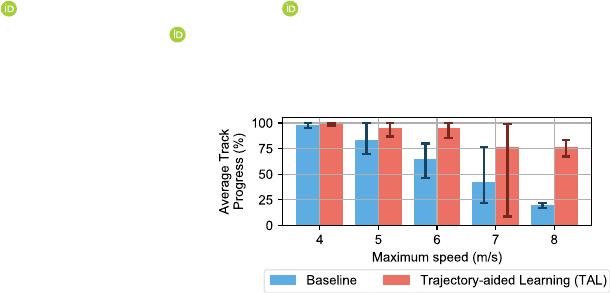
Fig. 1. Our method achieves significantly higher average progress around the
track at high speeds than the baseline.
In contrast to classical methods, deep learning agents use
a neural network to map raw sensor data (LiDAR scans) di-
rectly to control commands without requiring explicit state
estimation [5]. Deep reinforcement learning (DRL) trains neural
networks from experience to select actions that maximise a
reward signal [6]. Previous DRL approaches have presented
end-to-end solutions for F1Tenth racing but have been limited to
low speeds [7], [8], and have lacked consideration of the speed
profile [9].
This letter approaches the problem of how to train DRL
agents for high-speed racing using only a LiDAR scan as in-
put. We provide insights on learning formulations for training
DRL agents for high-performance control through the following
contributions:
1) Present trajectory-aided learning (TAL), which uses an
optimal trajectory to train DRL agents for high-speed
racing using raw LiDAR scans as input.
2) Demonstrate that TAL improves the completion rate of
DRL agents at high speeds compared to the baseline
learning formulation, as shown in Fig. 1.
3) Demonstrate that TAL agents select speed profiles sim-
ilar to the optimal trajectory and outperform related ap-
proaches in the literature.
II. L
ITERATURE STUDY
We study methods of autonomous racing in the categories of
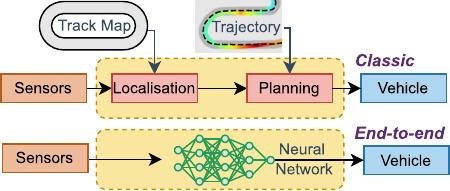
classical methods and end-to-end learning. Fig. 2 shows how the
classical racing pipeline uses a localisation module to enable a
planner to track a precomputed optimal trajectory, and end-to-
end learning replaces the entire pipeline with a neural network-
based agent.
2377-3766 © 2023 IEEE. Personal use is permitted, but republication/redistribution requires IEEE permission.
See https://www.ieee.org/publications/rights/index.html for more information.
Authorized licensed use limited to: Shenzhen Institute of Advanced Technology CAS. Downloaded on October 11,2023 at 14:34:47 UTC from IEEE Xplore. Restrictions apply.
5354 IEEE ROBOTICS AND AUTOMATION LETTERS, VOL. 8, NO. 9, SEPTEMBER 2023
Fig. 2. Classical racing stack using localisation and planning modules, and
end-to-end racing using a neural network without state estimation.
A. Classical Racing
The classical racing method calculates an optimal trajectory
and then uses a path-following algorithm to track it [1]. Trajec-
tory optimisation techniques calculate a set of waypoints (posi-
tions with a s peed reference) on a track that, when followed, lead
the vehicle to complete a lap in the shortest time possible [3].A
path-following algorithm tracks the trajectory using the vehicle’s
pose as calculated by a localisation algorithm.
Localisation: Localisation approaches for autonomous racing
depend on the sensors and computation available. Full-sized
racing cars are often equipped with GPS (GNSS), LiDAR,
radar, cameras, IMUs, and powerful computers that can fuse
these measurements in real-time [10]. Classical F1Tenth racing
approaches have used a particle filter that takes a LiDAR scan
and a map of the track to estimate the vehicle’s pose [2], [4],
[11]. Localisation methods are inherently limited by requiring a
race track map and, thus, are inflexible to unmapped tracks.
Classical Path-Following: Model-predictive controllers
(MPC) and pure pursuit path-followers have been used for
trajectory tracking [1]. MPC planners calculate optimal con-
trol commands in a receding horizon manner [12] and have
demonstrated high-performance results racing F1Tenth vehicles
at speeds of up to 7 m/s [2]. The pure pursuit algorithm uses
a geometric model to calculate a steering angle to follow the
optimal trajectory [13], and has been used to race at speeds of
7m/s[11] and over 8 m/s [14].
Learning-based Path-following: Classical path-following al-
gorithms have been replaced by neural networks, aiming to
improve computational efficiency (compared to MPC) [12],
[15] and performance in difficult-to-model conditions such as
drifting [16]. Including upcoming trajectory points in the state
vector (as opposed to only centerline points [15]) has shown to
improve racing performance [17], [18]. This shows demonstrates
that using the optimal trajectory results in high-performance
racing.
While classical and learning-based path-following methods
have produced high-performance results, they are inherently
limited by requiring the vehicle’s location on the map.
B. End-to-end Learning
In contrast to classical methods that use a perception, planning
and control pipeline, end-to-end methods use a neural network
to map raw sensory data to control references [9]. While some
approaches have used camera images [19], the dominant input
has been LiDAR scans [7], [9], [20].
Autonomous Driving: End-to-end learning agents can use a
subset of beams from a LiDAR scan to output steering references
that control a vehicle travelling at constant speed [7]. While
imitation learning (IL) has been used to train agents to copy an
expert policy [21], deep reinforcement learning, has shown bet-
ter results, with higher lap completion rates [7]. DRL algorithms
train agents in an environment (simulation [7] or real-world
system [20] ), where at each timestep, the agent receives a state,
selects an action and then receives a reward. DRL approaches to
driving F1Tenth vehicles have considered low, constant speeds
of 1.5 m/s [7], [22],2m/s[20], and 2.4 m/s [8]. While indicating
that DRL agents can control a vehicle, these methods neglect the
central racing challenge of speed selection.
Autonomous Racing: Using model-free end-to-end DRL
agents to select speed and steering commands for autonomous
racing is a difficult problem [23], [24]. In response, Brunnbauer
et al. [23] turned to model-based learning and Zhang et al. [24]
incorporated an artificial potential field planner in the learning
to simplify t he learning problem. Both [23] and [24] show that
their agents regularly crash while using top speeds of only
5 m/s, demonstrating the difficulty of learning for high-speed
autonomous racing. Bosello et al. [9] use a model-free DRL
algorithm (DQN) for F1Tenth racing at speeds of up to 5 m/s,
but provide no detail on the speed profile, trajectory or crash
rate.
Summary: Classical racing methods have produced high-
performance racing behaviour using high maximum speeds but
are limited by requiring localisation. In contrast, end-to-end
DRL agents are successful in controlling vehicles at low speeds
using only the LiDAR scan as input. While some methods have
approached speed selection using DRL agents, there has been
little study on the speed profiles selected, and the highest speed
used is 5 m/s, which is significantly less than classical methods of
8 m/s. This letter targets the gap in developing high-performance
racing solutions for steering and speed control in autonomous
race cars.
III. M
ETHODOLOGY
A. Reinforcement Learning Preliminary
Deep reinforcement learning (DRL) trains autonomous
agents, consisting of deep neural networks, to maximise a reward
signal from experience [6]. Reinforcement learning problems
are modelled as Markov Decision Processes (MDPs), where the
agent receives a state s from the environment and selects an
action a. After each action has been executed, the environment
returns a reward r indicating how good or bad the action was
and a new state s
.
This work considers deep-deterministic-policy-gradient
(DDPG) algorithms since we work with a continuous action
space [25]. DDPG algorithms maintain two neural networks, an
actor μ that maps a state to an action and a critic Q that evaluates
the action-value function. A pair of networks are maintained for
the actor and the critic; the model networks are used to select
actions, and target networks calculate the targets μ
and Q
.A
Authorized licensed use limited to: Shenzhen Institute of Advanced Technology CAS. Downloaded on October 11,2023 at 14:34:47 UTC from IEEE Xplore. Restrictions apply.
of 7
25墨值下载
【版权声明】本文为墨天轮用户原创内容,转载时必须标注文档的来源(墨天轮),文档链接,文档作者等基本信息,否则作者和墨天轮有权追究责任。如果您发现墨天轮中有涉嫌抄袭或者侵权的内容,欢迎发送邮件至:contact@modb.pro进行举报,并提供相关证据,一经查实,墨天轮将立刻删除相关内容。
下载排行榜

评论