



Non-stationary Transformers.pdf
50墨值下载

Non-stationary Transformers:
Exploring the Stationarity in Time Series Forecasting
Yong Liu
∗
, Haixu Wu
∗
, Jianmin Wang, Mingsheng Long
B
School of Software, BNRist, Tsinghua University, China
{liuyong21,whx20}@mails.tsinghua.edu.cn, {jimwang,mingsheng}@tsinghua.edu.cn
Abstract
Transformers have shown great power in time series forecasting due to their
global-range modeling ability. However, their performance can degenerate ter-
ribly on non-stationary real-world data in which the joint distribution changes
over time. Previous studies primarily adopt stationarization to attenuate the non-
stationarity of original series for better predictability. But the stationarized series
deprived of inherent non-stationarity can be less instructive for real-world bursty
events forecasting. This problem, termed over-stationarization in this paper, leads
Transformers to generate indistinguishable temporal attentions for different series
and impedes the predictive capability of deep models. To tackle the dilemma
between series predictability and model capability, we propose Non-stationary
Transformers as a generic framework with two interdependent modules: Series
Stationarization and De-stationary Attention. Concretely, Series Stationarization
unifies the statistics of each input and converts the output with restored statis-
tics for better predictability. To address the over-stationarization problem, De-
stationary Attention is devised to recover the intrinsic non-stationary information
into temporal dependencies by approximating distinguishable attentions learned
from raw series. Our Non-stationary Transformers framework consistently boosts
mainstream Transformers by a large margin, which reduces MSE by 49.43% on
Transformer, 47.34% on Informer, and 46.89% on Reformer, making them the
state-of-the-art in time series forecasting. Code is available at this repository:
https://github.com/thuml/Nonstationary_Transformers.
1 Introduction
Time series forecasting has become increasingly ubiquitous in real-world applications, such as weather
forecasting, energy consumption planning, and financial risk assessment. Recently, Transformers [
34
]
have achieved progressive breakthrough on extensive areas [
12
,
13
,
10
,
24
]. Especially in time
series forecasting, credited to their stacked structure and the capability of attention mechanisms,
Transformers can naturally capture the temporal dependencies from deep multi-level features [
39
,
19
,
22, 37], thereby fitting the series forecasting task perfectly.
Despite the remarkable architectural design, it is still challenging for Transformers to predict real-
world time series because of the non-stationarity of data. Non-stationary time series is characterized
by the continuous change of statistical properties and joint distribution over time, which makes
the time series less predictable [
6
,
16
]. Besides, it is a fundamental problem to make deep models
generalize well on a varying distribution [
28
,
21
,
5
]. In previous work, it is generally acknowledged
to pre-process the time series by stationarization [
26
,
29
,
17
], which can attenuate the non-stationarity
of raw time series for better predictability and provide more stable data distribution for deep models.
∗
Equal Contribution
36th Conference on Neural Information Processing Systems (NeurIPS 2022).
arXiv:2205.14415v3 [cs.LG] 18 Oct 2022
Ⅰ Ⅱ Ⅲ
Non-stationary
Varied !, #
(a) Vanilla
Transformer
(b) Transformer with
Series Stationarization
(c) Non-stationary
Transformer
Ⅰ
!
$
, #
$
Ⅱ
!
%
, #
%
Ⅲ
!
&
, #
&
Learned
Attention
Zoom in
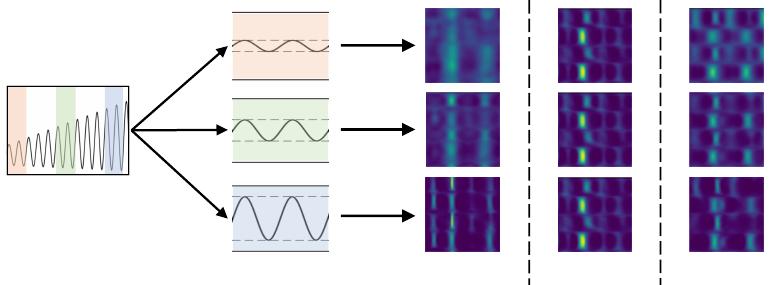
Figure 1: Visualization of learned temporal attentions for different series with varied mean
µ
and
standard deviation
σ
. (a) is from the vanilla Transformer [
34
] trained on raw series. (b) is from
the Transformer trained on stationarized series, which presents similar attentions. (c) is from Non-
stationary Transformers, which involves De-stationary Attention to avoid over-stationarization.
However, non-stationarity is the inherent property of real-world time series and also good guidance for
discovering temporal dependencies for forecasting. Experimentally, we observe that training on the
stationarized series will undermine the distinction of attentions learned by Transformers. While vanilla
Transformers [
34
] can capture distinct temporal dependencies from different series in Figure 1(a),
Transformers trained on the stationarized series tend to generate indistinguishable attentions in
Figure 1(b). This problem, named by the over-stationarization, will bring unexpected side-effect
that makes Transformers fail to capture eventful temporal dependencies, limit the model’s predictive
ability, and even induce the model to generate outputs with huge non-stationarity deviation from the
ground truth. Thus, how to attenuate time series non-stationarity towards better predictability and
mitigate the over-stationarization problem for model capability simultaneously is the key problem to
further improve the performance of forecasting.
In this paper, we explore the effect of stationarization in time series forecasting and propose Non-
stationary Transformers as a general framework, which empowers Transformer [
34
] and its efficient
variants [
19
,
39
,
37
] with great predictive ability for real-world time series. The proposed framework
involves two interdependent modules: Series Stationarization to increase the predictability of non-
stationary series and De-stationary Attention to alleviate over-stationarization. Technically, Series
Stationarization adopts a simple but effective normalization strategy to unify the key statistics of
each series without extra parameters. And De-stationary Attention approximates the attention of
unstationarized data and compensates the intrinsic non-stationarity of raw series. Benefiting from
the above designs, Non-stationary Transformers can take advantage of the great predictability of
stationarized series and crucial temporal dependencies discovered from original non-stationary data.
Our method achieves state-of-the-art performance on six real-world benchmarks and can generalize
to various Transformers for further improvement. The contributions lie in three folds:
•
We refine that the predictive capability of non-stationary series is essential in real-world
forecasting. By detailed analysis, we find out that current stationarization approaches will
lead to the over-stationarization problem, limiting the predictive capability of Transformers.
•
We propose Non-stationary Transformers as a generic framework, including Series Sta-
tionarization to make the series more predictable and De-stationary Attention to avoid the
over-stationarization problem by re-incorporating the non-stationarity of original series.
•
Non-stationary Transformers consistently boosts four mainstream Transformers by a large
margin and achieves state-of-the-art performance on six real-world benchmarks.
2 Related Work
2.1 Deep Models for Time Series Forecasting
In recent years, deep models with elaboratively designed architectures have achieved great progress
in time series forecasting. RNN-based models [
35
,
38
,
25
,
31
,
32
] are proposed for application in an
2
of 21
50墨值下载
【版权声明】本文为墨天轮用户原创内容,转载时必须标注文档的来源(墨天轮),文档链接,文档作者等基本信息,否则作者和墨天轮有权追究责任。如果您发现墨天轮中有涉嫌抄袭或者侵权的内容,欢迎发送邮件至:contact@modb.pro进行举报,并提供相关证据,一经查实,墨天轮将立刻删除相关内容。
下载排行榜

评论