



SCALEFORMER ITERATIVE MULTI-SCALE REFINING.pdf
50墨值下载
Published as a conference paper at ICLR 2023
SCALEFORMER: ITERATIVE MULTI-SCALE REFINING
TRANSFORMERS FOR TIME SERIES FORECASTING
Mohammad Amin Shabani,
Simon Fraser University, Canada
& Borealis AI, Canada
mshabani@sfu.ca
Amir Abdi, Lili Meng, Tristan Sylvain
Borealis AI, Canada
{firstname.lastname}@borealisai.com
ABSTRACT
The performance of time series forecasting has recently been greatly improved by
the introduction of transformers. In this paper, we propose a general multi-scale
framework that can be applied to the state-of-the-art transformer-based time series
forecasting models (FEDformer, Autoformer, etc.). By iteratively refining a fore-
casted time series at multiple scales with shared weights, introducing architecture
adaptations, and a specially-designed normalization scheme, we are able to achieve
significant performance improvements, from
5.5%
to
38.5%
across datasets and
transformer architectures, with minimal additional computational overhead. Via
detailed ablation studies, we demonstrate the effectiveness of each of our contri-
butions across the architecture and methodology. Furthermore, our experiments
on various public datasets demonstrate that the proposed improvements outper-
form their corresponding baseline counterparts. Our code is publicly available in
https://github.com/BorealisAI/scaleformer.
1 INTRODUCTION
Coarse ForecastingFine Forecasting
Time
Value
Value
Value
Value
GroundTruth
Prediction
GroundTruth
Prediction
GroundTruth
Prediction
GroundTruth
Prediction
0
50
100 150 200
0
20
40
60
80
100
0 10 20 30
40 50
0 5 10 15 20 25
0.5
0.0
-0.5
-1.0
-1.5
0.5
0.0
-0.5
-1.0
-1.5
0.5
0.0
-0.5
-1.0
-1.5
0.0
-0.2
-0.5
-0.6
-0.8
-1.0
-1.2
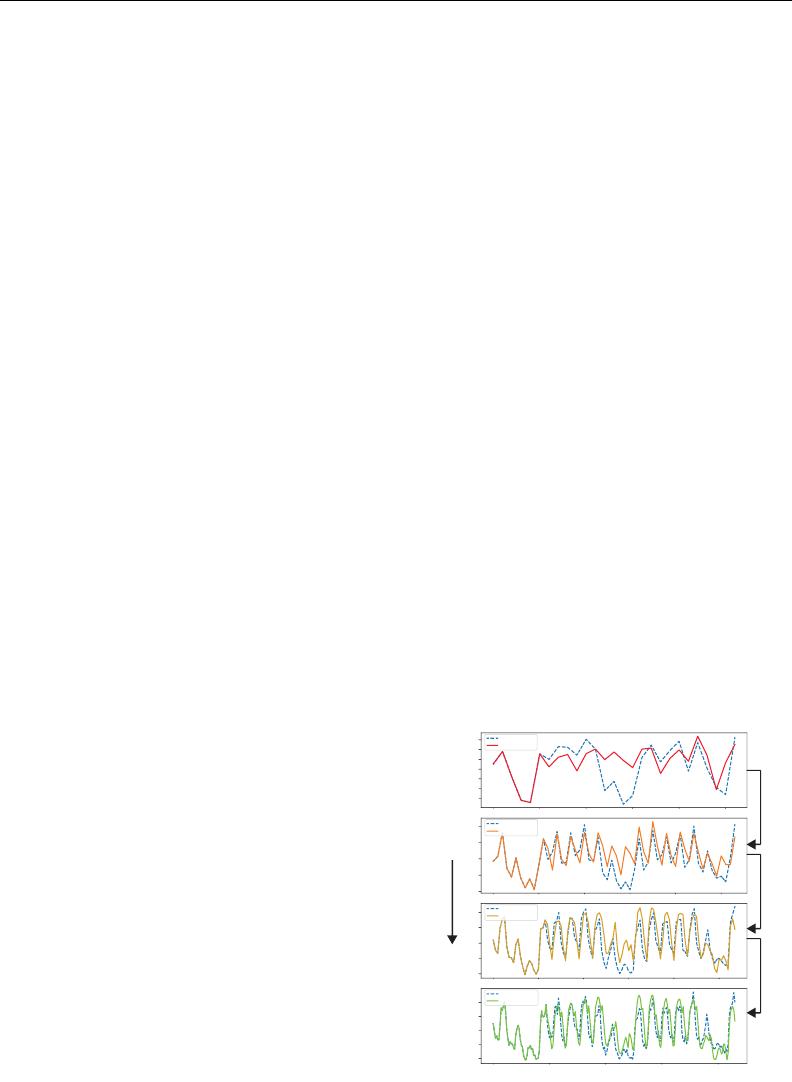
Figure 1: Intermediate forecasts by our model
at different time scales. Iterative refinement
of a time series forecast is a strong structural
prior that benefits time series forecasting.
Integrating information at different time scales is es-
sential to accurately model and forecast time series
(Mozer, 1991; Ferreira et al., 2006). From weather
patterns that fluctuate both locally and globally, as
well as throughout the day and across seasons and
years, to radio carrier waves which contain relevant
signals at different frequencies, time series forecast-
ing models need to encourage scale awareness in
learnt representations. While transformer-based ar-
chitectures have become the mainstream and state-
of-the-art for time series forecasting in recent years,
advances have focused mainly on mitigating the stan-
dard quadratic complexity in time and space, e.g.,
attention (Li et al., 2019; Zhou et al., 2021) or struc-
tural changes (Xu et al., 2021; Zhou et al., 2022b),
rather than explicit scale-awareness. The essential
cross-scale feature relationships are often learnt im-
plicitly, and are not encouraged by architectural priors
of any kind beyond the stacked attention blocks that
characterize the transformer models. Autoformer (Xu
et al., 2021) and Fedformer (Zhou et al., 2022b) introduced some emphasis on scale-awareness by
enforcing different computational paths for the trend and seasonal components of the input time
series; however, this structural prior only focused on two scales: low- and high-frequency components.
Given their importance to forecasting, can we make transformers more scale-aware?
We enable this scale-awareness with Scaleformer. In our proposed approach, showcased in Figure 1,
time series forecasts are iteratively refined at successive time-steps, allowing the model to better
capture the inter-dependencies and specificities of each scale. However, scale itself is not sufficient.
Iterative refinement at different scales can cause significant distribution shifts between intermediate
1
arXiv:2206.04038v4 [cs.LG] 7 Feb 2023

Published as a conference paper at ICLR 2023
forecasts which can lead to runaway error propagation. To mitigate this issue, we introduce cross-scale
normalization at each step.
Our approach re-orders model capacity to shift the focus on scale awareness, but does not fundamen-
tally alter the attention-driven paradigm of transformers. As a result, it can be readily adapted to
work jointly with multiple recent time series transformer architectures, acting broadly orthogonally
to their own contributions. Leveraging this, we chose to operate with various transformer-based
backbones (e.g. Fedformer, Autoformer, Informer, Reformer, Performer) to further probe the effect
of our multi-scale method on a variety of experimental setups.
Our contributions are as follows: (1) we introduce a novel iterative scale-refinement paradigm that
can be readily adapted to a variety of transformer-based time series forecasting architectures. (2) To
minimize distribution shifts between scales and windows, we introduce cross-scale normalization on
outputs of the Transformer. (3) Using Informer and AutoFormer, two state-of-the-art architectures, as
backbones, we demonstrate empirically the effectiveness of our approach on a variety of datasets.
Depending on the choice of transformer architecture, our mutli-scale framework results in mean
squared error reductions ranging from
5.5%
to
38.5%
. (4) Via a detailed ablation study of our
findings, we demonstrate the validity of our architectural and methodological choices.
2 RELATED WORKS
Time-series forecasting
: Time-series forecasting plays an important role in many domains, including:
weather forecasting (Murphy, 1993), inventory planning (Syntetos et al., 2009), astronomy (Scargle,
1981), economic and financial forecasting (Krollner et al., 2010). One of the specificities of time
series data is the need to capture seasonal trends (Brockwell & Davis, 2009). There exits a vast variety
of time-series forecasting models (Box & Jenkins, 1968; Hyndman et al., 2008; Salinas et al., 2020;
Rangapuram et al., 2018; Bai et al., 2018; Wu et al., 2020). Early approaches such as ARIMA (Box
& Jenkins, 1968) and exponential smoothing models (Hyndman et al., 2008) were followed by the
introduction of neural network based approaches involving either Recurrent Neural Netowkrs (RNNs)
and their variants (Salinas et al., 2020; Rangapuram et al., 2018; Salinas et al., 2020) or Temporal
Convolutional Networks (TCNs) (Bai et al., 2018).
More recently, time-series Transformers (Wu et al., 2020; Zerveas et al., 2021; Tang & Matteson,
2021) were introduced for the forecasting task by leveraging self-attention mechanisms to learn
complex patterns and dynamics from time series data. Informer (Zhou et al., 2021) reduced quadratic
complexity in time and memory to
O(L log L)
by enforcing sparsity in the attention mechanism
with the ProbSparse attention. Yformer (Madhusudhanan et al., 2021) proposed a Y-shaped encoder-
decoder architecture to take advantage of the multi-resolution embeddings. Autoformer (Xu et al.,
2021) used a cross-correlation-based attention mechanism to operate at the level of subsequences.
FEDformer (Zhou et al., 2022b) employs frequency transform to decompose the sequence into
multiple frequency domain modes to extract the feature, further improving the performance of
Autoformer.
Multi-scale neural architectures
: Multi-scale and hierarchical processing is useful in many domains,
such as computer vision (Fan et al., 2021; Zhang et al., 2021; Liu et al., 2018), natural language
processing (Nawrot et al., 2021; Subramanian et al., 2020; Zhao et al., 2021) and time series
forecasting (Chen et al., 2022; Ding et al., 2020). Multiscale Vision Transformers (Fan et al., 2021)
is proposed for video and image recognition, by connecting the seminal idea of multiscale feature
hierarchies with transformer models, however, it focuses on the spatial domain, specially designed
for computer vision tasks. Cui et al. (2016) proposed to use different transformations of a time series
such as downsampling and smoothing in parallel to the original signal to better capture temporal
patterns and reduce the effect of random noise. Many different architectures have been proposed
recently (Chung et al., 2016; Che et al., 2018; Shen et al., 2020; Chen et al., 2021) to improve RNNs
in tasks such as language processing, computer vision, time-series analysis, and speech recognition.
However, these methods are mainly focused on proposing a new RNN-based module which is not
applicable to transformers directly. The same direction has been also investigated in Transformers,
TCN, and MLP models. Recent work Du et al. (2022) proposed multi-scale segment-wise correlations
as a multi-scale version of the self-attention mechanism. Our work is orthogonal to the above methods
2
of 23
50墨值下载
【版权声明】本文为墨天轮用户原创内容,转载时必须标注文档的来源(墨天轮),文档链接,文档作者等基本信息,否则作者和墨天轮有权追究责任。如果您发现墨天轮中有涉嫌抄袭或者侵权的内容,欢迎发送邮件至:contact@modb.pro进行举报,并提供相关证据,一经查实,墨天轮将立刻删除相关内容。
下载排行榜

评论