



Learning A Sparse Transformer Network for Effective Image Deraining.pdf
25墨值下载
Learning A Sparse Transformer Network for Effective Image Deraining
Xiang Chen
1
Hao Li
1
Mingqiang Li
2
Jinshan Pan
1
*
1
School of Computer Science and Engineering, Nanjing University of Science and Technology
2
Information Science Academy, China Electronics Technology Group Corporation
Abstract
Transformers-based methods have achieved significant
performance in image deraining as they can model the
non-local information which is vital for high-quality im-
age reconstruction. In this paper, we find that most ex-
isting Transformers usually use all similarities of the to-
kens from the query-key pairs for the feature aggrega-
tion. However, if the tokens from the query are differ-
ent from those of the key, the self-attention values esti-
mated from these tokens also involve in feature aggregation,
which accordingly interferes with the clear image restora-
tion. To overcome this problem, we propose an effective
DeRaining network, Sparse Transformer (DRSformer) that
can adaptively keep the most useful self-attention values
for feature aggregation so that the aggregated features bet-
ter facilitate high-quality image reconstruction. Specifi-
cally, we develop a learnable top-k selection operator to
adaptively retain the most crucial attention scores from the
keys for each query for better feature aggregation. Si-
multaneously, as the naive feed-forward network in Trans-
formers does not model the multi-scale information that is
important for latent clear image restoration, we develop
an effective mixed-scale feed-forward network to gener-
ate better features for image deraining. To learn an en-
riched set of hybrid features, which combines local con-
text from CNN operators, we equip our model with mix-
ture of experts feature compensator to present a coop-
eration refinement deraining scheme. Extensive experi-
mental results on the commonly used benchmarks demon-
strate that the proposed method achieves favorable perfor-
mance against state-of-the-art approaches. The source code
and trained models are available at https://github.
com/cschenxiang/DRSformer.
1. Introduction
Single image deraining is a typical low-level vision prob-
lem emerging in the last decade. It aims to recover the clean
*
Corresponding author.
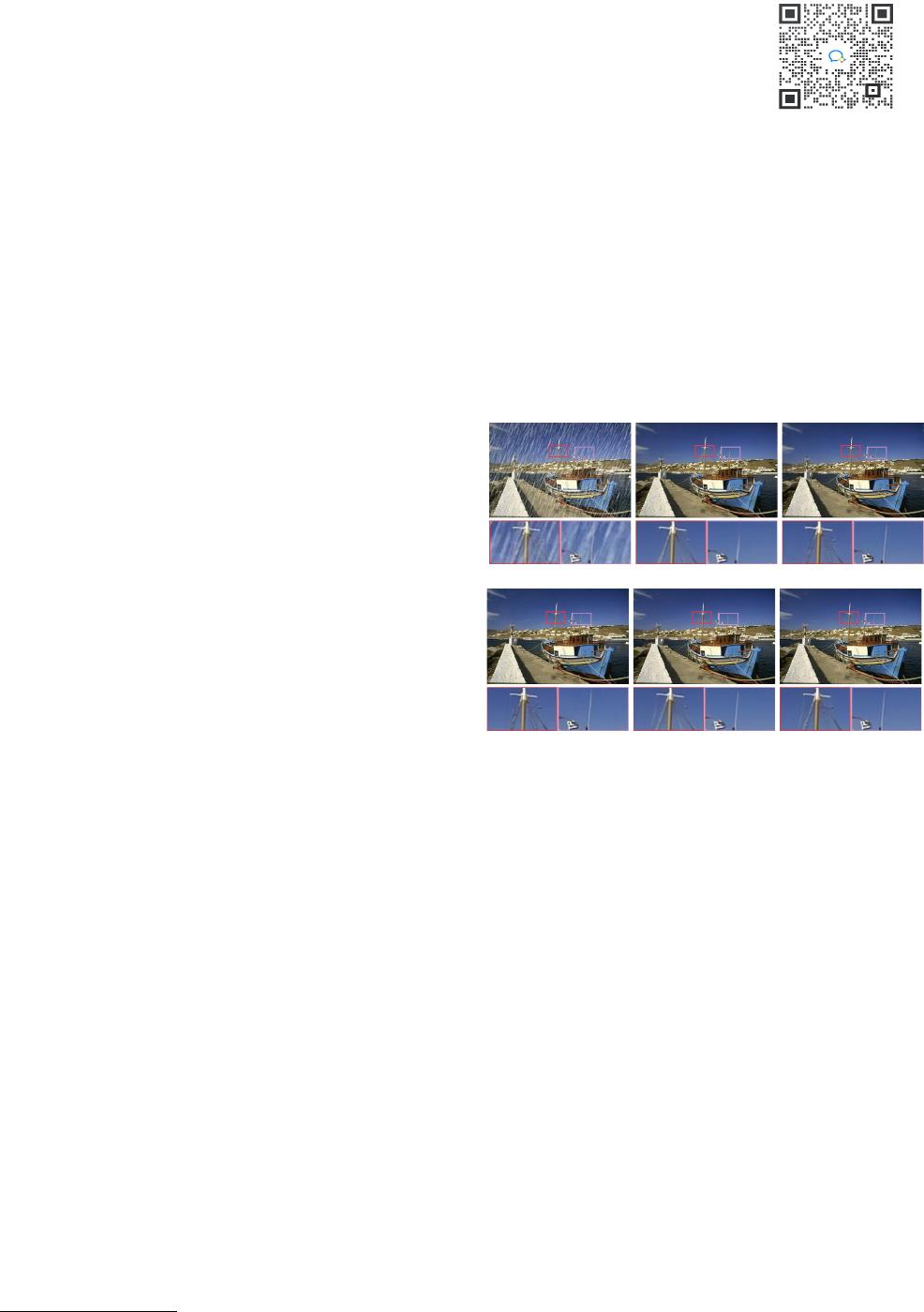
(a) Rainy Input (b) Uformer [48] (c) Restormer [58]
(d) IDT [50] (e) Ours (f) Ground Truth
Figure 1. Image deraining results between our method and recent
Transformer-based methods [48,50,58]. Our method can generate
high-quality image with more accurate detail and texture recovery.
image from the observed rainy one. As the clear image and
rain streaks are unknown, it is an ill-posed inverse problem.
To solve this problem, early approaches [20, 24, 60] usu-
ally impose various priors based on statistical properties of
rain streaks and clear images. In fact, these handcrafted pri-
ors are not robust to complex and varying rainy scenarios,
which limit the deraining performance.
Recently, numerous learning-based methods [4, 19, 23,
36, 52, 53, 56] have resorted to diverse CNN architectures
as a preferable choice compared to traditional algorithms.
However, the intrinsic characteristics of convolutional op-
eration, i.e, local receptive fields and independence of input
content, hinder the model’s capacity to eliminate long-range
rain degradation perturbation. To alleviate such limitations,
Transformers [2, 26, 35, 50] have been applied to image de-
raining and have achieved decent performance as they can
better model the non-local information for high-quality im-
age reconstruction. Nevertheless, the image details, which
are local features of images, are not modeled well by these
approaches when restoring clear images as shown in Fig-
ure 1. One main reason is that the self-attention in Trans-
formers does not model the local invariant properties that
1
arXiv:2303.11950v1 [cs.CV] 21 Mar 2023

CNNs do well. Since rain streaks tend to confuse with back-
ground details in local regions, recent studies [5, 18, 57] try
to mitigate such drawbacks by combining CNN operations
and Transformers for boosting image deraining, where the
Transformers based on the standard formulations.
We note that the standard Transformers [40] usually use
all attention relations based on the query-key pairs to ag-
gregate features. As the tokens from the key are not always
relevant to those from the query, using the self-attention val-
ues estimated from these tokens in the feature aggregation
interferes with the following latent clear image restoration.
The root cause behind this deficiency lies in that, the na-
tive dense calculation pattern of self-attention amplifies rel-
atively smaller similarity weights, making feature interac-
tion and aggregation process susceptible to implicit noises.
This also naturally leads to corresponding redundant or ir-
relevant representations are still taken into consideration
when modeling global feature dependencies [44, 64]. Thus,
these findings motivate us to explore the most useful self-
attention values so that we can make full use of the features
for better image restoration.
To this end, we develop an effective sparse Transformer
network for image deraining, named as DRSformer. Specif-
ically, the key component of the proposed framework is
the sparse Transformer block (STB) which contains a top-
k sparse attention (TKSA) that keeps the most useful self-
attention values for feature aggregation and a mixed-scale
feed-forward network (MSFN) that explores the multi-scale
features for better image deraining. First, we design the top-
k attention mechanism to replace the vanilla self-attention
[40]. The TKSA keeps the largest K similarity scores be-
tween the queries and the keys for the self-attention comput-
ing, thereby facilitating better feature aggregation. Further-
more, the developed MSFN further explores the multi-scale
information to better improve the aggregated features. Fi-
nally, based on the observation that rain distribution reveals
the degradation location and degree, we also introduce mix-
ture of experts feature compensator (MEFC) to provide col-
laborative refinement for STB. With the above-mentioned
designs, our proposed method offers three-fold advantages:
(1) it can enjoy natural robustness in terms of less sensi-
tivity to useless feature interference, (2) it can not only en-
rich the locality but also empower the capability of global
feature exploitation, and (3) it can co-explore data (embod-
ied in MEFC) and content (embodied in STB) sparsity for
achieving deraining performance gains.
The main contributions are summarized as follows:
• We propose a sparse Transformer architecture to help
generate high-quality deraining results with more ac-
curate detail and texture recovery.
• We develop a simple yet effective learnable top-k se-
lection operator to adaptively maintain the most useful
self-attention values for better feature aggregation.
• We design an effective feed-forward network based on
mixed-scale fusion strategy to explore multi-scale rep-
resentations for better facilitating image deraining.
• Extensive experimental results on various benchmarks
demonstrate that our method achieves favorable per-
formance against state-of-the-art (SOTA) approaches.
2. Related Work
Single image deraining. Since image deraining is an ill-
posed problem, traditional methods [12, 20, 24, 30, 60] usu-
ally develop kinds of image priors to provide additional
constraints. However, these handcrafted priors tend to rely
on empirical observations and thus are not able to model
the inherent properties of clear images. To overcome this
problem, numerous CNN-based frameworks [53] have been
developed to solve image deraining and achieved decent
restoration performance. To better represent the rain distri-
bution, several studies take rain characteristics such as rain
direction [27], density [61], veiling effect [15] into account,
and optimize the network structure via recursive computa-
tion [19, 23, 36] or transfer mechanism [16, 49, 54, 55]. Al-
though these methods achieve better performance than the
hand-crafted prior-based ones, they have difficulty captur-
ing the long-range dependencies due to the intrinsic limi-
tations of convolution. Different CNN-based deraining ap-
proaches, we utilize the Transformer as the network back-
bone to model non-local information for image deraining.
Vision Transformers. Motivated by the great success of
the Transformers [7] in natural language processing (NLP)
[40] and high-level vision tasks [1, 28], Transformers have
been applied to image restoration [2, 13, 48, 51, 58] and per-
form better than the previous CNN-based baselines as they
are able to model non-local information. For the field of im-
age rain removal, Jiang et al. [18] design a dynamic asso-
ciated deraining network by incorporating self-attention in
Transformer with a background recovery network. More re-
cently, Xiao et al. [50] elaborately develop image deraining
Transformer (IDT) with window-based and spatial-based
dual Transformer to achieve excellent results. Note that,
most existing methods rely on the dense dot-product self-
attention as the heart of Transformers. However, one short-
coming of this computation manner is that redundant or ir-
relevant features with smaller weights may interfere with
the attention map, which makes the output features contain
potential noises. In this work, we propose sparse attention
in Transformer to relieve the negligence of the most relevant
information faced by vanilla self-attention.
Sparse representation. With inspirations drawn from neu-
ral activity in biological brains, sparsity of hidden represen-
tation in deep neural networks as a tantalizing “free lunch”
emerges for both vision and NLP tasks [44, 64]. Indeed, it
is widely proven that sparse representation also plays a crit-
ical role in handling low-level vision problems, such as im-
2
of 10
25墨值下载
【版权声明】本文为墨天轮用户原创内容,转载时必须标注文档的来源(墨天轮),文档链接,文档作者等基本信息,否则作者和墨天轮有权追究责任。如果您发现墨天轮中有涉嫌抄袭或者侵权的内容,欢迎发送邮件至:contact@modb.pro进行举报,并提供相关证据,一经查实,墨天轮将立刻删除相关内容。
下载排行榜

评论