



CelebV-Text A Large-Scale Facial Text-Video Dataset.pdf
50墨值下载
CelebV-Text: A Large-Scale Facial Text-Video Dataset
Jianhui Yu
1∗
Hao Zhu
2∗
Liming Jiang
3
Chen Change Loy
3
Weidong Cai
1
Wayne Wu
4
1
University of Sydney
2
SenseTime Research
3
S-Lab, Nanyang Technological University
4
Shanghai AI Laboratory
jianhui.yu@sydney.edu.au haozhu96@gmail.com {liming002,ccloy}@ntu.edu.sg
tom.cai@sydney.edu.au wuwenyan0503@gmail.com
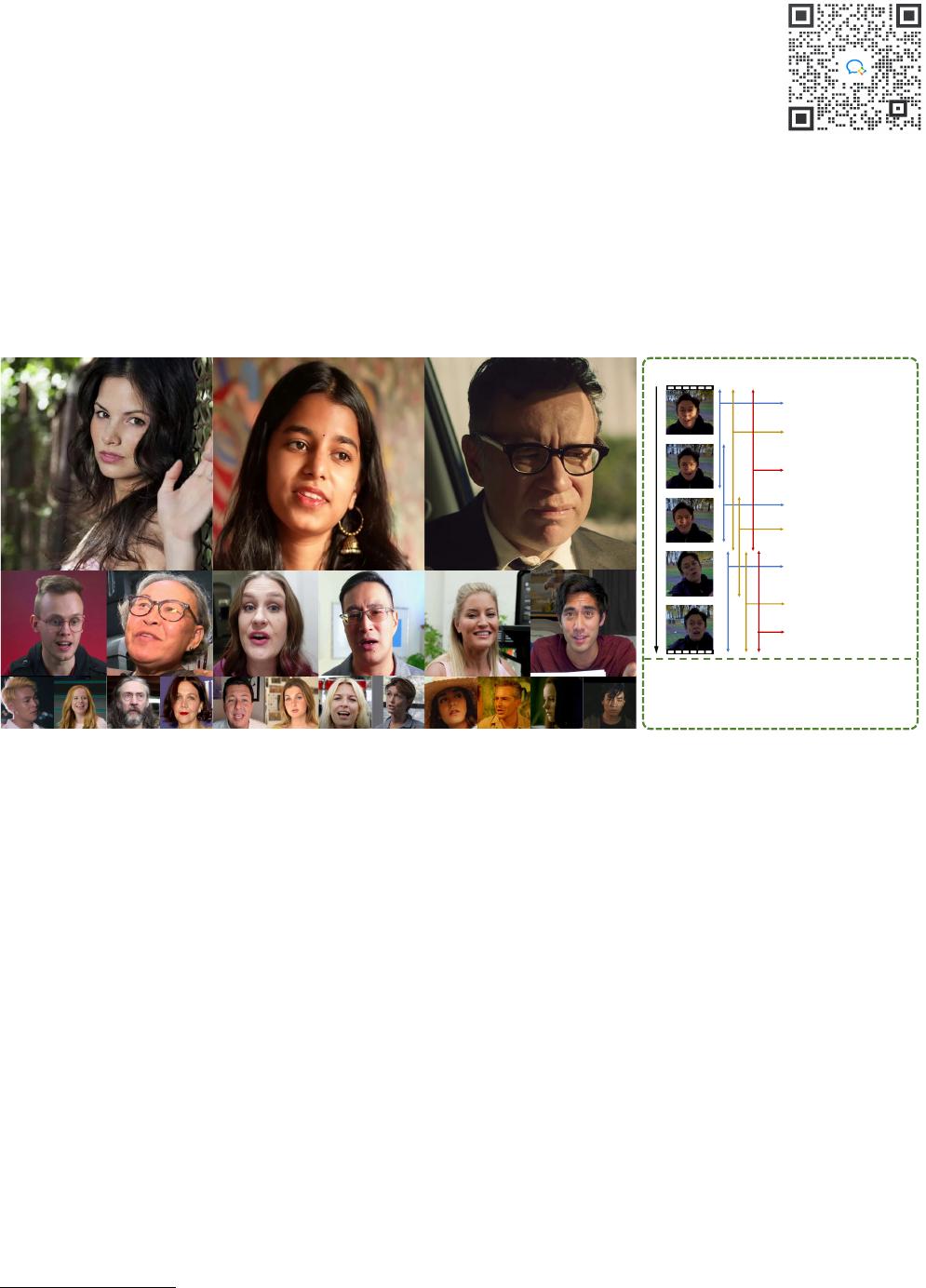
(a) Video Samples (left: general appearance, middle: detailed appearance, right:
changes to back lighting.
The light direction then
to the left of the face.
side lighting with 45 degrees
The light direction is firstly
surprised.isFinally, this man
Then, he turns to be contempt.
seems happy.
At the beginning, the man
and frowns at the same time.
In the end, he wags his head
He then smiles for a bit.
shot time.
This man begins to gaze for a
..
....
..
time
)Light directions/ Emotion/ Action(
Dynamic description:
(b) Text Descriptions
light conditions)
.temperaturecolorlightdayawithlight intensity of this video is darkThe
.freckle on the left cheekgets aHe and bags under eyes. eyebrows
archedThe man has a short black hair with a receding hairline. He has
)Light conditions/ Detailed Appearance / General Appearance(
Static description:
Figure 1. Overview of CelebV-Text. CelebV-Text contains (a) 70, 000 video samples and (b) 1, 400, 000 text descriptions. Each video
sample is annotated with general appearance, detailed appearance, light conditions, action, emotion, and light directions.
Abstract
Text-driven generation models are flourishing in video
generation and editing. However, face-centric text-to-video
generation remains a challenge due to the lack of a suitable
dataset containing high-quality videos and highly relevant
texts. This paper presents CelebV-Text, a large-scale, di-
verse, and high-quality dataset of facial text-video pairs, to
facilitate research on facial text-to-video generation tasks.
CelebV-Text comprises 70,000 in-the-wild face video clips
with diverse visual content, each paired with 20 texts gen-
erated using the proposed semi-automatic text generation
strategy. The provided texts are of high quality, describ-
ing both static and dynamic attributes precisely. The supe-
riority of CelebV-Text over other datasets is demonstrated
via comprehensive statistical analysis of the videos, texts,
and text-video relevance. The effectiveness and potential
of CelebV-Text are further shown through extensive self-
evaluation. A benchmark is constructed with representa-
tive methods to standardize the evaluation of the facial text-
to-video generation task. All data and models are publicly
available
1
.
*
Equal contribution.
1
Project page: https://celebv-text.github.io
1. Introduction
Text-driven video generation has recently garnered sig-
nificant attention in the fields of computer vision and com-
puter graphics. By using text as input, video content can be
generated and controlled, inspiring numerous applications
in both academia and industry [5,35,45,49]. However, text-
to-video generation still faces many challenges, particularly
in the face-centric scenario where generated video frames
often lack quality [19, 35, 39] or have weak relevance to in-
put texts [2,4,41,74]. We believe that one of the main issues
is the absence of a well-suited facial text-video dataset con-
taining high-quality video samples and text descriptions of
various attributes highly relevant to videos.
Constructing a high-quality facial text-video dataset
poses several challenges, mainly in three aspects. 1) Data
collection. The quality and quantity of video samples
largely determine the quality of generated videos [11, 47,
50, 66]. However, obtaining such a large-scale dataset with
high-quality samples while maintaining a natural distribu-
tion and smooth video motion is challenging. 2) Data an-
notation. The relevance of text-video pairs needs to be en-
sured. This requires a comprehensive coverage of text for
describing the content and motion appearing in the video,
1
arXiv:2303.14717v1 [cs.CV] 26 Mar 2023
such as light conditions and head movements. 3) Text gen-
eration. Producing diverse and natural texts are non-trivial.
Manual text generation is expensive and not scalable. While
auto-text generation is easily extensible, it is limited in nat-
uralness.
To overcome the challenges mentioned above, we care-
fully design a comprehensive data construction pipeline that
includes data collection and processing, data annotation,
and semi-auto text generation. First, to obtain raw videos,
we follow the data collection steps of CelebV-HQ, which
has proven to be effective in [73]. We introduce a minor
modification to the video processing step to improve the
video’s smoothness further. Next, to ensure highly relevant
text-video pairs, we analyze videos from both temporal dy-
namics and static content and establish a set of attributes
that may or may not change over time. Finally, we propose
a semi-auto template-based method to generate texts that
are diverse and natural. Our approach leverages the advan-
tages of both auto- and manual-text methods. Specifically,
we design a rich variety of grammar templates as [10,57] to
parse annotation and manual texts, which are flexibly com-
bined and modified to achieve high diversity, complexity,
and naturalness.
With the proposed pipeline, we create CelebV-Text,
a Large-Scale Facial Text-Video Dataset, which includes
70, 000 in-the-wild video clips with a resolution of at least
512× 512 and 1, 400, 000 text descriptions with 20 for each
clip. As depicted in Figure 1, CelebV-Text consists of high-
quality video samples and text descriptions for realistic face
video generation. Each video is annotated with three types
of static attributes (40 general appearances, 5 detailed ap-
pearances, and 6 light conditions) and three types of dy-
namic attributes (37 actions, 8 emotions, and 6 light direc-
tions). All dynamic attributes are densely annotated with
start and end timestamps, while manual-texts are provided
for labels that cannot be discretized. Furthermore, we have
designed three templates for each attribute type, resulting in
a total of 18 templates that can be flexibly combined. All
attributes and manual-texts are naturally described in our
generated texts.
CelebV-Text surpasses existing face video datasets [11]
in terms of resolution (over 2 times higher), number of sam-
ples, and more diverse distribution. In addition, the texts in
CelebV-Text exhibit higher diversity, complexity, and natu-
ralness than those in text-video datasets [20, 73]. CelebV-
Text also shows high relevance of text-video pairs, validated
by our text-video retrieval experiments [18]. To further ex-
amine the effectiveness and potential of CelebV-Text, we
evaluate it on a representative baseline [20] for facial text-
to-video generation. Our results show better relevance be-
tween generated face videos and texts when compared to
a state-of-the-art large-scale pretrained model [27]. Fur-
thermore, we show that a simple modification of [20] with
text interpolation can significantly improve temporal coher-
ence. Finally, we present a new benchmark for text-to-video
generation to standardize the facial text-to-video generation
task, which includes representative models [5, 20] on three
text-video datasets.
The main contributions of this work are summarized as
follows: 1) We propose CelebV-Text, the first large-scale
facial text-video dataset with high-quality videos, as well
as rich and highly-relevant texts, to facilitate research in fa-
cial text-to-video generation. 2) Comprehensive statistical
analyses are conducted to examine video/text quality and
diversity, as well as text-video relevance, demonstrating the
superiority of CelebV-Text. 3) A series of self-evaluations
are performed to demonstrate the effectiveness and poten-
tial of CelebV-Text. 4) A new benchmark for text-to-video
generation is constructed to promote the standardization of
the facial text-to-video generation task.
2. Related Work
Text-to-Video Generation. Text-driven video generation,
which involves generating videos from text descriptions,
has recently gained significant interest as a challenging task.
Mittal et al. [45] first introduced this task to generate se-
mantically consistent videos conditioned on encoded cap-
tions. Other studies, such as [5, 16, 48], attempt to generate
video samples conditioned on encoded text inputs. How-
ever, due to the low richness of text descriptions and the
small number of data samples, the generated video samples
are often at low resolution or lack relevance with the input
texts. More recently, several works [20, 27, 28, 61, 63–65]
have employed discrete latent codes [17, 60] for more re-
alistic video generation. Some of these works treat videos
as a sequence of independent images [20, 27, 64, 65], while
Phenaki [61] considers temporal relations between each
frame for a more robust video decoding process. An-
other branch of studies leverage diffusion models for text-
to-video generation [21, 25, 26, 55], which require mil-
lions or billions of samples to achieve high-quality gener-
ation. While text-to-video generation methods are rapidly
evolving, they are generally designed for generating gen-
eral videos. Among these methods, only MMVID [20] has
conducted specific experiments with face-centric descrip-
tions. One possible reason for this is that facial text-to-
video generation requires more accurate and detailed text
descriptions than general tasks. However, there is currently
no suitable dataset available that provides such properties
for face-centric text-to-video generation.
Multimodal Datasets. Existing multimodal datasets can be
categorized into two classes: open-world and closed-world.
Open-world datasets [3,9,13,33,36,37,42,45,53,54,68,72]
are widely used for text-to-image/video generation tasks.
Some of them have manual annotations [13, 33, 36, 54, 68]
and part of them are directly collected from the Internet,
such as subtitles [42, 53]. Closed-world datasets are mostly
composed of images or videos collected in constrained en-
vironment with corresponding information such as text.
CLEVR [29] is a synthetic text-image dataset produced by
arranging 3D objects with different shapes under a con-
trolled background. While MUGEN [22] is a video-audio-
text dataset that was collected using CoinRun [12] by intro-
ducing audio and new interactions. The corresponding text
is produced by human annotators and grammar templates.
2
of 21
50墨值下载
【版权声明】本文为墨天轮用户原创内容,转载时必须标注文档的来源(墨天轮),文档链接,文档作者等基本信息,否则作者和墨天轮有权追究责任。如果您发现墨天轮中有涉嫌抄袭或者侵权的内容,欢迎发送邮件至:contact@modb.pro进行举报,并提供相关证据,一经查实,墨天轮将立刻删除相关内容。
下载排行榜

评论