



Multiplex Memory Network for Collaborative Filtering_BUPT, Ant Group, SMU_2020_SDM.pdf
免费下载

Multiplex Memory Network for Collaborative Filtering
Xunqiang Jiang
∗
Binbin Hu
†
Yuan Fang
‡
Chuan Shi
∗§
Abstract
Recommender systems play an important role in helping
users discover items of interest from a large resource collec-
tion in various online services. Although current deep neural
network-based collaborative filtering methods have achieved
state-of-the-art performance in recommender systems, they
still face a few major weaknesses. Most importantly, such
deep methods usually focus on the direct interaction be-
tween users and items only, without explicitly modeling
high-order co-occurrence contexts. Furthermore, they treat
the observed data uniformly, without fine-grained differenti-
ation of importance or relevance in the user-item interactions
and high-order co-occurrence contexts. Inspired by recent
progress in memory networks, we propose a novel multiplex
memory network for collaborative filtering (MMCF). More
specifically, MMCF leverages a multiplex memory layer con-
sisting of an interaction memory and two co-occurrence con-
text memories simultaneously, in order to jointly capture and
locate important and relevant information in both user-item
interactions and co-occurrence contexts. Lastly, we conduct
extensive experiments on four datasets, and the results show
the superior performance of our model in comparison with
a suite of state-of-the-art methods.
1 Introduction
In the era of information overload, recommender sys-
tems have been playing an increasingly important role in
various online services [6], including E-commerce, online
news and social media. Current recommender systems
evolve around learning an effective preference predic-
tion function based on historical user-item interaction
records, known as collaborative filtering (CF) [17]. In
particular, matrix factorization (MF) [7] is one of the
most successful methods among CF techniques, which
models the preference as the inner product of user and
item latent factors. Since the interactions between users
and items are often complex and may involve vastly dif-
∗
Beijing University of Posts and Telecommunications, China.
Email: {skd621, shichuan}@bupt.edu.cn
†
Ant Financial Services Group, China. Email:
bin.hbb@antfin.com
‡
Singapore Management University, Singapore. Email:
yfang@smu.edu.sg
§
Corresponding author
ferent underlying intentions, such a shallow representa-
tion could be inadequate in expressing the preferences.
Due to the ability of modeling non-linear functions,
deep neural networks have yielded state-of-the-art per-
formance in many research areas such as computer vi-
sion and natural language processing. The recent inte-
gration of deep models into recommender systems has
also revealed the remarkable strength of complex non-
linear transformations of user-item interactions. Exist-
ing neural network-based recommendation fall into two
broad categories. The first category replaces the tradi-
tional inner product with nonlinear neural networks to
model more complex prediction functions [2, 18]. Recent
efforts [15, 27] further utilize random walks to augment
user-item interactions, which ultimately train a more
effective deep model. The second category extends the
matrix factorization by incorporating deep representa-
tions learned from additional side information such as
review texts and videos [25, 28].
Unfortunately, these deep recommendation models
still suffer from several limitations. Consider the sce-
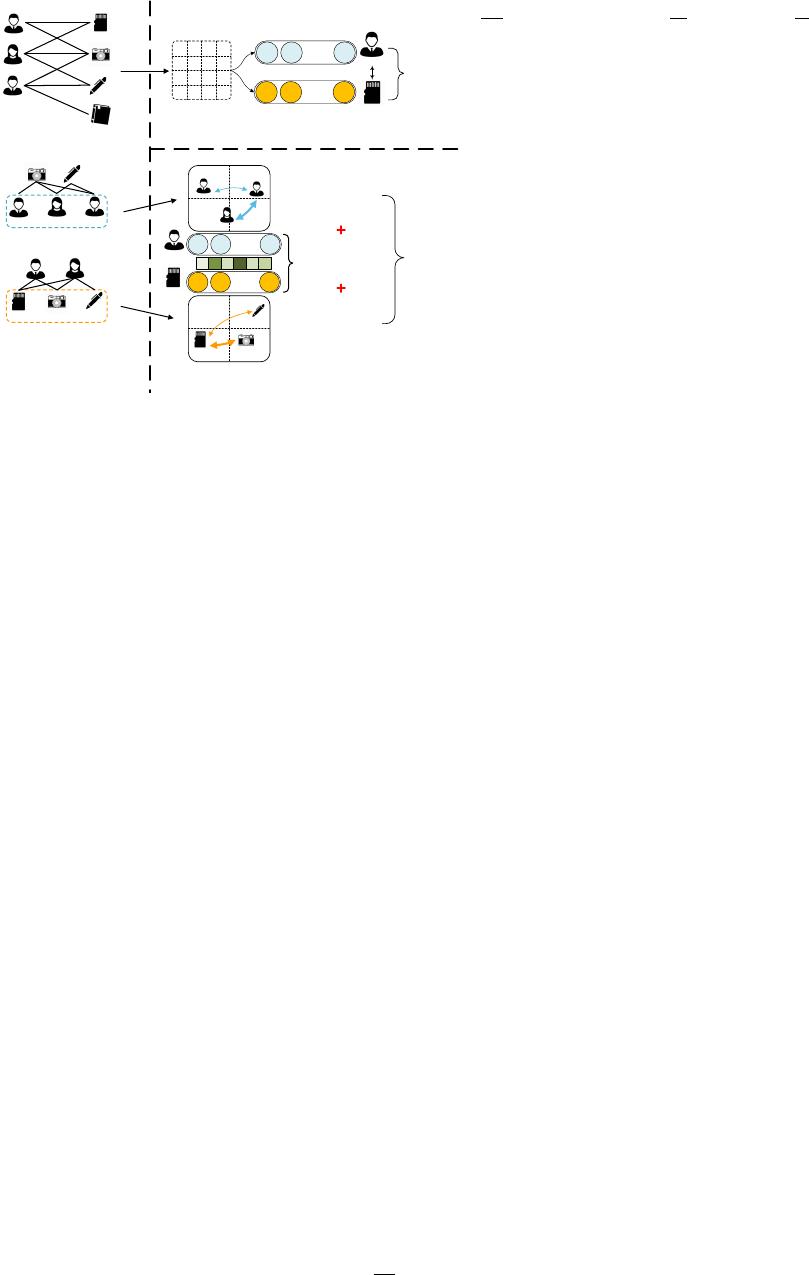
nario in Fig. 1(a1)—given that the user u
3
purchased
items such as camera (i
2
), pen (i
3
) and book (i
4
) in
the past, the recommender system needs to determine
whether u
3
is likely to purchase a memory card (i
1
).
One limitation of the previous deep models, as
sketched in Fig. 1(b), is that they mainly focus on the
direct interaction between users and items, without ex-
plicitly accounting for the high-order co-occurrence con-
texts between users and items, respectively. Examples
are the co-purchase contexts between users such as u
1
and u
2
both purchasing the same item camera (i
2
) in
Fig. 1(a2), as well as the co-purchased context between
items such as the memory card (i
1
) and camera (i
2
) both
purchased by the same user u
1
in Fig. 1(a3). Such high-
order contexts are especially crucial in sparse datasets
lacking enough user-item interactions. While some ex-
isting works [1, 4, 27] have attempted to utilize higher-
order information, they focus on enriching user-item in-
teractions, rather than explicitly modeling user-user and
item-item contexts.
Second, most previous works treat the observed
data (i.e., user-item interactions and co-occurrence con-
texts) uniformly, without fine-grained differentiation of
their underpinning preferences or importance. Intu-
91
Copyright © 2020 by SIAM
Unauthorized reproduction of this article is prohibited
Downloaded 01/12/24 to 27.19.3.156 . Redistribution subject to SIAM license or copyright; see https://epubs.siam.org/terms-privacy
User Item
(b) Previous Models
𝒖
𝟑
𝒊
𝟑
Interaction
Embedding
Co-occurrence
User Embedding
Co-occurrence
Item Embedding
Prediction
(c) Our Model
(a) User-Item Interactions
and Co-occurrence context
𝒊
𝟏
𝒊
𝟐
𝒊
𝟑
𝒊
𝟒
𝒖
𝟐
𝒖
𝟏
𝒖
𝟑
𝒖
𝟐
𝒖
𝟏
𝒖
𝟑
𝒊
𝟐
𝒖
𝟐
𝒖
𝟏
𝒊
𝟏
𝒊
𝟐
𝒊
𝟑
𝒖
𝟐
𝒖
𝟏
𝒊
𝟏
𝒊
𝟐
𝒊
𝟑
User-Item
Interaction
0.7 0.3 0.8
0.3 0.4 0.7
Prediction
0.7 0.3 0.8
0.3 0.4 0.7
𝒖
𝟑
𝒊
𝟏
𝒖
𝟑
𝒊
𝟏
(a1) User-Item Interactions
(a2) User Co-occurrence
(a3) Item Co-occurrence
Figure 1: Illustration of our problem. (a) User-item
interactions and co-occurrence contexts. (b) Previous
models focusing on user-item interactions. (c) Our
model with fine-grained interactions and co-occurrence
contexts.
itively, a user-item interaction could be influenced by
diverse preferences, given users from different demo-
graphic, socioeconomic or cultural groups. Generally,
such diverse preferences may be weighed differently in
different interactions. While such differentiation has
been explored to some extent for user-item interactions
[1, 23, 30], it remains an open question for co-occurrence
contexts, which are likewise not uniformly important
to the recommendation. As shown in Fig. 1(c), given
a memory card (i
1
), the co-occurring camera (i
2
) is a
more important context than a pen (i
3
), as memory card
and camera are more complementary in nature. Similar
scenarios exist in user co-occurrence contexts. Thus, in
both user-item interactions and co-occurrence contexts,
we need a fine-grained model that allows different pref-
erences and contexts to receive varying attention.
To deal with the above considerations, two critical
questions must be addressed. First, how to integrate
user-item interactions and co-occurrence contexts in a
unified and end-to-end manner? Second, how to enable
fine-grained differentiation for both user-item interac-
tions and co-occurrence contexts? Inspired by the re-
cent progress in memory networks [14, 20], a few studies
[1, 23, 24] have employed memory networks in recom-
mender systems, which have the advantage of modeling
fine-grained preferences with a memory module. How-
ever, their architecture only operates with a single type
of memory centering around user-item interactions. Dif-
ferent from them, we firstly propose a novel Multiplex
Memory Network for Collaborative Filtering (MMCF),
which leverages multiplex memory layers to jointly cap-
ture user-item interactions and the co-occurrence con-
texts simultaneously in one framework. More specifi-
cally, the multiplex memory layer is designed to accom-
modate multiple types of memory concurrently, consist-
ing of an interaction memory to model user-item in-
teractions and two co-occurrence context memories to
model user-user and item-item contexts, respectively.
These memories are not independent and their inter-
play is also captured by our model. Furthermore, to-
wards fine-grained interactions and contexts, for each
type of memory, an attention mechanism is employed
to locate the important and relevant information in the
memory slots.
In summary, we make the following contributions.
(1) We highlight the importance of explicitly modeling
the user and item co-occurrence contexts in deep mod-
els especially when the user-item interactions are sparse,
which is also observed empirically in our experiments.
(2) We propose a novel model MMCF, a deep multiplex
memory network to jointly capture fine-grained user-
item interactions and co-occurrence contexts through
multiple types of memory in an unified, end-to-end
framework. To our best knowledge, MMCF is the first
memory network concurrently employing multiple types
of memory for collaborative filtering. (3) We conduct
extensive experiments on four real-world benchmarks,
validating the effectiveness of MMCF and its assump-
tions.
2 Related Work
Collaborative filtering (CF) aims to recommend a suit-
able list of items based on historical user-item inter-
action records. In particular, the matrix factorization
(MF) method [5, 7] has shown its effectiveness in many
applications, which decomposes the user-item interac-
tion matrix to learn low-rank latent user and item fac-
tors. Furthermore, many studies [4, 10, 13, 19] have
been proposed to incorporate additional side informa-
tion. In spite of the success of existing CF-based rec-
ommendation methods, they still suffer from the limited
ability of modeling more complex user-item interactions.
Due to the ability of modeling arbitrary non-linear
functions, deep neural networks endow recommender
system with the potential of capturing more complex
and intricate user-item interactions [2, 8, 9, 12, 18].
Similar to the traditional MF-based model, various
attempts [4, 22] have been made to integrate different
side information into the deep models. However, most
of these deep models only concern with coarse-grained
user-item interactions.
To enable fine-grained modeling, several studies at-
92
Copyright © 2020 by SIAM
Unauthorized reproduction of this article is prohibited
Downloaded 01/12/24 to 27.19.3.156 . Redistribution subject to SIAM license or copyright; see https://epubs.siam.org/terms-privacy
of 9
免费下载
【版权声明】本文为墨天轮用户原创内容,转载时必须标注文档的来源(墨天轮),文档链接,文档作者等基本信息,否则作者和墨天轮有权追究责任。如果您发现墨天轮中有涉嫌抄袭或者侵权的内容,欢迎发送邮件至:contact@modb.pro进行举报,并提供相关证据,一经查实,墨天轮将立刻删除相关内容。
下载排行榜

评论