



VLDB2024_AutoTQA:Towards Autonomous Tabular Question Answering through Multi-Agent Large Language Models_PingCAP.pdf
免费下载

AutoTQA: Towards Autonomous Tabular estion Answering
through Multi-Agent Large Language Models
Jun-Peng Zhu
East China Normal University
& PingCAP, China
zjp.dase@stu.ecnu.edu.cn
Peng Cai
East China Normal University
pcai@dase.ecnu.edu.cn
Kai Xu
PingCAP, China
xukai@pingcap.com
Li Li
PingCAP, China
lili@pingcap.com
Yishen Sun
PingCAP, China
sunyishen@pingcap.com
Shuai Zhou
PingCAP, China
zhoushuai@pingcap.com
Haihuang Su
PingCAP, China
suhaihuang@pingcap.com
Liu Tang
PingCAP, China
tl@pingcap.com
Qi Liu
PingCAP, China
liuqi@pingcap.com
ABSTRACT
With the growing signicance of data analysis, several studies aim
to provide precise answers to users’ natural language questions
from tables, a task referred to as tabular question answering (TQA).
The state-of-the-art TQA approaches are limited to handling only
single-table questions. However, real-world TQA problems are in-
herently complex and frequently involve multiple tables, which
poses challenges in directly extending single-table TQA designs to
handle multiple tables, primarily due to the limited extensibility of
the majority of single-table TQA methods.
This paper proposes AutoTQA, a novel
Auto
nomous
T
abular
Q
uestion
A
nswering framework that employs multi-agent large
language models (LLMs) across multiple tables from various sys-
tems (e.g., TiDB, BigQuery). AutoTQA comprises ve agents: the
User, responsible for receiving the user’s natural language inquiry;
the Planner, tasked with creating an execution plan for the user’s in-
quiry; the Engineer, responsible for executing the plan step-by-step;
the Executor, provides various execution environments (e.g., text-to-
SQL) to fulll specic tasks assigned by the Engineer; and the Critic,
responsible for judging whether to complete the user’s natural lan-
guage inquiry and identifying gaps between the current results and
initial tasks. To facilitate the interaction between dierent agents,
we have also devised agent scheduling algorithms. Furthermore,
we have developed LinguFlow, an open-source, low-code visual
programming tool, to quickly build and debug LLM-based appli-
cations, and to accelerate the creation of various external tools
and execution environments. We also implemented a series of data
connectors, which allows AutoTQA to access various tables from
multiple systems. Extensive experiments show that AutoTQA de-
livers outstanding performance on four representative datasets.
This work is licensed under the Creative Commons BY-NC-ND 4.0 International
License. Visit https://creativecommons.org/licenses/by-nc-nd/4.0/ to view a copy of
this license. For any use beyond those covered by this license, obtain permission by
emailing info@vldb.org. Copyright is held by the owner/author(s). Publication rights
licensed to the VLDB Endowment.
Proceedings of the VLDB Endowment, Vol. 17, No. 12 ISSN 2150-8097.
doi:10.14778/3685800.3685816
PVLDB Reference Format:
Jun-Peng Zhu, Peng Cai, Kai Xu, Li Li, Yishen Sun, Shuai Zhou, Haihuang
Su, Liu Tang, Qi Liu. AutoTQA: Towards Autonomous Tabular Question
Answering through Multi-Agent Large Language Models. PVLDB, 17(12):
3920 - 3933, 2024.
doi:10.14778/3685800.3685816
1 INTRODUCTION
Tabular Question Answering (TQA) [
4
,
7
,
8
,
12
,
16
,
20
,
24
,
27
,
52
–
54
,
59
] is a crucial task in data analysis, focusing on providing
answers from tables in response to a user’s natural language (NL)
inquiry. Data are commonly presented in tabular form in scenarios
such as nancial reports and statistical reports. Users often need
expertise to handle and address questions in such scenarios eec-
tively. TQA approaches address these issues without demanding
extensive expertise in natural language processing and data analy-
sis. In a real scenario, however, tables have complex forms, such
as relational database (RDB) tables (i.e., structured tables) and web
tables. Furthermore, TQA tasks can encompass the manipulation of
multiple tables, including operations such as joins, set operations,
and others. The ongoing exploration of a unied TQA framework
applicable to various scenarios remains a prominent research focus
within data analysis and natural language processing.
The state-of-the-art large language models (LLMs) such as Chat-
GPT [
25
], BLOOM [
36
] and LLaMA [
39
] have experienced rapid
development, to achieve general articial intelligence, showcas-
ing remarkable zero-shot [
44
] capabilities in a variety of linguistic
applications. However, while these LLMs demonstrate excellence
in general knowledge, their performance within specic domains,
such as data analysis, may yield somewhat erroneous answers and
should not be entirely relied upon due to a lack of domain-specic
training [
60
]. The emergence of LLMs presents new opportunities
and challenges for the tasks associated with TQA.
Limitations of Prior Art. As far as we know, state-of-the-art
TQA approaches have their limitations:
(1) Lack of eective solutions in multi-table TQA. Current
TQA approaches [
8
,
16
,
24
,
52
,
54
] are typically limited to address-
ing single-table TQA tasks. In this context, users send a natural
language inquiry, and these approaches can only analyze data from
3920
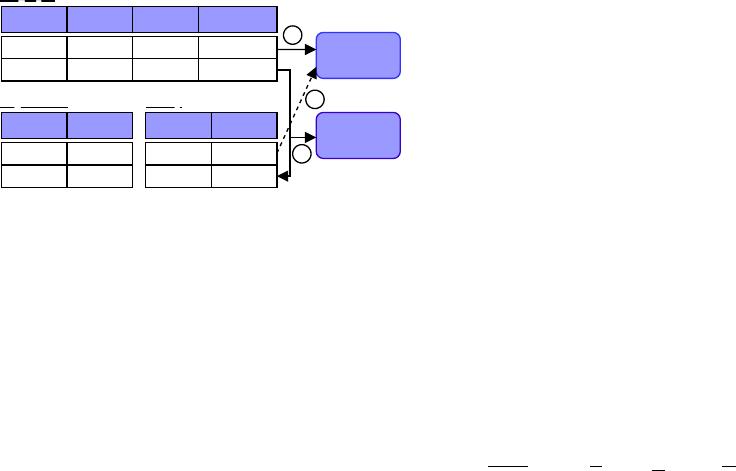
ID Name Email Depno
001 Lucy lucy@com 1
002 Tom tom@com 2
Employee
ID Bonus
001 $2100
002 $1569
Salary
What is the year-end bonus for Tom?
Single-table
QA
Depno DepName
1 R&D
2 FINANCE
Department
Multi-table
QA
1
2
3
Figure 1: A Motivating Example for Multiple Tables TQA.
a single table specied by a user to provide answers. Typically, this
process involves employing Python or SQL for data manipulation
on a single table. However, a common scenario arises where, for
example, for convenience of management, the company stores basic
employee information in the Employee table. Simultaneously, the
nance department establishes a Salary table for eective salary
management and security, housing employee IDs and the corre-
sponding salary details. When sending an inquiry such as “What
is the year-end bonus for Tom?”, it is required to perform a table
join operation, joining the Employee and Salary tables using the
employee ID as the join key. As depicted in Figure 1, in this instance,
the Employee table and the Salary table individually (➀ or ➁) can-
not answer the user’s inquiry. An operation of join (
➂
) between the
two tables is required. In addition to executing a table join, the task
may require complex analyses, such as set operations. It may even
be necessary to perform multiple complex operations in a specic
order (or steps) on multiple tables. MultiTabQA [
27
] is a method
that is able to address TQA tasks in multiple tables. Nevertheless,
it requires elaborate pre-training and ne-tuning processes, pos-
ing signicant complexity for the PingCAP. The task of multiple
tables TQA has not yet received exhaustive research attention, and
it continues to exhibit the following two limitations.
(2) Lack of adequate exploration of LLM capabilities. The
state-of-the-art ReAcTable [
54
], uses a combination of Chain of
Thought (CoT) [
45
] and ReAct [
51
] paradigm to facilitate responses
to user’s questions. However, relying solely on these two in-context
learning approaches is inadequate to fully explore the capabilities
of LLM. In the context of ReAcTable, the challenge arises when en-
countering an empty answer at an intermediate step, as the method
faces diculty distinguishing between an incorrect response and
a genuinely empty one. Through extensive experiments, we have
identied numerous factors contributing to the occurrence of empty
answers. Furthermore, it is crucial to note that encoding the data
from the table directly into the ReAcTable prompt [
54
] is not prac-
tical, especially for large tables in business operations. Another
crucial capability of LLMs is their ability to learn from conversa-
tions. LLMs represent a type of generative articial intelligence
from conversations, and existing TQA methods utilizing LLMs do
not fully exploit this potential. Providing appropriate guidance to
LLMs is likely to result in more accurate responses and improve
overall eciency.
(3) Lack of solutions for manipulating multiple tables from
multiple systems. The state-of-the-art TQA approaches [
7
,
12
,
16
,
20
,
24
,
54
,
59
] face challenges when simultaneously dealing with
structured database tables and semi-structured tables (such as web
tables). These tables could be stored in MySQL, S3 object storage, or
obtained in real time through APIs. These approaches require users
to undergo an intricate preprocessing and extract, transform, and
load (ETL) process, thereby signicantly increasing the complexity
of the TQA task. Large-scale ETL processes executed in batches
typically require signicant resources. Users of TQA should be
freed from these complexities.
Key Technical Challenges. As mentioned above, we summa-
rize the challenges in the design of the TQA approaches for the
dierent scenarios:
•
The rst technical challenge is how to design and imple-
ment a unied TQA framework capable of addressing both
single table and multiple tables TQA tasks.
•
The second technical challenge is how to maximize the uti-
lization of the LLM’s capabilities to provide answers while
concurrently verifying the correctness of those answers.
•
The third technical challenge is how to eciently manage
various tables from multiple systems.
Proposed Approach. To this end, we propose AutoTQA, an
Auto
nomous
T
abular
Q
uestion
A
nswering framework employing
multi-agent large language models in this paper. To overcome the
rst two challenges, we introduce AutoTQA, designed to eciently
support the TQA tasks of single table and multiple tables. AutoTQA
delves into multi-agent LLMs, involving ve distinct roles: User,
Planner, Engineer, Executor, and Critic. These agents collaborate
to respond to user inquiries through conversations. The User for-
mulates the question in natural language, the Planner generates a
detailed execution plan that combines standard operation proce-
dure (SOP) of business operations, the Engineer executes the plan
step-by-step, and the Executor invokes the suitable LLM-based ap-
plications for data processing using Python or SQL. Throughout
the task, the Critic intervenes to evaluate task completion and iden-
tify gaps in the plan and original tasks. Upon detecting gaps, the
Critic instructs the Planner to revise the plan. To precisely sched-
ule dierent agents to collaborate on tasks, we also propose agent
scheduling algorithms. To address the third challenge, AutoTQA
integrates a series of data connectors utilizing Trino [
37
,
40
] to
streamline access to data from multiple systems within a single
query.
It is essential to note that when the Engineer is tasked with
a specic sub-task, it does not execute the task directly, such as
writing Python or SQL code. The Engineer only needs to describe
the task and then delegate it to Executor. The Executor initializes
with the LLM-based execution environment, adapting to various
requirements (or tasks). AutoTQA decouples the Engineer from
the specic execution process, making it easier to locate problems
and improve accuracy in the LLM-based execution environment.
Rapidly and eciently building and debugging LLM-based applica-
tions presents challenges. To address this challenge, we developed
and implemented LinguFlow, an open source, low code visual pro-
gramming tool for the development and deployment of LLM-based
applications. Serving as a low-code programming tool, LinguFlow
helps application developers in the rapid construction, debugging,
and deployment of LLM-based applications. Developers need only
3921
of 14
免费下载
【版权声明】本文为墨天轮用户原创内容,转载时必须标注文档的来源(墨天轮),文档链接,文档作者等基本信息,否则作者和墨天轮有权追究责任。如果您发现墨天轮中有涉嫌抄袭或者侵权的内容,欢迎发送邮件至:contact@modb.pro进行举报,并提供相关证据,一经查实,墨天轮将立刻删除相关内容。
下载排行榜

文档被以下合辑收录
评论