



REGER: Reordering Time Series Data for Regression Encoding.pdf
100墨值下载
REGER: Reordering Time Series Data for
Regression Encoding
Jinzhao Xiao
Tsinghua University
xjc22@mails.tsinghua.edu.cn
Wendi He
Tsinghua University
he-wd21@mails.tsinghua.edu.cn
Shaoxu Song
∗
BNRist, Tsinghua University
sxsong@tsinghua.edu.cn
Xiangdong Huang
Timecho Ltd
hxd@timecho.com
Chen Wang
Timecho Ltd
wangchen@timecho.com
Jianmin Wang
Tsinghua University
jimwang@tsinghua.edu.cn
Abstract—Regression models are employed in lossless compres-
sion of time series data, by storing the residual of each point,
known as regression encoding. Owing to value fluctuation, the
regression residuals could be large and thus occupy huge space.
It is worth noting that compared to the fluctuating values, time
intervals are often regular and easy to compress, especially in
the IoT scenarios where sensor data are collected in a preset
frequency. In this sense, there is a trade-off between storing
the regular timestamps and fluctuating values. Intuitively, rather
than in time order, we may exchange the data points in the
series such that the nearby ones have both smoother timestamps
and values, leading to lower residuals. In this paper, we propose
to reorder the time series data for better regression encoding.
Rather than recomputing from scratch, efficient updates of
residuals after moving some points are devised. The experimental
comparison over various real-world datasets, either public or
collected by our industrial partners, illus trates the superiority of
the proposal in compression ratio. The method, REGression En-
coding with Reordering (REGER), has now become an encoding
method in an open-source time series database, Apache IoTDB.
Index Terms—time series, regression, encoding, reordering
I. INTRODUCTION
While a number of data encoding methods can be applied
to compress time series [36], lossless regression encoding is
found effective, such as FIRE in SPRINTZ [11]. The idea is
to learn regression models over the time series and record the
corresponding residuals. By adding model predictions with the
stored residuals, it decodes the compressed time series.
To illustrate the significance of regression encoding, con-
sider the sequence of timestamps in Figure 1(a). As shown, the
timestamps have a clear increasing pattern and thus are highly
predictable by a regression model. The corresponding residuals
of the auto-regression model are small as reported in Figure
2(a). Storing the much smaller residuals and regression ratio is
obviously more efficient than the original timestamps. Hence,
the application scenarios of regression encoding are those
sequences highly predictable with small r egression residuals.
A. Motivation
Unfortunately, time series may have large value fluctuations,
leading to huge space of residuals. For instance, Figure 1(b)
∗
Shaoxu Song (https://sxsong.github.io/) is the corresponding author.
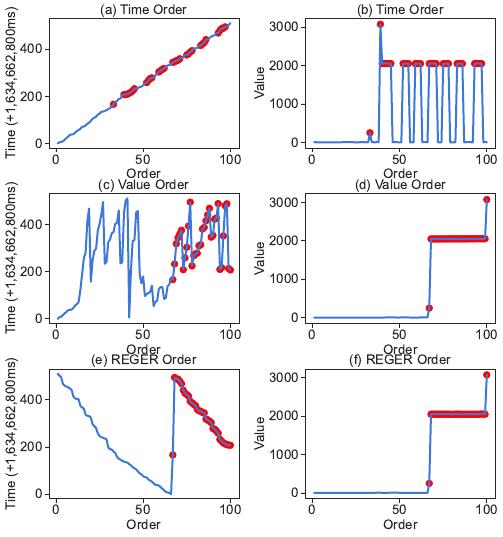
Fig. 1: Data points of timestamps and values cropped from a real-word time
series CS-Sensors in Figure 9(f), ordered by time in (a) and (b ), by value in
(c) and (d), or by our proposal in (e) and (f), with various fluctuations. The
red points denote those moved by our REGER.
illustrates the values of points ordered by timestamps. It is
difficult to learn a regression model to capture the fluctuating
pattern. Hence, the model prediction will be inaccurate, and
the residuals are l arge to store for lossless regression encoding.
Note that data points in a time series may not always
be sorted by timestamps [37]. For example, one may order
a series by values [35]. While the values become smoother
and better for regression as illustrated in Figure 1(d), the
corresponding timestamps in Figure 1(c) fluctuate more sig-
nificantly than that ordered by time in Figure 1(a). The overall
residuals of time and value are not improved.
Intuitively, we may only move together some of the data
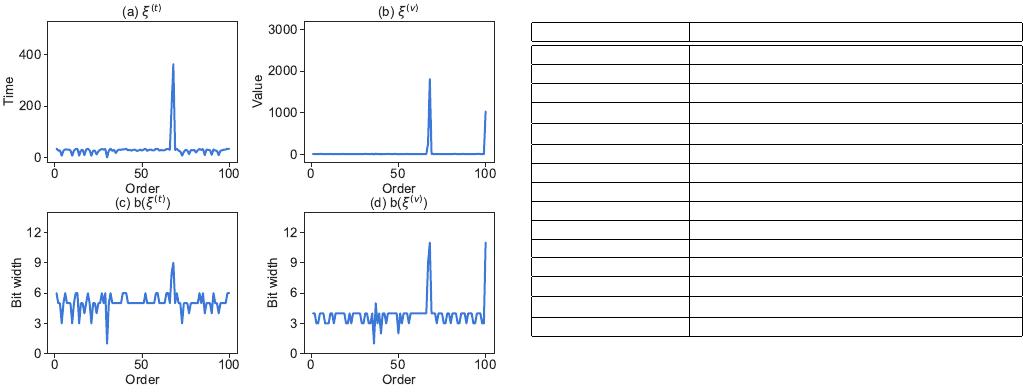
Fig. 2: The encoded series ξ of regression residuals and the corresponding
bitwidth series b(ξ) in Example 1, for time series x in Figure 1(a) and (b)
points with both similar time and value in the series. For
example, we exchange the red points to the new positions
such that the significantly fluctuating values originally in
Figure 1(b) become more stable for regression in Figure 1(f).
Meanwhile, the corresponding nearby timestamps in Figure
1(e) are similar as well. As shown, the newly introduced
timestamp fluctuation is not as significant as that removed in
value. It is also less fluctuating than Figure 1(c), where the
points are ordered by value. In this sense, the overall residuals
of time and value are reduced in regression encoding.
B. Solution
Note that timestamps are crucial in IoT applications. Hence,
in regression encoding, both timestamps and values are en-
coded and stored, in the same order of data points. For data
points ordered by timestamps in Figure 1(a)(b), while the
timestamp storage is effective, the corresponding values have
large fluctuations and thus large auto-regression residuals. On
the other hand, for data points ordered by values in Figure
1(c)(d), the value storage is efficient, whereas the correspond-
ing timestamps suffer large fluctuations and again large auto-
regression residuals. To balance the trade-off, we propose to
find a better ordering of data points (by Algorithm 1) that may
have smaller residuals of auto-regression on timestamps and
values, respectively, and consequently the total storage usage.
Since both timestamps and values are encoded and stored,
they can be naturally decoded, respectively, by adding the
auto-regression model predictions with the stored residuals.
The decoded data points of timestamps and values are then
ordered again on timestamps, recovering exactly the original
time series by Algorithm 2. Therefore, REGER is lossless and
will not destroy the downstream tasks.
C. Contribution
Our major contributions in this study are as follows.
TABLE I: Notations
Notation Description
x a time series
n the number of values in a block of time series
q the number of values in a pack of time series
x
(t)
, x
(v)
timestamps and values of time series x
f
(t)
, f
(v)
regression models for timestamp and value
ǫ residual series of x
ξ encoded series o f ǫ
b(ξ) bitwidth series of ξ
x
A
x reordered by order A
x
α→β
reorder x by moving α-th point to position β
g(j ) points affected by moving a point from α
h(j ) points affected by moving a point to j
H (ξ
g(j )
),H (ξ
h(j )
) residual cost of g(j ) and h(j ) points in ξ
H (ξ
[1,n]\g(j )\h(j )
) residual cost of unchanged points in ξ
p the order of the autoregressive model
(1) We formalize the problem of time series reordering
for regression encoding, in Section II. Finding the optimal
reordering of time series for regression encoding, however,
is costly and not affordable during the extremely fast data
ingestion, especially in t he IoT scenarios.
(2) We propose an efficient heuristic algorithm that moves
one point at a time, leading to lower residuals, in Section III.
Rather than recomputing from scratch, an efficient incremental
strategy is devised for updating residuals after point moving.
(3) Remarkably, the proposed method, REGression Encod-
ing with Reordering (REGER), has now become an encoding
method in an open-source time series database, Apache IoTDB
[18], [34]. We present the system deployment in Section IV.
(4) We conduct extensive experiments over various real-
world datasets. The results demonstrate that the reordered time
series has better compression ratio than the natural time order.
The code of REGER method has been included in the
system repository of Apache IoTDB [6]. The experiment
related code and data are available in [7] for reproducibility.
Table I lists the frequently used notations.
II. ENCODING METHOD
Since large fluctuations like abnormal behaviors often ap-
pear in t ime series, the residuals will be very l arge for regres-
sion encoding. It leads to more bit widths for storing residuals,
higher space cost. Thus, we propose a method that reorders
the time series, which could reduce the bit widths of residuals.
In the following, we introduce regression encoding in Section
II-B and time s eries reordering problem in Section II-C.
A. Preliminary
Consider a time series of n data points. It usually corre-
sponds to a block in the database management system for data
encoding, as introduced in Section IV below.
Definition 1 (Time Series): A time series is denoted by two
sequences of time and value,
x = (x
(t)
, x
(v)
),
where x
(t)
contains n timestamps, and x
(v)
has n values.
x
(t)
= (x
(t)
1
, x
(t)
2
, . . . , x
(t)
n
), x
(v)
= (x
(v)
1
, x
(v)
2
, . . . , x
(v)
n
).
2
of 13
100墨值下载
【版权声明】本文为墨天轮用户原创内容,转载时必须标注文档的来源(墨天轮),文档链接,文档作者等基本信息,否则作者和墨天轮有权追究责任。如果您发现墨天轮中有涉嫌抄袭或者侵权的内容,欢迎发送邮件至:contact@modb.pro进行举报,并提供相关证据,一经查实,墨天轮将立刻删除相关内容。
下载排行榜

评论