



Graph_Convolutional_Neural_Network_for_Intelligent_Fault_Diagnosis_of_Machines_via_Knowledge_Graph.pdf
免费下载
7862 IEEE TRANSACTIONS ON INDUSTRIAL INFORMATICS, VOL. 20, NO. 5, MAY 2024
Graph Convolutional Neural Network for
Intelligent Fault Diagnosis of Machines
via Knowledge Graph
Zehui Mao , Senior Member, IEEE, Huan Wang , Bin Jiang , Fellow, IEEE, Juan Xu , Member, IEEE,
and Huifeng Guo
Abstract—Considering the challenge of deep mining of
root causes in machine failures, a knowledge aggrega-
tion fault diagnosis (KAFD) model is proposed, in which
the graph convolutional network (GCN) GraphSAGE is im-
proved and introduced into the knowledge graph (KG)-
based fault diagnosis. Historical maintenance data of ma-
chines is used to construct a fault phenomenon-FBG,
which is then combined with the fault diagnosis knowledge
graph (FDKG) to form a collaborative FDKG. A single-layer
knowledge aggregation network (KAN) that incorporates
sensitivity factors and configures different types of GCN
aggregators is constructed in the proposed KAFD. Based
on deep neighbor aggregation operations on collaborative
FDKG, KAFD obtained by stacking multiple KANs, can cap-
ture the higher order structural information and semantic
information, which results in the multihop reasoning, im-
provement of the rationality and diversity of fault cause
tracing. The KAFD is experimentally validated through two
fault diagnosis datasets, which are constructed by the
maintenance data of an industrial enterprise, and the re-
sults demonstrate the excellent performance.
Index Terms—Fault diagnosis, graph neural networks,
industrial machines, knowledge graph (KG).
I. INTRODUCTION
I
NDUSTRIAL machines have been becoming more complex
and expensive with the high performance, as the advanced
intelligent devices and monitoring technologies are introduced
Manuscript received 23 October 2023; revised 10 December 2023;
accepted 6 February 2024. Date of publication 29 February 2024; date
of current version 6 May 2024. This work was supported in part by the
National Key Research and Development Program of China under Grant
2021YFB3301300 and in part by ZTE Industry-University-Institute Co-
operation Funds. Paper no. TII-23-3628. (Corresponding author: Juan
Xu.)
Zehui Mao, Huan Wang, and Bin Jiang are with the College of
Automation Engineering, Nanjing University of Aeronautics and As-
tronautics, Nanjing 210016, China (e-mail: zehuimao@nuaa.edu.cn;
wanghuan233@nuaa.edu.cn; binjiang@nuaa.edu.cn).
Juan Xu is with the College of Computer Science and Technology,
Nanjing University of Aeronautics and Astronautics, Nanjing 210016,
China (e-mail: juanxu@nuaa.edu.cn).
Huifeng Guo is with the State Key Laboratory of Mobile Network and
Mobile Multimedia Technology, Shenzhen 518000, China, and also with
the ZTE Corporation, Shenzhen 518000, China (e-mail: guo.huifeng2
@zte.com.cn).
Color versions of one or more figures in this article are available at
https://doi.org/10.1109/TII.2024.3367010.
Digital Object Identifier 10.1109/TII.2024.3367010
into them. However, this leads to an increasing requirement on
reliability and safety of industrial machines subjected to faults
and failures [1]. Fault diagnosis that detects the occurrence of a
fault as early as possible and identifies the location and type of
the fault as accurately as possible, is a key mean to ensure the
safety of industrial machines [2], [3].
With the development of technology, the fault diagnosis
methods are receiving more and more attention, including the
model-based methods [4], [5], data driven-based methods [6],
[7], [8], [9], and knowledge-based methods [10]. As a significant
amount of maintenance records can be accumulated during the
long-term maintenance and repair processes of industrial ma-
chines, which contain the valuable knowledge and information
related to machine fault diagnosis.
Knowledge-based fault diagnosis methods commonly include
expert systems, fault tree analysis, and knowledge graphs (KGs).
By automating the acquisition, organization, and analysis of
various machine information, including maintenance history and
expert experience, KG-based fault diagnosis methods can iden-
tify fault root causes and provide solutions. Existing research
mainly utilizes KG reasoning techniques [11], [12], [13], which
can make inferences about potential causes or solutions based
on entities and relations. During the machine operating, the
new data and information reflecting new faults often emerge
often generates. Incorporating new data and information into
existing KGs and reasoning requires offline updates, difficult to
be updated and improved dynamically.
Recommendation systems, by continuously collecting feed-
back from maintenance personnel during the maintenance pro-
cess, can achieve dynamic updates and continuously improve
the accuracy of fault cause recommendations, addressing the
issue of dynamic updates in KG-based fault diagnosis. Fusing
the KGs and recommendation algorithms can address the issue
of dynamic updates in KG-based fault diagnosis, which can be
primarily achieved through the propagation-based methods [14],
[15]. Propagation-based methods can expand the depth of infor-
mation reception by following the deep aggregation, thereby
fully utilizing the information in the KG to better predict fault
causes and locate potential fault causes. Deep aggregation is
the core of graph convolutional neural networks (GCN) [16],in
which GraphSAGE [17] is a representative model. But GCNs
like GraphSAGE is not feasible for weighted graphs, as they
can only perform equally weighted aggregations of neighboring
1551-3203 © 2024 IEEE. Personal use is permitted, but republication/redistribution requires IEEE permission.
See https://www.ieee.org/publications/rights/index.html for more information.
Authorized licensed use limited to: ZTE CORPORATION. Downloaded on November 26,2024 at 06:05:55 UTC from IEEE Xplore. Restrictions apply.
MAO et al.: GRAPH CONVOLUTIONAL NEURAL NETWORK FOR INTELLIGENT FAULT DIAGNOSIS OF MACHINES VIA KNOWLEDGE GRAPH 7863
nodes. In addition, GraphSAGE imposes limitations on the
number of sampled neighbors, leading to the loss of important
local information for some nodes and making it unsuitable
for representation learning tasks in KGs and requiring further
improvements.
This article aims to address the challenges of difficult fault
knowledge mining and low real-time performance by combining
KGs with recommendation systems. To tackle these challenges,
a novel knowledge aggregation fault diagnosis (KAFD) model
is proposed. The main contributions of this article are as follows.
1) As KGs and recommendation algorithms are combined
and introduced into the industrial machine fault diagnosis,
a new knowledge aggregation network (KAN) is de-
signed, which incorporates sensitivity factor to make the
GCN suitable for the structure of fault diagnosis knowl-
edge graph (FDKG). This design allows for weighted
operations on different nodes of the FDKG, considering
the importance of different neighboring entities.
2) The deep aggregation idea is applied, and the KAFD
model is constructed. By stacking KAN, KAFD expands
the depth of information reception, facilitating multihop
reasoning in the KG and further exploration of potential
fault causes.
The rest of this article are organized as follows. Section II
describes the fault diagnosis problem based on KGs. Section III
introduces the structure of the KAFD model. Section IV presents
and analyzes the performance of the KAFD model. Finally,
Section V concludes this article.
II. P
ROBLEM FORMULATION
This section analyzes the task of KG-based fault diagnosis
for industrial machines, and provides a formulation to describe
the fault diagnosis problem achieved by recommending the fault
root cause from the fault phenomenon.
A. Fault Phenomenon-Fault Root Cause Bipartite Graph
(FBG)
For fault diagnosis, recommendation system determines the
root cause of the fault from the fault phenomenon. In the
recommendation system, associations between fault phenom-
ena and causes are represented as an FBG defined as U =
{y
fs
|f ∈F,s∈S}, where F is the set of fault phenomena,
S is the set of fault root causes, and y
fs
correlation between
fault root causes and fault phenomena as
y
fs
=
1,fand s have connection in history
0, otherwise.
. (1)
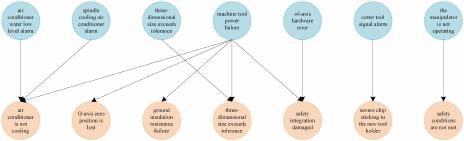
Due to the sparsity problem of the practical fault data from
the industrial machines, numerous node in the generated fault
bipartite graph only have a few correlative connections, as shown
in Fig. 1, where blue circles are the fault phenomenon and red
circle are the fault root causes. The sparse correlative connec-
tions cause some information missed in the recommendation
system, and the associations between fault phenomena and fault
root causes cannot be accurately expressed, which effect the
Fig. 1. Example of an FBG sparsity problem.
accuracy of fault diagnosis. However, the FDKG, established us-
ing the triples obtained by the knowledge extraction technology,
contains the substantial knowledge about faults. An extra KG can
help supplement the information and improve the representation
of the associations in FBG [18].
B. Fault Diagnosis Knowledge Graph
The method of taking FDKGs as auxiliary information of the
recommendation system contributes to enrich the representation
of fault phenomena and root causes, relieves the sparsity problem
of fault data, and enhances the accuracy and interpretability of
the model.
Similar to the generic KG, FDKG consists of a large number of
triples (h, r, t) as the basic units, denoted as G = {(h, r, t)|h, t ∈
E,r ∈R}, where E is the set of all entities, and R represents
the set of all relations. In the KG, facts are expressed as triples
(head entity, relation, tail entity), which are interconnected to
express real-world knowledge and facilitate computer under-
standing. In the FDKG, facts are expressed as triples (head
entity, relation, tail entity), which interconnect each other to
express knowledge for computer understanding. In this study, the
FDKG is constructed by unstructured data of industrial machines
accumulated during the production process.
C. Collaborative Knowledge Graph (CKG)
As the FDKG and the FBG are established using the different
and independent information of fault data, a CKG which can
associates these two graphs into a unified relational network to
unify the two parts of information, is necessary. The associations
between the fault phenomenon and the fault root cause are
expressed in the form of triples (phenomenon, connect, cause)
in the CKG, where y
fs
= 1 denotes as an additional relation
connect between f and s. Define the alignment set as A, which
denotes that the root cause s of the fault in the FBG can be
aligned to the entity e in the FDKG. Based on the alignment
set A, the FBG and the FDKG are combined into a unified
CKG G
= {(h, r, t)|h, t ∈E
,r ∈R
}, where E
= E∪Fand
R
= R∪{connect}.
D. High-Order Relation
In a unified CKG, high-order relations between fault phe-
nomena and root causes could be established by bridging two
entities that not directly connected. Define the L-order connec-
tion between nodes as a high-order relation path e
0
r
1
−→ e
1
r
2
−→
···
r
L
−→ e
L
, where r
l
∈E
, r
l
∈R
, l ∈ L. More correlation
information between entities could be obtained. As illustrated
Authorized licensed use limited to: ZTE CORPORATION. Downloaded on November 26,2024 at 06:05:55 UTC from IEEE Xplore. Restrictions apply.
of 9
免费下载
【版权声明】本文为墨天轮用户原创内容,转载时必须标注文档的来源(墨天轮),文档链接,文档作者等基本信息,否则作者和墨天轮有权追究责任。如果您发现墨天轮中有涉嫌抄袭或者侵权的内容,欢迎发送邮件至:contact@modb.pro进行举报,并提供相关证据,一经查实,墨天轮将立刻删除相关内容。
下载排行榜

文档被以下合辑收录
评论